
BuddhistCatholicContemplativeEvangelicalGeneral ChristianHinduJewishLatter-day SaintMuslimNew VisionsProgressive Christian
Beliefs
- Buddhist
- Catholic
- Contemplative
- Evangelical
- General Christian
- Hindu
- Jewish
- Latter-day Saint
- More Voices
- Muslim
- New Visions
- Pagan
- Progressive Christian
Topics
- Religion News
- Food and Religion
- Sports and Religion
- Religious Art
- Religious Music and Entertainment
- Religious Events
- History and Religion
- Style and Religion
- Politics and Religion
- Women in Religion
- Recreation Outdoors and Religion
- Business Finance and Religion
- Careers Workplace and Religion
- Education and Religion
- Family Parenting and Religion
- Health Fitness and Religion
- Home and Religion
- Relationships and Religion
- Technology and Religion
- Travel and Religion
Columnists
- Buddhist Columnists
- Business Finance and Religion Columnists
- Careers Workplace and Religion Columnists
- Catholic Columnists
- Contemplative Columnists
- Education and Religion Columnists
- Evangelists Columnists
- Family Parenting and Religion Columnists
- General Christian Columnists
- Health Fitness and Religion Columnists
- Hindu Columnists
- History and Religion Columnists
- Home and Religion Columnists
- Jewish Columnists
- More Voices Columnists
- Latter Day Columnists
- Muslim Columnists
- New Visions Columnists
- Nonreligious Columnists
- Pagan Columnists
- Politics and Religion Columnists
- Progressive Columnists
- Recreation Outdoors and Religion Columnists
- Relationships and Religion Columnists
- Religion News Columnists
- Religious Art Columnists
- Religious Events Columnists
- Religious Music and Entertainment Columnists
- Sports and Religion Columnists
- Style and Religion Columnists
- Technology and Religion Columnists
- Travel and Religion Columnists
- Women in Religion Columnists
Resource Library
- 2026 Calendar
- Library of World Religions
- The 100 Most Holy Places on Earth
- Patheos Answers
- Podcasts
- Videos
- Faith Leaders Database
- Anglican Episcopalian
- Bahai
- Baptist
- Buddhism
- Christianity
- Confucianism
- Eastern Orthodoxy
- Hinduism
- Holiness and Pentecostal
- ISKCON
- Islam
- Judaism
- Lutheran
- Methodist
- The Church of Jesus Christ of Latter-day Saints
- New Age
- Paganism
- Presbytarian and Reformed
- Protestantism
- Religion Behind the Scenes
- Roman Catholic
- Scientology
- Shia Islam
- Sikhism
- Sufism
- Sunni Islam
- Taoism
- Zen
- See all religions
Research Tools
 Ad-Free & Subscriber Log-In Subscription Support
Ad-Free & Subscriber Log-In Subscription Support
Follow Patheos 

- Trending:
- Forgiveness
- |
- Marriage
- |
- Consciousness
- |
- Death Penalty
- |
- Election
- |
- Halloween
 Unequally Yoked
- Home
- Catholic
- Futzing Around with Final Causes
Futzing Around with Final Causes
Last updated on: December 3, 2012 at 10:16 am by Leah Libresco
Futzing Around with Final Causes 2012-12-03T10:16:42-05:00 Leah Libresco
Patheos Explore the world's faith through different perspectives on religion and spirituality! Patheos has the views of the prevalent religions and spiritualities of the world.
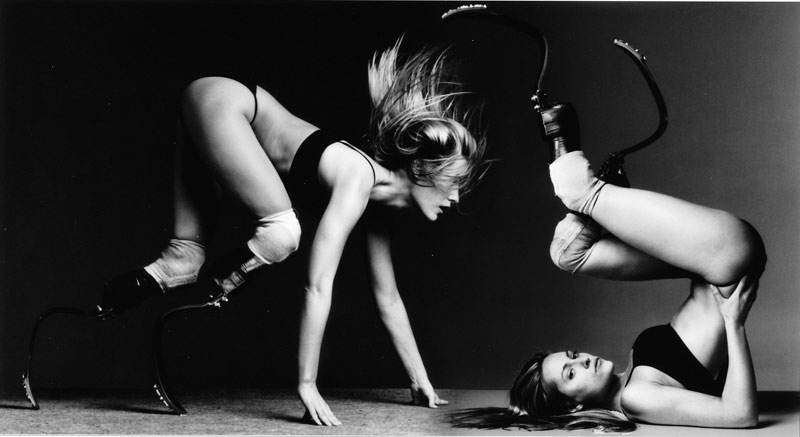
Paralympic athlete Aimee Mullins
This post is part of a series on Aquinas, Aristotle, and Edward Feser’s explanation of them both.
Back to Feser and Aristotle for a bit. Later on in The Last Superstition, Feser talks about some of the obvious final causes we can observe. He’s using this section to defend natural law against the accusation that it’s proponents want us to go back to pre-modern technology and to set up his attack on homosexuality. I’m not interested in those points, so you can look them up yourselves. I want to discuss what his theory implies about transhumanism and teleology. Feser writes:
When we get to biological organisms, we have things whose natures or essences more obviously involve certain final causes or purposes. So, for example, the function or final cause of eyeballs is to enable us to see. But suppose someone’s eyeballs are deficient in some way, making his vision blurry. In that case, to wear eyeglasses isn’t contrary to the natural function of eyeballs; rather, it quite obviously restores to the eyeballs their ability to carry out their natural function. Bicycles don’t do this, of course, but they do extend, rather than conflict with, the ability of the legs to carry our their natural function of allowing us to move about.
I think of the final causes Feser is describing (seeing, moving) as being hugely subordinate to other goals (perceiving, ability to interact with parts of the world non-adjacent to me). There’s not automatically a virtue in my current means of achieving those goals. Without the ability to hear or vocalize, I can still talk if I know ASL. Oral and signed languages have strengths and weaknesses, but both will serve. A bicycle might get me places faster, and so might swappable bionic legs.
I assume Feser is only ok with supplementing, not replacing the human body, but (as you might expect) I’m willing to go further. There might be final causes that aren’t well served by my current form, so I’d like to adapt it. There is one big difficulty with my position though.
If you believe the human body has an inherent dignity, and that our form directs us to the correct final cause, you can bootstrap yourself from observations about your body to hypotheses about your telos. If, like me, you see the body as optimized and arbitrary, I have to find a different foundation for my claims about ought; the Aristolelian framework won’t get me all the way there.
That’s my dilemma, and I’m not sure Feser has earned his escape route from it. To really honor the human body and not want to tinker with the form, I think you need to oppose evolution, or, at the very least, believe God put a very heavy thumb on the scale when it came to criteria for fitness. The worthiness of our physical form has to come from somewhere, since I don’t think our experience with our meatsuits and our anthropologic data show it as good in itself.
This post is part of a series on Aquinas, Aristotle, and Edward Feser’s explanation of them both.
Previous Post

January 22, 2012
Lewis Trounces Freud
Next Post
January 25, 2012 It's Hard Out Here for a Platonist
Browse Our Archives
Select a Category 7 Quick Takes Apologetics Atheism Book Conversion Debate Tactics Debates Epistemology/Philosophy Housekeeping Ideological Turing Test Marriage Morality in Practice Parsing Catholicism Possibly Heretical Radio Reviews/Recommendations Sequence Index Spiritual Practice Uncategorized
Select a Month April 2017 March 2017 January 2017 December 2016 September 2016 August 2016 July 2016 June 2016 May 2016 April 2016 March 2016 February 2016 January 2016 December 2015 November 2015 October 2015 September 2015 August 2015 July 2015 June 2015 May 2015 April 2015 March 2015 February 2015 January 2015 December 2014 November 2014 October 2014 September 2014 August 2014 July 2014 June 2014 May 2014 April 2014 March 2014 February 2014 January 2014 December 2013 November 2013 October 2013 September 2013 August 2013 July 2013 June 2013 May 2013 April 2013 March 2013 February 2013 January 2013 December 2012 November 2012 October 2012 September 2012 August 2012 July 2012 June 2012 May 2012 April 2012 March 2012 February 2012 January 2012 December 2011 November 2011 October 2011 September 2011 August 2011 July 2011 June 2011 May 2011 April 2011 March 2011 February 2011 January 2011 December 2010 November 2010 October 2010 September 2010 August 2010 July 2010 June 2010
Follow Us!
TAKE THE
Religious Wisdom Quiz
Who found baby Moses in the river?
Select your answer to see how you score.
A shepherd Moses' mother Miriam Pharaoh's daughter
Related posts from Unequally Yoked

Rational Faith: More working hypothesis than logical proof

Starting Conversations During Francis's Visit

Life Lessons that Can't be Taught at College's...

Books that Change the Way You Think [Radio...
TRENDING AT PATHEOS Catholic

Rejecting Doom: Christian Hope And Human Action
Christianity is a religion of hope. We are to have hope and...

It’s What Comes From Within Which Matters
One of the most difficult things for us to understand is why...

Why I Choose the Eucharist Over the Sermon
Choose the Eucharist, Not the Sermon What are we supposed to get...

5 Design Elements Found in Spiritually Rooted Homes
Putting Spirituality Into Home Decor Our homes are more than our living...

Credo: A Story of God Told with the...
About 10 years ago, I began to imagine a personal "Credo" that...

The Anatomy of Divine Revelation in Catholic Thought
The claim that God has made Himself known to human beings is...
view all Catholic blogs
Ad-Free & Subscriber Log-In Subscription Support
- About Us
- 2026 Calendar
- Videos
- Podcasts
- Library of World Religions
- Faith In Media Tracker
- Advertise With Us
- Write for Us
- Privacy Policy
- Terms of Service
- Do Not Sell My Data
- Contact Us
- Radiant Digital
- Manage Newsletter Subscriptions
- Unsubscribe From Notifications
- Sitemap
Copyright 2008-2026, Patheos. All rights reserved.
Subscription Support Ad-Free & Subscriber Log-In
Follow Patheos