
BuddhistCatholicContemplativeEvangelicalGeneral ChristianHinduJewishLatter-day SaintMuslimNew VisionsProgressive Christian
Beliefs
- Buddhist
- Catholic
- Contemplative
- Evangelical
- General Christian
- Hindu
- Jewish
- Latter-day Saint
- More Voices
- Muslim
- New Visions
- Pagan
- Progressive Christian
Topics
- Religion News
- Food and Religion
- Sports and Religion
- Religious Art
- Religious Music and Entertainment
- Religious Events
- History and Religion
- Style and Religion
- Politics and Religion
- Women in Religion
- Recreation Outdoors and Religion
- Business Finance and Religion
- Careers Workplace and Religion
- Education and Religion
- Family Parenting and Religion
- Health Fitness and Religion
- Home and Religion
- Relationships and Religion
- Technology and Religion
- Travel and Religion
Columnists
- Buddhist Columnists
- Business Finance and Religion Columnists
- Careers Workplace and Religion Columnists
- Catholic Columnists
- Contemplative Columnists
- Education and Religion Columnists
- Evangelists Columnists
- Family Parenting and Religion Columnists
- General Christian Columnists
- Health Fitness and Religion Columnists
- Hindu Columnists
- History and Religion Columnists
- Home and Religion Columnists
- Jewish Columnists
- More Voices Columnists
- Latter Day Columnists
- Muslim Columnists
- New Visions Columnists
- Nonreligious Columnists
- Pagan Columnists
- Politics and Religion Columnists
- Progressive Columnists
- Recreation Outdoors and Religion Columnists
- Relationships and Religion Columnists
- Religion News Columnists
- Religious Art Columnists
- Religious Events Columnists
- Religious Music and Entertainment Columnists
- Sports and Religion Columnists
- Style and Religion Columnists
- Technology and Religion Columnists
- Travel and Religion Columnists
- Women in Religion Columnists
Resource Library
- 2026 Calendar
- Library of World Religions
- The 100 Most Holy Places on Earth
- Patheos Answers
- Podcasts
- Videos
- Faith Leaders Database
- Anglican Episcopalian
- Bahai
- Baptist
- Buddhism
- Christianity
- Confucianism
- Eastern Orthodoxy
- Hinduism
- Holiness and Pentecostal
- ISKCON
- Islam
- Judaism
- Lutheran
- Methodist
- The Church of Jesus Christ of Latter-day Saints
- New Age
- Paganism
- Presbytarian and Reformed
- Protestantism
- Religion Behind the Scenes
- Roman Catholic
- Scientology
- Shia Islam
- Sikhism
- Sufism
- Sunni Islam
- Taoism
- Zen
- See all religions
Research Tools
 Ad-Free & Subscriber Log-In Subscription Support
Ad-Free & Subscriber Log-In Subscription Support
Follow Patheos 

- Trending:
- Forgiveness
- |
- Marriage
- |
- Consciousness
- |
- Death Penalty
- |
- Election
- |
- Halloween
 Unequally Yoked
- Home
- Catholic
- Human Approximations of Morality
Human Approximations of Morality
Last updated on: November 30, 2012 at 11:27 am by Leah Libresco
Human Approximations of Morality 2012-11-30T11:27:27-05:00 Leah Libresco
Patheos Explore the world's faith through different perspectives on religion and spirituality! Patheos has the views of the prevalent religions and spiritualities of the world.

Adam Lee, author of Daylight Atheism, has just gotten into an argument with Peter Hitchens over Divine Command Theory. Peter Hitchens contends:
“For a moral code to be effective, it must be attributed to, and vested in, a nonhuman source. It must be beyond the power of humanity to change it to suit itself.”
Adam responded in two posts, the first titled “There Is No Non-Human Moral Authority” and a second responding to comments Hitchens made in-thread. I think I disagree with both the guys in this argument, but I’m a little worried that my dispute with Adam might be definitional, so let me try to lay out my position as clearly as possible (and with as many math analogies as I can). Here’s Adam’s position:
The fatal flaw in this position is that, contrary to your confident presumption, there is no non-human moral authority. Every religious book is written, edited, and printed by humans. All moral opinions, interpretations, and proclamations are human opinions. If there were a huge, glowing set of tablets with commandments engraved on them that descended from the sky accompanied by angels blowing trumpets, and the choice was between following those or making up moral laws on our own, we’d be having a very different debate; but there is no such thing. All moral laws are humanly produced. The question is which set of human-created laws we should follow and why.
I agree with Adam that there isn’t a non-human agent we can consult on moral issues (no oracle or book of cheat codes), but I disagree strongly that all moral law flows from human opinion. Human writings are attempts to describe and summarize moral obligation, just as mathematical theorems describe relationships between transcendent objects and biology gives good-enough approximations of how things work at the scale of cells, allowing us to ignore atoms and quantum whatsits. All of these are human-constructed maps of territories that already exist and are more complex and detailed than we are up to dealing with on a day to day basis.
(It might be a good idea to pop over to Less Wrong for a moment and check out Yudkowsky’s essay on confusing the map for the territory: “Fallacies of Compression“).
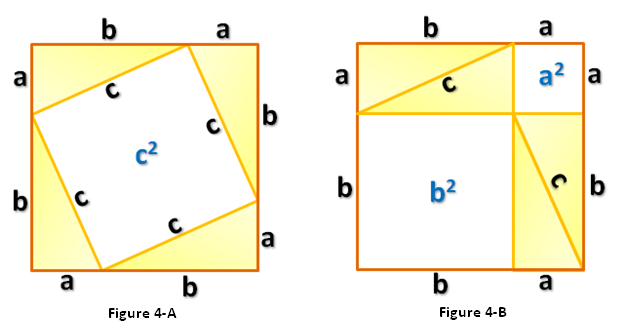
A Divine Agent isn’t required to conceive of moral law as non-contingent on human descriptions. Accepting this fact shouldn’t be a problem for any atheist who happily accepts that the Pythagorean theorem was true before Pythagoras and would be true even if humans hadn’t ever come down from the trees. Just as mathematicians can refine and revise their descriptions of the properties of mathematical object, philosophers can revise their description of moral law.
The upshot is that the question we’re trying to answer is not “Which set of human-created laws we should follow and why?” but “Which set of human-created approximations to Moral Law is most accurate, and how do we check?” There’s a bonus question, too, which is “How fine-grained an approximation of Moral Law do I need to be able to choose actions correctly?”
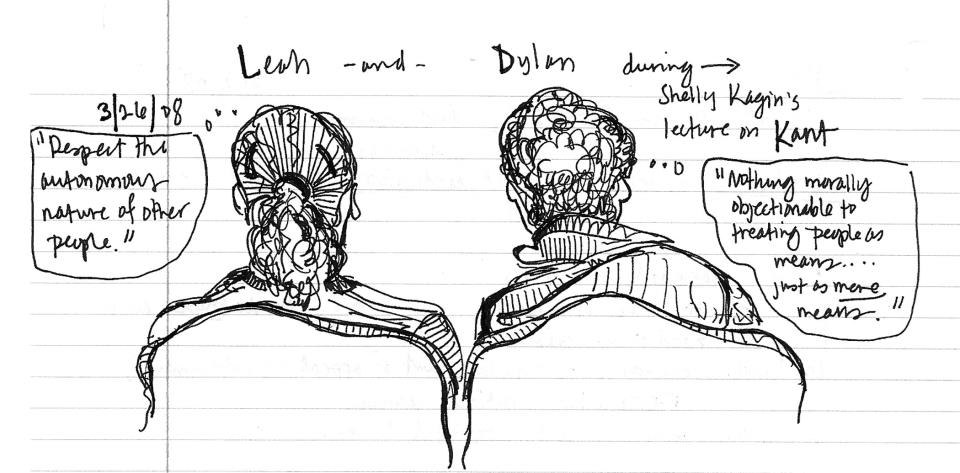
I stuck by Kantianism for a long while, and although my read of it had some serious, dangerous flaws, “Treat other people as ends-in-themselves” is a pretty good big picture encapsulation of your moral obligations. And a lot of the time, you don’t need to do any intellectual heavy lifting to see your duty clear. When you’re not sure which people count as people or you’re not sure whether a certain act means treating someone as a mere means, then it’s time to drill down and find or invent a more zoomed-in ethics. But all of this is still an attempt to better describe something that already exists independent of human portraits of it. And you can play around with High Energy Theoretical Ethics if you want to fill in some of the “Here Be Dragons” regions, but that level of detail won’t be necessary for most folks.
But whether your moral map is highly detailed or a set of broad principals, whether you’re mostly on the money or dangerously misguided, and whether you think of it as universally binding or wholly subjective, it’s still a human-made map of a human-independent territory.
Previous Post

December 29, 2011
A Good Humored Review
Next Post
January 3, 2012 It's Utilitarianism All the Way Down?
Browse Our Archives
Select a Category 7 Quick Takes Apologetics Atheism Book Conversion Debate Tactics Debates Epistemology/Philosophy Housekeeping Ideological Turing Test Marriage Morality in Practice Parsing Catholicism Possibly Heretical Radio Reviews/Recommendations Sequence Index Spiritual Practice Uncategorized
Select a Month April 2017 March 2017 January 2017 December 2016 September 2016 August 2016 July 2016 June 2016 May 2016 April 2016 March 2016 February 2016 January 2016 December 2015 November 2015 October 2015 September 2015 August 2015 July 2015 June 2015 May 2015 April 2015 March 2015 February 2015 January 2015 December 2014 November 2014 October 2014 September 2014 August 2014 July 2014 June 2014 May 2014 April 2014 March 2014 February 2014 January 2014 December 2013 November 2013 October 2013 September 2013 August 2013 July 2013 June 2013 May 2013 April 2013 March 2013 February 2013 January 2013 December 2012 November 2012 October 2012 September 2012 August 2012 July 2012 June 2012 May 2012 April 2012 March 2012 February 2012 January 2012 December 2011 November 2011 October 2011 September 2011 August 2011 July 2011 June 2011 May 2011 April 2011 March 2011 February 2011 January 2011 December 2010 November 2010 October 2010 September 2010 August 2010 July 2010 June 2010
Follow Us!
TAKE THE
Religious Wisdom Quiz
What did the prodigal son ask his father for?
Select your answer to see how you score.
A new home A sword A wife His inheritance
Related posts from Unequally Yoked

Rational Faith: More working hypothesis than logical proof

Life Lessons that Can't be Taught at College's...

Books that Change the Way You Think [Radio...

Your religion... is it bigger than a breadbox?
TRENDING AT PATHEOS Catholic

Rejecting Doom: Christian Hope And Human Action
Christianity is a religion of hope. We are to have hope and...

It’s What Comes From Within Which Matters
One of the most difficult things for us to understand is why...

Why I Choose the Eucharist Over the Sermon
Choose the Eucharist, Not the Sermon What are we supposed to get...

5 Design Elements Found in Spiritually Rooted Homes
Putting Spirituality Into Home Decor Our homes are more than our living...

Credo: A Story of God Told with the...
About 10 years ago, I began to imagine a personal "Credo" that...

The Anatomy of Divine Revelation in Catholic Thought
The claim that God has made Himself known to human beings is...
view all Catholic blogs
Ad-Free & Subscriber Log-In Subscription Support
- About Us
- 2026 Calendar
- Videos
- Podcasts
- Library of World Religions
- Faith In Media Tracker
- Advertise With Us
- Write for Us
- Privacy Policy
- Terms of Service
- Do Not Sell My Data
- Contact Us
- Radiant Digital
- Manage Newsletter Subscriptions
- Unsubscribe From Notifications
- Sitemap
Copyright 2008-2026, Patheos. All rights reserved.
Subscription Support Ad-Free & Subscriber Log-In
Follow Patheos