
BuddhistCatholicContemplativeEvangelicalGeneral ChristianHinduJewishLatter-day SaintMuslimNew VisionsProgressive Christian
Beliefs
- Buddhist
- Catholic
- Contemplative
- Evangelical
- General Christian
- Hindu
- Jewish
- Latter-day Saint
- More Voices
- Muslim
- New Visions
- Pagan
- Progressive Christian
Topics
- Religion News
- Food and Religion
- Sports and Religion
- Religious Art
- Religious Music and Entertainment
- Religious Events
- History and Religion
- Style and Religion
- Politics and Religion
- Women in Religion
- Recreation Outdoors and Religion
- Business Finance and Religion
- Careers Workplace and Religion
- Education and Religion
- Family Parenting and Religion
- Health Fitness and Religion
- Home and Religion
- Relationships and Religion
- Technology and Religion
- Travel and Religion
Columnists
- Buddhist Columnists
- Business Finance and Religion Columnists
- Careers Workplace and Religion Columnists
- Catholic Columnists
- Contemplative Columnists
- Education and Religion Columnists
- Evangelists Columnists
- Family Parenting and Religion Columnists
- General Christian Columnists
- Health Fitness and Religion Columnists
- Hindu Columnists
- History and Religion Columnists
- Home and Religion Columnists
- Jewish Columnists
- More Voices Columnists
- Latter Day Columnists
- Muslim Columnists
- New Visions Columnists
- Nonreligious Columnists
- Pagan Columnists
- Politics and Religion Columnists
- Progressive Columnists
- Recreation Outdoors and Religion Columnists
- Relationships and Religion Columnists
- Religion News Columnists
- Religious Art Columnists
- Religious Events Columnists
- Religious Music and Entertainment Columnists
- Sports and Religion Columnists
- Style and Religion Columnists
- Technology and Religion Columnists
- Travel and Religion Columnists
- Women in Religion Columnists
Resource Library
- 2026 Calendar
- Library of World Religions
- The 100 Most Holy Places on Earth
- Patheos Answers
- Podcasts
- Videos
- Faith Leaders Database
- Anglican Episcopalian
- Bahai
- Baptist
- Buddhism
- Christianity
- Confucianism
- Eastern Orthodoxy
- Hinduism
- Holiness and Pentecostal
- ISKCON
- Islam
- Judaism
- Lutheran
- Methodist
- The Church of Jesus Christ of Latter-day Saints
- New Age
- Paganism
- Presbytarian and Reformed
- Protestantism
- Religion Behind the Scenes
- Roman Catholic
- Scientology
- Shia Islam
- Sikhism
- Sufism
- Sunni Islam
- Taoism
- Zen
- See all religions
Research Tools
 Ad-Free & Subscriber Log-In Subscription Support
Ad-Free & Subscriber Log-In Subscription Support
Follow Patheos 

- Trending:
- Forgiveness
- |
- Marriage
- |
- Consciousness
- |
- Death Penalty
- |
- Election
- |
- Halloween
 Unequally Yoked
- Home
- Catholic
- Feser’s Typology of Atheism (Part 1)
Feser’s Typology of Atheism (Part 1)
Last updated on: November 27, 2012 at 11:42 am by Leah Libresco
Feser’s Typology of Atheism (Part 1) 2012-11-27T11:42:53-05:00 Leah Libresco
Patheos Explore the world's faith through different perspectives on religion and spirituality! Patheos has the views of the prevalent religions and spiritualities of the world.
Edward Feser, a professor at Pasadena City College has set out to create a typology of ways atheists feel about religion or particular religious traditions. It’s a two-dimensional description of attitudes, categorizing atheists by how they respond to religious metaphysics and religious practice. I’ll take a look at the metaphysics spectrum he proposes today and take a crack at the religion-in-practice one tomorrow.

I found Feser’s system helpful in clarifying my own stand on Christianity generally and Catholicism in particular. I could imagine this typology could also help smooth discussion between atheists and believers (or possibly get you to the fight more efficiently). I think the default assumption when someone meets an atheist is that s/he belongs to category 1 below, but if you want a productive conversation, you need to be able to explain your position on the spectrum and get to your true rejection.
- Religious belief has no serious intellectual content at all. It is and always has been little more than superstition, the arguments offered in its defense have always been feeble rationalizations, and its claims are easily refuted.
- Religious belief does have serious intellectual content, has been developed in interesting and sophisticated ways by philosophers and theologians, and was defensible given the scientific and philosophical knowledge available to previous generations. But advances in science and philosophy have now more or less decisively refuted it. Though we can respect the intelligence of an Aquinas or a Maimonides, we can no longer take their views seriously as live options.
- Religious belief is still intellectually defensible today, but not as defensible as atheism. An intelligent and well-informed person could be persuaded by the arguments presented by the most sophisticated contemporary proponents of a religion, but the arguments of atheists are at the end of the day more plausible
No matter how confident you are that there is no god(s), I don’t think you should feel comfortable slotting yourself into category 1 for all religions. As I wrote in my Atheist’s Guide to Catholics, there have been plenty of smart people playing for the other team, and, when they ran into problems of consistency, they tended to come up with solutions, not stick their fingers in their ears and chant “I can’t hear you.” The religions that deserve a type 1 explanation tend to be straight-up cults or prevalent in intellectually isolated communities. Anyone who’s not facing critics is more likely to end up devoid of intellectual content.

So where does that leave religions like Scientology, which spend a lot of time under attack and who have religious metaphysics fleshed out to a DnD-level of detail? Well, you can graduate to level 2 and still be false. But religions don’t earn a level 2 in my book solely on the basis of being plausibly self-consistent. Remember, that would also legitimize the metaphysics I want to wish into being, that of Diane Duane’s YA Young Wizards series. To level up, I need a religion and it’s apologists to be able to tackle the problem of other minds: they need to be able to understand the objections made by people outside their religion (i.e. they can’t be people who couldn’t scrape even a low pass on an ideological turing test).
The easiest example of a blind-to-outside-objections apologist is someone who declares, “You’re only an atheist because you’re angry at God!” No, I’m an atheist just because I don’t believe in any gods, so I can’t hold a grudge against a non-existent being. And now I’m pretty confident in the non-existence of your grasp of my position. You only get points for apologetics if they’re directed at non-strawmen.
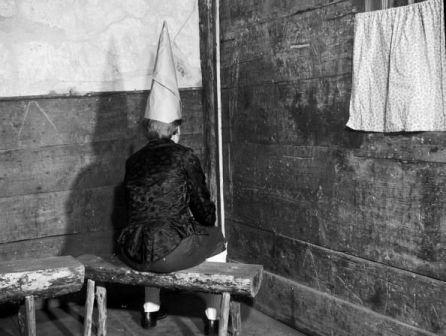
Stay in that corner til you imagine a better opponent!
Patheos blogger Mark Shea is good on other topics, but he fell into an issue-specific version of this trap in his recent National Catholic Register article on homosexuality. Hint: if you ask me why I’m bisexual and why I fight for LGBT rights, my answer will not begin “Well, I am deeply narcissistic.”
Avoiding these traps gets you to a category 2 objection. You hit level 3 if I think your religious metaphysics are the theological equivalent of non-Euclidean geometry. You only need one thing granted, and then the whole thing hangs together and your replies to my objections turn out to be correct. Your religion offers predictions and explanations that are mostly consistent with lived experience, and where they differ, you’ve got an alternate framework that, with your major premise granted, would compel me to reject my experience or metaphysics where they clash with yours.
I would place Catholicism on the edge between categories 2 and 3, but, on a number of ethical issues, it has level 1 blindness problems.
Previous Post

November 18, 2011
7 Quick Takes (11/17/11)
Next Post
November 23, 2011 Feser's Typology of Atheism (Part 2)
Browse Our Archives
Select a Category 7 Quick Takes Apologetics Atheism Book Conversion Debate Tactics Debates Epistemology/Philosophy Housekeeping Ideological Turing Test Marriage Morality in Practice Parsing Catholicism Possibly Heretical Radio Reviews/Recommendations Sequence Index Spiritual Practice Uncategorized
Select a Month April 2017 March 2017 January 2017 December 2016 September 2016 August 2016 July 2016 June 2016 May 2016 April 2016 March 2016 February 2016 January 2016 December 2015 November 2015 October 2015 September 2015 August 2015 July 2015 June 2015 May 2015 April 2015 March 2015 February 2015 January 2015 December 2014 November 2014 October 2014 September 2014 August 2014 July 2014 June 2014 May 2014 April 2014 March 2014 February 2014 January 2014 December 2013 November 2013 October 2013 September 2013 August 2013 July 2013 June 2013 May 2013 April 2013 March 2013 February 2013 January 2013 December 2012 November 2012 October 2012 September 2012 August 2012 July 2012 June 2012 May 2012 April 2012 March 2012 February 2012 January 2012 December 2011 November 2011 October 2011 September 2011 August 2011 July 2011 June 2011 May 2011 April 2011 March 2011 February 2011 January 2011 December 2010 November 2010 October 2010 September 2010 August 2010 July 2010 June 2010
Follow Us!
TAKE THE
Religious Wisdom Quiz
Where did David hide from Saul for many years?
Select your answer to see how you score.
Jericho Jerusalem The wilderness Philistine camp
Related posts from Unequally Yoked

Rational Faith: More working hypothesis than logical proof

Starting Conversations During Francis's Visit

Desiring Abundance of Life, Not Just Absence of...

Why Not Refer to ISIS by an Epithet?
TRENDING AT PATHEOS Catholic

Rejecting Doom: Christian Hope And Human Action
Christianity is a religion of hope. We are to have hope and...

It’s What Comes From Within Which Matters
One of the most difficult things for us to understand is why...

Why I Choose the Eucharist Over the Sermon
Choose the Eucharist, Not the Sermon What are we supposed to get...

5 Design Elements Found in Spiritually Rooted Homes
Putting Spirituality Into Home Decor Our homes are more than our living...

Credo: A Story of God Told with the...
About 10 years ago, I began to imagine a personal "Credo" that...

The Anatomy of Divine Revelation in Catholic Thought
The claim that God has made Himself known to human beings is...
view all Catholic blogs
Ad-Free & Subscriber Log-In Subscription Support
- About Us
- 2026 Calendar
- Videos
- Podcasts
- Library of World Religions
- Faith In Media Tracker
- Advertise With Us
- Write for Us
- Privacy Policy
- Terms of Service
- Do Not Sell My Data
- Contact Us
- Radiant Digital
- Manage Newsletter Subscriptions
- Unsubscribe From Notifications
- Sitemap
Copyright 2008-2026, Patheos. All rights reserved.
Subscription Support Ad-Free & Subscriber Log-In
Follow Patheos