
BuddhistCatholicContemplativeEvangelicalGeneral ChristianHinduJewishLatter-day SaintMuslimNew VisionsProgressive Christian
Beliefs
- Buddhist
- Catholic
- Contemplative
- Evangelical
- General Christian
- Hindu
- Jewish
- Latter-day Saint
- More Voices
- Muslim
- New Visions
- Pagan
- Progressive Christian
Topics
- Religion News
- Food and Religion
- Sports and Religion
- Religious Art
- Religious Music and Entertainment
- Religious Events
- History and Religion
- Style and Religion
- Politics and Religion
- Women in Religion
- Recreation Outdoors and Religion
- Business Finance and Religion
- Careers Workplace and Religion
- Education and Religion
- Family Parenting and Religion
- Health Fitness and Religion
- Home and Religion
- Relationships and Religion
- Technology and Religion
- Travel and Religion
Columnists
- Buddhist Columnists
- Business Finance and Religion Columnists
- Careers Workplace and Religion Columnists
- Catholic Columnists
- Contemplative Columnists
- Education and Religion Columnists
- Evangelists Columnists
- Family Parenting and Religion Columnists
- General Christian Columnists
- Health Fitness and Religion Columnists
- Hindu Columnists
- History and Religion Columnists
- Home and Religion Columnists
- Jewish Columnists
- More Voices Columnists
- Latter Day Columnists
- Muslim Columnists
- New Visions Columnists
- Nonreligious Columnists
- Pagan Columnists
- Politics and Religion Columnists
- Progressive Columnists
- Recreation Outdoors and Religion Columnists
- Relationships and Religion Columnists
- Religion News Columnists
- Religious Art Columnists
- Religious Events Columnists
- Religious Music and Entertainment Columnists
- Sports and Religion Columnists
- Style and Religion Columnists
- Technology and Religion Columnists
- Travel and Religion Columnists
- Women in Religion Columnists
Resource Library
- 2026 Calendar
- Library of World Religions
- The 100 Most Holy Places on Earth
- Patheos Answers
- Podcasts
- Videos
- Faith Leaders Database
- Anglican Episcopalian
- Bahai
- Baptist
- Buddhism
- Christianity
- Confucianism
- Eastern Orthodoxy
- Hinduism
- Holiness and Pentecostal
- ISKCON
- Islam
- Judaism
- Lutheran
- Methodist
- The Church of Jesus Christ of Latter-day Saints
- New Age
- Paganism
- Presbytarian and Reformed
- Protestantism
- Religion Behind the Scenes
- Roman Catholic
- Scientology
- Shia Islam
- Sikhism
- Sufism
- Sunni Islam
- Taoism
- Zen
- See all religions
Research Tools
 Ad-Free & Subscriber Log-In Subscription Support
Ad-Free & Subscriber Log-In Subscription Support
Follow Patheos 

- Trending:
- Forgiveness
- |
- Marriage
- |
- Consciousness
- |
- Death Penalty
- |
- Election
- |
- Halloween
 Unequally Yoked
- Home
- Catholic
- Why Bother Genemodding?
Why Bother Genemodding?
Last updated on: November 14, 2012 at 4:12 pm by Leah Libresco
Why Bother Genemodding? 2012-11-14T16:12:37-05:00 Leah Libresco
Patheos Explore the world's faith through different perspectives on religion and spirituality! Patheos has the views of the prevalent religions and spiritualities of the world.
 Flesh to fiber-optic interface from Battlestar Galactica
Alex Knapp likes to kick around transhumanist problems at Forbes, and he’s concluded genetic engineering will almost certainly result in “horrific moral atrocities.” Simply put:
The “failed prototypes” are people. People who have to grow up and live with the consequences of the inevitable mistakes that will be made in the process of experimenting. Assuming, of course, they can physically live with those consequences at all.
And there’s the problem. When you get right down to it, I do not see any way to perform experiments involving signficant genetic enhancements that don’t end in the suffering of a human being. A human being whose DNA was altered without consent, who is participating in a scientific experiment without consent, and is, basically, being born into slavery, with their sole purpose in life being a stepping stone to making other people “better.”
I’m mostly in agreement with Knapp, so let me quickly get to where we diverge. I think he’s selling short the extent to which many fetuses, children, and adults end up in experiments they didn’t consent to that are meant for their own good. No fetus signed a waiver to be in a study of folic acid supplements, but they were hardly ‘born into slavery’ or reduced to a mere means as a result. And after birth, you can end up in a poorly run experiment, with potential for long term harm every time your state overhauls its school curriculum or changes the food safety standards. Let’s not inflate the threat-to-personhood danger just because these environmental changes are more cutting edge.
That being said, I’m in agreement that DNA-tweaking is dead on arrival. Genetic engineering is pretty much guaranteed to wind up in the middle of the abortion debate, since it’s a lot easier to select embryos than alter them. That issue taboos the whole subject for a significant proportion of the population. And pro-choicers like me still have plenty of reasons to be leery of the whole endeavor. As Knapp points out, any pre-birth enhancements tend to run into some serious problems with consent. We make plenty of choices that alter a baby’s biology, but this isn’t exactly folic acid supplements. There’s no strong consensus about what kind of enhancements are desirable or necessary, so there’s no way to argue that the person-to-be tacitly consents. And, historically, this kind of consensus isn’t all too trustworthy, anyway (cf. the practice of neo-natal genital surgery for intersex infants).
Absent a profound shift in expectations for our physical hardware, these objections are enough to kibosh any plan for human genetic engineering. And that’s fine by me, since there’s no reason transhumanists should have picked that as a goal to begin with. Focusing the conversation there is a way to push transhumanist goals into a far-distant future. Definitionally, you’re taking all the pressure off our generation, since, absent some really clever virus engineering, there’s no way we can use this tool to modify ourselves.

But aspiring body hackers do have options right now. The two I’m most interested in assimilating are a constant awareness of compass directions, and, subsequently, better navigational instincts, and the ability to sense electromagnetic fields (though I’d be going the magnets-in-nail-polish route, and steering clear of the surgical implants).
If those aren’t the augmentations you want, then start trying to put together a different mechanical/biological kludge. Just try and do some thinking about what you actually want to be, not what kind of thing is cool at parties. Levitation or flight sound cool, but I’m better served by the exertion of walking on a day-to-day basis, and when I do need to fly, I have this wacky trick called buying plane tickets.
Does that not seem cool and futuristic enough? Tough beans. Transhumanism is more about problem-solving than aesthetics, and plenty of currently existing tech can solve my problems even if it doesn’t meld with my wetware. But most people think that physical tech somehow doesn’t count and gadgets like my iPhone or my laptop (both of which radically change how I access, store, and process information, and then go on to give me totally new kinds of ways to act in the world) have nothing to do with the transhumanist project.
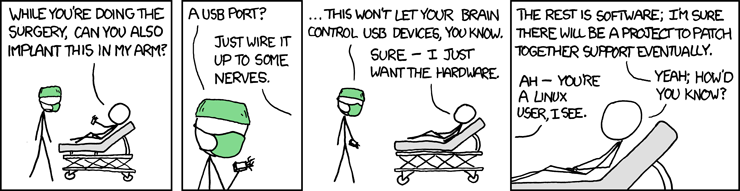
The weird thing is that even when we want to do something as radical as genetic engineering, we still want it to feel natural, smoothly and inextricably bound to us. An inborn sense of direction seems more real than training with the Northstar anklet. Farther along the spectrum, a surgical implant must be more a part of us than a magnet that’s only glued on.
One of my transhumanism hobbyhorses is trying to blur the definition of the body and stop privileging the squishy bits that happen to be attached to us at birth. Another one is making war on any infatuation with the ‘natural’ or ‘organic’ generally. I’ll worry about the aesthetics of an interface after I’ve got something I can use.
Oh, and don’t forget that some of the best bang for your buck transhumanism around is policing cruft and biases in your own reasoning. Cognitive hacking is still hacking, even if it doesn’t get to incorporate any cool-looking LEDs.

Previous Post

September 14, 2011
Dualism and Descartes's Demon
Next Post
September 16, 2011 Soup Nazi Approach to Sex
Browse Our Archives
Select a Category 7 Quick Takes Apologetics Atheism Book Conversion Debate Tactics Debates Epistemology/Philosophy Housekeeping Ideological Turing Test Marriage Morality in Practice Parsing Catholicism Possibly Heretical Radio Reviews/Recommendations Sequence Index Spiritual Practice Uncategorized
Select a Month April 2017 March 2017 January 2017 December 2016 September 2016 August 2016 July 2016 June 2016 May 2016 April 2016 March 2016 February 2016 January 2016 December 2015 November 2015 October 2015 September 2015 August 2015 July 2015 June 2015 May 2015 April 2015 March 2015 February 2015 January 2015 December 2014 November 2014 October 2014 September 2014 August 2014 July 2014 June 2014 May 2014 April 2014 March 2014 February 2014 January 2014 December 2013 November 2013 October 2013 September 2013 August 2013 July 2013 June 2013 May 2013 April 2013 March 2013 February 2013 January 2013 December 2012 November 2012 October 2012 September 2012 August 2012 July 2012 June 2012 May 2012 April 2012 March 2012 February 2012 January 2012 December 2011 November 2011 October 2011 September 2011 August 2011 July 2011 June 2011 May 2011 April 2011 March 2011 February 2011 January 2011 December 2010 November 2010 October 2010 September 2010 August 2010 July 2010 June 2010
Follow Us!
TAKE THE
Religious Wisdom Quiz
True or False: James says that whoever keeps the whole law but stumbles at just one point is guilty of breaking all of it.
Select your answer to see how you score.
FALSE TRUE
Related posts from Unequally Yoked

The Tony-Winning Guide To Temptation And Grace

Hedgehogs of Redemption and the Comedy of Grace

Mercy, Justice, and How To Tell The Difference

Pinning down *which* error is made in this...
TRENDING AT PATHEOS Catholic

Rejecting Doom: Christian Hope And Human Action
Christianity is a religion of hope. We are to have hope and...

It’s What Comes From Within Which Matters
One of the most difficult things for us to understand is why...

Why I Choose the Eucharist Over the Sermon
Choose the Eucharist, Not the Sermon What are we supposed to get...

5 Design Elements Found in Spiritually Rooted Homes
Putting Spirituality Into Home Decor Our homes are more than our living...

Credo: A Story of God Told with the...
About 10 years ago, I began to imagine a personal "Credo" that...

The Anatomy of Divine Revelation in Catholic Thought
The claim that God has made Himself known to human beings is...
view all Catholic blogs
Ad-Free & Subscriber Log-In Subscription Support
- About Us
- 2026 Calendar
- Videos
- Podcasts
- Library of World Religions
- Faith In Media Tracker
- Advertise With Us
- Write for Us
- Privacy Policy
- Terms of Service
- Do Not Sell My Data
- Contact Us
- Radiant Digital
- Manage Newsletter Subscriptions
- Unsubscribe From Notifications
- Sitemap
Copyright 2008-2026, Patheos. All rights reserved.
Subscription Support Ad-Free & Subscriber Log-In
Follow Patheos