
BuddhistCatholicContemplativeEvangelicalGeneral ChristianHinduJewishLatter-day SaintMuslimNew VisionsProgressive Christian
Beliefs
- Buddhist
- Catholic
- Contemplative
- Evangelical
- General Christian
- Hindu
- Jewish
- Latter-day Saint
- More Voices
- Muslim
- New Visions
- Pagan
- Progressive Christian
Topics
- Religion News
- Food and Religion
- Sports and Religion
- Religious Art
- Religious Music and Entertainment
- Religious Events
- History and Religion
- Style and Religion
- Politics and Religion
- Women in Religion
- Recreation Outdoors and Religion
- Business Finance and Religion
- Careers Workplace and Religion
- Education and Religion
- Family Parenting and Religion
- Health Fitness and Religion
- Home and Religion
- Relationships and Religion
- Technology and Religion
- Travel and Religion
Columnists
- Buddhist Columnists
- Business Finance and Religion Columnists
- Careers Workplace and Religion Columnists
- Catholic Columnists
- Contemplative Columnists
- Education and Religion Columnists
- Evangelists Columnists
- Family Parenting and Religion Columnists
- General Christian Columnists
- Health Fitness and Religion Columnists
- Hindu Columnists
- History and Religion Columnists
- Home and Religion Columnists
- Jewish Columnists
- More Voices Columnists
- Latter Day Columnists
- Muslim Columnists
- New Visions Columnists
- Nonreligious Columnists
- Pagan Columnists
- Politics and Religion Columnists
- Progressive Columnists
- Recreation Outdoors and Religion Columnists
- Relationships and Religion Columnists
- Religion News Columnists
- Religious Art Columnists
- Religious Events Columnists
- Religious Music and Entertainment Columnists
- Sports and Religion Columnists
- Style and Religion Columnists
- Technology and Religion Columnists
- Travel and Religion Columnists
- Women in Religion Columnists
Resource Library
- 2026 Calendar
- Library of World Religions
- The 100 Most Holy Places on Earth
- Patheos Answers
- Podcasts
- Videos
- Faith Leaders Database
- Anglican Episcopalian
- Bahai
- Baptist
- Buddhism
- Christianity
- Confucianism
- Eastern Orthodoxy
- Hinduism
- Holiness and Pentecostal
- ISKCON
- Islam
- Judaism
- Lutheran
- Methodist
- The Church of Jesus Christ of Latter-day Saints
- New Age
- Paganism
- Presbytarian and Reformed
- Protestantism
- Religion Behind the Scenes
- Roman Catholic
- Scientology
- Shia Islam
- Sikhism
- Sufism
- Sunni Islam
- Taoism
- Zen
- See all religions
Research Tools
 Ad-Free & Subscriber Log-In Subscription Support
Ad-Free & Subscriber Log-In Subscription Support
Follow Patheos 

- Trending:
- Forgiveness
- |
- Marriage
- |
- Consciousness
- |
- Death Penalty
- |
- Election
- |
- Halloween
 Unequally Yoked
- Home
- Catholic
- [Guest Post] Close Reading of Acts 13
[Guest Post] Close Reading of Acts 13
Last updated on: November 1, 2012 at 1:52 pm by Leah Libresco
[Guest Post] Close Reading of Acts 13 2012-11-01T13:52:25-04:00 Leah Libresco
Patheos Explore the world's faith through different perspectives on religion and spirituality! Patheos has the views of the prevalent religions and spiritualities of the world.
Yesterday, Christian H of The Thinking Grounds posted an outline of how he approaches the Bible (a response to a plea for guest posts). Today, he’s given us a thorough example of what his theory looks like when it’s applied. Many thanks for his contribution.
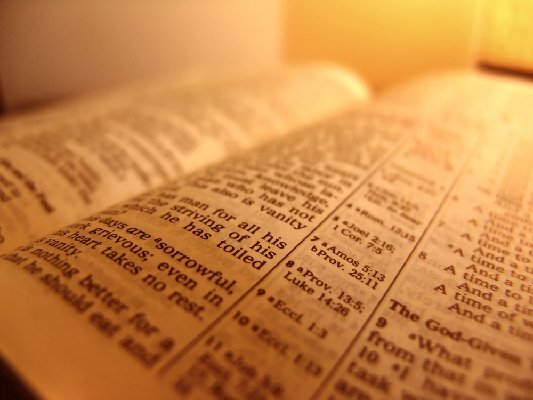
Given how abstract my previous post was, I think that a concrete example is in order. I suggest that you read that previous post if you haven’t already, as I wrote this as a companion to that. I also want to remind you that I don’t expect or want you to emulate this; I’m rather explaining how I do it so that you have some understanding of how an all-too-human moderate Christian approaches Scripture.
I recently read Acts (NRSV) and I’ve decided to walk you through my experience, as I best remember it, when reading parts of chapter 13. I’ll be excerpting the parts that I want to discuss so you don’t need to go look it up if you don’t want to. However, it might be beneficial for you to look at the whole chapter and react to it yourself before seeing my response.
I’ve picked this part because it elicited thinking about readerly heuristics. It’s not the passage in Acts that bothers me the most (that would be Acts 5.1-11) or excites me the most (that would be Acts 7), but it’s one that is troublesome to me and that raised questions of reading practice.
Let’s dive in, shall we?
Acts 13 [4-12]
So, being sent out by the Holy Spirit, they [Barnabas and Saul-renamed-Paul] went down to Seleucia; and from there they sailed to Cyprus. When they arrived at Salamis, they proclaimed the word of God in the synagogues of the Jews. And they had John also to assist them. When they had gone through the whole island as far as Paphos, they met a certain magician, a Jewish false prohet, named Bar-Jesus. He was with the proconsul, Sergius Paulus, an intelligent man, who summoned Barnabas and Saul and wanted to hear the word of God. But the magician Elymas (for that is the translation of his name) opposed them and tried to turn the proconsul away from the faith. But Saul, also known as Paul, filled with the Holy Spirit, looked intently at him and said, “You son of the devil, you enemy of all righteousness, full of all deceit and villainy, will you not stop making crooked the straight paths of the Lord? And now listen—the hand of the Lord is against you, and you will be blind for a while, unable to see the sun.” Immediately mist and darkness came over him, and he went about groping for someone to lead him by the hand. When the proconsul saw what had happened, he believed, for he was astonished at the teaching about the Lord.
Coming to this, I wondered how one could read this metaphorically rather than literally. I wondered this because miracles seem immediately improbable, though I’m not willing to reject them entirely. However, I find that for the most part I can get what I need from a passage without worrying about whether it’s literal. So I’m interested in checking here for a substantive difference between a literal and metaphorical reading. After all, even if it is literal, it seems reasonable to suggest that the metaphorical reading still stands. (Consider that the fall of the Berlin Wall, the razing of the Bastille, the settling of Vinland, and the crossing of the Rubicon are all more meaningful symbolically than practically. These all happened, but they are more relevant as metaphors than as histories.)
 Raphael’s The Blinding of Elymas
So can it be metaphorical? Does it make sense as metaphor? That is, could Sergius Paulus be able to see that Elymas is metaphorically blind? Let’s say Paul does not actually blind but Elymas but rather forces Elymas to display his own pre-existing inability to understand what’s going on (metaphorically, blindness) and to become aware of this blindness. I think I can fairly assume that he is “blind” beforehand because he’s described as a false prophet, suggesting a lack of awareness both about the future and about what he’s doing. Paul could, presumably, expose this blindness through discourse, but does that seem likely? This is a case of Your Mileage May Vary, but I think it’s reasonable to suppose so. If Paul could more convincingly explain the Scriptures, it would perhaps do the work in that culture. Does it have the same heft, though? I’m not sure that it does; actually making Elymas blind would be a better display of truth—or at least power—than convincing him that he’s metaphorically blind.
If we take seriously that he is a magician—in the sense that Heinrich Cornelius Agrippa or Johann Georg Faust or John Dee were magicians, that the people around him believe he wields magical power—then we must take into account that truth-claims were often expected to be performative. You demonstrated truth by exercising power. We don’t need to think truth-claims can be expected to live up to this standard (or, at least, not the kind of truth-claims we’re concerned with here), but we should take this into account when dealing with persuasions of characters***** in this context. And yet this heft may only be necessary as a poetic addition; the heft demonstrates to us readers what the stakes are, but to suppose that it’s only metaphorical doesn’t lessen the impact of the piece; it’s still clear that Paul is converting proconsuls through demonstrating the ideological inadequacies of the competition.
And so I end somewhat unsure. While I think I can still get a working meaning from this text without believing it literally, it does seem somewhat robbed of its power. I would want to lean toward saying that it’s literal were it not for my vague scepticism regarding miraculous claims that are not necessary to Christian belief. (That is, I don’t reject the resurrection and I don’t reject the claim that Jesus performed miracles, but I will remain uncommitted on as much else as possible.) So this passage gives me trouble that I can’t resolve with this passage alone. I therefore file it under Things to Think About Regarding Acts and move on, watching out for other places which may complicate or relieve the tensions of this book. That is, I intend to keep my eyes open for other things that support either a metaphorical heuristic or a literalist heuristic.
Let’s take a look at a second passage:
[44-52]
The next Sabbath almost the whole city gathered to hear the word of the Lord. But when the Jews saw the crowds, they were filled with jealousy; and blaspheming, they contradicted what was spoken by Paul. Then both Paul and Barnabas spoke out boldly, saying, “It was necessary that the word of God should be spoken first to you. Since you reject it and judge yourselves unworthy of eternal life, we are now turning to the Gentiles. For so the Lord has commanded us, saying,‘I have set you to be a light for the Gentiles,
so that you may bring salvation to the ends of the earth.’
When the Gentiles heard this, they were glad and praised the word of the Lord; and as many as had been destined for eternal life became believers. Thus the word of the Lord spread throughout the region. But the Jews incited the devout women of high standing and the leading men of the city, and stirred up persecution against Paul and Barnabas, and drove them out of their region. So they shook the dust off their feet in protest against them, and went to Iconium. And the disciples were filled with joy and with the Holy Spirit. [emphasis mine]
13.48b (bolded) is what I want to call your attention to. That some folks might be destined for eternal life is an interesting idea, one that runs against the Arminian bias of our contemporary culture. That is, this seems to specify that we do not choose to believe, but rather are destined to believe. Such a concept itself seems to run against parts of the Epistles, but let’s stick to Acts. The other (common) positions are Calvinism and Universalism. This latter is one that I am trying to read the Bible “for”; I’ve lately been keeping an eye out for parts of the Bible which seem to speak for or against Universalism. I’ve been doing this since reading Dr. Beck’s series arguing for Universalism, and I’m as persuaded as someone as perpetually uncertain as I am can be. The next test, however, is to see whether Universalism can be supported Biblically; if it can’t, I’m going to need to question Universalism and/or the need to test doctrines against Scripture. So when I see passages like this, I get antsy: if anyone isn’t destined for eternal life, I’m going to have to worry about that next step. And if we read on we can see that at least some folks in this audience weren’t among those converted: the Jewish hecklers.
I don’t know what to do with these folks. There are a number of possible resolutions here: the hecklers, as Jewish people, could be considered already part of the saved, but this doesn’t work based on what Paul says in his speech; there could be translation issues in 48b, but not only does this simply scream “cop out”, but I don’t have any reason, at the moment, to suppose this is the case; the Jews mentioned in 13.50 might not refer to people in attendance (the ones in 13.45), but rather to the Jewish elders who appear as villains recurrently through Acts; or the author’s understanding of soteriology is wrong. This last has some merit: close readings of the Bible suggest that a lot of people, including some of the authors, had mixed or partial understandings of salvation and heaven. This makes some sense; only some Jewish believers had an idea of heaven, so early explorations of the idea would be confused. We may need to subordinate this passage—it is, after all, a single phrase, and doesn’t do much to change the whole passage—to a broader, more synthetic reading of Scripture. See Dr. Beck’s blog for more on that. I may be required to say that this particular line (ie. 13.48b) is a human artifact that introduces error into the text. Of course, the existence of such artifacts makes reading difficult, but it seems to be more likely that revelation, if it exists, would be striated with these artifacts than that revelation would somehow be preserved flawlessly through human chroniclers, authors, transcribers, and translators. Beyond this, my ideas on universalism come not as much from a synthetic view of the Bible as from my pre-existing ideas about God; if universalism is not true, I must reconsider either these pre-existing beliefs or the line of reasoning that got me from them to universalism. Until there is more reason to suppose the Bible lacks these artifacts than there is to suppose that a universalist soteriology is false, I will go—provisionally, of course—with universalism and artifacts.
I imagine you might find this method unsatisfying; at least, I find this method unsatisfying. It renders more ifs and roundabout wonderings than it does concrete answers. Then again, I chose some of the more troublesome passages; had I picked other examples, you’d have seen more cases of, “OK, so this helps clarify cases in which I think corrected other people is good and when it is not so good,” or “Right, yes, I do need to do more of this,” or, “Paul is right to warn against this; the trouble is, am I currently more like the people he is warning or the people he is warning against?”. So I do have some constructive reading. There’s a lot of fun, too. When you’re like me and find words a near-constant avenue for pleasure or at least interest, and when you like to think about narrative, allusion, and genre, then looking at how Paul uses Scripture or philosophy in his speeches can be fascinating. (Seriously, read Acts 7 and tell me that it isn’t one of the meatiest and most productive recaps and set-ups you’ve ever read. It positions the book of Acts perfectly.)
———
*I use the word “character” unabashedly. People in textual narratives are characters, whether they existed or not. If I were reading a biography that I could personally attest was as accurate as theoretically possible—not as accurate as we’d like, by the way—I would still want to use the word “character”, especially in more narrative sections. I think this word does us the courtesy of reminding us that what we are reading is not the person him or herself but rather a textual representation of that person which, in its representational nature, will inevitably be fictional in some sense of another if only due to necessary incompleteness.

Previous Post

August 10, 2011
[Guest Post] A Christian Lit Nerd Reads the Bible
Next Post
August 15, 2011 Greedy Self-Denial
Browse Our Archives
Select a Category 7 Quick Takes Apologetics Atheism Book Conversion Debate Tactics Debates Epistemology/Philosophy Housekeeping Ideological Turing Test Marriage Morality in Practice Parsing Catholicism Possibly Heretical Radio Reviews/Recommendations Sequence Index Spiritual Practice Uncategorized
Select a Month April 2017 March 2017 January 2017 December 2016 September 2016 August 2016 July 2016 June 2016 May 2016 April 2016 March 2016 February 2016 January 2016 December 2015 November 2015 October 2015 September 2015 August 2015 July 2015 June 2015 May 2015 April 2015 March 2015 February 2015 January 2015 December 2014 November 2014 October 2014 September 2014 August 2014 July 2014 June 2014 May 2014 April 2014 March 2014 February 2014 January 2014 December 2013 November 2013 October 2013 September 2013 August 2013 July 2013 June 2013 May 2013 April 2013 March 2013 February 2013 January 2013 December 2012 November 2012 October 2012 September 2012 August 2012 July 2012 June 2012 May 2012 April 2012 March 2012 February 2012 January 2012 December 2011 November 2011 October 2011 September 2011 August 2011 July 2011 June 2011 May 2011 April 2011 March 2011 February 2011 January 2011 December 2010 November 2010 October 2010 September 2010 August 2010 July 2010 June 2010
Follow Us!
TAKE THE
Religious Wisdom Quiz
Which king's name appears as an author in Proverbs, apart from Solomon?
Select your answer to see how you score.
Saul David Hezekiah Lemuel
Related posts from Unequally Yoked

Starving Laypeople of Devotion in Church

Aunt Alberta And Being Right (but the boring...

The Virtues of Sad Songs (a piece for...

The (Extra) Mercy of My Conversion
TRENDING AT PATHEOS Catholic

Rejecting Doom: Christian Hope And Human Action
Christianity is a religion of hope. We are to have hope and...

It’s What Comes From Within Which Matters
One of the most difficult things for us to understand is why...

Why I Choose the Eucharist Over the Sermon
Choose the Eucharist, Not the Sermon What are we supposed to get...

5 Design Elements Found in Spiritually Rooted Homes
Putting Spirituality Into Home Decor Our homes are more than our living...

Credo: A Story of God Told with the...
About 10 years ago, I began to imagine a personal "Credo" that...

The Anatomy of Divine Revelation in Catholic Thought
The claim that God has made Himself known to human beings is...
view all Catholic blogs
Ad-Free & Subscriber Log-In Subscription Support
- About Us
- 2026 Calendar
- Videos
- Podcasts
- Library of World Religions
- Faith In Media Tracker
- Advertise With Us
- Write for Us
- Privacy Policy
- Terms of Service
- Do Not Sell My Data
- Contact Us
- Radiant Digital
- Manage Newsletter Subscriptions
- Unsubscribe From Notifications
- Sitemap
Copyright 2008-2026, Patheos. All rights reserved.
Subscription Support Ad-Free & Subscriber Log-In
Follow Patheos