
BuddhistCatholicContemplativeEvangelicalGeneral ChristianHinduJewishLatter-day SaintMuslimNew VisionsProgressive Christian
Beliefs
- Buddhist
- Catholic
- Contemplative
- Evangelical
- General Christian
- Hindu
- Jewish
- Latter-day Saint
- More Voices
- Muslim
- New Visions
- Pagan
- Progressive Christian
Topics
- Religion News
- Food and Religion
- Sports and Religion
- Religious Art
- Religious Music and Entertainment
- Religious Events
- History and Religion
- Style and Religion
- Politics and Religion
- Women in Religion
- Recreation Outdoors and Religion
- Business Finance and Religion
- Careers Workplace and Religion
- Education and Religion
- Family Parenting and Religion
- Health Fitness and Religion
- Home and Religion
- Relationships and Religion
- Technology and Religion
- Travel and Religion
Columnists
- Buddhist Columnists
- Business Finance and Religion Columnists
- Careers Workplace and Religion Columnists
- Catholic Columnists
- Contemplative Columnists
- Education and Religion Columnists
- Evangelists Columnists
- Family Parenting and Religion Columnists
- General Christian Columnists
- Health Fitness and Religion Columnists
- Hindu Columnists
- History and Religion Columnists
- Home and Religion Columnists
- Jewish Columnists
- More Voices Columnists
- Latter Day Columnists
- Muslim Columnists
- New Visions Columnists
- Nonreligious Columnists
- Pagan Columnists
- Politics and Religion Columnists
- Progressive Columnists
- Recreation Outdoors and Religion Columnists
- Relationships and Religion Columnists
- Religion News Columnists
- Religious Art Columnists
- Religious Events Columnists
- Religious Music and Entertainment Columnists
- Sports and Religion Columnists
- Style and Religion Columnists
- Technology and Religion Columnists
- Travel and Religion Columnists
- Women in Religion Columnists
Resource Library
- 2026 Calendar
- Library of World Religions
- The 100 Most Holy Places on Earth
- Patheos Answers
- Podcasts
- Videos
- Faith Leaders Database
- Anglican Episcopalian
- Bahai
- Baptist
- Buddhism
- Christianity
- Confucianism
- Eastern Orthodoxy
- Hinduism
- Holiness and Pentecostal
- ISKCON
- Islam
- Judaism
- Lutheran
- Methodist
- The Church of Jesus Christ of Latter-day Saints
- New Age
- Paganism
- Presbytarian and Reformed
- Protestantism
- Religion Behind the Scenes
- Roman Catholic
- Scientology
- Shia Islam
- Sikhism
- Sufism
- Sunni Islam
- Taoism
- Zen
- See all religions
Research Tools
 Ad-Free & Subscriber Log-In Subscription Support
Ad-Free & Subscriber Log-In Subscription Support
Follow Patheos 

- Trending:
- Forgiveness
- |
- Marriage
- |
- Consciousness
- |
- Death Penalty
- |
- Election
- |
- Halloween
 Unequally Yoked
- Home
- Catholic
- Playing the Consistency Game
Playing the Consistency Game
Last updated on: October 30, 2012 at 2:40 pm by Leah Libresco
Playing the Consistency Game 2012-10-30T14:40:17-04:00 Leah Libresco
Patheos Explore the world's faith through different perspectives on religion and spirituality! Patheos has the views of the prevalent religions and spiritualities of the world.

When I posted earlier on the blogfight unleashed by Jenifer Fulwiler’s post “Five Catholic Teachings that Make Sense to Atheists,” I focused on how to gauge the sincerity of a convert’s discarded beliefs. That was an argument about the author, and now I want to focus on the dispute over the logic of her post. Jen wasn’t offering a proof of Catholicism’s claims, she was trying to show that the system held together pretty well. PZ Myers wrote two posts rejecting the validity of this approach
Does she even realize that including speculation about the nature of God and heaven, especially speculation that ignores the monstrous tyranny described in the Bible, means it automatically makes no sense at all to an atheist?
…So first, find an atheist who’s willing to pretend that she believes in a god. Then, while she’s pretending with all of her might, maybe her brain will be addled enough to accept the load of swill that follows. Brilliant! I have another suggestion: 1) find an atheist who is tripping balls on ‘shrooms, 2) whack them hard enough on the head to give them a concussion, and 3) proselytize! Jesus wins!
I come down on Jen’s side. It can be useful for both sides to put aside the big contentious dispute and talk about how well the rest of the theory stands up, even when you grant the cornerstone premise. This is exactly what Myers, Loftus, and other do when they ask Christians why, if god(s) exist, why they’re so certain that their take on this god is accurate.
Don’t forget that atheists and Christians don’t just disagree on which way the evidence points, they disagree on what kind of evidence should be counted. Atheists think that proof for the existence of God should look like the proof for the existence of life on the moon, or an invisible dragon in the garage. There should be observable, reproducible evidence that is convincing to pretty much any person with a grip on reality. Christians like Jen think that this kind of proposition is more like the squishy claims of “my mother loves me” or “people’s actions have moral weight” or “the physical world is not an illusion.” These claims are not provable in any formal system and they don’t lend themselves to definite empirical observation.
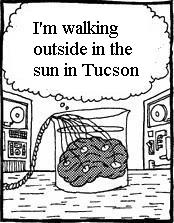
Trying to settle the standard is intensely frustrating and leads to a lot of talking past each other. But if you play the internally consistent game, it’s easier to learn how your opposite number thinks (maybe even well enough to pass an ideological Turing Test). You can see whether, even when spotted the major premise, your opponent’s system makes predictions about the empirical world that are flat out wrong. If there aren’t any obvious misses, is it because your sparring partner has limited the real world implications of his position until they can’t pay rent? How do they respond to that criticism?
If you don’t hit snags of the type described above, then maybe your opponent does have a reasonably coherent system, if you grant them a few foundational beliefs. Now it’s time to go back to arguing about how you judge those base beliefs. Or maybe, if their system did make good predictions that paid rent, you should take another look at the system that you brought to the table, test your own predictive power, and think about whether you’ve gained any evidence in favor of metaphysical backsliding (use the link if you don’t know the phrase).
The fact that a system is self-consistent is not proof that it’s true. I know the conventional example given by G.K. Chesterton in Orthodoxy:
The madman’s explanation of a thing is always complete, and often in a purely rational sense satisfactory. Or, to speak more strictly, the insane explanation, if not conclusive, is at least unanswerable; this may be observed specially in the two or three commonest kinds of madness. If a man says (for instance) that men have a conspiracy against him, you cannot dispute it except by saying that all the men deny that they are conspirators; which is exactly what conspirators would do. His explanation covers the facts as much as yours.
But I like to point to the well-fleshed out (but still sadly fictional) world of Harry Potter. The fandom that surrounds Rowling’s world is also a good example of how an unfinished and inconsistent world can be neatened up by scrupulous fans fixing Flints (theological examples fall under the heading of scriptural fanfiction).
On the other side of the coin, an inconsistent system isn’t necessarily false. It can be better to bite the bullet, and admit that you don’t know how to choose between two conflicting claims than to cling to one out of fear of looking uncertain. It’s easier to fix a problem you admit is a weakness than one you’ve papered over.

When two different philosophies manage to both look reasonably consistent, and the crucial proposition is unproveable or untestable, then you’ve got a case of non-Euclidean theologies (the phrase is inspired by the non-Euclidean geometries when you vary the definition of Euclid’s Fifth Postulate). You could conclude that these theologies are evenly balanced, but I’m inclined to say that the tie goes to the atheist position, since I’d expect a god to give people a bit more of a fighting chance to be converted.

Previous Post

July 27, 2011
And You Never Were a Scotsman!
Next Post
August 1, 2011 The 'Obvious' Consequence
Browse Our Archives
Select a Category 7 Quick Takes Apologetics Atheism Book Conversion Debate Tactics Debates Epistemology/Philosophy Housekeeping Ideological Turing Test Marriage Morality in Practice Parsing Catholicism Possibly Heretical Radio Reviews/Recommendations Sequence Index Spiritual Practice Uncategorized
Select a Month April 2017 March 2017 January 2017 December 2016 September 2016 August 2016 July 2016 June 2016 May 2016 April 2016 March 2016 February 2016 January 2016 December 2015 November 2015 October 2015 September 2015 August 2015 July 2015 June 2015 May 2015 April 2015 March 2015 February 2015 January 2015 December 2014 November 2014 October 2014 September 2014 August 2014 July 2014 June 2014 May 2014 April 2014 March 2014 February 2014 January 2014 December 2013 November 2013 October 2013 September 2013 August 2013 July 2013 June 2013 May 2013 April 2013 March 2013 February 2013 January 2013 December 2012 November 2012 October 2012 September 2012 August 2012 July 2012 June 2012 May 2012 April 2012 March 2012 February 2012 January 2012 December 2011 November 2011 October 2011 September 2011 August 2011 July 2011 June 2011 May 2011 April 2011 March 2011 February 2011 January 2011 December 2010 November 2010 October 2010 September 2010 August 2010 July 2010 June 2010
Follow Us!
TAKE THE
Religious Wisdom Quiz
Who said, "You shall have no other gods before me"?
Select your answer to see how you score.
Joshua Moses God Aaron
Related posts from Unequally Yoked

Rational Faith: More working hypothesis than logical proof

Starting Conversations During Francis's Visit

Desiring Abundance of Life, Not Just Absence of...

Why Not Refer to ISIS by an Epithet?
TRENDING AT PATHEOS Catholic

The Parable Of The Sower And The Word...
One of Christ’s most famous parables is that of the sower who...

Rejecting Doom: Christian Hope And Human Action
Christianity is a religion of hope. We are to have hope and...

Why I Choose the Eucharist Over the Sermon
Choose the Eucharist, Not the Sermon What are we supposed to get...

5 Design Elements Found in Spiritually Rooted Homes
Putting Spirituality Into Home Decor Our homes are more than our living...

Credo: A Story of God Told with the...
About 10 years ago, I began to imagine a personal "Credo" that...

The Anatomy of Divine Revelation in Catholic Thought
The claim that God has made Himself known to human beings is...
view all Catholic blogs
Ad-Free & Subscriber Log-In Subscription Support
- About Us
- 2026 Calendar
- Videos
- Podcasts
- Library of World Religions
- Faith In Media Tracker
- Advertise With Us
- Write for Us
- Privacy Policy
- Terms of Service
- Do Not Sell My Data
- Contact Us
- Radiant Digital
- Manage Newsletter Subscriptions
- Unsubscribe From Notifications
- Sitemap
Copyright 2008-2026, Patheos. All rights reserved.
Subscription Support Ad-Free & Subscriber Log-In
Follow Patheos