
BuddhistCatholicContemplativeEvangelicalGeneral ChristianHinduJewishLatter-day SaintMuslimNew VisionsProgressive Christian
Beliefs
- Buddhist
- Catholic
- Contemplative
- Evangelical
- General Christian
- Hindu
- Jewish
- Latter-day Saint
- More Voices
- Muslim
- New Visions
- Pagan
- Progressive Christian
Topics
- Religion News
- Food and Religion
- Sports and Religion
- Religious Art
- Religious Music and Entertainment
- Religious Events
- History and Religion
- Style and Religion
- Politics and Religion
- Women in Religion
- Recreation Outdoors and Religion
- Business Finance and Religion
- Careers Workplace and Religion
- Education and Religion
- Family Parenting and Religion
- Health Fitness and Religion
- Home and Religion
- Relationships and Religion
- Technology and Religion
- Travel and Religion
Columnists
- Buddhist Columnists
- Business Finance and Religion Columnists
- Careers Workplace and Religion Columnists
- Catholic Columnists
- Contemplative Columnists
- Education and Religion Columnists
- Evangelists Columnists
- Family Parenting and Religion Columnists
- General Christian Columnists
- Health Fitness and Religion Columnists
- Hindu Columnists
- History and Religion Columnists
- Home and Religion Columnists
- Jewish Columnists
- More Voices Columnists
- Latter Day Columnists
- Muslim Columnists
- New Visions Columnists
- Nonreligious Columnists
- Pagan Columnists
- Politics and Religion Columnists
- Progressive Columnists
- Recreation Outdoors and Religion Columnists
- Relationships and Religion Columnists
- Religion News Columnists
- Religious Art Columnists
- Religious Events Columnists
- Religious Music and Entertainment Columnists
- Sports and Religion Columnists
- Style and Religion Columnists
- Technology and Religion Columnists
- Travel and Religion Columnists
- Women in Religion Columnists
Resource Library
- 2026 Calendar
- Library of World Religions
- The 100 Most Holy Places on Earth
- Patheos Answers
- Podcasts
- Videos
- Faith Leaders Database
- Anglican Episcopalian
- Bahai
- Baptist
- Buddhism
- Christianity
- Confucianism
- Eastern Orthodoxy
- Hinduism
- Holiness and Pentecostal
- ISKCON
- Islam
- Judaism
- Lutheran
- Methodist
- The Church of Jesus Christ of Latter-day Saints
- New Age
- Paganism
- Presbytarian and Reformed
- Protestantism
- Religion Behind the Scenes
- Roman Catholic
- Scientology
- Shia Islam
- Sikhism
- Sufism
- Sunni Islam
- Taoism
- Zen
- See all religions
Research Tools
 Ad-Free & Subscriber Log-In Subscription Support
Ad-Free & Subscriber Log-In Subscription Support
Follow Patheos 

- Trending:
- Forgiveness
- |
- Marriage
- |
- Consciousness
- |
- Death Penalty
- |
- Election
- |
- Halloween
 Unequally Yoked
- Home
- Catholic
- William Lane Craig and I (briefly) Agree!
William Lane Craig and I (briefly) Agree!
Last updated on: October 3, 2012 at 10:54 am by Leah Libresco
William Lane Craig and I (briefly) Agree! 2012-10-03T10:54:36-04:00 Leah Libresco
Patheos Explore the world's faith through different perspectives on religion and spirituality! Patheos has the views of the prevalent religions and spiritualities of the world.

P.Z. Myers has a post up lambasting Christian apologist William Lane Craig for his defense of genocides in the Old Testament. Here’s the damning paragraph:
Moreover, if we believe, as I do, that God’s grace is extended to those who die in infancy or as small children, the death of these children was actually their salvation. We are so wedded to an earthly, naturalistic perspective that we forget that those who die are happy to quit this earth for heaven’s incomparable joy. Therefore, God does these children no wrong in taking their lives.
Don’t worry, this isn’t the part I agree with. This is just more of the same bizarre situational ethics that I only hear Christians fall back on when it’s time to explain away the Old Testament. By this logic, Christians should consider killing any children I have, to spare them my heathen upbringing, and I’d be doing a kindness if I waited outside a church to shoot anyone who had just received a plenary indulgence on Divine Mercy Sunday today. Christians can reasonably view death as not too tragic, because they believe in an afterlife administered by a merciful God, but I rarely hear them speak this way in any other context.
But Craig went on to say something I do find compelling (though P.Z. Myers did not.)
WLC: So whom does God wrong in commanding the destruction of the Canaanites? Not the Canaanite adults, for they were corrupt and deserving of judgement. Not the children, for they inherit eternal life. So who is wronged? Ironically, I think the most difficult part of this whole debate is the apparent wrong done to the Israeli soldiers themselves. Can you imagine what it would be like to have to break into some house and kill a terrified woman and her children? The brutalizing effect on these Israeli soldiers is disturbing.
Myers: No. No, I can’t imagine that. I can imagine parts of it: I can imagine a long, heavy piece of sharp metal in my hands. I can imagine a frightened, unarmed woman in front of me, trying to shelter her children. The part I can’t imagine, the stuff I’m having real trouble with, is imagining voluntarily raising my hand and hacking them to death. I have a choice in that situation, and I know myself well enough that if have to choose between killing people and letting them live, I’d let them live, not that it would be a difficult decision at all. I also have no illusion that, in this imaginary situation where I have all the power and my ‘enemies’ are weak and helpless, I am the one who is being wronged.
The idea that a good God would order his chosen people to commit inhuman brutalities seems unsupportable. It’s one of the theodicy problems that bothered me when I posted about the slaughter of the Amalekites, and I’m glad Craig can admit that this at least is disturbing. So this is where I back Craig against Myers.
I think Myers’s response is produced by the kind of cushy, privileged, upper-middle class background we share. Neither Myers not I have any expectation of facing a situation where we would face the choice to take someone else’s life, so the idea of steeling oneself to kill is abstract. Maybe Myers will change his tune if he takes a look at the cover story of the New York Times Magazine this week: “A Beast in the Heart of Every Fighting Man.”
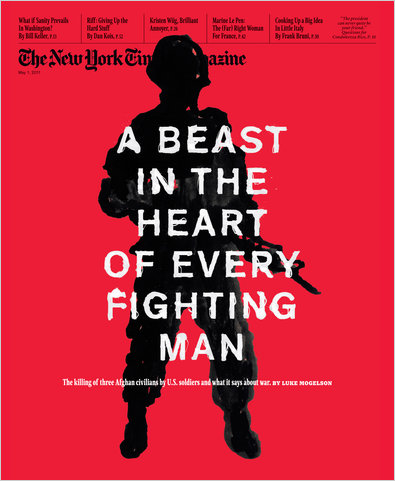
The story covers the infamous “kill team” of American soldiers in Afghanistan — a group of soldiers who allegedly murdered civilians for kicks and then planted weapons on their bodies so they looked like insurgents. I recommend reading the entire story, but here’s a small excerpt describing the experience of a whistleblower on the team:
The man, Mullah Allah Dad, was brought outside, where, Winfield told investigators, “Sergeant Gibbs said: ‘Just put him down in that ditch right there. Put him on his knees.’ ” Winfield and Morlock both claim that after Allah Dad was lowered to his knees, they took cover behind a sand berm about 15 feet away. Winfield and Morlock say Gibbs activated an American fragmentation grenade and tossed it at Allah Dad’s feet. In his confession, Morlock says that as he did so, Gibbs yelled: “Kill him! Kill him!” During his initial questioning, Winfield remembered Morlock giving the order to shoot before the grenade detonated.
Morlock and Winfield both admit firing their rifles. Winfield, whose lawyer now claims he deliberately aimed high, told Army special agents: “I took a man from his family. I don’t know if it was my bullets that killed him or the grenade that killed him. But I was a part of it.” Christopher Winfield, who has had many conversations with his son about this moment, told me: “Fear set in for him. He said he was having a huge anxiety attack. He couldn’t feel his fingers. He couldn’t feel his feet. He panicked . . . almost passed out.” Christopher said that for a moment, while trying to decide what to do, his son even considered shooting Gibbs.
With America engaged in four wars (if you’re counting Pakistan, and I do), it’s essential to recognize the way that brutalities warp and damage the person committing them as well as the victim. Myers is being glib when he refuses to recognize that, whether the Israelites who slaughtered infants were driven to atrocities out of fear of God or chose brutality willingly, they were marked and wounded by their acts.
Craig’s promises of salvation after death don’t address the fate of these Old Testament sin-eaters. Myers’s dismissal of the damage suffered by someone who has done evil lets us off the hook for sending soldiers into moral (as well as mortal) peril.

Previous Post

April 30, 2011
Baffled by Divine Mercy Sunday
Next Post
May 2, 2011 Rejoice not when thine enemy falleth
Browse Our Archives
Select a Category 7 Quick Takes Apologetics Atheism Book Conversion Debate Tactics Debates Epistemology/Philosophy Housekeeping Ideological Turing Test Marriage Morality in Practice Parsing Catholicism Possibly Heretical Radio Reviews/Recommendations Sequence Index Spiritual Practice Uncategorized
Select a Month April 2017 March 2017 January 2017 December 2016 September 2016 August 2016 July 2016 June 2016 May 2016 April 2016 March 2016 February 2016 January 2016 December 2015 November 2015 October 2015 September 2015 August 2015 July 2015 June 2015 May 2015 April 2015 March 2015 February 2015 January 2015 December 2014 November 2014 October 2014 September 2014 August 2014 July 2014 June 2014 May 2014 April 2014 March 2014 February 2014 January 2014 December 2013 November 2013 October 2013 September 2013 August 2013 July 2013 June 2013 May 2013 April 2013 March 2013 February 2013 January 2013 December 2012 November 2012 October 2012 September 2012 August 2012 July 2012 June 2012 May 2012 April 2012 March 2012 February 2012 January 2012 December 2011 November 2011 October 2011 September 2011 August 2011 July 2011 June 2011 May 2011 April 2011 March 2011 February 2011 January 2011 December 2010 November 2010 October 2010 September 2010 August 2010 July 2010 June 2010
Follow Us!
TAKE THE
Religious Wisdom Quiz
How many days are in a week?
Select your answer to see how you score.
Seven Five Ten Twelve
Related posts from Unequally Yoked

Rational Faith: More working hypothesis than logical proof

The Tony-Winning Guide To Temptation And Grace

Hedgehogs of Redemption and the Comedy of Grace

Mercy, Justice, and How To Tell The Difference
TRENDING AT PATHEOS Catholic

Rejecting Doom: Christian Hope And Human Action
Christianity is a religion of hope. We are to have hope and...

It’s What Comes From Within Which Matters
One of the most difficult things for us to understand is why...

Why I Choose the Eucharist Over the Sermon
Choose the Eucharist, Not the Sermon What are we supposed to get...

5 Design Elements Found in Spiritually Rooted Homes
Putting Spirituality Into Home Decor Our homes are more than our living...

Credo: A Story of God Told with the...
About 10 years ago, I began to imagine a personal "Credo" that...

The Anatomy of Divine Revelation in Catholic Thought
The claim that God has made Himself known to human beings is...
view all Catholic blogs
Ad-Free & Subscriber Log-In Subscription Support
- About Us
- 2026 Calendar
- Videos
- Podcasts
- Library of World Religions
- Faith In Media Tracker
- Advertise With Us
- Write for Us
- Privacy Policy
- Terms of Service
- Do Not Sell My Data
- Contact Us
- Radiant Digital
- Manage Newsletter Subscriptions
- Unsubscribe From Notifications
- Sitemap
Copyright 2008-2026, Patheos. All rights reserved.
Subscription Support Ad-Free & Subscriber Log-In
Follow Patheos