
BuddhistCatholicContemplativeEvangelicalGeneral ChristianHinduJewishLatter-day SaintMuslimNew VisionsProgressive Christian
Beliefs
- Buddhist
- Catholic
- Contemplative
- Evangelical
- General Christian
- Hindu
- Jewish
- Latter-day Saint
- More Voices
- Muslim
- New Visions
- Pagan
- Progressive Christian
Topics
- Religion News
- Food and Religion
- Sports and Religion
- Religious Art
- Religious Music and Entertainment
- Religious Events
- History and Religion
- Style and Religion
- Politics and Religion
- Women in Religion
- Recreation Outdoors and Religion
- Business Finance and Religion
- Careers Workplace and Religion
- Education and Religion
- Family Parenting and Religion
- Health Fitness and Religion
- Home and Religion
- Relationships and Religion
- Technology and Religion
- Travel and Religion
Columnists
- Buddhist Columnists
- Business Finance and Religion Columnists
- Careers Workplace and Religion Columnists
- Catholic Columnists
- Contemplative Columnists
- Education and Religion Columnists
- Evangelists Columnists
- Family Parenting and Religion Columnists
- General Christian Columnists
- Health Fitness and Religion Columnists
- Hindu Columnists
- History and Religion Columnists
- Home and Religion Columnists
- Jewish Columnists
- More Voices Columnists
- Latter Day Columnists
- Muslim Columnists
- New Visions Columnists
- Nonreligious Columnists
- Pagan Columnists
- Politics and Religion Columnists
- Progressive Columnists
- Recreation Outdoors and Religion Columnists
- Relationships and Religion Columnists
- Religion News Columnists
- Religious Art Columnists
- Religious Events Columnists
- Religious Music and Entertainment Columnists
- Sports and Religion Columnists
- Style and Religion Columnists
- Technology and Religion Columnists
- Travel and Religion Columnists
- Women in Religion Columnists
Resource Library
- 2026 Calendar
- Library of World Religions
- The 100 Most Holy Places on Earth
- Patheos Answers
- Podcasts
- Videos
- Faith Leaders Database
- Anglican Episcopalian
- Bahai
- Baptist
- Buddhism
- Christianity
- Confucianism
- Eastern Orthodoxy
- Hinduism
- Holiness and Pentecostal
- ISKCON
- Islam
- Judaism
- Lutheran
- Methodist
- The Church of Jesus Christ of Latter-day Saints
- New Age
- Paganism
- Presbytarian and Reformed
- Protestantism
- Religion Behind the Scenes
- Roman Catholic
- Scientology
- Shia Islam
- Sikhism
- Sufism
- Sunni Islam
- Taoism
- Zen
- See all religions
Research Tools
 Ad-Free & Subscriber Log-In Subscription Support
Ad-Free & Subscriber Log-In Subscription Support
Follow Patheos 

- Trending:
- Forgiveness
- |
- Marriage
- |
- Consciousness
- |
- Death Penalty
- |
- Election
- |
- Halloween
 Unequally Yoked
- Home
- Catholic
- Prayer, Belief, and More Jump Discontinuities
Prayer, Belief, and More Jump Discontinuities
Last updated on: September 25, 2012 at 12:56 am by Leah Libresco
Prayer, Belief, and More Jump Discontinuities 2012-09-25T00:56:28-04:00 Leah Libresco
Patheos Explore the world's faith through different perspectives on religion and spirituality! Patheos has the views of the prevalent religions and spiritualities of the world.
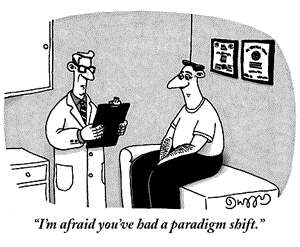
The post last week on being prayed for sparked some interesting questions about free will and belief. I thought returning to that topic would be a nice complement to the discussion about choosing to alter your own will that’s developing out of Tristyn’s pharmaceutical thought experiment.
Disagreement arose over whether a petitionary prayer to God seeking my conversion was an affront to my free will or agency. Posters P. Coyle and Hendy made the great point that belief is not a matter of will. (Hendy’s gone into a lot more detail about the nature of belief at his own blog here). I can’t will myself to believe that God exists, so a change in my belief (whether caused by God or any other reason) is not an imposition on my will. This would be the case even if God poked into my head and altered my belief, though I don’t think that’s exactly what Christians pray for when they pray for conversion.
Christians I’ve talked to tend to think that there is evidence for their belief. Some Christians think that atheists don’t consider their evidence in good faith, but many others concede that the evidence that sustains their belief is not universally accessible. Miracles or a subjective feeling of closeness to God might be personally convincing, but they’re impossible to offer as anything but hearsay evidence to others.
What Christians I’ve talked to hope for is that I would be able to access this kind of evidence or that I would stop applying a needlessly high standard of evidence to some claims. Some of my Christian friends think some of my other beliefs are most compatible with Christianity, so they’re hoping I get over whatever is preventing me from recognizing that fact, whether it’s pride, fear, or too much optimism that a superior system exists. They’re asking God to smooth any of these paths to truth.
Ultimately I don’t find this kind of prayer any more of a threat to my free will than someone offering me reading material that could change my mind. Data is compulsion, but it’s good compulsion. My will and desire aren’t and shouldn’t be directed to preserving a certain belief, I aspire that all my beliefs are true. The Christian who prays for me and little old atheist me are in agreement about our goal at that level.
I’m pushy in this way when I try to explain complicated science facts to someone less immersed in the topic than I am. I have data that the other person can’t parse, which I believe would be compelling if they could understand it. I might try to throw my interlocutor into the path of someone I thought would be better able to explain (kind of what Christians are doing) or I might cheat a little and try to convince using an appeal to authority, playing on their trust and my apparent expertise. My preference is that they believe the right thing for the right reasons, but I can’t necessarily get there if their background is too limited.
I think we may all be in agreement here, even though we disagree about what the truth actually is. Yudowski’s Litany of Tarski and Litany of Gendlin may be of interest to everyone here.
There’s a different issue tied up in this question that has less to do with problems of will than the continuity of self. If God altered my beliefs suddenly while I was asleep and I woke up a Christian, the real issue is the discontinuity between my identity when I went to sleep and my identity when I woke up. If I became aware of this kind of reversal, I’d be more likely to find my new belief to be evidence of my own insanity than evidence of God.
Identity can weather sudden changes and epiphanies without being broken, but all of these are accompanied by at least a subjective sense of cause. Otherwise they feel like delusion and annihilation. That’s not to say that big shifts aren’t always a kind of violence to the self, but at least you’ve sacrificed your old self on the altar of some greater good. Remembering the cause of that shift provides some connection to the dross you burned away.

Previous Post

March 14, 2011
Inducing a Moral Jump Discontinuity (A thought experiment)
Next Post
March 17, 2011 Drinking Death Upon Yourself
Browse Our Archives
Select a Category 7 Quick Takes Apologetics Atheism Book Conversion Debate Tactics Debates Epistemology/Philosophy Housekeeping Ideological Turing Test Marriage Morality in Practice Parsing Catholicism Possibly Heretical Radio Reviews/Recommendations Sequence Index Spiritual Practice Uncategorized
Select a Month April 2017 March 2017 January 2017 December 2016 September 2016 August 2016 July 2016 June 2016 May 2016 April 2016 March 2016 February 2016 January 2016 December 2015 November 2015 October 2015 September 2015 August 2015 July 2015 June 2015 May 2015 April 2015 March 2015 February 2015 January 2015 December 2014 November 2014 October 2014 September 2014 August 2014 July 2014 June 2014 May 2014 April 2014 March 2014 February 2014 January 2014 December 2013 November 2013 October 2013 September 2013 August 2013 July 2013 June 2013 May 2013 April 2013 March 2013 February 2013 January 2013 December 2012 November 2012 October 2012 September 2012 August 2012 July 2012 June 2012 May 2012 April 2012 March 2012 February 2012 January 2012 December 2011 November 2011 October 2011 September 2011 August 2011 July 2011 June 2011 May 2011 April 2011 March 2011 February 2011 January 2011 December 2010 November 2010 October 2010 September 2010 August 2010 July 2010 June 2010
Follow Us!
TAKE THE
Religious Wisdom Quiz
In 1 Peter, what does Peter say Sarah called Abraham?
Select your answer to see how you score.
Master My beloved Father Lord
Related posts from Unequally Yoked

Starting Conversations During Francis's Visit

Desiring Abundance of Life, Not Just Absence of...
Why Not Refer to ISIS by an Epithet?

Life Lessons that Can't be Taught at College's...
TRENDING AT PATHEOS Catholic

Creation, Preservation, and Teleology in Catholic Theology
As I write this, it is very early Monday morning. Like millions...

The Parable Of The Sower And The Word...
One of Christ’s most famous parables is that of the sower who...

Rejecting Doom: Christian Hope And Human Action
Christianity is a religion of hope. We are to have hope and...

Why I Choose the Eucharist Over the Sermon
Choose the Eucharist, Not the Sermon What are we supposed to get...

5 Design Elements Found in Spiritually Rooted Homes
Putting Spirituality Into Home Decor Our homes are more than our living...

Credo: A Story of God Told with the...
About 10 years ago, I began to imagine a personal "Credo" that...
view all Catholic blogs
Ad-Free & Subscriber Log-In Subscription Support
- About Us
- 2026 Calendar
- Videos
- Podcasts
- Library of World Religions
- Faith In Media Tracker
- Advertise With Us
- Write for Us
- Privacy Policy
- Terms of Service
- Do Not Sell My Data
- Contact Us
- Radiant Digital
- Manage Newsletter Subscriptions
- Unsubscribe From Notifications
- Sitemap
Copyright 2008-2026, Patheos. All rights reserved.
Subscription Support Ad-Free & Subscriber Log-In
Follow Patheos