
BuddhistCatholicContemplativeEvangelicalGeneral ChristianHinduJewishLatter-day SaintMuslimNew VisionsProgressive Christian
Beliefs
- Buddhist
- Catholic
- Contemplative
- Evangelical
- General Christian
- Hindu
- Jewish
- Latter-day Saint
- More Voices
- Muslim
- New Visions
- Pagan
- Progressive Christian
Topics
- Religion News
- Food and Religion
- Sports and Religion
- Religious Art
- Religious Music and Entertainment
- Religious Events
- History and Religion
- Style and Religion
- Politics and Religion
- Women in Religion
- Recreation Outdoors and Religion
- Business Finance and Religion
- Careers Workplace and Religion
- Education and Religion
- Family Parenting and Religion
- Health Fitness and Religion
- Home and Religion
- Relationships and Religion
- Technology and Religion
- Travel and Religion
Columnists
- Buddhist Columnists
- Business Finance and Religion Columnists
- Careers Workplace and Religion Columnists
- Catholic Columnists
- Contemplative Columnists
- Education and Religion Columnists
- Evangelists Columnists
- Family Parenting and Religion Columnists
- General Christian Columnists
- Health Fitness and Religion Columnists
- Hindu Columnists
- History and Religion Columnists
- Home and Religion Columnists
- Jewish Columnists
- More Voices Columnists
- Latter Day Columnists
- Muslim Columnists
- New Visions Columnists
- Nonreligious Columnists
- Pagan Columnists
- Politics and Religion Columnists
- Progressive Columnists
- Recreation Outdoors and Religion Columnists
- Relationships and Religion Columnists
- Religion News Columnists
- Religious Art Columnists
- Religious Events Columnists
- Religious Music and Entertainment Columnists
- Sports and Religion Columnists
- Style and Religion Columnists
- Technology and Religion Columnists
- Travel and Religion Columnists
- Women in Religion Columnists
Resource Library
- 2026 Calendar
- Library of World Religions
- The 100 Most Holy Places on Earth
- Patheos Answers
- Podcasts
- Videos
- Faith Leaders Database
- Anglican Episcopalian
- Bahai
- Baptist
- Buddhism
- Christianity
- Confucianism
- Eastern Orthodoxy
- Hinduism
- Holiness and Pentecostal
- ISKCON
- Islam
- Judaism
- Lutheran
- Methodist
- The Church of Jesus Christ of Latter-day Saints
- New Age
- Paganism
- Presbytarian and Reformed
- Protestantism
- Religion Behind the Scenes
- Roman Catholic
- Scientology
- Shia Islam
- Sikhism
- Sufism
- Sunni Islam
- Taoism
- Zen
- See all religions
Research Tools
 Ad-Free & Subscriber Log-In Subscription Support
Ad-Free & Subscriber Log-In Subscription Support
Follow Patheos 

- Trending:
- Forgiveness
- |
- Marriage
- |
- Consciousness
- |
- Death Penalty
- |
- Election
- |
- Halloween
 Unequally Yoked
- Home
- Catholic
- God Can’t Prove Much to Puny Mortals
God Can’t Prove Much to Puny Mortals
Last updated on: September 25, 2012 at 11:51 pm by Leah Libresco
God Can’t Prove Much to Puny Mortals 2012-09-25T23:51:06-04:00 Leah Libresco
Patheos Explore the world's faith through different perspectives on religion and spirituality! Patheos has the views of the prevalent religions and spiritualities of the world.
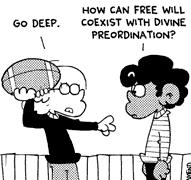
Over in the comment thread of last week’s post on standards of proof for miracles, P. Coyle and Iota have been hashing out the classic argument that a truly unambiguous miracle would be a blow against our free will, forcing us to believe in God. I want to walk through and discuss their positions, since this is a common Christian contention (and because it’s going to set me up perfectly for a Harry Potter fanfiction reference in today’s Sunday’s Good Book post). Everyone’s comments have been trimmed for length; I’ve tried to keep the messages clear, but it’s worth going back to the original comment thread.
P. Coyle framed the problem through the analogous case of a juror whose beliefs are compelled by evidence:
Suppose you are on a jury. You have been presented with evidence that has convinced you, beyond a reasonable doubt, that the defendant is guilty. Having been so convinced, could you, as an act of free will, “choose to believe” that the defendant is NOT guilty? My contention is that you could not. Yes, you could use your free will to vote to acquit the accused, even though you believe he is guilty, but you would be using your free will to choose how to act, not to choose what to believe…
Thus, I still remain completely unconvinced by your previous argument that God, if he existed, could not demonstrate his existence to us beyond a reasonable doubt without interfering with our free will. To reiterate, by analogy you seem to be saying that a prosecutor who presents a jury with sufficient evidence to demonstrate the guilt of the accused beyond a reasonable doubt is interfering with the jury’s free will.

Iota agreed that a prosecutor presenting evidence beyond a reasonable doubt would ‘force’ a juror to believe in the defendant’s guilt but countered by saying that God has a qualitatively different power to compel belief:
What I could choose to do [in the jury example] would be to either say that because I find the evidence compelling I WON’T be convinced of any alternative (upgrading my “moral certainty” to “absolute certainty”) or to say “Of course, I COULD be wrong…” (even if I think that chance is 0,000001%)…
A prosecutor similarly could not “prove” that Mr. Smith is innocent of a crime. He could prove that, given there are no advances in forensics and no evidence was misinterpreted, Mr. Smith did not kill Ms. Newman in the way the prosecution states she had been killed.
What the prosecution could not do (and here they significantly differ from God) is wipe away all those extra conditions above. And those extra conditions are important. If none of them remained, I could not make the choice I wrote of above (between upgrading my “moral certainty” to “absolute certainty” or not) – it simply would be upgraded, without any choice on my part. And that upgrade, I think, is the essence of “having faith” as I understand it.
Personally, I think Iota is overestimating the power even an omniscient god would have to prove it’s existence to us. Ebonmuse of Daylight Atheism had an excellent post this week on the difficulty of distinguishing between between gods, sufficiently advanced aliens, etc. No god could muster proof of abilities that are beyond our capacity to comprehend; I can see someone bilocate, but I can’t observe an ability to be all-loving. Ebonmuse correctly concluded that any sufficiently powerful being, whether or not it was God, would be able to compel ritual worship and belief in existence.
 Maybe even these guys
A different Christian talking point seems like it could be of use here. Plenty of Christians I’ve scrapped with sidestep a demand for proof of God’s existence by asking me, “Can you prove your mother loves you?” There’s no way to conclusively settle the question, no proof to offer a skeptic, but we’re comfortable relying on our experience and letting it serve as the foundation of our lives. My mother’s love is a lot more interesting than the simple fact of my mother’s existence.
I’m not very sympathetic to the the argument God mustn’t overwhelm us with proof of existence, since acknowledging a being is a long way from loving. Any god/alien/person with a really sharp stick could force me to believe in their power and make me build temples to their might, but what the Christian god wants is willing, joyful obedience born out of love. Lucifer’s non serviam seems like evidence that knowledge of God’s existence and power isn’t enough to compel loving submission.
There are other arguments for the legitimacy of a hidden god, but this one sure doesn’t hold water for me.

Previous Post

March 19, 2011
Committing a Capital Crime in Debate
Next Post
March 20, 2011 Trying to Will Your Beliefs (A Case Study)
Browse Our Archives
Select a Category 7 Quick Takes Apologetics Atheism Book Conversion Debate Tactics Debates Epistemology/Philosophy Housekeeping Ideological Turing Test Marriage Morality in Practice Parsing Catholicism Possibly Heretical Radio Reviews/Recommendations Sequence Index Spiritual Practice Uncategorized
Select a Month April 2017 March 2017 January 2017 December 2016 September 2016 August 2016 July 2016 June 2016 May 2016 April 2016 March 2016 February 2016 January 2016 December 2015 November 2015 October 2015 September 2015 August 2015 July 2015 June 2015 May 2015 April 2015 March 2015 February 2015 January 2015 December 2014 November 2014 October 2014 September 2014 August 2014 July 2014 June 2014 May 2014 April 2014 March 2014 February 2014 January 2014 December 2013 November 2013 October 2013 September 2013 August 2013 July 2013 June 2013 May 2013 April 2013 March 2013 February 2013 January 2013 December 2012 November 2012 October 2012 September 2012 August 2012 July 2012 June 2012 May 2012 April 2012 March 2012 February 2012 January 2012 December 2011 November 2011 October 2011 September 2011 August 2011 July 2011 June 2011 May 2011 April 2011 March 2011 February 2011 January 2011 December 2010 November 2010 October 2010 September 2010 August 2010 July 2010 June 2010
Follow Us!
TAKE THE
Religious Wisdom Quiz
What happened when Jesus touched the coffin of the widow's son at Nain?
Select your answer to see how you score.
The coffin broke The crowd dispersed Rain fell The son came back to life
Related posts from Unequally Yoked

Rational Faith: More working hypothesis than logical proof

Starting Conversations During Francis's Visit

Life Lessons that Can't be Taught at College's...

Books that Change the Way You Think [Radio...
TRENDING AT PATHEOS Catholic

Rejecting Doom: Christian Hope And Human Action
Christianity is a religion of hope. We are to have hope and...

It’s What Comes From Within Which Matters
One of the most difficult things for us to understand is why...

Why I Choose the Eucharist Over the Sermon
Choose the Eucharist, Not the Sermon What are we supposed to get...

5 Design Elements Found in Spiritually Rooted Homes
Putting Spirituality Into Home Decor Our homes are more than our living...

Credo: A Story of God Told with the...
About 10 years ago, I began to imagine a personal "Credo" that...

The Anatomy of Divine Revelation in Catholic Thought
The claim that God has made Himself known to human beings is...
view all Catholic blogs
Ad-Free & Subscriber Log-In Subscription Support
- About Us
- 2026 Calendar
- Videos
- Podcasts
- Library of World Religions
- Faith In Media Tracker
- Advertise With Us
- Write for Us
- Privacy Policy
- Terms of Service
- Do Not Sell My Data
- Contact Us
- Radiant Digital
- Manage Newsletter Subscriptions
- Unsubscribe From Notifications
- Sitemap
Copyright 2008-2026, Patheos. All rights reserved.
Subscription Support Ad-Free & Subscriber Log-In
Follow Patheos