
BuddhistCatholicContemplativeEvangelicalGeneral ChristianHinduJewishLatter-day SaintMuslimNew VisionsProgressive Christian
Beliefs
- Buddhist
- Catholic
- Contemplative
- Evangelical
- General Christian
- Hindu
- Jewish
- Latter-day Saint
- More Voices
- Muslim
- New Visions
- Pagan
- Progressive Christian
Topics
- Religion News
- Food and Religion
- Sports and Religion
- Religious Art
- Religious Music and Entertainment
- Religious Events
- History and Religion
- Style and Religion
- Politics and Religion
- Women in Religion
- Recreation Outdoors and Religion
- Business Finance and Religion
- Careers Workplace and Religion
- Education and Religion
- Family Parenting and Religion
- Health Fitness and Religion
- Home and Religion
- Relationships and Religion
- Technology and Religion
- Travel and Religion
Columnists
- Buddhist Columnists
- Business Finance and Religion Columnists
- Careers Workplace and Religion Columnists
- Catholic Columnists
- Contemplative Columnists
- Education and Religion Columnists
- Evangelists Columnists
- Family Parenting and Religion Columnists
- General Christian Columnists
- Health Fitness and Religion Columnists
- Hindu Columnists
- History and Religion Columnists
- Home and Religion Columnists
- Jewish Columnists
- More Voices Columnists
- Latter Day Columnists
- Muslim Columnists
- New Visions Columnists
- Nonreligious Columnists
- Pagan Columnists
- Politics and Religion Columnists
- Progressive Columnists
- Recreation Outdoors and Religion Columnists
- Relationships and Religion Columnists
- Religion News Columnists
- Religious Art Columnists
- Religious Events Columnists
- Religious Music and Entertainment Columnists
- Sports and Religion Columnists
- Style and Religion Columnists
- Technology and Religion Columnists
- Travel and Religion Columnists
- Women in Religion Columnists
Resource Library
- 2026 Calendar
- Library of World Religions
- The 100 Most Holy Places on Earth
- Patheos Answers
- Podcasts
- Videos
- Faith Leaders Database
- Anglican Episcopalian
- Bahai
- Baptist
- Buddhism
- Christianity
- Confucianism
- Eastern Orthodoxy
- Hinduism
- Holiness and Pentecostal
- ISKCON
- Islam
- Judaism
- Lutheran
- Methodist
- The Church of Jesus Christ of Latter-day Saints
- New Age
- Paganism
- Presbytarian and Reformed
- Protestantism
- Religion Behind the Scenes
- Roman Catholic
- Scientology
- Shia Islam
- Sikhism
- Sufism
- Sunni Islam
- Taoism
- Zen
- See all religions
Research Tools
 Ad-Free & Subscriber Log-In Subscription Support
Ad-Free & Subscriber Log-In Subscription Support
Follow Patheos 

- Trending:
- Forgiveness
- |
- Marriage
- |
- Consciousness
- |
- Death Penalty
- |
- Election
- |
- Halloween
 Unequally Yoked
- Home
- Catholic
- This is NOT How Evolution Works
This is NOT How Evolution Works
Last updated on: September 10, 2012 at 12:52 am by Leah Libresco
This is NOT How Evolution Works 2012-09-10T00:52:35-04:00 Leah Libresco
Patheos Explore the world's faith through different perspectives on religion and spirituality! Patheos has the views of the prevalent religions and spiritualities of the world.
But it’s a good primer in some of the most common mistakes from people who are semi-literate in the relevant sciences, so I’m going to go through the problems from a recent post (“Less Mature by Age“) by Robin Hanson at Overcoming Bias.
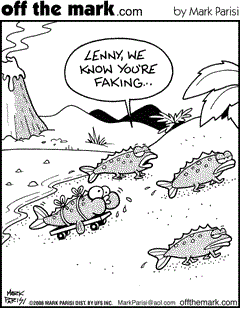
The Background Data:
Hanson found an article from the Journal of Personality and Social Psychology that suggested that, although there is an overall positive correlation between age and psychosocial maturity, this trend reverses during the teenage years. In other words, the older you get, the more mature you are on average in situations involving others, but you’re likely to regress as a teen. I can’t get the full text of the article, so I can’t comment on the instrument they used to gauge maturity or how large any differences were. Since my issue is with Hanson’s interpretation, though, let’s assume the methodology was perfect and any observed effects were large enough to care about.
Here’s Hanson’s take:
Many like to think that we become more “mature” as we age because our experience with life teaches us the wisdom of mature behavior. They then presume that teens would be better off acting more maturely, and should be forced to do so if necessary. However, this “maturity as learning” theory conflicts with the fact that we become less mature as we become teens. An alternate theory, that better accounts for the above patterns, is that we are programmed to have different personalities and attitudes at different ages, because for our distant ancestors those attitudes were useful at those ages. Beware too easily assuming that others would be better off if they were more like you.
Problem 1: Did you see any ‘teens’ in the Middle Ages?
Beware too easily assuming that the modern understanding of stages of life have anything to do with the lives of our ‘distant ancestors’ or the evolutionary pressures they faced. The idea of ‘teenager’ or any intermediate step between childhood and adulthood is extremely modern and much too recent to have any profound evolutionary impact. Just because I can, I ran ‘teenager’ through the new Google Books ngram viewer (it track mentions of a word or short phrase in the entire corpus of books Google has scanned. You can read more here). Here’s what the search turned up (click the image to enlarge):
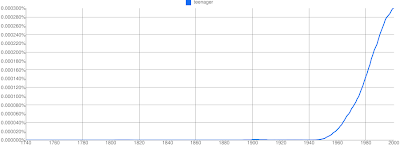
Evolution doesn’t produce species-wide changes over the short term. Evolutionary changes are easy to observe in bacteria because the generations are so short-lived so scientists can burn through a lot of ‘time.’ Humans live for a long time, and wait a long time to reproduce, so there’s no way evolutionary pressures could have had time to alter the way teens think and behave when we’ve only had teens for so few generations.
Whatever the scientists observed has nothing to do with teens today. It’s not evidence, as Hanson argues, that antisocial behavior from teens is appropriate or the result of optimized programming. Whatever programming we’ve got has been unpredictably outpaced by the changes we’ve made to our environment and our culture. The historical situation that led to a maturity regress isn’t likely to still be active, so these adaptations are the equivalent of trying to input data into a laptop with punch cards. The task they were designed to do no longer exists.
Problem 2: Evolution is Really Lazy
But even if the category of ‘teenager’ had existed for long enough to be subject to evolutionary pressure, Hanson is still attributing way too much precision to a process as messy as evolution. Evolution is not a process of meticulous fine-tuning and optimization. It is the process of eliminating the totally unworkable. That means plenty of barely acceptable kludges stick around in the gene pool because they aren’t easy to discern or they kick in after reproductive ages or because they just aren’t that bad, even if they aren’t perfect.
If teen backsliding on maturity were a response to evolutionary pressure, there’s no guarantee it’s a particularly good response. There’s also no evidence that the alternate scenario of a positive correlation for all of life was on the table as an alternative when this adaptation won out. Therefore, it’s ridiculous to talk about this finding as a rebuke to people who expect teenagers to act mature. That could very well be the best behavior, but our ineffective genes prevent us from acting as we ought.
Evolutionary psychology is not a trump card that can justify behaviors. The wonder of humans is that we are aware of evolutionary drives and artifacts and can choose to transcend them. We lose this opportunity when we reify the products of evolution or ascribe too much design to the process.
/To be human is to be more than human/

Previous Post

December 27, 2010
Guest Posting and a New Year's Challenge
Next Post
December 31, 2010 7 Quick Takes (12/31/10)
Browse Our Archives
Select a Category 7 Quick Takes Apologetics Atheism Book Conversion Debate Tactics Debates Epistemology/Philosophy Housekeeping Ideological Turing Test Marriage Morality in Practice Parsing Catholicism Possibly Heretical Radio Reviews/Recommendations Sequence Index Spiritual Practice Uncategorized
Select a Month April 2017 March 2017 January 2017 December 2016 September 2016 August 2016 July 2016 June 2016 May 2016 April 2016 March 2016 February 2016 January 2016 December 2015 November 2015 October 2015 September 2015 August 2015 July 2015 June 2015 May 2015 April 2015 March 2015 February 2015 January 2015 December 2014 November 2014 October 2014 September 2014 August 2014 July 2014 June 2014 May 2014 April 2014 March 2014 February 2014 January 2014 December 2013 November 2013 October 2013 September 2013 August 2013 July 2013 June 2013 May 2013 April 2013 March 2013 February 2013 January 2013 December 2012 November 2012 October 2012 September 2012 August 2012 July 2012 June 2012 May 2012 April 2012 March 2012 February 2012 January 2012 December 2011 November 2011 October 2011 September 2011 August 2011 July 2011 June 2011 May 2011 April 2011 March 2011 February 2011 January 2011 December 2010 November 2010 October 2010 September 2010 August 2010 July 2010 June 2010
Follow Us!
TAKE THE
Religious Wisdom Quiz
Which prophet spoke God's judgment against Edom?
Select your answer to see how you score.
Obadiah Ezekiel Joel Jonah
Related posts from Unequally Yoked
Harrison Bergeron-ing a Too-Exceptional Sprinter

"Because I am fearfully and wonderfully made"
Dennett's Thesis isn't Evidence for Very Interesting Claims

Bob, can I interest you in Transhumanism?
TRENDING AT PATHEOS Catholic

Rejecting Doom: Christian Hope And Human Action
Christianity is a religion of hope. We are to have hope and...

It’s What Comes From Within Which Matters
One of the most difficult things for us to understand is why...

Why I Choose the Eucharist Over the Sermon
Choose the Eucharist, Not the Sermon What are we supposed to get...

5 Design Elements Found in Spiritually Rooted Homes
Putting Spirituality Into Home Decor Our homes are more than our living...

Credo: A Story of God Told with the...
About 10 years ago, I began to imagine a personal "Credo" that...

The Anatomy of Divine Revelation in Catholic Thought
The claim that God has made Himself known to human beings is...
view all Catholic blogs
Ad-Free & Subscriber Log-In Subscription Support
- About Us
- 2026 Calendar
- Videos
- Podcasts
- Library of World Religions
- Faith In Media Tracker
- Advertise With Us
- Write for Us
- Privacy Policy
- Terms of Service
- Do Not Sell My Data
- Contact Us
- Radiant Digital
- Manage Newsletter Subscriptions
- Unsubscribe From Notifications
- Sitemap
Copyright 2008-2026, Patheos. All rights reserved.
Subscription Support Ad-Free & Subscriber Log-In
Follow Patheos