
BuddhistCatholicContemplativeEvangelicalGeneral ChristianHinduJewishLatter-day SaintMuslimNew VisionsProgressive Christian
Beliefs
- Buddhist
- Catholic
- Contemplative
- Evangelical
- General Christian
- Hindu
- Jewish
- Latter-day Saint
- More Voices
- Muslim
- New Visions
- Pagan
- Progressive Christian
Topics
- Religion News
- Food and Religion
- Sports and Religion
- Religious Art
- Religious Music and Entertainment
- Religious Events
- History and Religion
- Style and Religion
- Politics and Religion
- Women in Religion
- Recreation Outdoors and Religion
- Business Finance and Religion
- Careers Workplace and Religion
- Education and Religion
- Family Parenting and Religion
- Health Fitness and Religion
- Home and Religion
- Relationships and Religion
- Technology and Religion
- Travel and Religion
Columnists
- Buddhist Columnists
- Business Finance and Religion Columnists
- Careers Workplace and Religion Columnists
- Catholic Columnists
- Contemplative Columnists
- Education and Religion Columnists
- Evangelists Columnists
- Family Parenting and Religion Columnists
- General Christian Columnists
- Health Fitness and Religion Columnists
- Hindu Columnists
- History and Religion Columnists
- Home and Religion Columnists
- Jewish Columnists
- More Voices Columnists
- Latter Day Columnists
- Muslim Columnists
- New Visions Columnists
- Nonreligious Columnists
- Pagan Columnists
- Politics and Religion Columnists
- Progressive Columnists
- Recreation Outdoors and Religion Columnists
- Relationships and Religion Columnists
- Religion News Columnists
- Religious Art Columnists
- Religious Events Columnists
- Religious Music and Entertainment Columnists
- Sports and Religion Columnists
- Style and Religion Columnists
- Technology and Religion Columnists
- Travel and Religion Columnists
- Women in Religion Columnists
Resource Library
- 2026 Calendar
- Library of World Religions
- The 100 Most Holy Places on Earth
- Patheos Answers
- Podcasts
- Videos
- Faith Leaders Database
- Anglican Episcopalian
- Bahai
- Baptist
- Buddhism
- Christianity
- Confucianism
- Eastern Orthodoxy
- Hinduism
- Holiness and Pentecostal
- ISKCON
- Islam
- Judaism
- Lutheran
- Methodist
- The Church of Jesus Christ of Latter-day Saints
- New Age
- Paganism
- Presbytarian and Reformed
- Protestantism
- Religion Behind the Scenes
- Roman Catholic
- Scientology
- Shia Islam
- Sikhism
- Sufism
- Sunni Islam
- Taoism
- Zen
- See all religions
Research Tools
 Ad-Free & Subscriber Log-In Subscription Support
Ad-Free & Subscriber Log-In Subscription Support
Follow Patheos 

- Trending:
- Forgiveness
- |
- Marriage
- |
- Consciousness
- |
- Death Penalty
- |
- Election
- |
- Halloween
 Unequally Yoked
- Home
- Catholic
- Mixed Salad and Separate Cultures
Mixed Salad and Separate Cultures
Last updated on: August 29, 2012 at 11:14 pm by Leah Libresco
Mixed Salad and Separate Cultures 2012-08-29T23:14:50-04:00 Leah Libresco
Patheos Explore the world's faith through different perspectives on religion and spirituality! Patheos has the views of the prevalent religions and spiritualities of the world.
Still working on a paper, still making short, standalone posts. Gevalt.
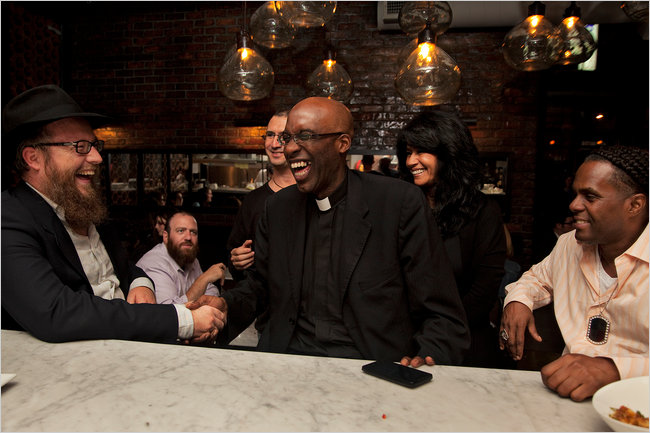
This week, the New York Times Magazine supplement was entirely about food, and, although as a college student with a meal plan I am singularly uninterested in cooking, one of the articles caught my eye. Food writer Frank Bruni tries to understand the success of the Basil Pizza and Wine Bar in a Hasidic neighborhood of New York City.
Bruni marvels at the Basil’s ability to attract Hasids, West Indian immigrant, and liberal ‘young professionals’ while hewing to the cultural and culinary demands of its Orthodox Jewish patrons. Clara Perez, Basil’s owner, meets the requirements for kosher certification, but must also make sure the female waitress are wearing long skirts, and that they never join in on a chorus of “Happy Birthday,” since it is forbidden for Orthodox Jewish men to hear a woman singing.
The restaurant undergoes periodic surprise inspections to make sure that it is keeping kashrut. And Rabbi Levy says he would be forced to revoke the kosher certification (making it forbidden for Orthodox to patronize the restaurant) if he discovered moral failings such as crude comedians or if young men and women at Basil were socializing “other than for matrimonial purposes.”
The article took the position that Basil represented an exciting compromise and a promising model for the somewhat segregated neighborhood, but I finished the article confused about what goal Bruni thought had been achieved. There didn’t seem to be anything particularly admirable about the ability of a cultural group to tolerate non-members who were scrupulously following their laws.
Is there something intrinsically valuable about diverse cultures occupying the same space?
When we talk about the virtues of diversity, we’re usually talking about more than a kind of anthropological fascination in seeing a different culture in real life. Diversity is supposed to bring another perspective to bear on our own prejudices and assumptions and help us root out false and destructive beliefs. This requires enough openness to dialogue and exposure to assemble some kind of marketplace of ideas and is always a threat to the culture to which you already belong.
Only the non-Orthodox are being exposed to alternate rules, but I doubt the emphasis on sex-segregation and impurity is going to have the same crossover appeal as Basil’s Parmesan and White Asparagus Pizza.
Does anyone else see a profound benefit for either community or a reason why this restaurant should be emulated?

Previous Post

October 11, 2010
Chesterton's Unlikely Heirs
Next Post
October 14, 2010 What brought me here, what brought you here
Browse Our Archives
Select a Category 7 Quick Takes Apologetics Atheism Book Conversion Debate Tactics Debates Epistemology/Philosophy Housekeeping Ideological Turing Test Marriage Morality in Practice Parsing Catholicism Possibly Heretical Radio Reviews/Recommendations Sequence Index Spiritual Practice Uncategorized
Select a Month April 2017 March 2017 January 2017 December 2016 September 2016 August 2016 July 2016 June 2016 May 2016 April 2016 March 2016 February 2016 January 2016 December 2015 November 2015 October 2015 September 2015 August 2015 July 2015 June 2015 May 2015 April 2015 March 2015 February 2015 January 2015 December 2014 November 2014 October 2014 September 2014 August 2014 July 2014 June 2014 May 2014 April 2014 March 2014 February 2014 January 2014 December 2013 November 2013 October 2013 September 2013 August 2013 July 2013 June 2013 May 2013 April 2013 March 2013 February 2013 January 2013 December 2012 November 2012 October 2012 September 2012 August 2012 July 2012 June 2012 May 2012 April 2012 March 2012 February 2012 January 2012 December 2011 November 2011 October 2011 September 2011 August 2011 July 2011 June 2011 May 2011 April 2011 March 2011 February 2011 January 2011 December 2010 November 2010 October 2010 September 2010 August 2010 July 2010 June 2010
Follow Us!
TAKE THE
Religious Wisdom Quiz
How does Isaiah describe the suffering servant's reaction to unjust treatment?
Select your answer to see how you score.
Roaring like a lion Silent as a sheep Fleeing to Egypt Weeping loudly
Related posts from Unequally Yoked

Why would Christians support the Secular Student Alliance?

Alain de Botton Gets it Backwards
'Atheist Lent' and False Unity

I'm keynoting at a Con for Christian nerds!
TRENDING AT PATHEOS Catholic

The Parable Of The Sower And The Word...
One of Christ’s most famous parables is that of the sower who...

Rejecting Doom: Christian Hope And Human Action
Christianity is a religion of hope. We are to have hope and...

Why I Choose the Eucharist Over the Sermon
Choose the Eucharist, Not the Sermon What are we supposed to get...

5 Design Elements Found in Spiritually Rooted Homes
Putting Spirituality Into Home Decor Our homes are more than our living...

Credo: A Story of God Told with the...
About 10 years ago, I began to imagine a personal "Credo" that...

The Anatomy of Divine Revelation in Catholic Thought
The claim that God has made Himself known to human beings is...
view all Catholic blogs
Ad-Free & Subscriber Log-In Subscription Support
- About Us
- 2026 Calendar
- Videos
- Podcasts
- Library of World Religions
- Faith In Media Tracker
- Advertise With Us
- Write for Us
- Privacy Policy
- Terms of Service
- Do Not Sell My Data
- Contact Us
- Radiant Digital
- Manage Newsletter Subscriptions
- Unsubscribe From Notifications
- Sitemap
Copyright 2008-2026, Patheos. All rights reserved.
Subscription Support Ad-Free & Subscriber Log-In
Follow Patheos