
BuddhistCatholicContemplativeEvangelicalGeneral ChristianHinduJewishLatter-day SaintMuslimNew VisionsProgressive Christian
Beliefs
- Buddhist
- Catholic
- Contemplative
- Evangelical
- General Christian
- Hindu
- Jewish
- Latter-day Saint
- More Voices
- Muslim
- New Visions
- Pagan
- Progressive Christian
Topics
- Religion News
- Food and Religion
- Sports and Religion
- Religious Art
- Religious Music and Entertainment
- Religious Events
- History and Religion
- Style and Religion
- Politics and Religion
- Women in Religion
- Recreation Outdoors and Religion
- Business Finance and Religion
- Careers Workplace and Religion
- Education and Religion
- Family Parenting and Religion
- Health Fitness and Religion
- Home and Religion
- Relationships and Religion
- Technology and Religion
- Travel and Religion
Columnists
- Buddhist Columnists
- Business Finance and Religion Columnists
- Careers Workplace and Religion Columnists
- Catholic Columnists
- Contemplative Columnists
- Education and Religion Columnists
- Evangelists Columnists
- Family Parenting and Religion Columnists
- General Christian Columnists
- Health Fitness and Religion Columnists
- Hindu Columnists
- History and Religion Columnists
- Home and Religion Columnists
- Jewish Columnists
- More Voices Columnists
- Latter Day Columnists
- Muslim Columnists
- New Visions Columnists
- Nonreligious Columnists
- Pagan Columnists
- Politics and Religion Columnists
- Progressive Columnists
- Recreation Outdoors and Religion Columnists
- Relationships and Religion Columnists
- Religion News Columnists
- Religious Art Columnists
- Religious Events Columnists
- Religious Music and Entertainment Columnists
- Sports and Religion Columnists
- Style and Religion Columnists
- Technology and Religion Columnists
- Travel and Religion Columnists
- Women in Religion Columnists
Resource Library
- 2026 Calendar
- Library of World Religions
- The 100 Most Holy Places on Earth
- Patheos Answers
- Podcasts
- Videos
- Faith Leaders Database
- Anglican Episcopalian
- Bahai
- Baptist
- Buddhism
- Christianity
- Confucianism
- Eastern Orthodoxy
- Hinduism
- Holiness and Pentecostal
- ISKCON
- Islam
- Judaism
- Lutheran
- Methodist
- The Church of Jesus Christ of Latter-day Saints
- New Age
- Paganism
- Presbytarian and Reformed
- Protestantism
- Religion Behind the Scenes
- Roman Catholic
- Scientology
- Shia Islam
- Sikhism
- Sufism
- Sunni Islam
- Taoism
- Zen
- See all religions
Research Tools
 Ad-Free & Subscriber Log-In Subscription Support
Ad-Free & Subscriber Log-In Subscription Support
Follow Patheos 

- Trending:
- Forgiveness
- |
- Marriage
- |
- Consciousness
- |
- Death Penalty
- |
- Election
- |
- Halloween
 Unequally Yoked
- Home
- Catholic
- Hail to the Cylinder God!
Hail to the Cylinder God!
Last updated on: April 10, 2012 at 8:49 pm by Leah Libresco
Hail to the Cylinder God! 2012-04-10T20:49:13-04:00 Leah Libresco
Patheos Explore the world's faith through different perspectives on religion and spirituality! Patheos has the views of the prevalent religions and spiritualities of the world.
This is the second post in a series about math and morality. You can see all posts in the series here.
I knew I’d get along with my soon-to-be friend Matt from our first discussion of theology. Matt was explaining why he saw paradox as the natural consequence finite humans trying to describe an infinite being, and he shifted right into the language of Flatland and topology.
“So imagine one religious group claims that God is a rectangle. And a rival sect claims that God is a circle. But there’s no reason to assume that God is confined to either of these ideas or that they represent a contradiction at all once you move beyond our limited perspective. God could be a cylinder, and each group simply had a different way of seeing him.”
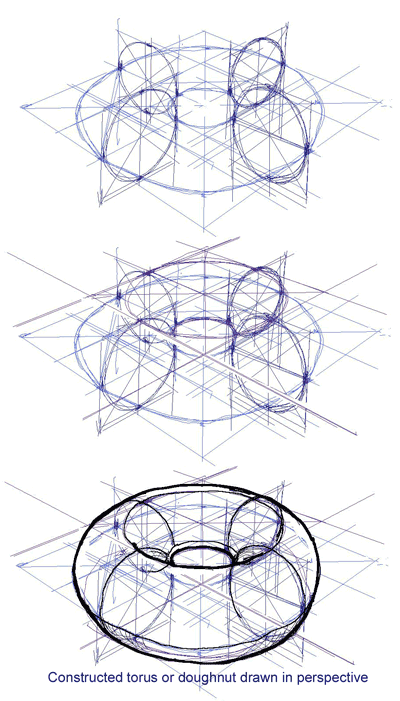
This blind men and the elephant rhetoric can be useful, but it has some pretty difficult epistemological consequences. Once you adopt this way of way of conceiving of god is that it becomes almost impossible to rule out any possible property of God. If the circle and rectangle sects were joined by a new religious movement that claimed to have experienced God as a donut-shaped object, how would we decide if this was heresy or enlightenment? When would it be necessary to revise our idea of the hyperdimensional topological God? It would be terribly embarrassing to discover that we were supposed to be worshipping a torus this whole time!
There is no way to verify or test the topological structure of God. As long as a new idea can conceivably be harmonized with the old conceptions of God, it cannot be said to be untrue. The same uncertainty would hold for many properties of God. And, especially for such a high stakes question, this level of uncertainty is intolerable.
To gain tolerance, you are forced to sacrifice the possibility of judgment. People of faith are left in the same position as cultural relativists, unable to denounce any practice as fundamentally misguided or harmful. This framework of discussing God or any metaphysical concept ultimately rules out any possibility of useful discussions.
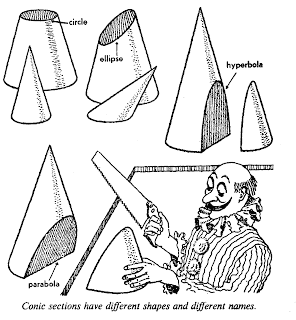
When we deal in abstractions, we need to confine our discussion to their projections into the observable universe. If two theories work equally well to explain our empirical observations of the world but have different metaphysical substructures, it is perfectly reasonable to choose one over the other on the basis of Occam’s Razor or any other aesthetic preference. The only way to choose between them is to devise an experiment whose results must be different depending on which universe we are living in. This is how the theory of the Big Bang won out over the Steady State model.
If two metaphysical theories make exactly the same predictions and do not differ on any point, I would question what is gained by differentiating between them (aside from thesis topics for philosophy PhDs).
For the rest of this series, I’m not going to dwell on the question of what kind of metaphysics underlies my ethics. I judge my theory by its correspondence with the observable world and trust that, if it is wrong, its flaws are either observable or irrelevant.
And tomorrow, I’ll finally be mixing some morality into this math lesson when I post on how we can experience and interpret moral strictures, even from our very limited perspective.

Previous Post

August 1, 2010
"From dreams I proceed to facts"
Next Post
August 3, 2010 As sure as I am of anything
Browse Our Archives
Select a Category 7 Quick Takes Apologetics Atheism Book Conversion Debate Tactics Debates Epistemology/Philosophy Housekeeping Ideological Turing Test Marriage Morality in Practice Parsing Catholicism Possibly Heretical Radio Reviews/Recommendations Sequence Index Spiritual Practice Uncategorized
Select a Month April 2017 March 2017 January 2017 December 2016 September 2016 August 2016 July 2016 June 2016 May 2016 April 2016 March 2016 February 2016 January 2016 December 2015 November 2015 October 2015 September 2015 August 2015 July 2015 June 2015 May 2015 April 2015 March 2015 February 2015 January 2015 December 2014 November 2014 October 2014 September 2014 August 2014 July 2014 June 2014 May 2014 April 2014 March 2014 February 2014 January 2014 December 2013 November 2013 October 2013 September 2013 August 2013 July 2013 June 2013 May 2013 April 2013 March 2013 February 2013 January 2013 December 2012 November 2012 October 2012 September 2012 August 2012 July 2012 June 2012 May 2012 April 2012 March 2012 February 2012 January 2012 December 2011 November 2011 October 2011 September 2011 August 2011 July 2011 June 2011 May 2011 April 2011 March 2011 February 2011 January 2011 December 2010 November 2010 October 2010 September 2010 August 2010 July 2010 June 2010
Follow Us!
TAKE THE
Religious Wisdom Quiz
What was the main language of Jesus’ daily speech?
Select your answer to see how you score.
Aramaic Latin Greek Hebrew
Related posts from Unequally Yoked

Rational Faith: More working hypothesis than logical proof

Life Lessons that Can't be Taught at College's...

Books that Change the Way You Think [Radio...

Your religion... is it bigger than a breadbox?
TRENDING AT PATHEOS Catholic

Rejecting Doom: Christian Hope And Human Action
Christianity is a religion of hope. We are to have hope and...

It’s What Comes From Within Which Matters
One of the most difficult things for us to understand is why...

Why I Choose the Eucharist Over the Sermon
Choose the Eucharist, Not the Sermon What are we supposed to get...

5 Design Elements Found in Spiritually Rooted Homes
Putting Spirituality Into Home Decor Our homes are more than our living...

Credo: A Story of God Told with the...
About 10 years ago, I began to imagine a personal "Credo" that...

The Anatomy of Divine Revelation in Catholic Thought
The claim that God has made Himself known to human beings is...
view all Catholic blogs
Ad-Free & Subscriber Log-In Subscription Support
- About Us
- 2026 Calendar
- Videos
- Podcasts
- Library of World Religions
- Faith In Media Tracker
- Advertise With Us
- Write for Us
- Privacy Policy
- Terms of Service
- Do Not Sell My Data
- Contact Us
- Radiant Digital
- Manage Newsletter Subscriptions
- Unsubscribe From Notifications
- Sitemap
Copyright 2008-2026, Patheos. All rights reserved.
Subscription Support Ad-Free & Subscriber Log-In
Follow Patheos