
BuddhistCatholicContemplativeEvangelicalGeneral ChristianHinduJewishLatter-day SaintMuslimNew VisionsProgressive Christian
Beliefs
- Buddhist
- Catholic
- Contemplative
- Evangelical
- General Christian
- Hindu
- Jewish
- Latter-day Saint
- More Voices
- Muslim
- New Visions
- Pagan
- Progressive Christian
Topics
- Religion News
- Food and Religion
- Sports and Religion
- Religious Art
- Religious Music and Entertainment
- Religious Events
- History and Religion
- Style and Religion
- Politics and Religion
- Women in Religion
- Recreation Outdoors and Religion
- Business Finance and Religion
- Careers Workplace and Religion
- Education and Religion
- Family Parenting and Religion
- Health Fitness and Religion
- Home and Religion
- Relationships and Religion
- Technology and Religion
- Travel and Religion
Columnists
- Buddhist Columnists
- Business Finance and Religion Columnists
- Careers Workplace and Religion Columnists
- Catholic Columnists
- Contemplative Columnists
- Education and Religion Columnists
- Evangelists Columnists
- Family Parenting and Religion Columnists
- General Christian Columnists
- Health Fitness and Religion Columnists
- Hindu Columnists
- History and Religion Columnists
- Home and Religion Columnists
- Jewish Columnists
- More Voices Columnists
- Latter Day Columnists
- Muslim Columnists
- New Visions Columnists
- Nonreligious Columnists
- Pagan Columnists
- Politics and Religion Columnists
- Progressive Columnists
- Recreation Outdoors and Religion Columnists
- Relationships and Religion Columnists
- Religion News Columnists
- Religious Art Columnists
- Religious Events Columnists
- Religious Music and Entertainment Columnists
- Sports and Religion Columnists
- Style and Religion Columnists
- Technology and Religion Columnists
- Travel and Religion Columnists
- Women in Religion Columnists
Resource Library
- 2026 Calendar
- Library of World Religions
- The 100 Most Holy Places on Earth
- Patheos Answers
- Podcasts
- Videos
- Faith Leaders Database
- Anglican Episcopalian
- Bahai
- Baptist
- Buddhism
- Christianity
- Confucianism
- Eastern Orthodoxy
- Hinduism
- Holiness and Pentecostal
- ISKCON
- Islam
- Judaism
- Lutheran
- Methodist
- The Church of Jesus Christ of Latter-day Saints
- New Age
- Paganism
- Presbytarian and Reformed
- Protestantism
- Religion Behind the Scenes
- Roman Catholic
- Scientology
- Shia Islam
- Sikhism
- Sufism
- Sunni Islam
- Taoism
- Zen
- See all religions
Research Tools
 Ad-Free & Subscriber Log-In Subscription Support
Ad-Free & Subscriber Log-In Subscription Support
Follow Patheos 

- Trending:
- Forgiveness
- |
- Marriage
- |
- Consciousness
- |
- Death Penalty
- |
- Election
- |
- Halloween

- Home
- Progressive Christian
- Politics and Religion
- What if the Trinity Has Been Misunderstood?
What if the Trinity Has Been Misunderstood?
Last updated on: May 8, 2026 at 2:10 pm by Eric Scot English
What if the Trinity Has Been Misunderstood? 2026-05-08T14:10:01-04:00 Eric Scot English
Patheos Explore the world's faith through different perspectives on religion and spirituality! Patheos has the views of the prevalent religions and spiritualities of the world.
There are some things in religious conversations that can seem taboo. The relationship between religion and science is one of those. Much of the reason for that is a bias we have inherited from early 20th-century evangelicalism and fundamentalism. When Darwinism began reshaping the cultural landscape, conservative Christian leaders perceived it not as an intellectual opportunity but as an existential threat. Their response was defensive and, in many ways, catastrophic for the long-term credibility of faith in the public square. Rather than asking what evolutionary biology might reveal about the God who ordered creation, they dug in. They lobbied school boards, rewrote curricula, and declared the whole enterprise spiritually dangerous. It worked — in the short term. But the cost was a generational suspicion between faith and science that we are still paying for today.
What is often missed in that history is the tragedy of a missed opportunity. Science, pursued honestly, has never been the enemy of a serious theology. The natural world — its structure, its patterns, its staggering complexity has always been one of the primary languages through which thoughtful people have encountered the divine. To wall theology off from scientific discovery is not to protect it. It is to slowly suffocate it.
With another hundred years or so under our belt, the picture has shifted considerably. Most people no longer experience science and faith as locked in a zero-sum war. The conversation has matured. Thinkers on both sides have done the difficult work of nuance, and a growing number of theologians, scientists, and practitioners have begun asking better questions — not whether God and science can coexist, but what they might actually illumine in each other when brought into honest dialogue.
Despite that shift, something has been missing. For all the progress in the conversation, you still have yet to see any major theological integration of cutting-edge science into mainstream theological belief systems. The popular church has largely been content to wave at science from a distance without doing the harder work of genuine integration.
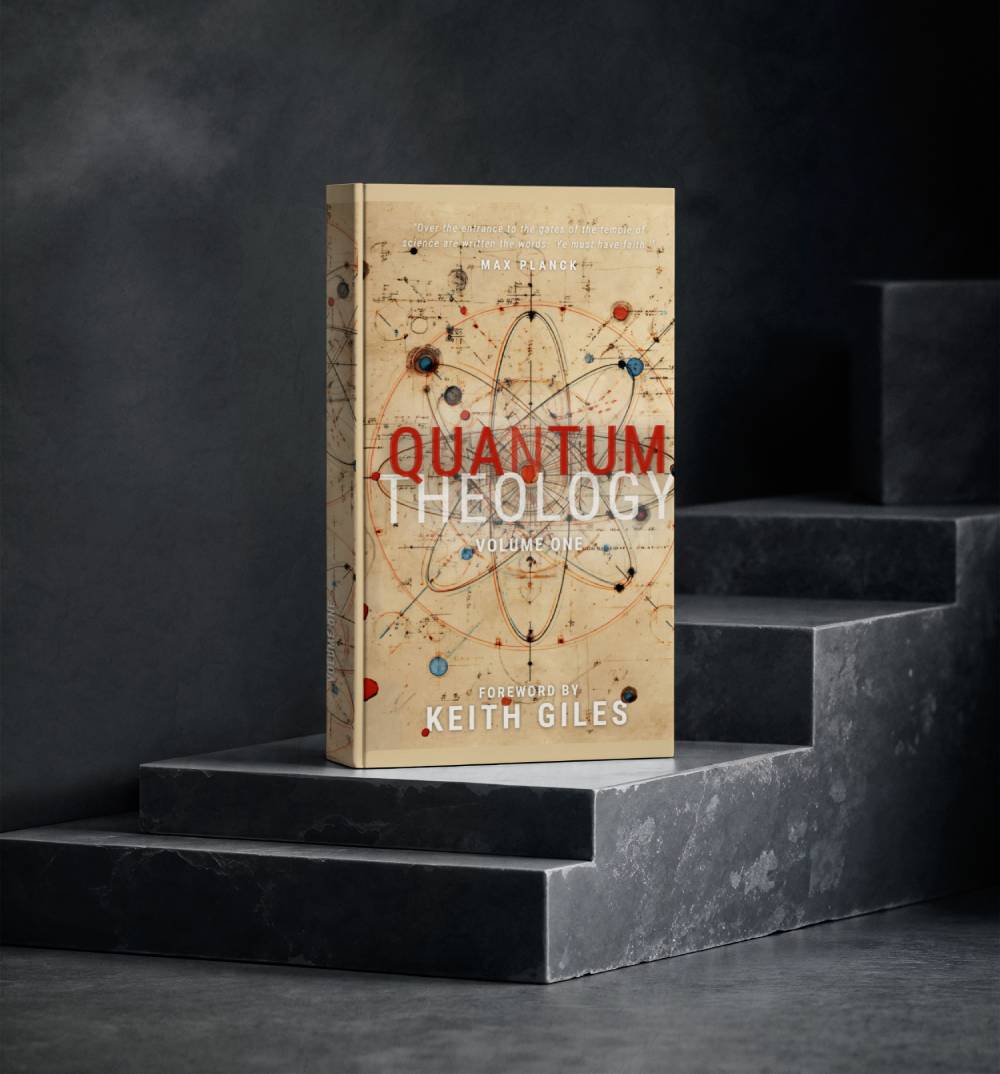
A new collection published by Quoir, Quantum Theology (2026), is trying to resolve that.
What Is Quantum Theology?
The book brings together a remarkable range of voices — theologians, scientists, mystics, and practitioners — all asking a version of the same question: what happens when the discoveries of quantum physics press themselves against our oldest convictions about God? What does it mean that reality, at its most fundamental level, is relational rather than mechanical? That particles behave differently when observed? That quantum entanglement connects distant objects in ways no classical physics can explain?
Quantum physics has dismantled the Newtonian universe piece by piece. What it has left in its place is not chaos but something far more interesting — a reality that is dynamic, relational, and irreducibly participatory. At the subatomic level, nothing exists in isolation. Everything is entangled with everything else. Observation shapes outcome. The observer is never truly separate from what is observed. These are not fringe ideas. They are the settled conclusions of the most rigorously tested field of science in human history.
The contributors to Quantum Theology don’t all arrive at the same destination. They represent genuinely different theological and scientific starting points. But the questions they are asking feel alive in a way that most Christian theological books do not. There is real intellectual risk in these pages, and that alone makes it worth your time.
A New Approach to the Doctrine of the Trinity
I had the privilege of lending my voice to Quantum Theology. My chapter is called The Psycho/Social Trinity, and it begins with a provocation.
For centuries, Christian theology has tried to understand the Trinity by starting with Jesus. What was his nature? How was he simultaneously divine and human? What was his ontological relationship to the Father? These are not bad questions — they produced some of the most sophisticated thinking in the history of Western philosophy. But they also produced councils drenched in political maneuvering, centuries of schism, and a doctrine that many people confess without ever really inhabiting.
The Council of Nicaea did not settle the question. It politically contained it. The Arian controversy did not end in 325 AD — it simply went underground, resurfacing in different forms across the following centuries. What was forged in those councils was as much a product of imperial politics as theological clarity. Constantine needed a unified church as much as the church needed an emperor’s protection, and the resulting theology bears the marks of that transaction.
That is not a cynical reading of church history. It is simply an honest one. And honesty requires us to ask: is the Trinitarian doctrine we inherited the clearest possible articulation of a genuine theological reality, or is it a historically conditioned approximation that we have been too afraid to revisit? My chapter argues for the latter — not to abandon the Trinity, but to find a more coherent way into it.
What if the doctrine of the Trinity made more sense if we started somewhere else entirely?
The Image of God and the Human Mind
Genesis tells us that humanity is made in the image of God — the imago dei. If that claim means anything, it means that humans carry something of a divine imprint. Not as metaphor or pious sentiment, but as a genuine structural reality. The text does not say we were made to think about God, or to worship God, or to obey God — though all of those follow. It says we were made in God’s image. Something of the divine architecture is replicated in us.
If that is true, then understanding the Trinity might run not through the councils of Nicaea but through a serious engagement with what human consciousness actually is and how it connects us to everything. The path to God may be shorter than we imagined — not because God is small, but because the image is closer than we think.
Augustine glimpsed this. Around 400 AD, in De Trinitate, he proposed that the unity of God resembles the unity of the human mind, and that the three persons of the Trinity could be understood through three interconnected mental faculties: Memory, Understanding, and Will. It was a genuinely original insight — and it was unfinished. He was constrained by the philosophical tools of his age, the Neo-Platonic categories he inherited, and the political pressures of a church still consolidating its authority. He saw the door but did not have the key to open it fully.
What Augustine could not have known is what we now understand about human consciousness, about quantum physics, and about the relational nature of reality itself. The cognitive sciences, depth psychology, and neuroscience have given us a far richer vocabulary for describing the structure of the human mind. And quantum physics has revealed a universe whose deepest feature is not matter but relationship. Both of these developments, I argue, have profound implications for how we understand the Trinitarian God.
Will, Word, and Consciousness: A Trinity That Makes Sense
My chapter argues that when these insights are taken seriously, the Trinity comes into focus in a way that is not only philosophically coherent but personally compelling. The Divine Mind — as Will, Word, and Consciousness — does not need to be defended as an abstract metaphysical formula. It can be recognized, at least in part, because its pattern is already echoed within us.
The Father, as Divine Will, is the originating movement within the divine life — not mere preference or desire, but the eternal orientation of God toward goodness, creation, and self-giving. Will, in the deepest sense, is what stands behind every act. It is the primal “yes” at the heart of reality. Everything that exists does so because a divine intentionality willed it into being and sustains it there. When Jesus speaks obsessively about doing the will of the Father, he is not performing submission — he is revealing what lies at the center of all things.
The Son, as Divine Word or Logos, is the eternal self-expression of that will. If the Father is the deep intention of God, the Son is how that intention becomes intelligible — articulate, personal, relational, and finally incarnate. The Logos is not an abstract principle. He is a person in whom the entire divine self-disclosure becomes flesh and takes up residence in human history. The incarnation is not a rescue mission tacked onto a plan that went wrong. It is the eternal “yes” of God spoken with human breath.
The Spirit, as Divine Consciousness, is the living awareness that unites Father and Son and breathes that communion into the world. Consciousness is not something the mind produces — it is the ground in which all mental activity occurs. The Spirit is the divine ground of awareness, the atmosphere in which the Father wills and the Son speaks, and the same presence that draws human consciousness into contact with the divine life. This is why the Spirit’s work is always described in relational terms — as advocate, comforter, guide, and unifier.
This is not a rejection of classical Trinitarian theology. It is, if anything, a more robust foundation for it — one that connects the best of the early Church Fathers to contemporary understandings of the mind, consciousness, and the relational fabric of the universe quantum physics keeps revealing. The early creeds were attempts to say something true about a reality that exceeded the philosophical tools available to say it. We have better tools now. We owe it to the tradition — and to the God it points toward — to use them.
There is much more to say about what that means, and why it matters not only for Christian theology but for the way we understand ourselves, our communities, and our calling. It has implications for how we practice prayer, how we understand the Church, and how we engage a world that is increasingly hungry for a faith that takes both God and reality seriously. But I will let the chapter make its case.
Read Quantum Theology
Quantum Theology is available now from Quoir. Whether you are a lifelong Christian, a skeptic, or somewhere in the restless middle, this book will press you to think more carefully — and more honestly — about the nature of God, the nature of reality, and why those two questions may not be as separate as we assumed.
You can view my UNenlightenment YouTube Channel HERE
You can view my UNenlightenment Podcast HERE
You can follow me on FaceBook HERE
Transform your life today by getting my book UNenlightenment HERE
Purchase my newest book The Kingdom of Man HERE
General Christian
Politics and Religion
History and Religion

About Eric English
Eric is a rogue philosopher, theologian, author, podcaster and ninja. He is a father of three, husband of one, and a poet unto himself. Eric’s main areas of thinking are in philosophy (specifically, Soren Kierkegaard), theology (Narrative Perspectivism), and culture. Eric also hosts the podcast UNenlightenment. You can read more about the author here.
Previous Post

December 1, 2025
A Eulogy for the Sleeping Church
Next Post

June 8, 2026 After the Eulogy Comes the Resurrection
Recent Comments
"We were all sold that same "bill of goods" about God. The transactional pact: if ..."
God’s Silence and the Anger We’re ..."
"I wish I could give you a hug. A world without suffering would have no ..."
God’s Silence and the Anger We’re ..."
"Thanks for your thoughts, but you pulled a classic conservative move to simply call people ..."
Your God is NOT Real: Evangelical ..."
"Sadly Eric English conveniently avoids addressing the failings of Progressive Left Christianity with it's false/political ..."
Your God is NOT Real: Evangelical ..."
Browse Our Archives
Select a Category Abortion Atonement Bible Book Review Church History Church/Culture Creative Deconstruction Deconstruction & Reconstruction Discipleship End Times Fun with Philosophy Incarnation Issues Jesus Meaning News Philosophy Podcast Polemic Political Problem of Evil Progressive Christianity Questions Return of Christ Second Coming Sexuality The Church Theology Truth Truth Uncategorized Universalism Women in Ministry
Select a Month October 2026 September 2026 August 2026 July 2026 June 2026 May 2026 December 2025 October 2025 September 2025 August 2025 July 2025 June 2025 May 2025 March 2025 February 2025 January 2025 October 2024 September 2024 August 2024 July 2024 June 2024 May 2024 April 2024 March 2024 February 2024 January 2024 December 2023 November 2023 October 2023 September 2023 August 2023 July 2023 June 2023 May 2023 April 2023 March 2023 February 2023 January 2023 December 2022 November 2022 October 2022 August 2022 May 2022 April 2022 March 2022 February 2022 January 2022 December 2021 November 2021 October 2021 August 2021 July 2021 June 2021 May 2021 April 2021 March 2021 February 2021 January 2021 December 2020 November 2020
Follow Us!
TAKE THE
Religious Wisdom Quiz
Who said, "Lord, why do you stand far off?"
Select your answer to see how you score.
Moses Jeremiah Job David
Books by This Author Books by UNenlightenment
Related posts from UNenlightenment


Donald Trump and the Kingdom of Man

Subliminalism & The Anti-Progressive Book Hijacking Jesus
Out Into The Desert Is A New Vision...
TRENDING AT PATHEOS Progressive Christian

What Being a Modern-Day Apostle Means to Me
In my last column, I discussed the ins and outs of modern-day...

Did Ancient China Once Worship the God of...
Across human history, a common thread weaves through the origins of the...

Love Your Neighbor – Including Earth-Kin: Lev. 19,...
God’s command to love your neighbor means acting in an ethical and...

Lead a Church Study of “Jesus and Lao...
Guest writer Jack Thomas (The Irreverent Reverend) reflects on leading his church...

Pastoral Wisdom for Responding to Sermon Pushback
Getting sermon pushback on your social justice sermon? Learn practical, Proverbs-based strategies...

Principles for Understanding the Apostolic Ministry Today
Whenever people discover that my formal ministry title is "apostle," as in...
view all Progressive Christian blogs
What Are Your Thoughts?leave a comment
Ad-Free & Subscriber Log-In Subscription Support
- About Us
- 2026 Calendar
- Videos
- Podcasts
- Library of World Religions
- Faith In Media Tracker
- Advertise With Us
- Write for Us
- Privacy Policy
- Terms of Service
- Do Not Sell My Data
- Contact Us
- Radiant Digital
- Manage Newsletter Subscriptions
- Unsubscribe From Notifications
- Sitemap
Copyright 2008-2026, Patheos. All rights reserved.
Subscription Support Ad-Free & Subscriber Log-In
Follow Patheos