
BuddhistCatholicContemplativeEvangelicalGeneral ChristianHinduJewishLatter-day SaintMuslimNew VisionsProgressive Christian
Beliefs
- Buddhist
- Catholic
- Contemplative
- Evangelical
- General Christian
- Hindu
- Jewish
- Latter-day Saint
- More Voices
- Muslim
- New Visions
- Pagan
- Progressive Christian
Topics
- Religion News
- Food and Religion
- Sports and Religion
- Religious Art
- Religious Music and Entertainment
- Religious Events
- History and Religion
- Style and Religion
- Politics and Religion
- Women in Religion
- Recreation Outdoors and Religion
- Business Finance and Religion
- Careers Workplace and Religion
- Education and Religion
- Family Parenting and Religion
- Health Fitness and Religion
- Home and Religion
- Relationships and Religion
- Technology and Religion
- Travel and Religion
Columnists
- Buddhist Columnists
- Business Finance and Religion Columnists
- Careers Workplace and Religion Columnists
- Catholic Columnists
- Contemplative Columnists
- Education and Religion Columnists
- Evangelists Columnists
- Family Parenting and Religion Columnists
- General Christian Columnists
- Health Fitness and Religion Columnists
- Hindu Columnists
- History and Religion Columnists
- Home and Religion Columnists
- Jewish Columnists
- More Voices Columnists
- Latter Day Columnists
- Muslim Columnists
- New Visions Columnists
- Nonreligious Columnists
- Pagan Columnists
- Politics and Religion Columnists
- Progressive Columnists
- Recreation Outdoors and Religion Columnists
- Relationships and Religion Columnists
- Religion News Columnists
- Religious Art Columnists
- Religious Events Columnists
- Religious Music and Entertainment Columnists
- Sports and Religion Columnists
- Style and Religion Columnists
- Technology and Religion Columnists
- Travel and Religion Columnists
- Women in Religion Columnists
Resource Library
- 2026 Calendar
- Library of World Religions
- The 100 Most Holy Places on Earth
- Patheos Answers
- Podcasts
- Videos
- Faith Leaders Database
- Anglican Episcopalian
- Bahai
- Baptist
- Buddhism
- Christianity
- Confucianism
- Eastern Orthodoxy
- Hinduism
- Holiness and Pentecostal
- ISKCON
- Islam
- Judaism
- Lutheran
- Methodist
- The Church of Jesus Christ of Latter-day Saints
- New Age
- Paganism
- Presbytarian and Reformed
- Protestantism
- Religion Behind the Scenes
- Roman Catholic
- Scientology
- Shia Islam
- Sikhism
- Sufism
- Sunni Islam
- Taoism
- Zen
- See all religions
Research Tools
 Ad-Free & Subscriber Log-In Subscription Support
Ad-Free & Subscriber Log-In Subscription Support
Follow Patheos 

- Trending:
- Forgiveness
- |
- Marriage
- |
- Consciousness
- |
- Death Penalty
- |
- Election
- |
- Halloween

- Home
- Progressive Christian
- Recreation, Outdoors and Religion
- Fun with Philosophy: Philosophical Fragments
Fun with Philosophy: Philosophical Fragments
Last updated on: September 24, 2024 at 12:17 pm by Eric Scot English
Fun with Philosophy: Philosophical Fragments 2024-09-24T12:17:31-04:00 Eric Scot English
Patheos Explore the world's faith through different perspectives on religion and spirituality! Patheos has the views of the prevalent religions and spiritualities of the world.
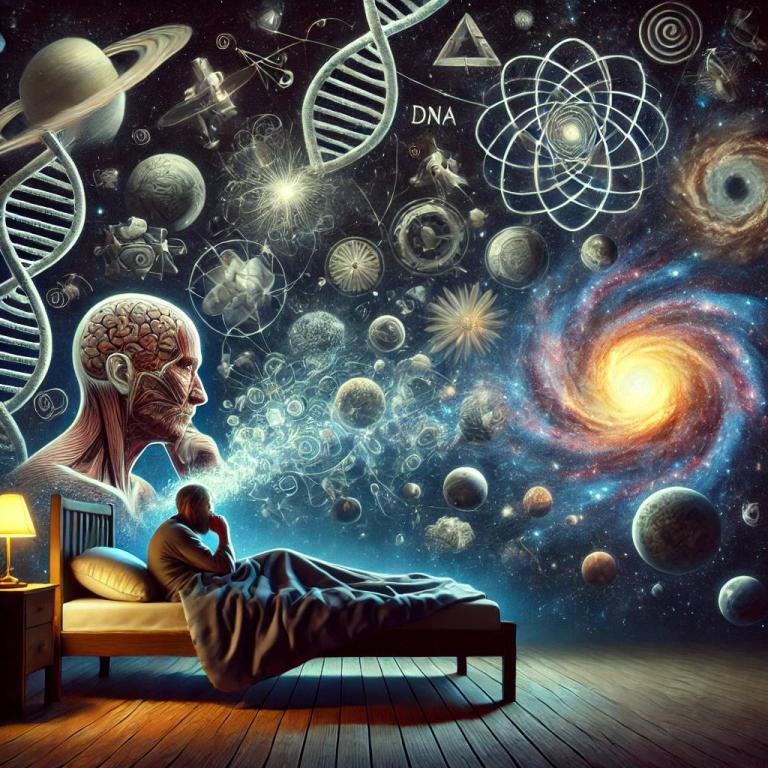
Image created in DallE for Patheos.
I don’t know if other philosophers lay up at night thinking deeply about mundane things but such has been my plight since I was a boy. This was, in part, why I decided to study philosophy in Graduate school. Many who study philosophy do so because they desire answers to life’s biggest questions. But for me, it was always about how to ask the right questions. It was in learning to ask those questions that got me to understand how to find the answers.
I also have an issue with modern philosophers who have long capitulated to science. The philosopher is no longer the one to hold the intellectual world accountable. Instead, they have compromised their discipline in order to provide an intellectual foundation for science and its political agenda. Philosophers these days are simply historians of thought who lack the courage to hold the world accountable.
With that said, let’s have fun with philosophy.
-
If some other Sperm Fertilized some other Egg, would I still be Me?
At first glance, this may look banal; perhaps even juvenile. Regardless, philosophers actually think about questions like this. It may seem like there is no possible way to know the answer to this question. It even provokes the question of nature versus nurture, which in most cases is what philosophers end with.
In order to come up with some answer it is important to understand the scientific aspects of DNA as one component of identity formation. Since we know that not all sperm and eggs carry the same DNA it seems that the answer to the question should be no, I would still not be me. One might point to the example that I could have been born female, which would have created an entirely different identity.
The best way to understand the relationship of nature and nurture is that nature provides the foundation for nurture to build upon. This means that there are any number of possibilities for personalities based on nature and nurture. Therefore, the question of nurture is a different one entirely.
However, in the context of our question, we are only interested in nature. But there is still an outstanding variable that we must consider – God. I do not think that God manufactures every child that has ever been born (well, maybe 1 🙂 ). But if we believe that God has any sort of relationship with humanity then I think we must consider that there is at least a purpose for every person. Additionally, if we believe that God has a will, then we must also believe that this purpose and will intersect. If this is the case then the only conclusion is that regardless of DNA, I would have always been the me God wanted me to be. Certainly, there always existed the possibility of some other existing in my place but since I exist in the real world, then I would have always existed regardless of what was possible or not.
- Is the Multiverse Theory Plausible?
For a number of years, scientists have used the idea of alternative universes as a possible way to explain reality. The idea is that there exist parallel universes that account for all possibilities in life where different decisions are made resulting in different outcomes.
First I want to point out that this is not novel. Philosophers have been using the idea of the possible worlds since Leibniz coined it in the 17th century. Leibniz, who was also a mathematician, used it as a source of logic in order to rationalize the problem of evil. Since then, the idea of possible worlds has been a mainstay in analytical philosophy.
The difference between its use in philosophy and science is important. In philosophy, it is used as a mental model of evaluation. In science, it is not contained mentally but exists in reality. That is where I take issue.
There exists an ontological problem with this theory. Let’s begin by asking the question, what is the thing that makes me, me? It’s the fact that I have consciousness and am self-aware. If I existed in any other world as me, then my consciousness would be duplicated across all possible worlds. Since knowledge of myself only exists in the actual world, then it cannot also exist in some other world simultaneously – even if my circumstances are different. Even though my circumstances might be different, the thing that makes me, me never changes. Therefore, since I have no knowledge of myself in any other world than this one, I can only actually exist in this one. This means that the idea of me existing in other worlds in some real way can’t be true.
- Is it Possible to Time Travel?
No. The question of time travel is certainly a romantic one but suffers from a significant amount of ontological/teleological problems that have long been ignored. That is, the same object cannot share the same space as itself because there can only exist one me at a time (I explained why in the previous section). The atoms that make me, me only exist singularly. In other words, there is no place on the planet or in the history of humanity where my molecular structure ever existed apart from my own timeline. There was never another me at some other point. I am utterly unique just as every other human being on the planet is. Moreover, in order for my molecular structure to be in the presence of another me, that molecular structure must be duplicated.
But let’s say for the sake of the argument that it is possible to duplicate my molecular structure. In order for time travel to be possible, it must be the case that every iteration of me that has ever existed is copied and stored someplace so that when I travel in time I can access that version of myself.
This seems unlikely, however, let’s say again that somehow it is possible. These iterations would require us to understand how they are recorded and know where they are stored. Does this mean there is some higher power that is recording these events? If so, then what is its purpose? Certainly, God would not allow such things to occur apart from them having a purpose. Is there any purpose whatsoever in time travel?
- Did it go bang?
A long-held theory of the universe and still the leading explanation for the existence of all things states that at some point a singularity became so dense that it essentially exploded. This explosion began spreading out in all directions eventually forming the place we all exist in. This of course means that the universe is still expanding outward from that original blast.
Why this theory is still predominated boggles the mind. Perhaps it is because there is yet to be an alternative theory that both vibes with Einsteinian physics and quantum physics. This would be fine, except the Big Bang Theory is still taught as though it were true.
The Big Bang Theory suffers from a paradox. If space and time share the fabric of the universe; then how was the expansion of the universe possible – if there was not yet a space for it to expand into? Something cannot create the thing it needs to exist. Additionally, what did this initial singularity exist within, if not space?
Unacceptable explanations have varied from: “That is a question science cannot answer” to “It was expanding into nothing”. And yet, many of these scientists have no problem making metaphysical claims like God doesn’t exist. Until science cuts the umbilical cord with Einstein it is unlikely that they will ever come up with a more plausible explanation.
- Does what we see in the Universe Actually Exist?
I have been asking this question for years and every time I ask it, I encounter a blank stare. I’m not even sure what the stare means. Does it mean that the person cannot believe someone can be that stupid? Does it mean that my question was so profound that their mind just exploded? Did the question induce a stroke? I don’t know. I would like to explore this question here. Allow me to frame the question this way.
When we view objects in space using our incredibly powerful telescopes, we see what an object looked like in the past. Moreover, the further we peer into space the further in time we see because it has taken the light emitted from that object longer to get to us. This means that when we view these objects, we are never viewing them as they are but as they were at some other time in the past.
This leads me to ask a few questions:
- How do we know any of it actually exists right now?
- If we can’t know what is out there right now, then how can we be mathematically certain about anything in the universe?
- Doesn’t this mean that much of science is based on what we perceive to exist rather than what we know exists?
- If so, how does this not violate the core tenets of science’s materialism?
Unfortunately, I am not sure this is an answerable question but I welcome your thoughts.
You can view my UNenlightenment YouTube Channel HERE
You can view my UNenlightenment Podcast HERE
You can follow me on FaceBook HERE
Transform your life today by getting my book UNenlightenment HERE
Learn about my upcoming book The Kingdom of Man HERE
General Christian
Recreation, Outdoors and Religion
Home and Religion

About Eric English
Eric is a rogue philosopher, theologian, author, podcaster and ninja. He is a father of three, husband of one, and a poet unto himself. Eric’s main areas of thinking are in philosophy (specifically, Soren Kierkegaard), theology (Narrative Perspectivism), and culture. Eric also hosts the podcast UNenlightenment. You can read more about the author here.
Previous Post
August 14, 2024
What Does It Mean To Be A Christian?
Next Post

October 28, 2024 Will Evangelicals Vote Donald Trump Again?
Recent Comments
"We were all sold that same "bill of goods" about God. The transactional pact: if ..."
God’s Silence and the Anger We’re ..."
"I wish I could give you a hug. A world without suffering would have no ..."
God’s Silence and the Anger We’re ..."
"Thanks for your thoughts, but you pulled a classic conservative move to simply call people ..."
Your God is NOT Real: Evangelical ..."
"Sadly Eric English conveniently avoids addressing the failings of Progressive Left Christianity with it's false/political ..."
Your God is NOT Real: Evangelical ..."
Browse Our Archives
Select a Category Abortion Atonement Bible Book Review Church History Church/Culture Creative Deconstruction Deconstruction & Reconstruction Discipleship End Times Fun with Philosophy Incarnation Issues Jesus Meaning News Philosophy Podcast Polemic Political Problem of Evil Progressive Christianity Questions Return of Christ Second Coming Sexuality The Church Theology Truth Truth Uncategorized Universalism Women in Ministry
Select a Month October 2026 September 2026 August 2026 July 2026 June 2026 May 2026 December 2025 October 2025 September 2025 August 2025 July 2025 June 2025 May 2025 March 2025 February 2025 January 2025 October 2024 September 2024 August 2024 July 2024 June 2024 May 2024 April 2024 March 2024 February 2024 January 2024 December 2023 November 2023 October 2023 September 2023 August 2023 July 2023 June 2023 May 2023 April 2023 March 2023 February 2023 January 2023 December 2022 November 2022 October 2022 August 2022 May 2022 April 2022 March 2022 February 2022 January 2022 December 2021 November 2021 October 2021 August 2021 July 2021 June 2021 May 2021 April 2021 March 2021 February 2021 January 2021 December 2020 November 2020
Follow Us!
TAKE THE
Religious Wisdom Quiz
Who is the "friend at midnight" in one of Jesus' parables?
Select your answer to see how you score.
A fisherman A neighbor seeking bread A soldier An angel
Books by This Author Books by UNenlightenment
Related posts from UNenlightenment
Fun with Philosophy: Experimenting with Certainty & God's...
Fun With Philosophy: An Existential Exploration Into Dreams,...

Fun with Philosophy: Time & Being
TRENDING AT PATHEOS Progressive Christian

What Being a Modern-Day Apostle Means to Me
In my last column, I discussed the ins and outs of modern-day...

Did Ancient China Once Worship the God of...
Across human history, a common thread weaves through the origins of the...

Love Your Neighbor – Including Earth-Kin: Lev. 19,...
God’s command to love your neighbor means acting in an ethical and...

Lead a Church Study of “Jesus and Lao...
Guest writer Jack Thomas (The Irreverent Reverend) reflects on leading his church...

Pastoral Wisdom for Responding to Sermon Pushback
Getting sermon pushback on your social justice sermon? Learn practical, Proverbs-based strategies...

Principles for Understanding the Apostolic Ministry Today
Whenever people discover that my formal ministry title is "apostle," as in...
view all Progressive Christian blogs
What Are Your Thoughts?leave a comment
Ad-Free & Subscriber Log-In Subscription Support
- About Us
- 2026 Calendar
- Videos
- Podcasts
- Library of World Religions
- Faith In Media Tracker
- Advertise With Us
- Write for Us
- Privacy Policy
- Terms of Service
- Do Not Sell My Data
- Contact Us
- Radiant Digital
- Manage Newsletter Subscriptions
- Unsubscribe From Notifications
- Sitemap
Copyright 2008-2026, Patheos. All rights reserved.
Subscription Support Ad-Free & Subscriber Log-In
Follow Patheos