
BuddhistCatholicContemplativeEvangelicalGeneral ChristianHinduJewishLatter-day SaintMuslimNew VisionsProgressive Christian
Beliefs
- Buddhist
- Catholic
- Contemplative
- Evangelical
- General Christian
- Hindu
- Jewish
- Latter-day Saint
- More Voices
- Muslim
- New Visions
- Pagan
- Progressive Christian
Topics
- Religion News
- Food and Religion
- Sports and Religion
- Religious Art
- Religious Music and Entertainment
- Religious Events
- History and Religion
- Style and Religion
- Politics and Religion
- Women in Religion
- Recreation Outdoors and Religion
- Business Finance and Religion
- Careers Workplace and Religion
- Education and Religion
- Family Parenting and Religion
- Health Fitness and Religion
- Home and Religion
- Relationships and Religion
- Technology and Religion
- Travel and Religion
Columnists
- Buddhist Columnists
- Business Finance and Religion Columnists
- Careers Workplace and Religion Columnists
- Catholic Columnists
- Contemplative Columnists
- Education and Religion Columnists
- Evangelists Columnists
- Family Parenting and Religion Columnists
- General Christian Columnists
- Health Fitness and Religion Columnists
- Hindu Columnists
- History and Religion Columnists
- Home and Religion Columnists
- Jewish Columnists
- More Voices Columnists
- Latter Day Columnists
- Muslim Columnists
- New Visions Columnists
- Nonreligious Columnists
- Pagan Columnists
- Politics and Religion Columnists
- Progressive Columnists
- Recreation Outdoors and Religion Columnists
- Relationships and Religion Columnists
- Religion News Columnists
- Religious Art Columnists
- Religious Events Columnists
- Religious Music and Entertainment Columnists
- Sports and Religion Columnists
- Style and Religion Columnists
- Technology and Religion Columnists
- Travel and Religion Columnists
- Women in Religion Columnists
Resource Library
- 2026 Calendar
- Library of World Religions
- The 100 Most Holy Places on Earth
- Patheos Answers
- Podcasts
- Videos
- Faith Leaders Database
- Anglican Episcopalian
- Bahai
- Baptist
- Buddhism
- Christianity
- Confucianism
- Eastern Orthodoxy
- Hinduism
- Holiness and Pentecostal
- ISKCON
- Islam
- Judaism
- Lutheran
- Methodist
- The Church of Jesus Christ of Latter-day Saints
- New Age
- Paganism
- Presbytarian and Reformed
- Protestantism
- Religion Behind the Scenes
- Roman Catholic
- Scientology
- Shia Islam
- Sikhism
- Sufism
- Sunni Islam
- Taoism
- Zen
- See all religions
Research Tools
 Ad-Free & Subscriber Log-In Subscription Support
Ad-Free & Subscriber Log-In Subscription Support
Follow Patheos 

- Trending:
- Forgiveness
- |
- Marriage
- |
- Consciousness
- |
- Death Penalty
- |
- Election
- |
- Halloween

- Home
- Progressive Christian
- History and Religion
- Fun with Philosophy: Experimenting with Certainty & God’s Existence
Fun with Philosophy: Experimenting with Certainty & God’s Existence
Last updated on: November 21, 2023 at 11:12 am by Eric Scot English
Fun with Philosophy: Experimenting with Certainty & God’s Existence 2023-11-21T11:12:05-05:00 Eric Scot English
Patheos Explore the world's faith through different perspectives on religion and spirituality! Patheos has the views of the prevalent religions and spiritualities of the world.

As a philosopher, specifically metaphysics, I have been trained to view reality in terms of possibilities instead of certainty. I recognize this bias going into any thinking project. However, I also think this is a good way to view the world. This of course means that I am often cautious of any claims of certainty, even scientific claims but it also means it is difficult to land in any one place. For a secular philosopher, this might be okay, but for a religious thinker, it is a difficult perspective to overcome.
To make the claim that God exists violates the aforementioned rules of thinking. Even lessening the certainty of the claim by stating that I believe God exists does little to ease my relativistic thinking. At some point in my philosophical journey, I realized that even if I exist in the realm of possibility, I still have to come to the understanding that one of those realms must be the real world. In fact, I do know with certainty, which of those worlds is real because I exist in it. My mere existence makes it certain. And, as any good existentialist would argue that is what matters.
This means it is at least the case that some certainty is warranted given the right circumstances. That does not mean we have to become materialists, but we can at least send a nice head nod in their direction even if they gaze at us with haughty derision.
Is Faith Certain?
When it comes to my faith, I do think that we have to believe in some things with certainty. For example, If I call myself a Christian, I should believe at least two things with some level of certainty. 1. God exists. 2. Jesus Christ was who he said he was. I think everything else is up for grabs.
Many of us have been taught that faith is antithetical to certainty. That faith is something you have because you are uncertain. But this is untrue (pun intended). Instead, faith is what we have as part of our journey into something more certain.
With that said it is important to understand what we mean by certainty. Certainty is not a thing that one obtains. Certainty is not a thing where one day you are without it and the next day you have it. There are degrees of certainty. For example, I am more certain of the existence of dinosaurs than I am of aliens. I am even more certain of my own existence than that of dinosaurs.
In philosophy, this is understood as probabilistic thinking. That is, we give weight to all truth claims and how true they might be and then make our decisions based on that weight. For example, should I jump out of this window and risk dying or should I stay and probably die at the hands of the uncompromising Chuck Norris? I calculate the risk based on the probability of surviving the fall versus surviving Norris. Yes, Norris is old, but he is still a bad dude. So, I take the calculated risk and jump.
There is also a distinction to be made between the extent to which I believe something to be certain – say God’s existence; and the extent to which I display that certainty to others. For example, in my personal life, my certainty regarding God always ebbs and flows – especially given my mood and experiences. However, in a situation where someone questions my belief in God, I will without hesitation assert my certainty.
Which version of certainty is more real is up for debate. Does my inner life allow me the freedom to experiment with curiosity and flip flopping on important issues? Absolutely, because I am my only judge. But when I put something out there in the world, I cannot take it back. People are free to judge it, analyze it, comment on it, etc. In some respect it has existence. For that reason alone, it might be more indicative of what I actually believe than what I experiment with in my inner thoughts because I know it is how the world perceives me to be.
Then of course we ask is the world’s perception of me the real me? Do I even have the ability to know myself apart from others’ perceptions of me? These are fun, but tangential questions for another time.
Does God Exist?
I am to some level certain of God’s existence – apart from actually seeing him I don’t think I can be fully certain. But I am certain to the extent that I would welcome death for this belief. I think he probably does, but that is based on many years of evidence, rationales, and experiences.
Unlike most progressive thinkers I do give weight to the classical arguments for God’s existence. Many might argue that these sorts of arguments are philosophical chicanery. Perhaps this is true. But I think it is only true when taking them individually. To me, the arguments for God’s existence are all “arguments of aspect”. What I mean by that is individually each argument is insufficient in “proving” in some logical sense the existence of God. Instead, each argument “proves” an aspect of God from a particular perspective. It is only when put together that they create a logical holistic picture of God.
For example, I think Anselm’s ontological argument is a strong argument for the existence of God (a nuanced version of it), but only from an existential logical perspective. It does not prove to me that God is moral; that Jesus was the Son of God; or even that I am following the right God. It only demonstrates the necessity for a God (any god) to exist (and to exist in a certain way).
However, when I take the nuanced ontological argument (Anselm) and pair it with the cosmological argument (Aquinas) and the argument of sufficient reason (Leibniz) I have a level of certainty that is pretty high. In my opinion, these three arguments together are very difficult if not impossible to overcome.
With that said, these arguments are only sufficient for belief in the actuality of God. They say nothing about following God. So, what is it that convinces me to follow God versus just acknowledging God’s existence? For me, the Christological argument, the Pauline argument, and Pascal’s wager argument are so convincing that if someone believes God does exist, they would be a fool not to also follow that God.
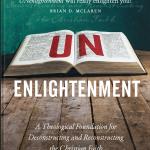
More than likely you are unfamiliar with the Christological and Pauline arguments as sufficient reason for belief in God because they are a variety of cobbled arguments that I have created over the years. If you have read my book, UNenlightenment then you should be familiar with them. However, in my next article, I will explain these two perspectives in detail as well as my understanding of Pascal’s wager which is probably different from what you are used to hearing. That should round off our exploration into certainty and God’s existence.
You can view my UNenlightenment YouTube Channel HERE
You can view my UNenlightenment Podcast HERE
You can follow me on FaceBook HERE
You can purchase the book UNenlightenment HERE.
Evangelical
History and Religion
Family, Parenting and Religion

About Eric English
Eric is a rogue philosopher, theologian, author, podcaster and ninja. He is a father of three, husband of one, and a poet unto himself. Eric’s main areas of thinking are in philosophy (specifically, Soren Kierkegaard), theology (Narrative Perspectivism), and culture. Eric also hosts the podcast UNenlightenment. You can read more about the author here.
Previous Post
November 3, 2023
Only UNenlightenment Can Help You Find God
Next Post

December 18, 2023 My Brief Glimpse Into Being Black
Recent Comments
"We were all sold that same "bill of goods" about God. The transactional pact: if ..."
God’s Silence and the Anger We’re ..."
"I wish I could give you a hug. A world without suffering would have no ..."
God’s Silence and the Anger We’re ..."
"Thanks for your thoughts, but you pulled a classic conservative move to simply call people ..."
Your God is NOT Real: Evangelical ..."
"Sadly Eric English conveniently avoids addressing the failings of Progressive Left Christianity with it's false/political ..."
Your God is NOT Real: Evangelical ..."
Browse Our Archives
Select a Category Abortion Atonement Bible Book Review Church History Church/Culture Creative Deconstruction Deconstruction & Reconstruction Discipleship End Times Fun with Philosophy Incarnation Issues Jesus Meaning News Philosophy Podcast Polemic Political Problem of Evil Progressive Christianity Questions Return of Christ Second Coming Sexuality The Church Theology Truth Truth Uncategorized Universalism Women in Ministry
Select a Month October 2026 September 2026 August 2026 July 2026 June 2026 May 2026 December 2025 October 2025 September 2025 August 2025 July 2025 June 2025 May 2025 March 2025 February 2025 January 2025 October 2024 September 2024 August 2024 July 2024 June 2024 May 2024 April 2024 March 2024 February 2024 January 2024 December 2023 November 2023 October 2023 September 2023 August 2023 July 2023 June 2023 May 2023 April 2023 March 2023 February 2023 January 2023 December 2022 November 2022 October 2022 August 2022 May 2022 April 2022 March 2022 February 2022 January 2022 December 2021 November 2021 October 2021 August 2021 July 2021 June 2021 May 2021 April 2021 March 2021 February 2021 January 2021 December 2020 November 2020
Follow Us!
TAKE THE
Religious Wisdom Quiz
Who is the "friend at midnight" in one of Jesus' parables?
Select your answer to see how you score.
A fisherman A neighbor seeking bread A soldier An angel
Books by This Author Books by UNenlightenment
Related posts from UNenlightenment

A Eulogy for the Sleeping Church

Are You A Saul Or Paul: The False...

Fun with Philosophy: Philosophical Fragments

Kierkegaard and Christian Nationalism
TRENDING AT PATHEOS Progressive Christian

What Being a Modern-Day Apostle Means to Me
In my last column, I discussed the ins and outs of modern-day...

Did Ancient China Once Worship the God of...
Across human history, a common thread weaves through the origins of the...

Love Your Neighbor – Including Earth-Kin: Lev. 19,...
God’s command to love your neighbor means acting in an ethical and...

Lead a Church Study of “Jesus and Lao...
Guest writer Jack Thomas (The Irreverent Reverend) reflects on leading his church...

Pastoral Wisdom for Responding to Sermon Pushback
Getting sermon pushback on your social justice sermon? Learn practical, Proverbs-based strategies...

Principles for Understanding the Apostolic Ministry Today
Whenever people discover that my formal ministry title is "apostle," as in...
view all Progressive Christian blogs
What Are Your Thoughts?leave a comment
Ad-Free & Subscriber Log-In Subscription Support
- About Us
- 2026 Calendar
- Videos
- Podcasts
- Library of World Religions
- Faith In Media Tracker
- Advertise With Us
- Write for Us
- Privacy Policy
- Terms of Service
- Do Not Sell My Data
- Contact Us
- Radiant Digital
- Manage Newsletter Subscriptions
- Unsubscribe From Notifications
- Sitemap
Copyright 2008-2026, Patheos. All rights reserved.
Subscription Support Ad-Free & Subscriber Log-In
Follow Patheos