
BuddhistCatholicContemplativeEvangelicalGeneral ChristianHinduJewishLatter-day SaintMuslimNew VisionsProgressive Christian
Beliefs
- Buddhist
- Catholic
- Contemplative
- Evangelical
- General Christian
- Hindu
- Jewish
- Latter-day Saint
- More Voices
- Muslim
- New Visions
- Pagan
- Progressive Christian
Topics
- Religion News
- Food and Religion
- Sports and Religion
- Religious Art
- Religious Music and Entertainment
- Religious Events
- History and Religion
- Style and Religion
- Politics and Religion
- Women in Religion
- Recreation Outdoors and Religion
- Business Finance and Religion
- Careers Workplace and Religion
- Education and Religion
- Family Parenting and Religion
- Health Fitness and Religion
- Home and Religion
- Relationships and Religion
- Technology and Religion
- Travel and Religion
Columnists
- Buddhist Columnists
- Business Finance and Religion Columnists
- Careers Workplace and Religion Columnists
- Catholic Columnists
- Contemplative Columnists
- Education and Religion Columnists
- Evangelists Columnists
- Family Parenting and Religion Columnists
- General Christian Columnists
- Health Fitness and Religion Columnists
- Hindu Columnists
- History and Religion Columnists
- Home and Religion Columnists
- Jewish Columnists
- More Voices Columnists
- Latter Day Columnists
- Muslim Columnists
- New Visions Columnists
- Nonreligious Columnists
- Pagan Columnists
- Politics and Religion Columnists
- Progressive Columnists
- Recreation Outdoors and Religion Columnists
- Relationships and Religion Columnists
- Religion News Columnists
- Religious Art Columnists
- Religious Events Columnists
- Religious Music and Entertainment Columnists
- Sports and Religion Columnists
- Style and Religion Columnists
- Technology and Religion Columnists
- Travel and Religion Columnists
- Women in Religion Columnists
Resource Library
- 2026 Calendar
- Library of World Religions
- The 100 Most Holy Places on Earth
- Patheos Answers
- Podcasts
- Videos
- Faith Leaders Database
- Anglican Episcopalian
- Bahai
- Baptist
- Buddhism
- Christianity
- Confucianism
- Eastern Orthodoxy
- Hinduism
- Holiness and Pentecostal
- ISKCON
- Islam
- Judaism
- Lutheran
- Methodist
- The Church of Jesus Christ of Latter-day Saints
- New Age
- Paganism
- Presbytarian and Reformed
- Protestantism
- Religion Behind the Scenes
- Roman Catholic
- Scientology
- Shia Islam
- Sikhism
- Sufism
- Sunni Islam
- Taoism
- Zen
- See all religions
Research Tools
 Ad-Free & Subscriber Log-In Subscription Support
Ad-Free & Subscriber Log-In Subscription Support
Follow Patheos 

- Trending:
- Forgiveness
- |
- Marriage
- |
- Consciousness
- |
- Death Penalty
- |
- Election
- |
- Halloween

- Home
- Progressive Christian
- Jesus Permits Us to Question
Jesus Permits Us to Question
Last updated on: August 3, 2022 at 12:16 pm by Eric Scot English
Jesus Permits Us to Question 2022-08-03T12:16:14-04:00 Eric Scot English
Patheos Explore the world's faith through different perspectives on religion and spirituality! Patheos has the views of the prevalent religions and spiritualities of the world.
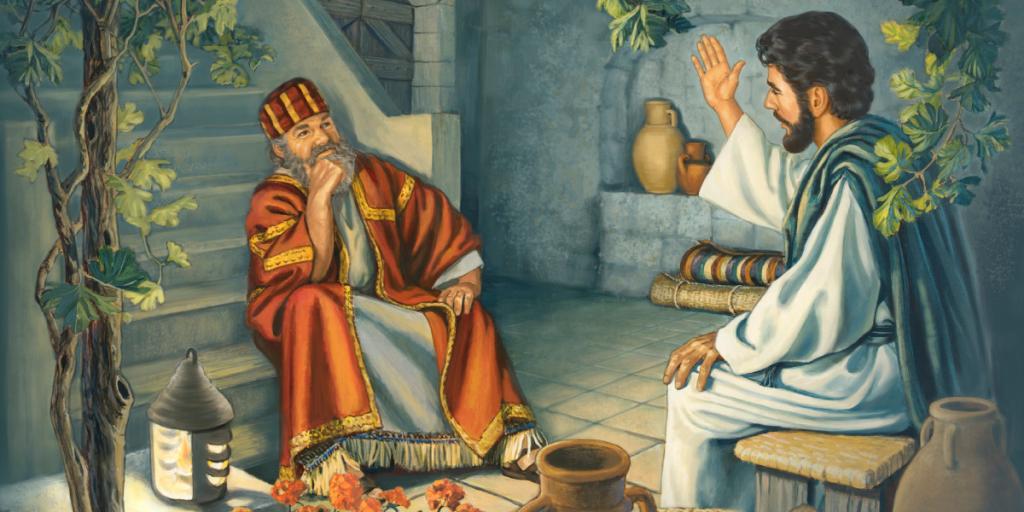
The mostly white Jesus with the equally white Nicodemus.
There are so many people who believe that doubt has no place in the Church. From Church leadership to the layperson. The reason that is often given has to do with the perceived incongruity between faith and doubt. However, what most of these people fail to understand is that faith is created in the infernal cistern of doubt. Even when most evangelicals present the Gospel it is often presented in such a way that one must doubt their “worldly” perspective to accept the religious one that Jesus offers. Faith is not antithetical to doubt, it is defined and refined by it.
Jesus the Doubter
Jesus follows the prophets in a long-established tradition of doubting Judaism. In fact, the entire ministry of Jesus was built upon the notion that Judaism was being practiced incorrectly. This is one reason Jesus is called a prophet. Much like modern evangelicalism, Judaism had established a strong intellectual bond to their religion. Oftentimes, the practice of Judaism was limited to the religious practices within the temple and not extended to the Jewish people. This inability to separate intellect from practice is the hallmark of the evangelical problem. Jesus is often seen as one calling out the religious leaders about this incongruency.
“Then Jesus said to the crowds and to his disciples: “The teachers of the law and the Pharisees sit in Moses’ seat. So you must be careful to do everything they tell you. But do not do what they do, for they do not practice what they preach. They tie up heavy, cumbersome loads and put them on other people’s shoulders, but they themselves are not willing to lift a finger to move them.” (Matthew 23 1:1-4)
“Woe to you, teachers of the law and Pharisees, you hypocrites! You give a tenth of your spices—mint, dill, and cumin. But you have neglected the more important matters of the law—justice, mercy, and faithfulness. You should have practiced the latter, without neglecting the former. You blind guides! You strain out a gnat but swallow a camel.” (Matthew 23:23-24) Emphasis mine.
I would like to suggest that questioning our faith is something that Jesus was a proponent of. If we are not in a state of constant skepticism, then how will we ever know when we have gone astray? If we are not constantly questioning our leaders how will we know when we have crossed that threshold? Karl Barth was famous for saying “Ecclesia semper reformanda est” the church should always be reformed. What Barth meant by this was that we should be constantly reforming. Reformation is always brought about by honest bouts with doubt.
Last year I wrote a blog article on “Doubt as a Spiritual Discipline” In that article, I suggested that we should look at doubt as we do the other spiritual disciplines. And, that it should be practiced regularly. This is the only way to hold leaders accountable (or if you are a leader to hold yourself accountable) to the vision of what it means to be God’s people in today’s society. It is very easy to stray from this vision because we are humans full of passion. And those passions can get in the way of moving towards progress if not held accountable. I would also like to argue that practicing doubt more often allows us to make a better time of each season we encounter the wilderness.
Nicodemus the Deconstructionist
Nicodemus might be a minor character in the overall story of the Gospel, but he plays a significant role for the believer as the proto-type deconstructionist. Nicodemus was a Pharisee and member of the Sanhedrin. He was present or was made aware of the incident where Jesus overturns the tables in the temple because John refers to it in John 3:2. This causes Nicodemus to approach Jesus one night to ask him why he has come. Jesus replies:
“Very truly I tell you, no one can see the kingdom of God unless they are born again.”
Most evangelicals and former evangelicals will recognize this religious language right away. Being “born again” is loaded with cultural and religious significance in the evangelism movements of the U.S. I would like to suggest that this has very little to do with salvation (being born again), but instead is addressing Nicodemus’ doubt. Nicodemus already believed in Jesus because he states:
“Rabbi, we know that you are a teacher who has come from God. For no one could perform the signs you are doing if God were not with him.” (John 3:2)
This indicates to us that Jesus was not specifically referring to Nicodemus’ salvation status. Instead, he was pulling Nicodemus into a journey of deconstruction that would flip on its head what it means to follow God. This was so revolutionary to Nicodemus that he was apparently changed by the conversation. Later we see him argue on behalf of Jesus. Namely, that the accusations lodged against him would be in line with the law. We also see him as one who was preparing the body for burial after Jesus’ death.
John chapter 3 can be broken into two parts. The first part has to do with the encounter Jesus has with Nicodemus (John 3:1-21). The second has to do with the purpose of baptism. The end of the conversation with Nicodemus acts as the transition into this new conversation about the purpose of baptism.
Later on in the passage, Jesus goes on to talk about Salvation and the role of Spirit and water Baptism, but those are tangential to the initial point Jesus is making with Nicodemus. The “salvation stuff” has more to do with Nicodemus reconstructing what it means to have belief in God – outside of temple worship.
Every time we are born again our eyes are reopened. This might include someone new to Christianity but may also include the believer who needs to be born again, and needs a different perspective. Doubt is the indicator that there is a need for deconstruction. And reconstruction is how we are “born again” into this new reality.
Concluding Thought
Have you been born again? Try it this year for the holiday and see where it leads you. Now, when an evangelical asks you if you have been born again you can respond confidently, “yes, several times in fact.” That should send their mind into a tailspin.
You can view my UNenlightenment YouTube Channel HERE
You can view my UNenlightenment Podcast HERE
You can follow me on FaceBook HERE

About Eric English
Eric is a rogue philosopher, theologian, podcaster and ninja. He is a father of three, husband of one, and a poet unto himself. Eric’s main areas of thinking are in philosophy (specifically, Soren Kierkegaard), theology (Narrative Perspectivism), and culture. Eric also hosts the podcast UNenlightenment. If you are interested in having Eric speak at your event, please contact him on Facebook. You can read more about the author here.
Previous Post
March 24, 2022
The Gnostics – A Response to Keith Giles
Next Post
April 18, 2022 God is Dead! A Post Easter Reflection
Browse Our Archives
Select a Category Abortion Atonement Bible Book Review Church History Church/Culture Creative Deconstruction Deconstruction & Reconstruction Discipleship End Times Fun with Philosophy Incarnation Issues Jesus Meaning News Philosophy Podcast Polemic Political Problem of Evil Progressive Christianity Questions Return of Christ Second Coming Sexuality The Church Theology Truth Truth Uncategorized Universalism Women in Ministry
Select a Month October 2026 September 2026 August 2026 July 2026 June 2026 May 2026 December 2025 October 2025 September 2025 August 2025 July 2025 June 2025 May 2025 March 2025 February 2025 January 2025 October 2024 September 2024 August 2024 July 2024 June 2024 May 2024 April 2024 March 2024 February 2024 January 2024 December 2023 November 2023 October 2023 September 2023 August 2023 July 2023 June 2023 May 2023 April 2023 March 2023 February 2023 January 2023 December 2022 November 2022 October 2022 August 2022 May 2022 April 2022 March 2022 February 2022 January 2022 December 2021 November 2021 October 2021 August 2021 July 2021 June 2021 May 2021 April 2021 March 2021 February 2021 January 2021 December 2020 November 2020
Follow Us!
TAKE THE
Religious Wisdom Quiz
What does Siloam mean?
Select your answer to see how you score.
Gift Love Received Sent
Books by This Author Books by UNenlightenment
Related posts from UNenlightenment

Deconstruction IS Discipleship
Tertullian On Equality and Mutuality Within Marriage
The Gnostics – A Response to Keith Giles

Deconstructing Racism (Part Two)
TRENDING AT PATHEOS Progressive Christian

What Being a Modern-Day Apostle Means to Me
In my last column, I discussed the ins and outs of modern-day...

Did Ancient China Once Worship the God of...
Across human history, a common thread weaves through the origins of the...

Love Your Neighbor – Including Earth-Kin: Lev. 19,...
God’s command to love your neighbor means acting in an ethical and...

Lead a Church Study of “Jesus and Lao...
Guest writer Jack Thomas (The Irreverent Reverend) reflects on leading his church...

Pastoral Wisdom for Responding to Sermon Pushback
Getting sermon pushback on your social justice sermon? Learn practical, Proverbs-based strategies...

Principles for Understanding the Apostolic Ministry Today
Whenever people discover that my formal ministry title is "apostle," as in...
view all Progressive Christian blogs
Ad-Free & Subscriber Log-In Subscription Support
- About Us
- 2026 Calendar
- Videos
- Podcasts
- Library of World Religions
- Faith In Media Tracker
- Advertise With Us
- Write for Us
- Privacy Policy
- Terms of Service
- Do Not Sell My Data
- Contact Us
- Radiant Digital
- Manage Newsletter Subscriptions
- Unsubscribe From Notifications
- Sitemap
Copyright 2008-2026, Patheos. All rights reserved.
Subscription Support Ad-Free & Subscriber Log-In
Follow Patheos