
BuddhistCatholicContemplativeEvangelicalGeneral ChristianHinduJewishLatter-day SaintMuslimNew VisionsProgressive Christian
Beliefs
- Buddhist
- Catholic
- Contemplative
- Evangelical
- General Christian
- Hindu
- Jewish
- Latter-day Saint
- More Voices
- Muslim
- New Visions
- Pagan
- Progressive Christian
Topics
- Religion News
- Food and Religion
- Sports and Religion
- Religious Art
- Religious Music and Entertainment
- Religious Events
- History and Religion
- Style and Religion
- Politics and Religion
- Women in Religion
- Recreation Outdoors and Religion
- Business Finance and Religion
- Careers Workplace and Religion
- Education and Religion
- Family Parenting and Religion
- Health Fitness and Religion
- Home and Religion
- Relationships and Religion
- Technology and Religion
- Travel and Religion
Columnists
- Buddhist Columnists
- Business Finance and Religion Columnists
- Careers Workplace and Religion Columnists
- Catholic Columnists
- Contemplative Columnists
- Education and Religion Columnists
- Evangelists Columnists
- Family Parenting and Religion Columnists
- General Christian Columnists
- Health Fitness and Religion Columnists
- Hindu Columnists
- History and Religion Columnists
- Home and Religion Columnists
- Jewish Columnists
- More Voices Columnists
- Latter Day Columnists
- Muslim Columnists
- New Visions Columnists
- Nonreligious Columnists
- Pagan Columnists
- Politics and Religion Columnists
- Progressive Columnists
- Recreation Outdoors and Religion Columnists
- Relationships and Religion Columnists
- Religion News Columnists
- Religious Art Columnists
- Religious Events Columnists
- Religious Music and Entertainment Columnists
- Sports and Religion Columnists
- Style and Religion Columnists
- Technology and Religion Columnists
- Travel and Religion Columnists
- Women in Religion Columnists
Resource Library
- 2026 Calendar
- Library of World Religions
- The 100 Most Holy Places on Earth
- Patheos Answers
- Podcasts
- Videos
- Faith Leaders Database
- Anglican Episcopalian
- Bahai
- Baptist
- Buddhism
- Christianity
- Confucianism
- Eastern Orthodoxy
- Hinduism
- Holiness and Pentecostal
- ISKCON
- Islam
- Judaism
- Lutheran
- Methodist
- The Church of Jesus Christ of Latter-day Saints
- New Age
- Paganism
- Presbytarian and Reformed
- Protestantism
- Religion Behind the Scenes
- Roman Catholic
- Scientology
- Shia Islam
- Sikhism
- Sufism
- Sunni Islam
- Taoism
- Zen
- See all religions
Research Tools
 Ad-Free & Subscriber Log-In Subscription Support
Ad-Free & Subscriber Log-In Subscription Support
Follow Patheos 

- Trending:
- Forgiveness
- |
- Marriage
- |
- Consciousness
- |
- Death Penalty
- |
- Election
- |
- Halloween

- Home
- Progressive Christian
- Either, Is Ignorance Bliss, OR Curing Cognitive Dissonance
Either, Is Ignorance Bliss, OR Curing Cognitive Dissonance
Last updated on: August 3, 2022 at 12:19 pm by Eric Scot English
Either, Is Ignorance Bliss, OR Curing Cognitive Dissonance 2022-08-03T12:19:37-04:00 Eric Scot English
Patheos Explore the world's faith through different perspectives on religion and spirituality! Patheos has the views of the prevalent religions and spiritualities of the world.

Why do people say ignorance is bliss? The simple answer is because sometimes it’s better for a person not to know the truth than to know it. I don’t have an issue with people who are truly ignorant of something. My problem is with people who are intentionally ignorant to get out of knowing something that could cause them to grow or change some previously held belief.
This is not meant to be an insult, but a matter of fact: many conservative evangelicals suffer from willful ignorance. I have had many conversations with many conservative evangelicals about a variety of topics over the years. In nearly every case, when I am face to face with one and I explain the logic behind why progressives think the way they do about a particular belief, the evangelical capitulates.
Now it could be that I am just the world’s greatest progressive apologist. That could explain why this happens. Or, and more likely, I have disrupted the individual’s ability to remain ignorant by presenting them with a coherent argument.
I think the key here is “in person”. For some reason presenting a logical argument in person is much more persuasive than in writing. Perhaps it is because we cannot control how much the individual actually reads, but we can control the amount of information we present them in person. In-person also provides a relational component that is missing in writing. Also, I think in-person conversations allow for an interlocution that is not present in writing. This allows for a give and take that is not present with the writing medium.
However, there are still some who, for whatever reason, will remain stubborn when confronted with a truth that is clear, logical, and rational. Ultimately, the stubbornness many of us see in conservative evangelical circles is a result of something called cognitive dissonance.
Cognitive Dissonance
When an individual (or a group) commits to remain ignorant about facts that are self-evident to others, they are said to have cognitive dissonance. Cognitive dissonance can affect a wide range of beliefs. It’s the inability (or even a lack of desire) to harmonize personal beliefs with some other axiom. This lack of desire is oftentimes a result of fear. Coming to grips with the demise of one’s belief creates disorientation that is difficult for the individual to deal with.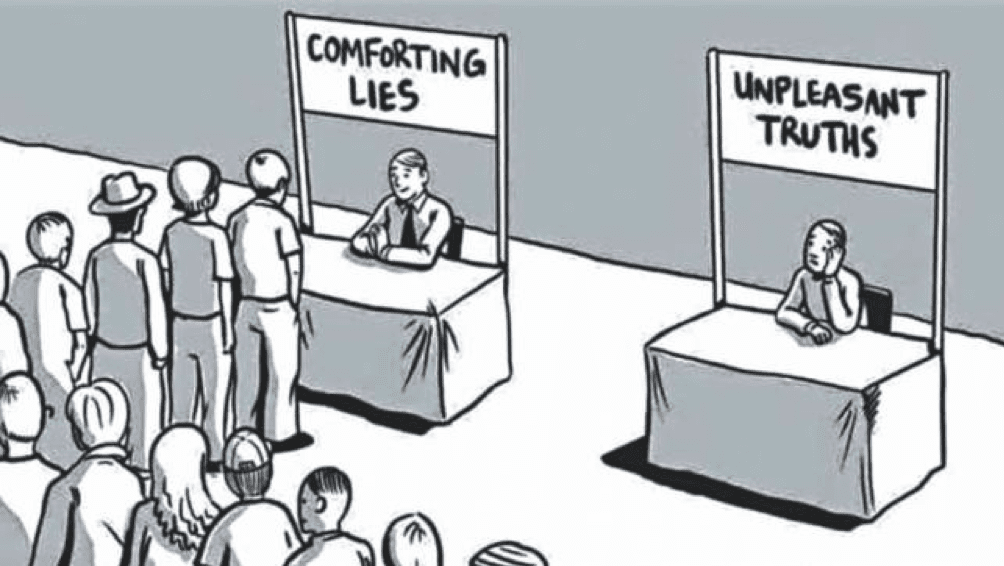
The cognitive dissonance of conservative evangelicals toward their belief about their place in culture is widely known and accepted by most – except conservative evangelicals of course. But, what is the cure for this intellectual disease? Is there a way to snap someone out of their cognitive dissonance? According to psychology, the answer is yes.
According to SimplyPsychology.org, there are three ways to reduce cognitive dissonance. I will discuss these three views below:
Changing Existing Beliefs
This one goes without saying. Of course, changing one’s belief about something will alter their cognitive dissonance. However, it has to be the right belief. It has to be in the right context. It has to be the right time.
Perhaps the aforementioned example of speaking with people in person regarding a particular belief is an example of this phenomenon. It will always be the case that having a relationship with an individual you are speaking with will always be the best context for helping to challenge that person with a new way of thinking.
Changing existing beliefs is very similar to the next one, but different in a few ways.
Adding New Beliefs
This is about providing new information that an individual did not previously have. So, instead of arguing about an individual’s perceived ignorance, one presents the other with incontrovertible information to the contrary. We see a lot of people who are deconstructing their faith as a product of this type of reasoning.
Unfortunately, this requires that the individual is a critical thinker. Many people are suspicious of new information – no matter how reasonable it sounds. In fact, they are often taught that the more reasonable argument is cleverly disguised as false teaching. This is often based on passages like 1 Timothy 4:3-4 and others like it.
“For the time will come when people will not put up with sound doctrine. Instead, to suit their own desires, they will gather around them a great number of teachers to say what their itching ears want to hear. They will turn their ears away from the truth and turn aside to myths.”
Presenting someone with a new way of thinking about an idea is often as much about how you say something as it is what you say. It is important to resist emotional arguing and the “me against you” mentality. For example, instead of beginning with the premise that the other person’s belief is incorrect, and then arguing from that perspective. You should first assert a positive feeling toward their belief, “Okay, I see what you’re saying“, followed by your belief. From there you can say why you don’t think that their belief is rational “I used to believe that, but this is why I don’t anymore”. This is both disarming and non-combative. What you don’t want to do is have a conversation full of emotion and combativeness, that will do nothing but make the cognitive dissonance worse. The more experiences the evangelical has that are emotional and combative, the more they will distrust those who disagree with them. As progressives, we should understand this better than anyone else since many of us have experienced these types of conversations with evangelicals.
Reducing the Importance of Beliefs
Good luck with this one. Since much of what conservative evangelicals believe is rooted in their belief in God (actually their strong belief in the inerrancy of scripture), then getting them to reduce the importance of that belief is nearly impossible.
However, I have found the best way to challenge a conservative evangelical about inerrancy is to show them how much more they view scripture over and above Jesus himself. I try to avoid using words like “idolatry” because these are loaded with emotion. Separating Jesus from scripture is difficult for many conservative evangelicals because all they know about Jesus comes from scripture which results in a conflation of the two. Moreover, reducing the importance of inerrancy (specifically) creates a watershed moment whereby deconstruction is not far behind.
With that said, in my experience, those who go through deconstruction will find themselves reducing their cognitive dissonance once their theology in the inerrancy of scripture begins to change. The reason for this is because inerrancy is the core of how all other beliefs are constructed for the evangelical.
But of course, this requires that an individual is already in a state of doubt or questioning and not fully immersed in the world of conservative evangelicalism. Nevertheless, it does prove the theory that reducing the importance of beliefs is useful for reducing the amount of cognitive dissonance that the individual experiences.
This also demonstrates the importance of deconstruction within the evangelical worldview. Until the individual has come to a place where they care more about what is true instead of what their group tells them to believe they will remain in a state of cognitive dissonance.
Concluding Thought
I have found that attempting to cure cognitive dissonance within evangelicalism is like the new evangelism. Converting people to critical thinking along the way we must stay humble about cognitive dissonance because it could very well be the case that we are the ones who suffer from it. Staying humble, staying informed, and refusing to adhere to progressive fundamentalism will help the progressive Christian to achieve this goal.
You can view my UNenlightenment YouTube Channel HERE
You can view my UNenlightenment Podcast HERE
You can follow me on FaceBook HERE

About Eric English
Eric is a rogue philosopher, theologian, podcaster and ninja. He is a father of three, husband of one, and a poet unto himself. Eric’s main areas of thinking are in philosophy (specifically, Soren Kierkegaard), theology (Narrative Perspectivism), and culture. Eric also hosts the podcast UNenlightenment. You can read more about the author here.
Previous Post

November 2, 2021
A Conversation with Frank Schaeffer
Next Post

November 12, 2021 The Genesis of Violence: A Review
Browse Our Archives
Select a Category Abortion Atonement Bible Book Review Church History Church/Culture Creative Deconstruction Deconstruction & Reconstruction Discipleship End Times Fun with Philosophy Incarnation Issues Jesus Meaning News Philosophy Podcast Polemic Political Problem of Evil Progressive Christianity Questions Return of Christ Second Coming Sexuality The Church Theology Truth Truth Uncategorized Universalism Women in Ministry
Select a Month October 2026 September 2026 August 2026 July 2026 June 2026 May 2026 December 2025 October 2025 September 2025 August 2025 July 2025 June 2025 May 2025 March 2025 February 2025 January 2025 October 2024 September 2024 August 2024 July 2024 June 2024 May 2024 April 2024 March 2024 February 2024 January 2024 December 2023 November 2023 October 2023 September 2023 August 2023 July 2023 June 2023 May 2023 April 2023 March 2023 February 2023 January 2023 December 2022 November 2022 October 2022 August 2022 May 2022 April 2022 March 2022 February 2022 January 2022 December 2021 November 2021 October 2021 August 2021 July 2021 June 2021 May 2021 April 2021 March 2021 February 2021 January 2021 December 2020 November 2020
Follow Us!
TAKE THE
Religious Wisdom Quiz
True or False: Ezekiel saw a vision of a valley of dry bones that came to life.
Select your answer to see how you score.
FALSE TRUE
Books by This Author Books by UNenlightenment
Related posts from UNenlightenment

After the Eulogy Comes the Resurrection

A Eulogy for the Sleeping Church

Trump’s America or Constantine’s Rome?

Are Christian Nationalists Behind our Involvement with Iran?
TRENDING AT PATHEOS Progressive Christian

What Being a Modern-Day Apostle Means to Me
In my last column, I discussed the ins and outs of modern-day...

Did Ancient China Once Worship the God of...
Across human history, a common thread weaves through the origins of the...

Love Your Neighbor – Including Earth-Kin: Lev. 19,...
God’s command to love your neighbor means acting in an ethical and...

Lead a Church Study of “Jesus and Lao...
Guest writer Jack Thomas (The Irreverent Reverend) reflects on leading his church...

Pastoral Wisdom for Responding to Sermon Pushback
Getting sermon pushback on your social justice sermon? Learn practical, Proverbs-based strategies...

Principles for Understanding the Apostolic Ministry Today
Whenever people discover that my formal ministry title is "apostle," as in...
view all Progressive Christian blogs
Ad-Free & Subscriber Log-In Subscription Support
- About Us
- 2026 Calendar
- Videos
- Podcasts
- Library of World Religions
- Faith In Media Tracker
- Advertise With Us
- Write for Us
- Privacy Policy
- Terms of Service
- Do Not Sell My Data
- Contact Us
- Radiant Digital
- Manage Newsletter Subscriptions
- Unsubscribe From Notifications
- Sitemap
Copyright 2008-2026, Patheos. All rights reserved.
Subscription Support Ad-Free & Subscriber Log-In
Follow Patheos