
BuddhistCatholicContemplativeEvangelicalGeneral ChristianHinduJewishLatter-day SaintMuslimNew VisionsProgressive Christian
Beliefs
- Buddhist
- Catholic
- Contemplative
- Evangelical
- General Christian
- Hindu
- Jewish
- Latter-day Saint
- More Voices
- Muslim
- New Visions
- Pagan
- Progressive Christian
Topics
- Religion News
- Food and Religion
- Sports and Religion
- Religious Art
- Religious Music and Entertainment
- Religious Events
- History and Religion
- Style and Religion
- Politics and Religion
- Women in Religion
- Recreation Outdoors and Religion
- Business Finance and Religion
- Careers Workplace and Religion
- Education and Religion
- Family Parenting and Religion
- Health Fitness and Religion
- Home and Religion
- Relationships and Religion
- Technology and Religion
- Travel and Religion
Columnists
- Buddhist Columnists
- Business Finance and Religion Columnists
- Careers Workplace and Religion Columnists
- Catholic Columnists
- Contemplative Columnists
- Education and Religion Columnists
- Evangelists Columnists
- Family Parenting and Religion Columnists
- General Christian Columnists
- Health Fitness and Religion Columnists
- Hindu Columnists
- History and Religion Columnists
- Home and Religion Columnists
- Jewish Columnists
- More Voices Columnists
- Latter Day Columnists
- Muslim Columnists
- New Visions Columnists
- Nonreligious Columnists
- Pagan Columnists
- Politics and Religion Columnists
- Progressive Columnists
- Recreation Outdoors and Religion Columnists
- Relationships and Religion Columnists
- Religion News Columnists
- Religious Art Columnists
- Religious Events Columnists
- Religious Music and Entertainment Columnists
- Sports and Religion Columnists
- Style and Religion Columnists
- Technology and Religion Columnists
- Travel and Religion Columnists
- Women in Religion Columnists
Resource Library
- 2026 Calendar
- Library of World Religions
- The 100 Most Holy Places on Earth
- Patheos Answers
- Podcasts
- Videos
- Faith Leaders Database
- Anglican Episcopalian
- Bahai
- Baptist
- Buddhism
- Christianity
- Confucianism
- Eastern Orthodoxy
- Hinduism
- Holiness and Pentecostal
- ISKCON
- Islam
- Judaism
- Lutheran
- Methodist
- The Church of Jesus Christ of Latter-day Saints
- New Age
- Paganism
- Presbytarian and Reformed
- Protestantism
- Religion Behind the Scenes
- Roman Catholic
- Scientology
- Shia Islam
- Sikhism
- Sufism
- Sunni Islam
- Taoism
- Zen
- See all religions
Research Tools
 Ad-Free & Subscriber Log-In Subscription Support
Ad-Free & Subscriber Log-In Subscription Support
Follow Patheos 

- Trending:
- Forgiveness
- |
- Marriage
- |
- Consciousness
- |
- Death Penalty
- |
- Election
- |
- Halloween

- Home
- Progressive Christian
- UNenlightenment is Being Certain of your Subjectivity
UNenlightenment is Being Certain of your Subjectivity
Last updated on: March 23, 2021 at 12:29 pm by Eric Scot English
UNenlightenment is Being Certain of your Subjectivity 2021-03-23T12:29:02-04:00 Eric Scot English
Patheos Explore the world's faith through different perspectives on religion and spirituality! Patheos has the views of the prevalent religions and spiritualities of the world.
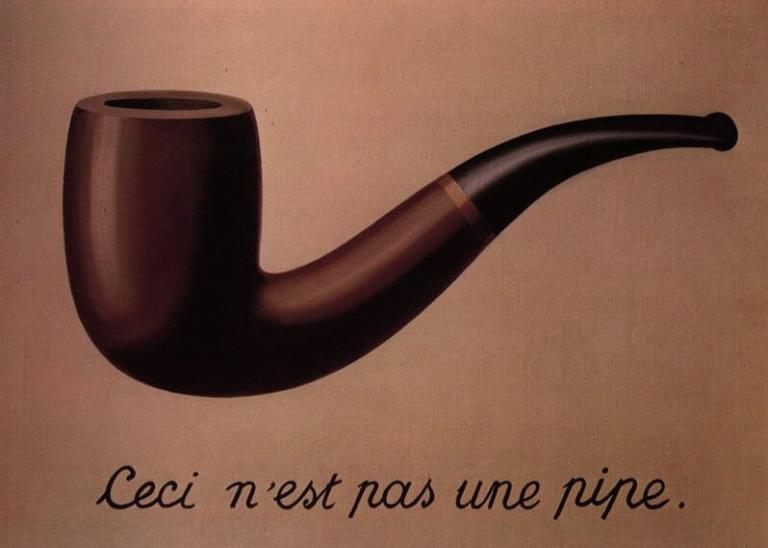
The Treachery of Images by: René Magritte
UNenlightenment is the undoing of our Enlightenment presuppositions, which in my opinion, prevent us from understanding the Gospel and thus living properly in the world. Nearly everything within our Christian experience has been influenced by the Enlightenment – from the way we do church, to the theology we teach our pastors and the behaviors of Christians in the culture at large. UNenlightenment is the process of undoing our bad habits, re-understanding scripture and faith, and using that information to live anew the Gospel in front of the world.
One such principle necessary for us to unlearn has to do with our dependence upon objectivity and our addiction to the certainty that it seemingly provides. This is not a total annihilation of objectivity, but a reframing of its exclusive relationship to truth.
The reason I chose this particular principle to discuss is that so many Christians believe that the truth of Christianity has to be objective and absolute, in order for it to be true. This is a fallacious way of thinking that is so ingrained in our churches that this belief is axiomatic to many.
When confronted with the logic of this proposition we have to ask the question, “How do we prove a metaphysical reality through an exclusively physical system?”
Our Addiction to Certainty
When I was in college, I really got into the whole apologetics scene. I found it energizing to engage in rational debate with those who disagreed with my worldview. I loved listening to debates and memorizing good arguments that I could later use as ammunition in my own conversations.
This version of Christianity fed my desire to have an “objective” faith. That is, a faith that could be proven instead of assumed to be true. If God was “provable” in some objective way, then I could convince skeptics that God existed.
However, this version of Christianity is not about sharing the Gospel, or even proving God. In fact, it doesn’t seem to have anything to do with God, but is more a reflection of one’s own need to be “right”. Soren Kierkegaard said it nicely in his journals:
“…And what would it profit me if I discovered a so-called objective truth; if I worked my way through the systems of the philosophers and was able to parade them forth on demand; if I was able to demonstrate the inconsistencies within each individual circle…-what would it profit me and for my life?… What would it profit me if the truth stood before me, cold and naked, not caring whether I acknowledged it or not, calling forth an anguished shudder rather than confident submission? I will certainly not deny that I still believe in the validity of an imperative of knowledge that has an influence upon men, but it nonetheless must become a living part of me, and this is what I now understand to be the heart of the matter. IT is for this my soul thirsts, as the deserts of Africa thirst for water.”
Was I trying to convince others of God’s reality or myself? I quickly learned that being able to memorize and recite an argument on command does not “deepen” one’s faith. Instead, it feeds one’s addiction to certainty. Moreover, what fuels our addiction to certainty is our need for absolutes and the security we feel with them. Unfortunately, I think this is largely due to our inability to understand what it means for God to be “absolute truth”. Or perhaps it has something to do with our arrogance to think we can apprehend such a truth completely.
The Incarnation was a demonstration that truth cannot be located solely in the axioms of doctrine but it required the overall “speech-act” of Jesus to be fully realized. That is, truth is to be demonstrated; it is to be acted upon before it can have a life of its own. Just as Jesus demonstrated the kingdom to us, so are we to demonstrate it to others. This demonstration is relative to the creative acts of the individual who lives out the message of Jesus’s love on the world stage. This demonstration by the individual is performed as one who stands subjectively before the truth they proclaim and the people they proclaim that truth too.
At some point, I realized my ability to craft a clever argument really had nothing to do with the truth about God. I had bought into this idea that things like proof, truth, and fact existed only in the “objective sense”. But, why did I think this way? What “proof” was there that this way of thinking was true to begin with? It was not long before I realized the whole idea of objectivity as a system collapses when we believe that it is the only means of true knowledge. (Perhaps the most significant reason for this is that objectivity cannot hold up under the weight of its own scrutiny. In other words, objectivity fails to be objective.)
Throughout my time within various evangelical churches, colleges, and seminaries ideas like subjectivity and relativism were looked down upon as intellectual hokum. Anyone who would consider such philosophies within their Christian walk was either labeled “liberal” or not considered “evangelical” – and…where I came from, if you’re not evangelical, then you’re not “Christian”.
However, even more, troublesome to me, was that my experience of the Christian faith did not correspond with what I heard people say about it. My faith has always been a subjective experience. For example, I speak to God through prayer; I interpret how He responds to me; I interpret what the Bible says and what it means; and I (as everyone does), experience something unique when I worship, etc.
Not only did my faith seem almost completely subjective, but it appeared to me as though the Church also practiced this (despite the fact that they claim they don’t believe in it.) Perhaps Evangelicalism is largely in denial about this, but the facts seem to corroborate the conclusion.
In fact, don’t we laud creative preachers who have interesting interpretations? Don’t we seek them out in droves? If a preacher always preached the same message wouldn’t we get bored? Wouldn’t we seek out a new preacher that was “fresh and exciting”?
If Christianity is supposed to be objective, then why do we define faith as “having assurance in that which is unseen”? (Hebrews 11:1) By this definition, faith is very much subjective.
So, I return to the question, “Why does Christianity have to be objective to be true?” Simply stated: it doesn’t! Neither “proving God’s existence”, nor “justifying the miraculous” make God any more “real”. In fact, it could be argued, an individual’s subjective experience of God is more real than what anyone can posit about Him objectively.
You can view my new UNenlightenment YouTube Channel HERE
You can view my new UNenlightenment Podcast HERE
You can follow me on FaceBook HERE
Previous Post

January 4, 2021
The Bible Is NOT The Word Of God Revisited
Next Post

January 11, 2021 We Needed Insurrection
Browse Our Archives
Select a Category Abortion Atonement Bible Book Review Church History Church/Culture Creative Deconstruction Deconstruction & Reconstruction Discipleship End Times Fun with Philosophy Incarnation Issues Jesus Meaning News Philosophy Podcast Polemic Political Problem of Evil Progressive Christianity Questions Return of Christ Second Coming Sexuality The Church Theology Truth Truth Uncategorized Universalism Women in Ministry
Select a Month October 2026 September 2026 August 2026 July 2026 June 2026 May 2026 December 2025 October 2025 September 2025 August 2025 July 2025 June 2025 May 2025 March 2025 February 2025 January 2025 October 2024 September 2024 August 2024 July 2024 June 2024 May 2024 April 2024 March 2024 February 2024 January 2024 December 2023 November 2023 October 2023 September 2023 August 2023 July 2023 June 2023 May 2023 April 2023 March 2023 February 2023 January 2023 December 2022 November 2022 October 2022 August 2022 May 2022 April 2022 March 2022 February 2022 January 2022 December 2021 November 2021 October 2021 August 2021 July 2021 June 2021 May 2021 April 2021 March 2021 February 2021 January 2021 December 2020 November 2020
Follow Us!
TAKE THE
Religious Wisdom Quiz
Who said: "Yet I hold this against you: You have forsaken the love you had at first"?
Select your answer to see how you score.
John Jesus (to the church in Ephesus) An angel The Spirit
Books by This Author Books by UNenlightenment
Related posts from UNenlightenment

A Eulogy for the Sleeping Church

Are You A Saul Or Paul: The False...

Kierkegaard Denied Being a Christian and so should...

Kierkegaard and Christian Nationalism
TRENDING AT PATHEOS Progressive Christian

What Being a Modern-Day Apostle Means to Me
In my last column, I discussed the ins and outs of modern-day...

Did Ancient China Once Worship the God of...
Across human history, a common thread weaves through the origins of the...

Love Your Neighbor – Including Earth-Kin: Lev. 19,...
God’s command to love your neighbor means acting in an ethical and...

Lead a Church Study of “Jesus and Lao...
Guest writer Jack Thomas (The Irreverent Reverend) reflects on leading his church...

Pastoral Wisdom for Responding to Sermon Pushback
Getting sermon pushback on your social justice sermon? Learn practical, Proverbs-based strategies...

Principles for Understanding the Apostolic Ministry Today
Whenever people discover that my formal ministry title is "apostle," as in...
view all Progressive Christian blogs
Ad-Free & Subscriber Log-In Subscription Support
- About Us
- 2026 Calendar
- Videos
- Podcasts
- Library of World Religions
- Faith In Media Tracker
- Advertise With Us
- Write for Us
- Privacy Policy
- Terms of Service
- Do Not Sell My Data
- Contact Us
- Radiant Digital
- Manage Newsletter Subscriptions
- Unsubscribe From Notifications
- Sitemap
Copyright 2008-2026, Patheos. All rights reserved.
Subscription Support Ad-Free & Subscriber Log-In
Follow Patheos