
BuddhistCatholicContemplativeEvangelicalGeneral ChristianHinduJewishLatter-day SaintMuslimNew VisionsProgressive Christian
Beliefs
- Buddhist
- Catholic
- Contemplative
- Evangelical
- General Christian
- Hindu
- Jewish
- Latter-day Saint
- More Voices
- Muslim
- New Visions
- Pagan
- Progressive Christian
Topics
- Religion News
- Food and Religion
- Sports and Religion
- Religious Art
- Religious Music and Entertainment
- Religious Events
- History and Religion
- Style and Religion
- Politics and Religion
- Women in Religion
- Recreation Outdoors and Religion
- Business Finance and Religion
- Careers Workplace and Religion
- Education and Religion
- Family Parenting and Religion
- Health Fitness and Religion
- Home and Religion
- Relationships and Religion
- Technology and Religion
- Travel and Religion
Columnists
- Buddhist Columnists
- Business Finance and Religion Columnists
- Careers Workplace and Religion Columnists
- Catholic Columnists
- Contemplative Columnists
- Education and Religion Columnists
- Evangelists Columnists
- Family Parenting and Religion Columnists
- General Christian Columnists
- Health Fitness and Religion Columnists
- Hindu Columnists
- History and Religion Columnists
- Home and Religion Columnists
- Jewish Columnists
- More Voices Columnists
- Latter Day Columnists
- Muslim Columnists
- New Visions Columnists
- Nonreligious Columnists
- Pagan Columnists
- Politics and Religion Columnists
- Progressive Columnists
- Recreation Outdoors and Religion Columnists
- Relationships and Religion Columnists
- Religion News Columnists
- Religious Art Columnists
- Religious Events Columnists
- Religious Music and Entertainment Columnists
- Sports and Religion Columnists
- Style and Religion Columnists
- Technology and Religion Columnists
- Travel and Religion Columnists
- Women in Religion Columnists
Resource Library
- 2026 Calendar
- Library of World Religions
- The 100 Most Holy Places on Earth
- Patheos Answers
- Podcasts
- Videos
- Faith Leaders Database
- Anglican Episcopalian
- Bahai
- Baptist
- Buddhism
- Christianity
- Confucianism
- Eastern Orthodoxy
- Hinduism
- Holiness and Pentecostal
- ISKCON
- Islam
- Judaism
- Lutheran
- Methodist
- The Church of Jesus Christ of Latter-day Saints
- New Age
- Paganism
- Presbytarian and Reformed
- Protestantism
- Religion Behind the Scenes
- Roman Catholic
- Scientology
- Shia Islam
- Sikhism
- Sufism
- Sunni Islam
- Taoism
- Zen
- See all religions
Research Tools
 Ad-Free & Subscriber Log-In Subscription Support
Ad-Free & Subscriber Log-In Subscription Support
Follow Patheos 

- Trending:
- Forgiveness
- |
- Marriage
- |
- Consciousness
- |
- Death Penalty
- |
- Election
- |
- Halloween

- Home
- Evangelical
- Moving from Victimization to Victorious Living
Moving from Victimization to Victorious Living
Last updated on: October 12, 2024 at 8:43 am by Paul Louis Metzger
Moving from Victimization to Victorious Living 2024-10-12T08:43:48-07:00 Paul Louis Metzger
Patheos Explore the world's faith through different perspectives on religion and spirituality! Patheos has the views of the prevalent religions and spiritualities of the world.

Luca Signorelli (1450–1523), “The Resurrected Christ Appearing to His Disciples,” 1514, Detroit Institute of Arts, Public Domain {{PD-US-expired}}

This post reflects on how we can move from enduring victimizing life circumstances to victorious living. On Yom Kippur, the Jewish Day of Atonement, I engage Rashi, Viktor Frankl, Charles Taylor, the resurrection stories of Jesus, and the account of Joseph with his brothers, to develop this claim.
Jewish Suffering, Resilience, and Creativity
The Jewish community has certainly endured incredible suffering and trauma throughout their history. Amid innumerable horrific ordeals, they have often demonstrated incredible resilience and creativity, and have grown through their immense struggles.
Rashi: Isaiah 53, Suffering, and Atonement
One example of such resilience and creativity is rabbinic leadership and scholarship. The Jewish scholar Rashi’s interpretation of Isaiah 53. Rashi (Rabbi Solomon ben Isaac) originally maintained that the suffering servant in Isaiah 53 was an individual messianic figure. But later, he interpreted the suffering servant as Israel. The Jewish people’s suffering serves to atone for the sins of the Gentiles. Two of the reasons for Rashi’s interpretation were: to shield the Jewish community from Christian apologists who identified the suffering servant as a messianic individual, which they believed is Jesus; and to find a reason for why the Jewish community had undergone such incredible suffering during the First Crusade. (Refer here to Joel Rembaum’s article on this subject) Of course, the interpretation of Isaiah 53 is open to debate. But what cannot be denied is the resilient and creative effort to help lead the Jewish community forward to find meaning amid extremely challenging life circumstances.
The October 7th Atrocity and Yom Kippur
Discussion of the atonement is timely. The Jewish calendar observes Yom Kippur, that is, the Day of Atonement, on October 11 and 12 this year. Jewish people throughout the world observe Yom Kippur, which today emphasizes prayer, repentance, forgiveness, changed lives and, for those who may take Rashi’s view, the Jewish community’s suffering itself is atoning. Such suffering continues. Here it is worth noting that, just this week, two rabbis reflected on the October 7th atrocity in Israel last year, noting that it, like Yom Kippur, will forever be part of the Jewish collective memory.
Viktor Frankl: Suffering and Meaning
People respond to suffering, trauma, and tragedy differently. Many seek to find a meaning in their suffering. Viktor Frankl, psychiatrist, neurologist, and Holocaust survivor, provided a rationale for why finding meaning in suffering is helpful: In Man’s Search for Meaning, he wrote: “In some ways suffering ceases to be suffering at the moment it finds a meaning, such as the meaning of a sacrifice.” And again, “Suffering is an ineradicable part of life, even as fate and death. Without suffering and death human life cannot be complete.”
For Frankl, finding meaning in life is critical to mental health. The psychologist’s job is not to help their clients find meaning rather than make them feel happy. Finding meaning would help them grow in resilience to survive and thrive.
He was critical of the American fixation with happiness. The goal of psychotherapy was to help people act responsibly in addressing the challenges that inevitably arise in life. Freedom without responsibility deteriorates, fostering an arbitrary existence. This emphasis on responsibility went against the stream of reducing individual persons to merely victims of nature or nature’s effects. “Calling for a re-humanization of psychotherapy, he emphasized the importance of reconnecting people with personal responsibility in order to overcome feelings of meaninglessness and despair.” (Refer here for the quote and a good overview of Frankl’s work).
I have found one quote in particular from Frankl’s classic work, Man’s Search for Meaning, especially helpful: “When we are no longer able to change a situation, we are challenged to change ourselves.” This classic statement from Frankl’s work has helped me cope and find hope in dealing with the ongoing suffering and trauma resulting from my son Christopher’s catastrophic brain injury and its aftermath.
Innocent Suffering, Victory amid Victimization
My Christian faith and daily Bible readings have also helped me gain strength and a sense of purpose amid incredible trials in life. The New Testament presents Jesus and his community as resilient and creative amid great challenges to their faith. What I find most striking is how Jesus provides meaning amid horrific suffering. Some in the Christian community have presented Jesus as an innocent victim, who though victimized, did not victimize others. He atoned for our sin amid great travail and trauma so that we might experience healing. (Still, it is important to note that Jesus did not die on Yom Kippur, but during Passover.)
How can any people, or an individual person, find meaning and live victoriously amid incredible suffering and trauma? How might we maintain innocence and not participate in the ongoing cycle of victimization in our world today? This is not simply a question I ask in relation to the Jewish people and their faith tradition, but also in relation to Christians, Muslims, and people of any spiritual path, or no religious tradition whatsoever. In what follows, I will highlight a Christian perspective for how we might choose to find meaning and respond.
Charles Taylor: Violence, Vulnerability, and Transformative Meaning
Charles Taylor reflects on Jesus’ atoning work in A Secular Age. He offers an alternative to the view that features divine violence and frames suffering as divine, which involves “punishment and pedagogy” (See A Secular Age, 654):
We could start somewhere quite different, see suffering and destruction as often themselves devoid of meaning, and see the self-giving of Christ to suffering as a new initiative by God, whereby suffering repairs the breach between God and humans, and thus has not a retrospective or already established, but a transformative meaning.
We start with the fact of human resistance to God, closure towards God who could heal the consequences of this resistance, which we call sin. This is the first mystery. God’s initiative is to enter, in full vulnerability, the heart of the resistance, to be among humans, offering participation in the divine life. The nature of the resistance is that this offer arouses even more violent opposition, not a divine violence, more a counter-divine one.
Now Christ’s reaction to the resistance was to offer no counter-resistance, but to continue loving and offering. This love can go to the very heart of things, and open a road even for the resisters. This is the second mystery. Through this loving submission, violence is turned around, and instead of breeding counter-violence in an endless spiral, can be transformed. A path is opened of non-power, limitless self-giving, full action, and infinite openness. (A Secular Age, 654)
Further to Taylor’s reflection, I have often found Jesus’ actions following his resurrection from the dead quite striking and even counter-intuitive. Rather than seeking to get even, he makes whole. He does not lead his disciples to attack those who have done him wrong, but rather, he forgave them and asked God to do so, too. (See Luke 23:34; NIV)
Jesus’ Peace: Not Getting Even, But Making Whole
In the canonical gospels, we find the resurrected Jesus appearing and greeting his followers with the words, “Peace be with you!” (See John 21:19-23; NIV) He walks with two other disciples on the Road to Emmaus and later breaks bread with them (Luke 24:13-35). On another occasion, he instructed the disciples where to catch fish and prepared a meal for them. (21:1-14) He was/is a person of peace and hospitality, as my colleague Suzanne Smith remarked in reflecting on these biblical texts on the resurrection. Again, his aim is not to get even, but to make whole.
If this is the case for Jesus, in view of him and in participation with him, how shall we respond? Will we rise from the tomb with him and “enter, in full vulnerability,” as Taylor reasons, “the heart of resistance” among our fellow humans? Will we also enter, not to react and seek revenge, but open ourselves up to the power of a cruciform and risen life, which as Taylor reasons involves “non-power, limitless self-giving, full action, and infinite openness”?
Joseph and Us: Reaction to Evil or Pro-action for Good?
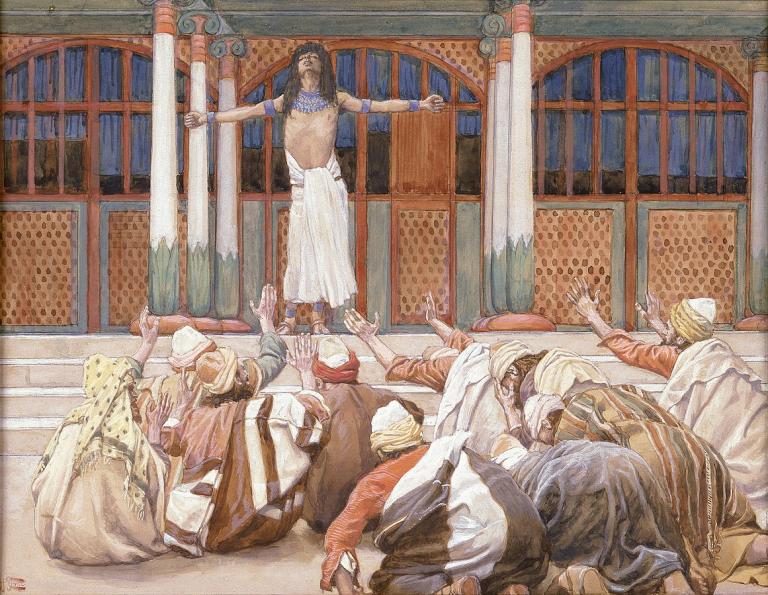
James Jacques Joseph Tissot, “Joseph Makes Himself Known to His Brethren,” c. 1896-1902, the Jewish Museum, New York, Public Domain {{PD-US-expired}}

It is not only freedom without responsibility that leads to an arbitrary existence. So, too, does the unending cycle of violence in our world today. Jesus calls us to enter the cycle of transformative meaning whereby we do not react, but proact. Rather than see ourselves as predetermined to play the victim and give up or get even, merely reacting in kind to what others have done to us. Jesus offers us another way, the path of vulnerability and a counter to the use of violence.
The biblical character Joseph was a type of Christ. He did not permit his victimizing life circumstances including his brothers’ selling him into slavery and later imprisonment to control him. Rather than be reactive, like Jesus, he was proactive in his relationships with those who harmed him. Rather than get even, he made whole. Joseph found meaning in his trials and reversed them to bring about a much greater good. To quote Joseph’s words uttered millennia ago to his brothers who had done him great harm, “You intended to harm me, but God intended it for good to accomplish what is now being done, the saving of many lives.” (Genesis 50:20; NIV)
It is not enough for me to quote these words. We must live them, as I pray these words over my son’s person and our future daily. I pray in earnest that our lives will count for a far greater good than the evils we have endured and that such good will lead to the liberation of many. Transformative meaning in the face of suffering and victimizing experiences gives rise to resilient hope and victorious living.

About Paul Louis Metzger
Paul Louis Metzger, Ph.D., is Professor of Christian Theology & Theology of Culture, Multnomah Biblical Seminary, Jessup University; Director of The Institute for Cultural Engagement: New Wine, New Wineskins; and author and editor of numerous works, including Setting the Spiritual Clock: Sacred Time Breaking Through the Secular Eclipse and More Than Things: A Personalist Ethics for a Throwaway Culture. You can read more about the author here.
Previous Post

October 10, 2024
Blast Off with Interstellar: the Cosmic Force of God's Love
Next Post

October 14, 2024 Reordering Time with Resilient Hope in a Disorienting World
Recent Comments
"Humility is a powerful weapon of mass construction. "On Palm Sunday, Jesus rides in triumph ..."
Holy Week Is Humble Week: “Beware ..."
"There is a new counter-apologetic method which is successfully being used against the arguments of ..."
Heavenly Father’s Day on Trinity Sunday
"A throwaway culture cannot be our way of proceeding was often emphasized by the late ..."
Excavating the Person in a Throwaway ..."
"Dr. Metzger, I appreciate your insight and transparency in this post. I have just added ..."
Embracing Emotions’ Full Range: From Grief ..."
Browse Our Archives
Select a Category Uncategorized
Select a Month June 2025 April 2025 March 2025 January 2025 December 2024 November 2024 October 2024 September 2024 August 2024 July 2024 June 2024 May 2024 April 2024 March 2024 February 2024 January 2024 December 2023 November 2023 October 2023 September 2023 August 2023 July 2023 June 2023 May 2023 April 2023 March 2023 February 2023 January 2023 December 2022 November 2022 October 2022 September 2022 August 2022 July 2022 June 2022 May 2022 April 2022 March 2022 February 2022 January 2022 December 2021 November 2021 October 2021 September 2021 August 2021 July 2021 June 2021 May 2021 April 2021 March 2021 February 2021 January 2021 December 2020 November 2020 October 2020 September 2020 August 2020 July 2020 June 2020 May 2020 April 2020 March 2020 February 2020 January 2020 December 2019 November 2019 October 2019 September 2019 August 2019 July 2019 June 2019 May 2019 April 2019 March 2019 February 2019 January 2019 December 2018 November 2018 October 2018 September 2018 August 2018 July 2018 June 2018 May 2018 April 2018 March 2018 February 2018 January 2018 December 2017 November 2017 October 2017 September 2017 August 2017 July 2017 June 2017 May 2017 April 2017 March 2017 February 2017 January 2017 December 2016 November 2016 October 2016 September 2016 August 2016 July 2016 June 2016 May 2016 April 2016 March 2016 February 2016 January 2016 December 2015 November 2015 October 2015 September 2015 August 2015 July 2015 June 2015 May 2015 April 2015 March 2015 February 2015 January 2015 December 2014 November 2014 October 2014 September 2014 August 2014 July 2014 June 2014 May 2014 April 2014 March 2014 February 2014 January 2014 December 2013 November 2013 October 2013 September 2013 August 2013 July 2013 June 2013 May 2013 April 2013 March 2013 February 2013 January 2013 December 2012 November 2012 October 2012 September 2012 August 2012 July 2012 June 2012 May 2012 April 2012 March 2012 February 2012
Follow Us!
TAKE THE
Religious Wisdom Quiz
Who did Paul send to check on the Thessalonians when he could not come himself?
Select your answer to see how you score.
Luke Timothy Silas Titus
Books by This Author Books by Paul Louis Metzger
Related posts from Uncommon God, Common Good
Faith's Ferment: Fostering Resilience in a Secular Age

Heavenly Father’s Day on Trinity Sunday

Easter Triduum: Obey Your Thirst—for God
TRENDING AT PATHEOS Evangelical

The REST of Your Life: A Creative Wrestles...
This week I had a conversation with a good friend from church....

How the author of the world's best hymn...
I've been working with John Newton for a while now. This makes...

Long before this Lectio Divina, Psalm 130 - the song - started...

What About the Trees? Another Living Parable
After I finished writing the last article about falling leaves as a...

Why Classical Education Is a Conversation, Not a...
Come and Read: Joy in Classical Education When I was a little...

Cornell University has received a great deal of negative publicity and intense...
view all Evangelical blogs
What Are Your Thoughts?leave a comment
Ad-Free & Subscriber Log-In Subscription Support
- About Us
- 2026 Calendar
- Videos
- Podcasts
- Library of World Religions
- Faith In Media Tracker
- Advertise With Us
- Write for Us
- Privacy Policy
- Terms of Service
- Do Not Sell My Data
- Contact Us
- Radiant Digital
- Manage Newsletter Subscriptions
- Unsubscribe From Notifications
- Sitemap
Copyright 2008-2026, Patheos. All rights reserved.
Subscription Support Ad-Free & Subscriber Log-In
Follow Patheos