
BuddhistCatholicContemplativeEvangelicalGeneral ChristianHinduJewishLatter-day SaintMuslimNew VisionsProgressive Christian
Beliefs
- Buddhist
- Catholic
- Contemplative
- Evangelical
- General Christian
- Hindu
- Jewish
- Latter-day Saint
- More Voices
- Muslim
- New Visions
- Pagan
- Progressive Christian
Topics
- Religion News
- Food and Religion
- Sports and Religion
- Religious Art
- Religious Music and Entertainment
- Religious Events
- History and Religion
- Style and Religion
- Politics and Religion
- Women in Religion
- Recreation Outdoors and Religion
- Business Finance and Religion
- Careers Workplace and Religion
- Education and Religion
- Family Parenting and Religion
- Health Fitness and Religion
- Home and Religion
- Relationships and Religion
- Technology and Religion
- Travel and Religion
Columnists
- Buddhist Columnists
- Business Finance and Religion Columnists
- Careers Workplace and Religion Columnists
- Catholic Columnists
- Contemplative Columnists
- Education and Religion Columnists
- Evangelists Columnists
- Family Parenting and Religion Columnists
- General Christian Columnists
- Health Fitness and Religion Columnists
- Hindu Columnists
- History and Religion Columnists
- Home and Religion Columnists
- Jewish Columnists
- More Voices Columnists
- Latter Day Columnists
- Muslim Columnists
- New Visions Columnists
- Nonreligious Columnists
- Pagan Columnists
- Politics and Religion Columnists
- Progressive Columnists
- Recreation Outdoors and Religion Columnists
- Relationships and Religion Columnists
- Religion News Columnists
- Religious Art Columnists
- Religious Events Columnists
- Religious Music and Entertainment Columnists
- Sports and Religion Columnists
- Style and Religion Columnists
- Technology and Religion Columnists
- Travel and Religion Columnists
- Women in Religion Columnists
Resource Library
- 2026 Calendar
- Library of World Religions
- The 100 Most Holy Places on Earth
- Patheos Answers
- Podcasts
- Videos
- Faith Leaders Database
- Anglican Episcopalian
- Bahai
- Baptist
- Buddhism
- Christianity
- Confucianism
- Eastern Orthodoxy
- Hinduism
- Holiness and Pentecostal
- ISKCON
- Islam
- Judaism
- Lutheran
- Methodist
- The Church of Jesus Christ of Latter-day Saints
- New Age
- Paganism
- Presbytarian and Reformed
- Protestantism
- Religion Behind the Scenes
- Roman Catholic
- Scientology
- Shia Islam
- Sikhism
- Sufism
- Sunni Islam
- Taoism
- Zen
- See all religions
Research Tools
 Ad-Free & Subscriber Log-In Subscription Support
Ad-Free & Subscriber Log-In Subscription Support
Follow Patheos 

- Trending:
- Forgiveness
- |
- Marriage
- |
- Consciousness
- |
- Death Penalty
- |
- Election
- |
- Halloween

- Home
- Evangelical
- The Biblical Crisis & The Batman: Tragedy and Hope
The Biblical Crisis & The Batman: Tragedy and Hope
Last updated on: September 24, 2024 at 5:15 pm by Paul Louis Metzger
The Biblical Crisis & The Batman: Tragedy and Hope 2024-09-24T17:15:44-07:00 Paul Louis Metzger
Patheos Explore the world's faith through different perspectives on religion and spirituality! Patheos has the views of the prevalent religions and spiritualities of the world.
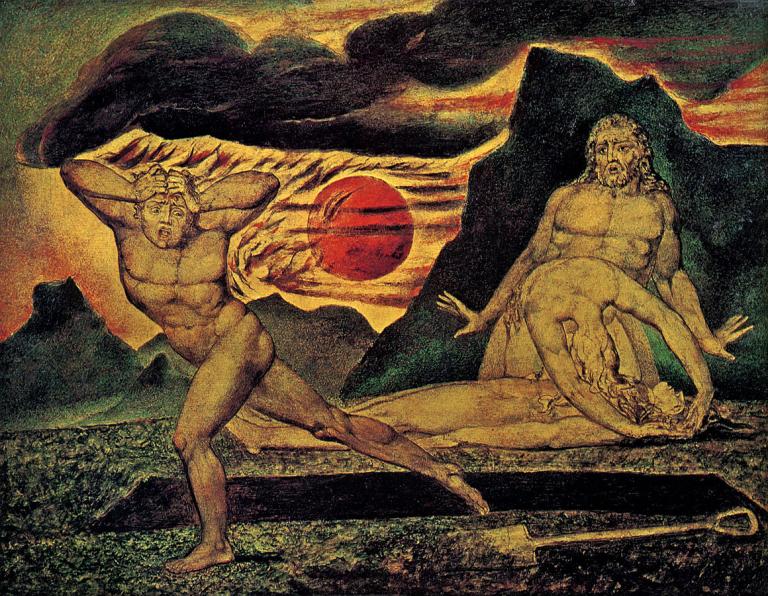
“The Body of Abel Found by Adam and Eve,” by William Blake, 1826 {{PD-US-Expired}}

This post reflects on the biblical story of humanity’s crisis or tragedy involving our original rebellion against God and its aftermath in Genesis 3 and 4. I also place it in the context of our contemporary society, engaging The Batman and East of Eden. In our seemingly eternal struggle with the tragic human condition, we often find comfort in tragic and heroic figures who seek to conquer despair and offer hope.
Fascination with Tragedy
Just like ancient people, we find tragic aspects of human existence fascinating. We rarely if ever find a story or movie believable and compelling if there are no tragic characters, elements, and events in the plot. Moreover, we often read or watch expectantly, wondering if the tales’ tragic figures will respond and if they will be able to climb out of the pit of depravity and despair to experience liberation.
Various traditions and classic works deal with the human crisis and hope of liberation. Buddhism’s diagnosis of the cause of suffering and the prescription for how to attain liberation is one enduring master narrative. Greek tragedies and human attempts to defy fate and experience freedom, as in the case of Oedipus Rex, linger long in the imagination. The biblical story of Adam and Eve’s fall into sin in Genesis 3 and their son Cain’s killing of his brother Abel in Genesis 4 take place east of Eden each and every generation, as John Steinbeck’s novel East of Eden illustrates.
In what immediately follows, I will present highlight reel material in the biblical story of the fall and its aftermath found in Genesis 3 and 4. Then I will turn to consider overlapping themes of tragedy and hope in The Batman and East of Eden.
Crisis Account Highlights in Genesis 3 and 4
Here are some select highlights from Genesis 3 and 4:
- The serpent, which Christian Scripture later associates with Satan, tricks the first couple into doubting and disobeying God’s Word (the command was recorded in Genesis 2). They eat the forbidden fruit from the tree of the knowledge of good and evil.
- The couple now become aware of their nakedness and hide from God on account of fear (and quite possibly guilt and shame).
- God goes in search of Adam and Eve.
- God judges the serpent as well as the couple for their rebellion. The fallout from humanity’s disobedience and cursed existence reaches every dimension of creaturely life.
- God casts Adam and Eve out the Garden of Eden so that they do not eat from the tree of life and live forever in their tragic condition. God also promises to deliver humanity from the serpent through the woman’s own seed.
- Adam and Eve’s son Cain becomes angry with his brother Abel because God favors him and his sacrifice.
- God warns Cain to resist sin and rule over it. Cain discounts God’s Word, choosing to do evil by killing his brother Abel.
- God curses Cain, removes him from his presence, and makes him a restless wanderer on the earth. And yet, God is merciful, protecting Cain from harm and granting Adam and Eve another child, Seth, in place of Abel.
More could be said about Genesis 3 and 4. But for the remainder of the post, we will talk more generally and existentially about the human fascination with tragedy and its aftermath and how we might respond with courage and hope.
Tragedies: Compelling Yet Overwhelming
I believe one of the reasons we often find tragedies so compelling is because they are relatable to our experience. Moreover, they can provide a sense of comfort that we are not alone in dealing with crises and seeking to overcome them. As the old saying goes, misery loves company, and in a variety of ways. Certainly, there are times when we seek to discount or avoid dealing with bad news. After all, there is only so much we can take. However, given how television and other news sources broadcast tragic events from across the globe, we find it very difficult to escape the deluge. It can become overwhelming. But so is our lot in life. Our crisis conditioning as humans can be overwhelming, and so we seek out tragic figures who are also heroic.
Tragic and Heroic Figures
We find one such tragic and heroic figure in the recent movie, The Batman. I read various sources that inspired Matt Reeve’s interpretation of the Batman played by Robert Pattinson. One finds that the movie’s theme song, Nirvana’s “Something in the Way,” is far from a coincidence. Nirvana’s front man, the late Kurt Cobain, inspired the Batman character. Reeves shares in an interview: “In that movie,” Reeves said, “you could really feel his [Pattinson’s] vulnerability and desperation, but you could also feel his power. I thought that was a great mix. He’s also got that Kurt Cobain thing, where he looks like a rock star, but you also feel like he could be a recluse.”
Contrary to what we might think, even great tragedies don’t leave us completely in despair. Certainly, billionaire Bruce Wayne, who is the Batman, endured daily the loss of his parents, who were murdered when he was a child. Later, as an adult, he witnesses their character assassination, as recounted in this unique or novel account of the superhero. But he did not allow evil to get the upper hand. Nor did he allow his depression to make him a complete recluse whereby he lived in isolation. He finds some level of solidarity with Alfred, the family butler who raised Bruce Wayne, Jim Gordon, Gotham’s city police commissioner, and the Catwoman. Together, they pursue justice in the seemingly unending battle with evil. The Batman harnessed his depression and turned his struggle with despair into a force for doing good, as one discerning, inspiring article conveys.
Interestingly, Martin Luther King, Jr., who struggled with deep depression throughout his life, also turned it into a force for good (Refer here). Similarly, in my estimation, Cobain sought to turn his abiding struggle with depression, mental illness, poor physical health, and addiction into forces for good. Songs like “Come As You Are,” “Dumb,” and “All Apologies” not only lead one to see his struggles and feel his pain, but express his empathy for those who experience life as recluses, always outside, wanting to get in. He opens the door so they can enter.
The Cain and Abel Story Revisited: East of Eden
Lastly, John Steinbeck tells us through Adam Trask that we need not, should not, allow despair to have the last word. Adam tells his son Cal, who represents Cain, that he need not always live to destroy. He can choose otherwise. In what follows, I draw from another Patheos post, “Bring it Home with John Steinbeck’s East of Eden,” where I recount the scene:
In Steinbeck’s East of Eden situated in and around Salinas, we encounter a man named Adam, who has two sons, Cal and Aron. Adam Trask’s son Cal is responsible in part for his brother Aron’s death. His pain over his father’s rejection of his gift in favor of his brother led him to seek to harm his brother (the same kind of favoritism and rejection were present in Adam Trask’s home when he was a boy). Cal exposed Aron to a dark family secret: their mother Cathy, who is hard and cold and who abandoned the family after the boys were born, makes her living running a house of prostitution. This revelation overwhelmed the innocent Aron and led him to make choices that resulted in his death (enlisting in the military and going off to fight in WW1 where he died).
Adam Trask is undone by the tragedy of Aron’s death. Paralyzed by a deadly stroke, he lies in bed. His Chinese servant Lee, who helped him raise the boys, seeks to reconcile Adam and his son Cal before Adam dies. At his bedside, Adam utters one word to Cal—the Hebrew word timshel. It is a word that God uttered to Cain as he wrestled with the temptation to sin against God and his brother. In East of Eden, it is interpreted as “Thou mayest” overcome sin. Even now, there is hope for Cal. Cal can change. He is not doomed to be evil like his mother, Cathy. He can live a new life. His father extends grace to him to free him with this word of hope. His father also changes in that he moves beyond a historic cycle of family favoritism to one of grace.
Restless Wanderers: In Search of Eternal Hope
All of us are from Salinas, California, which is where Steinbeck was raised. In other words, none of us live in a pristine garden. We all live east of Eden. But we don’t have to live as victims of our fallen state and societal environment or fractured family histories and personal cycles of dysfunction. We may overcome our acts of violence, rejection, haunting memories, and abandonment from the past. We can offer words of hope and live lives of grace toward others, just as God spared Cain from a similar fate to Abel’s east of Eden, as we bring the cosmic story home.
Each in their own way, Matt Reeves’ Batman, Kurt Cobain, and John Steinbeck’s retelling of the Cain and Abel story help us see that we are restless wanderers east of Eden. And yet, there is always hope. We can experience connection with others, find courage to face life’s tragedies, and operate with compassion for other restless wanderers.
Through it all, may we come to terms with the very real possibility that the God who kicked the first couple out of Eden only did so to spare them from a far greater evil—to take from the tree of life and live that tragic existence forever (See Genesis 3:21-24). God who promised to deliver them from the serpent’s snares through the woman’s seed (Genesis 3:15). This same God will provide a way out of no way so that Adam and Eve’s progeny may experience healing from the curse and flourish forever as his children by the tree of life in the city of God (Revelation 22:1-5).

About Paul Louis Metzger
Paul Louis Metzger, PhD, is Professor of Theology & Culture, Multnomah Biblical Seminary, Jessup University, Director of The Institute for Cultural Engagement: New Wine, New Wineskins, and author and editor of numerous works featuring theology, religion, philosophy, ethics, and contemporary culture. You can read more about the author here.
Previous Post

September 17, 2024
Pay Attention: Epiphanies Appear Suddenly and Unexpectedly
Next Post
September 30, 2024 Celebrate Human Dignity through Lament in a Therapeutic Age
Recent Comments
"Humility is a powerful weapon of mass construction. "On Palm Sunday, Jesus rides in triumph ..."
Holy Week Is Humble Week: “Beware ..."
"There is a new counter-apologetic method which is successfully being used against the arguments of ..."
Heavenly Father’s Day on Trinity Sunday
"A throwaway culture cannot be our way of proceeding was often emphasized by the late ..."
Excavating the Person in a Throwaway ..."
"Dr. Metzger, I appreciate your insight and transparency in this post. I have just added ..."
Embracing Emotions’ Full Range: From Grief ..."
Browse Our Archives
Select a Category Uncategorized
Select a Month June 2025 April 2025 March 2025 January 2025 December 2024 November 2024 October 2024 September 2024 August 2024 July 2024 June 2024 May 2024 April 2024 March 2024 February 2024 January 2024 December 2023 November 2023 October 2023 September 2023 August 2023 July 2023 June 2023 May 2023 April 2023 March 2023 February 2023 January 2023 December 2022 November 2022 October 2022 September 2022 August 2022 July 2022 June 2022 May 2022 April 2022 March 2022 February 2022 January 2022 December 2021 November 2021 October 2021 September 2021 August 2021 July 2021 June 2021 May 2021 April 2021 March 2021 February 2021 January 2021 December 2020 November 2020 October 2020 September 2020 August 2020 July 2020 June 2020 May 2020 April 2020 March 2020 February 2020 January 2020 December 2019 November 2019 October 2019 September 2019 August 2019 July 2019 June 2019 May 2019 April 2019 March 2019 February 2019 January 2019 December 2018 November 2018 October 2018 September 2018 August 2018 July 2018 June 2018 May 2018 April 2018 March 2018 February 2018 January 2018 December 2017 November 2017 October 2017 September 2017 August 2017 July 2017 June 2017 May 2017 April 2017 March 2017 February 2017 January 2017 December 2016 November 2016 October 2016 September 2016 August 2016 July 2016 June 2016 May 2016 April 2016 March 2016 February 2016 January 2016 December 2015 November 2015 October 2015 September 2015 August 2015 July 2015 June 2015 May 2015 April 2015 March 2015 February 2015 January 2015 December 2014 November 2014 October 2014 September 2014 August 2014 July 2014 June 2014 May 2014 April 2014 March 2014 February 2014 January 2014 December 2013 November 2013 October 2013 September 2013 August 2013 July 2013 June 2013 May 2013 April 2013 March 2013 February 2013 January 2013 December 2012 November 2012 October 2012 September 2012 August 2012 July 2012 June 2012 May 2012 April 2012 March 2012 February 2012
Follow Us!
TAKE THE
Religious Wisdom Quiz
Who predicted the birth of John the Baptist?
Select your answer to see how you score.
Gabriel Uriel Raphael Michael
Books by This Author Books by Paul Louis Metzger
Related posts from Uncommon God, Common Good
Bringing Hope Back to Life in the Valley...

Pentecost Sunday: Keep Your Eye on the Holy...

A Living Hope Is Revolutionary
Breaking Bad: Going from Bad to Worse East...
TRENDING AT PATHEOS Evangelical

How the author of the world's best hymn...
I've been working with John Newton for a while now. This makes...

Long before this Lectio Divina, Psalm 130 - the song - started...

What About the Trees? Another Living Parable
After I finished writing the last article about falling leaves as a...

Why Classical Education Is a Conversation, Not a...
Come and Read: Joy in Classical Education When I was a little...

Falling Leaves: A Living Parable on Letting Go
I’ve spent the vast majority of my life in the southeast corner...

Cornell University has received a great deal of negative publicity and intense...
view all Evangelical blogs
What Are Your Thoughts?leave a comment
Ad-Free & Subscriber Log-In Subscription Support
- About Us
- 2026 Calendar
- Videos
- Podcasts
- Library of World Religions
- Faith In Media Tracker
- Advertise With Us
- Write for Us
- Privacy Policy
- Terms of Service
- Do Not Sell My Data
- Contact Us
- Radiant Digital
- Manage Newsletter Subscriptions
- Unsubscribe From Notifications
- Sitemap
Copyright 2008-2026, Patheos. All rights reserved.
Subscription Support Ad-Free & Subscriber Log-In
Follow Patheos