
BuddhistCatholicContemplativeEvangelicalGeneral ChristianHinduJewishLatter-day SaintMuslimNew VisionsProgressive Christian
Beliefs
- Buddhist
- Catholic
- Contemplative
- Evangelical
- General Christian
- Hindu
- Jewish
- Latter-day Saint
- More Voices
- Muslim
- New Visions
- Pagan
- Progressive Christian
Topics
- Religion News
- Food and Religion
- Sports and Religion
- Religious Art
- Religious Music and Entertainment
- Religious Events
- History and Religion
- Style and Religion
- Politics and Religion
- Women in Religion
- Recreation Outdoors and Religion
- Business Finance and Religion
- Careers Workplace and Religion
- Education and Religion
- Family Parenting and Religion
- Health Fitness and Religion
- Home and Religion
- Relationships and Religion
- Technology and Religion
- Travel and Religion
Columnists
- Buddhist Columnists
- Business Finance and Religion Columnists
- Careers Workplace and Religion Columnists
- Catholic Columnists
- Contemplative Columnists
- Education and Religion Columnists
- Evangelists Columnists
- Family Parenting and Religion Columnists
- General Christian Columnists
- Health Fitness and Religion Columnists
- Hindu Columnists
- History and Religion Columnists
- Home and Religion Columnists
- Jewish Columnists
- More Voices Columnists
- Latter Day Columnists
- Muslim Columnists
- New Visions Columnists
- Nonreligious Columnists
- Pagan Columnists
- Politics and Religion Columnists
- Progressive Columnists
- Recreation Outdoors and Religion Columnists
- Relationships and Religion Columnists
- Religion News Columnists
- Religious Art Columnists
- Religious Events Columnists
- Religious Music and Entertainment Columnists
- Sports and Religion Columnists
- Style and Religion Columnists
- Technology and Religion Columnists
- Travel and Religion Columnists
- Women in Religion Columnists
Resource Library
- 2026 Calendar
- Library of World Religions
- The 100 Most Holy Places on Earth
- Patheos Answers
- Podcasts
- Videos
- Faith Leaders Database
- Anglican Episcopalian
- Bahai
- Baptist
- Buddhism
- Christianity
- Confucianism
- Eastern Orthodoxy
- Hinduism
- Holiness and Pentecostal
- ISKCON
- Islam
- Judaism
- Lutheran
- Methodist
- The Church of Jesus Christ of Latter-day Saints
- New Age
- Paganism
- Presbytarian and Reformed
- Protestantism
- Religion Behind the Scenes
- Roman Catholic
- Scientology
- Shia Islam
- Sikhism
- Sufism
- Sunni Islam
- Taoism
- Zen
- See all religions
Research Tools
 Ad-Free & Subscriber Log-In Subscription Support
Ad-Free & Subscriber Log-In Subscription Support
Follow Patheos 

- Trending:
- Forgiveness
- |
- Marriage
- |
- Consciousness
- |
- Death Penalty
- |
- Election
- |
- Halloween

- Home
- Evangelical
- Beyond Excarnation to Incarnation in Daily Life
Beyond Excarnation to Incarnation in Daily Life
Last updated on: September 15, 2024 at 7:30 am by Paul Louis Metzger
Beyond Excarnation to Incarnation in Daily Life 2024-09-15T07:30:05-07:00 Paul Louis Metzger
Patheos Explore the world's faith through different perspectives on religion and spirituality! Patheos has the views of the prevalent religions and spiritualities of the world.
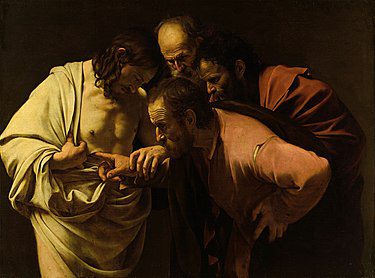
Caravaggio, “The Incredulity of Saint Thomas,” circa 1601-1602, Public Domain {{PD-US-Expired}}

It is one thing to believe in the incarnation. It is quite another to live it out. Of course, from an orthodox Christian vantage point, there is only one incarnation—Jesus of Nazareth, who is the eternal Word who became human flesh and blood (John 1:14). And yet, the Christian is called to participate through God’s Spirit in Jesus’ embodied life. In other words, love is active and embodied. This post highlights the importance of embodiment for various domains of life. Incarnation must replace excarnation.
Incarnation and Excarnation
In A Secular Age, Charles Taylor speaks of the struggle between incarnation and excarnation. All too often, the modern turn to reason led to an ‘all in the head’ way of being. One also finds this dynamic in Platonist thought in the ancient period. These paradigms promote excarnation. But from a Christian vantage point, which celebrates incarnation, it is essential to emphasize embodied reason and spirituality.
Thus, we must account for the importance of emotions, among other dimensions of our humanity. While it would be unwise and possibly dangerous to give free reign to emotional flurries, we must not discount emotions either. In fact, without the emotions and other aspects of our embodiment, we cannot attain fullness.
One only encounters God’s love known as “agape” in embodied terms. As Taylor reasons, “Agape moves outward from the guts; the New Testament word for ‘taking pity’, splangnizesthai, places the response in the bowels. We cease being able to make sense of this the more we go along with…self-alienating images,” which emerge from analyzing ourselves primarily through the media and virtual means or when viewing humans as “users of tools,” “separable instruments,” and “parts of systems.” Taylor claims, “Resurrection only makes sense when we take seriously enfleshment.” (740-741)
From Reductionism to Fullness
Taylor goes so far as to argue that to undo “disenchanting reductionism,” we must “rediscover the way in which life in our natural surroundings, as well as bodily feeling, bodily action, and bodily expression, can be channels of contact with fullness.” (766) Such enchantment from my vantage point is revealed not only in John 1:14, which speaks of the incarnate Word as the fullness of grace and truth, but also in Colossians 2:9-10 in contrast to proto-gnostic teachings that denigrated embodiment: “For all the fullness of deity dwells in bodily form, and you have been given fullness in him.”
I found Taylor’s reflection of how excarnation manifests itself in objectified knowledge most insightful and relevant to my own experience. He makes the following point in his engagement of Charles Péguy’s own critical analysis of modernity. Modernity exalted “disengaged reason as the royal road to knowledge, even in human affairs. The proper road to knowledge is by objectification,…” For Taylor, objectification entails “grasping the matter studied as something quite independent of us, where we don’t need to understand it all through our involvement with it, or the meanings it has in our lives…” He adds that “This view of what knowledge is tends to favour, without necessarily generating, a view of humanity which is ‘objectified’ in another sense, that is, understood as on all fours with non-human objects, understood in mechanistic terms, and in a determinist framework.” (746)
Objectivity vs. Objectification
I have witnessed this objectifying approach to humanity over the past three and a half years while caring for my adult son, who endured a catastrophic brain injury in January 2021. The scientific community is well known for approaching patients in objectifying terms. Objectivity has its rightful role, but what are the limits to safeguard human subjectivity and personhood? An article in The Journal of Medicine and Philosophy notes the problematic orientation involving objectification in the natural sciences and proposes a solution involving a balance between objective analysis of the body while accounting for the patient’s subjective account of what they are experiencing. The author, Fredrik Svenaeus, argues:
Objectification is no doubt a real problem in medicine and it can lead to bad medical practice or, in the worst case, dehumanization of the patient if not enveloped by a personalistic attitude. Nevertheless, objectification also plays a major and necessary role in medicine, the patient’s body should be viewed as a (malfunctioning) biological organism in order to find diseases and be able to cure them. The listening to the patient’s illness story should not be replaced, but, indeed, developed by the physical examination of his body searching for the causes of his complaints. Whereas phenomenologists have so far been keen on identifying the negative aspects of objectification in medicine, a more balanced strategy might be to discuss and analyze differences between medical objectifications that make the patient feel like being merely a body and the objectifications that do not deprive the patient of his subjectivity. This is what I intend to do in this paper. “Bad objectification” makes the patient feel like being a body instead of being a person, while “good objectification” makes the patient feel like a body but not in a way that is detrimental for his personhood. In some cases, which I will come back to, such good forms of objectification can even make the patient feel more at home with himself by incorporating a richer understanding of what goes on in the body.
The Incarnation and Holistic Care
The implication of the doctrine of the incarnation calls us to feel more at home in the world in which the eternal Word became flesh and blood, and in our own bodies, just as he did. It is important as the article indicates to treat the body objectively, while also accounting for the patient’s feelings and observations. Medical staff experience heavy demands on their time and so it proves especially difficult to take time to ease patients’ anxiety and to listen to them. Still, if doctors don’t listen to their patients, it can end up leading to misdiagnosis and wrong treatment.
A therapist specializing in neurological occupational therapy provides a wonderful balance between the two in caring for my son. The therapist carefully analyzes my son clinically as a biological organism. But she also accounts for his personhood, which is integral to his biological and neurological base, even in its severely damaged status. She speaks to Christopher by name, demonstrates incredible patience in waiting for him to respond, nimbly moves his hands, arms, and head, highlights miniscule and significant signs of progress, and instructs my wife and me scientifically, albeit in emotionally astute terms.
Incarnation and Spiritual Formation
How might the preceding discussion translate into the sphere of spiritual formation when dealing with suffering and trauma in order to cultivate resilience in a rationalistic and objectifying age? In short, the church needs to act in keeping with what it is, the body of Christ. We must account for one another fully, not simply cognitively or materialistically, but holistically, as Jesus’ people. Such holistic care involves knowing one another by name, listening to one another’s stories, affirming people’s emotional expressions, bearing patiently with one another in our emotional and physical struggles, and cultivating a sense that we can only experience spiritual fullness by celebrating the various dimensions of embodiment.
As stated at the outset of this blog post, it is one thing to believe in the incarnation. It is quite another to live it out. May we who are members of Christ’s body make every effort to operate as his hands and feet.

About Paul Louis Metzger
Paul Louis Metzger, PhD, is Professor of Theology & Culture, Multnomah Biblical Seminary, Jessup University, Director of The Institute for Cultural Engagement: New Wine, New Wineskins, and author and editor of numerous books and articles. You can read more about the author here.
Previous Post

September 2, 2024
How to Live to the Full: With Great Expectancy
Next Post
September 10, 2024 Prometheus Unbound: Finding Direction Home
Recent Comments
"Humility is a powerful weapon of mass construction. "On Palm Sunday, Jesus rides in triumph ..."
Holy Week Is Humble Week: “Beware ..."
"There is a new counter-apologetic method which is successfully being used against the arguments of ..."
Heavenly Father’s Day on Trinity Sunday
"A throwaway culture cannot be our way of proceeding was often emphasized by the late ..."
Excavating the Person in a Throwaway ..."
"Dr. Metzger, I appreciate your insight and transparency in this post. I have just added ..."
Embracing Emotions’ Full Range: From Grief ..."
Browse Our Archives
Select a Category Uncategorized
Select a Month June 2025 April 2025 March 2025 January 2025 December 2024 November 2024 October 2024 September 2024 August 2024 July 2024 June 2024 May 2024 April 2024 March 2024 February 2024 January 2024 December 2023 November 2023 October 2023 September 2023 August 2023 July 2023 June 2023 May 2023 April 2023 March 2023 February 2023 January 2023 December 2022 November 2022 October 2022 September 2022 August 2022 July 2022 June 2022 May 2022 April 2022 March 2022 February 2022 January 2022 December 2021 November 2021 October 2021 September 2021 August 2021 July 2021 June 2021 May 2021 April 2021 March 2021 February 2021 January 2021 December 2020 November 2020 October 2020 September 2020 August 2020 July 2020 June 2020 May 2020 April 2020 March 2020 February 2020 January 2020 December 2019 November 2019 October 2019 September 2019 August 2019 July 2019 June 2019 May 2019 April 2019 March 2019 February 2019 January 2019 December 2018 November 2018 October 2018 September 2018 August 2018 July 2018 June 2018 May 2018 April 2018 March 2018 February 2018 January 2018 December 2017 November 2017 October 2017 September 2017 August 2017 July 2017 June 2017 May 2017 April 2017 March 2017 February 2017 January 2017 December 2016 November 2016 October 2016 September 2016 August 2016 July 2016 June 2016 May 2016 April 2016 March 2016 February 2016 January 2016 December 2015 November 2015 October 2015 September 2015 August 2015 July 2015 June 2015 May 2015 April 2015 March 2015 February 2015 January 2015 December 2014 November 2014 October 2014 September 2014 August 2014 July 2014 June 2014 May 2014 April 2014 March 2014 February 2014 January 2014 December 2013 November 2013 October 2013 September 2013 August 2013 July 2013 June 2013 May 2013 April 2013 March 2013 February 2013 January 2013 December 2012 November 2012 October 2012 September 2012 August 2012 July 2012 June 2012 May 2012 April 2012 March 2012 February 2012
Follow Us!
TAKE THE
Religious Wisdom Quiz
According to Jesus, what defiles a person?
Select your answer to see how you score.
Clothing What comes out of the heart Food eaten Money
Books by This Author Books by Paul Louis Metzger
Related posts from Uncommon God, Common Good

As the World Turns: Planetary Rotation and Daily...

Heavenly Father’s Day on Trinity Sunday

Easter Triduum: Obey Your Thirst—for God

Holy Week Is Humble Week: "Beware of Becoming...
TRENDING AT PATHEOS Evangelical

How the author of the world's best hymn...
I've been working with John Newton for a while now. This makes...

Long before this Lectio Divina, Psalm 130 - the song - started...

What About the Trees? Another Living Parable
After I finished writing the last article about falling leaves as a...

Why Classical Education Is a Conversation, Not a...
Come and Read: Joy in Classical Education When I was a little...

Falling Leaves: A Living Parable on Letting Go
I’ve spent the vast majority of my life in the southeast corner...

Cornell University has received a great deal of negative publicity and intense...
view all Evangelical blogs
What Are Your Thoughts?leave a comment
Ad-Free & Subscriber Log-In Subscription Support
- About Us
- 2026 Calendar
- Videos
- Podcasts
- Library of World Religions
- Faith In Media Tracker
- Advertise With Us
- Write for Us
- Privacy Policy
- Terms of Service
- Do Not Sell My Data
- Contact Us
- Radiant Digital
- Manage Newsletter Subscriptions
- Unsubscribe From Notifications
- Sitemap
Copyright 2008-2026, Patheos. All rights reserved.
Subscription Support Ad-Free & Subscriber Log-In
Follow Patheos