
BuddhistCatholicContemplativeEvangelicalGeneral ChristianHinduJewishLatter-day SaintMuslimNew VisionsProgressive Christian
Beliefs
- Buddhist
- Catholic
- Contemplative
- Evangelical
- General Christian
- Hindu
- Jewish
- Latter-day Saint
- More Voices
- Muslim
- New Visions
- Pagan
- Progressive Christian
Topics
- Religion News
- Food and Religion
- Sports and Religion
- Religious Art
- Religious Music and Entertainment
- Religious Events
- History and Religion
- Style and Religion
- Politics and Religion
- Women in Religion
- Recreation Outdoors and Religion
- Business Finance and Religion
- Careers Workplace and Religion
- Education and Religion
- Family Parenting and Religion
- Health Fitness and Religion
- Home and Religion
- Relationships and Religion
- Technology and Religion
- Travel and Religion
Columnists
- Buddhist Columnists
- Business Finance and Religion Columnists
- Careers Workplace and Religion Columnists
- Catholic Columnists
- Contemplative Columnists
- Education and Religion Columnists
- Evangelists Columnists
- Family Parenting and Religion Columnists
- General Christian Columnists
- Health Fitness and Religion Columnists
- Hindu Columnists
- History and Religion Columnists
- Home and Religion Columnists
- Jewish Columnists
- More Voices Columnists
- Latter Day Columnists
- Muslim Columnists
- New Visions Columnists
- Nonreligious Columnists
- Pagan Columnists
- Politics and Religion Columnists
- Progressive Columnists
- Recreation Outdoors and Religion Columnists
- Relationships and Religion Columnists
- Religion News Columnists
- Religious Art Columnists
- Religious Events Columnists
- Religious Music and Entertainment Columnists
- Sports and Religion Columnists
- Style and Religion Columnists
- Technology and Religion Columnists
- Travel and Religion Columnists
- Women in Religion Columnists
Resource Library
- 2026 Calendar
- Library of World Religions
- The 100 Most Holy Places on Earth
- Patheos Answers
- Podcasts
- Videos
- Faith Leaders Database
- Anglican Episcopalian
- Bahai
- Baptist
- Buddhism
- Christianity
- Confucianism
- Eastern Orthodoxy
- Hinduism
- Holiness and Pentecostal
- ISKCON
- Islam
- Judaism
- Lutheran
- Methodist
- The Church of Jesus Christ of Latter-day Saints
- New Age
- Paganism
- Presbytarian and Reformed
- Protestantism
- Religion Behind the Scenes
- Roman Catholic
- Scientology
- Shia Islam
- Sikhism
- Sufism
- Sunni Islam
- Taoism
- Zen
- See all religions
Research Tools
 Ad-Free & Subscriber Log-In Subscription Support
Ad-Free & Subscriber Log-In Subscription Support
Follow Patheos 

- Trending:
- Forgiveness
- |
- Marriage
- |
- Consciousness
- |
- Death Penalty
- |
- Election
- |
- Halloween

- Home
- Evangelical
- Health, Fitness and Religion
- Reenchanting Patient Care in a Disenchanted Age
Reenchanting Patient Care in a Disenchanted Age
Last updated on: March 2, 2024 at 5:34 pm by Paul Louis Metzger
Reenchanting Patient Care in a Disenchanted Age 2024-03-02T17:34:01-08:00 Paul Louis Metzger
Patheos Explore the world's faith through different perspectives on religion and spirituality! Patheos has the views of the prevalent religions and spiritualities of the world.
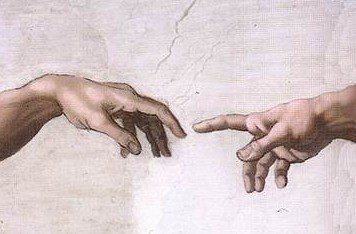
“The Creation of Adam,” part of Sistine Chapel ceiling, fresco by Michelangelo, 1509 {{PD-US-expired}}

The mindset of autonomy, objectivity, and detachment dominates so many aspects of our society. I often see it on display in the medical community and in the marketplace.
Philosopher Charles Taylor’s concept of the “bounded” or “buffered” self in his magisterial work, A Secular Age, not only reflects the secular age’s view of humanity in relation to a transcendent or spiritual realm. It also manifests itself in our relation to one another (For a brief reflection on his treatment of the “buffered” self, see pages 37-42).
The “buffered” self has replaced the traditional view of reality as “porous” where transcendent forces, those beyond space and time, penetrate and influence us. To use Max Weber’s famous term “disenchantment,” we live in a disenchanted age. Similarly, we wander about in a disengaged epoch.
Far too often, our society views life in transactional terms, whereby we enter into and pull out of contractual agreements without really being affected by them. We presume that we remain detached from one another but fail to realize that the more we commodify relationships the less human we become. Similarly, we can view one another as lab specimens to dissect, not realizing that we cut ourselves in the process of dismemberment.
I have witnessed dismemberment for over three years now in certain quarters of the medical community. Unfortunately, all too often a medical expert’s professional analysis does not account for what our family medical advisor Dr. Robert Lyman Potter calls “intuitive feeling.” And for all their talk of objectivity, determinations to discount others’ observations out of hand because they have not observed them goes beyond scientific analysis. That is not an objective move, but a subjective determination. It leads me to wonder if Søren Kierkegaard was right when he argued that every claim of objectivity involves a sense of veiled subjectivity.
Certainly, scientific observation is critical when the medical professional assigns values and judgments to what they perceive and test. The impressive findings of modern science result from such objectivity. But there are limits to this approach, as Taylor and Potter also argue (See for example Taylor, A Secular Age, 285-287).
For example, our son Christopher often responds differently to loved ones and caregivers who know him well than to outside clinical observers. After all, he is not an automaton. He is not a buffered, but porous self who even in his minimally conscious state can feel and intuit the approach others take to him.
I have witnessed countless times when I think Christopher’s motions are reflexive rather than reflective. Similarly, I have also witnessed a great variety of situations where Christopher is responding consciously. It is not a coincidence that those closest to him are those who comment on his responsiveness. Perhaps at times they project conscious control, but there are others whom I believe dismiss out of hand what non-specialist observers who are empathically and intuitively connected perceive.
I also find such dismemberment in play when dealing with patients’ families. While patients are rightly the primary focus of all care, the patient does not exist in a vacuum. There is a vital sense in which, as Dr. Potter said to me, the patient is Christopher and the family, not Christopher alone. When one discounts the family’s perspectives and refuses to involve them in the care giving process, one hurts the primary patient. Such buffering cuts off the emotional circulation that is needed to maximize opportunities for the possibility of meaningful recovery.
One must account for the holistic dimensions of our humanity, which the social sciences are intended to do, if we are to make a comprehensive assessment of the person who is a patient. We must juxtapose the various disciplines so that the natural and human sciences relate to one another in porous terms rather than discount one another in a buffered way. Otherwise, we will be left with a dismembered view of the human patient, whereby their social and natural aspects of their identity are completely separate, leaving them as a ghost in a machine.
Interestingly enough, Dr. Potter who resonates with my reflections did not come upon this holistic and expansive view of medical practice and ethics in a vacuum. His own course of studies took him beyond the realm of pursuing his doctorate and professorship in medicine at the University of Kansas to obtaining a doctorate in religion, psychology, and ethics at the University of Chicago Divinity School. As personalist ethicists in our respective spheres, we agree that proper assessment of a patient should not be limited to the professional making objective evaluations in a hermetically sealed environment but expanded to include the social matrix of those closest to the patient, whether family, friends, or those caregivers who provide the most intimate care.
We need to open up our emotional pores and not buffer ourselves from assigning meaning and value to interpersonal connections and how they may very well impact a patient’s care. While emotions should not have free reign and cloud careful testing and analysis, which the natural sciences prize, the medical community must account for them in making comprehensive judgments. It is vital that all healthcare professionals integrate the scientific method involving technological precision with keen compassionate engagement.
We must work together in society to re-enchant the universe of patient care. Such re-enchantment does not involve talk of angelic interventions and demonic intrusions or alchemy dictating and distorting scientific analysis and exchanges. Rather, it requires that we do not quench but expand the human spirit in all medical clinical encounters and social interactions.
Health, Fitness and Religion
Family, Parenting and Religion

About Paul Louis Metzger
Paul Louis Metzger, Ph.D., is Professor of Theology & Culture, Multnomah University & Seminary; Director of The Institute for Cultural Engagement: New Wine, New Wineskins; and author and editor of numerous works, including More Than Things: A Personalist Ethics for a Throwaway Culture (IVP Academic, 2023). You can read more about the author here.
Previous Post
February 3, 2024
Stimulate Growth by Grace
Next Post
March 24, 2024 Living with Palms Joined: A Palm Sunday Meditation
Recent Comments
"Humility is a powerful weapon of mass construction. "On Palm Sunday, Jesus rides in triumph ..."
Holy Week Is Humble Week: “Beware ..."
"There is a new counter-apologetic method which is successfully being used against the arguments of ..."
Heavenly Father’s Day on Trinity Sunday
"A throwaway culture cannot be our way of proceeding was often emphasized by the late ..."
Excavating the Person in a Throwaway ..."
"Dr. Metzger, I appreciate your insight and transparency in this post. I have just added ..."
Embracing Emotions’ Full Range: From Grief ..."
Browse Our Archives
Select a Category Uncategorized
Select a Month June 2025 April 2025 March 2025 January 2025 December 2024 November 2024 October 2024 September 2024 August 2024 July 2024 June 2024 May 2024 April 2024 March 2024 February 2024 January 2024 December 2023 November 2023 October 2023 September 2023 August 2023 July 2023 June 2023 May 2023 April 2023 March 2023 February 2023 January 2023 December 2022 November 2022 October 2022 September 2022 August 2022 July 2022 June 2022 May 2022 April 2022 March 2022 February 2022 January 2022 December 2021 November 2021 October 2021 September 2021 August 2021 July 2021 June 2021 May 2021 April 2021 March 2021 February 2021 January 2021 December 2020 November 2020 October 2020 September 2020 August 2020 July 2020 June 2020 May 2020 April 2020 March 2020 February 2020 January 2020 December 2019 November 2019 October 2019 September 2019 August 2019 July 2019 June 2019 May 2019 April 2019 March 2019 February 2019 January 2019 December 2018 November 2018 October 2018 September 2018 August 2018 July 2018 June 2018 May 2018 April 2018 March 2018 February 2018 January 2018 December 2017 November 2017 October 2017 September 2017 August 2017 July 2017 June 2017 May 2017 April 2017 March 2017 February 2017 January 2017 December 2016 November 2016 October 2016 September 2016 August 2016 July 2016 June 2016 May 2016 April 2016 March 2016 February 2016 January 2016 December 2015 November 2015 October 2015 September 2015 August 2015 July 2015 June 2015 May 2015 April 2015 March 2015 February 2015 January 2015 December 2014 November 2014 October 2014 September 2014 August 2014 July 2014 June 2014 May 2014 April 2014 March 2014 February 2014 January 2014 December 2013 November 2013 October 2013 September 2013 August 2013 July 2013 June 2013 May 2013 April 2013 March 2013 February 2013 January 2013 December 2012 November 2012 October 2012 September 2012 August 2012 July 2012 June 2012 May 2012 April 2012 March 2012 February 2012
Follow Us!
TAKE THE
Religious Wisdom Quiz
The night of the Passover what did Israel have to do so their firstborn wouldn't die?
Select your answer to see how you score.
Go to Sleep Take a Bath Put blood around the door of their homes Change Clothes
Books by This Author Books by Paul Louis Metzger
Related posts from Uncommon God, Common Good

Heavenly Father’s Day on Trinity Sunday

Easter Triduum: Obey Your Thirst—for God

Holy Week Is Humble Week: "Beware of Becoming...

Excavating the Person in a Throwaway Culture
TRENDING AT PATHEOS Evangelical

The REST of Your Life: A Creative Wrestles...
This week I had a conversation with a good friend from church....

How the author of the world's best hymn...
I've been working with John Newton for a while now. This makes...

Long before this Lectio Divina, Psalm 130 - the song - started...

What About the Trees? Another Living Parable
After I finished writing the last article about falling leaves as a...

Why Classical Education Is a Conversation, Not a...
Come and Read: Joy in Classical Education When I was a little...

Cornell University has received a great deal of negative publicity and intense...
view all Evangelical blogs
What Are Your Thoughts?leave a comment
Ad-Free & Subscriber Log-In Subscription Support
- About Us
- 2026 Calendar
- Videos
- Podcasts
- Library of World Religions
- Faith In Media Tracker
- Advertise With Us
- Write for Us
- Privacy Policy
- Terms of Service
- Do Not Sell My Data
- Contact Us
- Radiant Digital
- Manage Newsletter Subscriptions
- Unsubscribe From Notifications
- Sitemap
Copyright 2008-2026, Patheos. All rights reserved.
Subscription Support Ad-Free & Subscriber Log-In
Follow Patheos