
BuddhistCatholicContemplativeEvangelicalGeneral ChristianHinduJewishLatter-day SaintMuslimNew VisionsProgressive Christian
Beliefs
- Buddhist
- Catholic
- Contemplative
- Evangelical
- General Christian
- Hindu
- Jewish
- Latter-day Saint
- More Voices
- Muslim
- New Visions
- Pagan
- Progressive Christian
Topics
- Religion News
- Food and Religion
- Sports and Religion
- Religious Art
- Religious Music and Entertainment
- Religious Events
- History and Religion
- Style and Religion
- Politics and Religion
- Women in Religion
- Recreation Outdoors and Religion
- Business Finance and Religion
- Careers Workplace and Religion
- Education and Religion
- Family Parenting and Religion
- Health Fitness and Religion
- Home and Religion
- Relationships and Religion
- Technology and Religion
- Travel and Religion
Columnists
- Buddhist Columnists
- Business Finance and Religion Columnists
- Careers Workplace and Religion Columnists
- Catholic Columnists
- Contemplative Columnists
- Education and Religion Columnists
- Evangelists Columnists
- Family Parenting and Religion Columnists
- General Christian Columnists
- Health Fitness and Religion Columnists
- Hindu Columnists
- History and Religion Columnists
- Home and Religion Columnists
- Jewish Columnists
- More Voices Columnists
- Latter Day Columnists
- Muslim Columnists
- New Visions Columnists
- Nonreligious Columnists
- Pagan Columnists
- Politics and Religion Columnists
- Progressive Columnists
- Recreation Outdoors and Religion Columnists
- Relationships and Religion Columnists
- Religion News Columnists
- Religious Art Columnists
- Religious Events Columnists
- Religious Music and Entertainment Columnists
- Sports and Religion Columnists
- Style and Religion Columnists
- Technology and Religion Columnists
- Travel and Religion Columnists
- Women in Religion Columnists
Resource Library
- 2026 Calendar
- Library of World Religions
- The 100 Most Holy Places on Earth
- Patheos Answers
- Podcasts
- Videos
- Faith Leaders Database
- Anglican Episcopalian
- Bahai
- Baptist
- Buddhism
- Christianity
- Confucianism
- Eastern Orthodoxy
- Hinduism
- Holiness and Pentecostal
- ISKCON
- Islam
- Judaism
- Lutheran
- Methodist
- The Church of Jesus Christ of Latter-day Saints
- New Age
- Paganism
- Presbytarian and Reformed
- Protestantism
- Religion Behind the Scenes
- Roman Catholic
- Scientology
- Shia Islam
- Sikhism
- Sufism
- Sunni Islam
- Taoism
- Zen
- See all religions
Research Tools
 Ad-Free & Subscriber Log-In Subscription Support
Ad-Free & Subscriber Log-In Subscription Support
Follow Patheos 

- Trending:
- Forgiveness
- |
- Marriage
- |
- Consciousness
- |
- Death Penalty
- |
- Election
- |
- Halloween

- Home
- Evangelical
- If Hell Is Other People, What Is Heaven?
If Hell Is Other People, What Is Heaven?
Last updated on: April 20, 2023 at 9:19 am by Paul Louis Metzger
If Hell Is Other People, What Is Heaven? 2023-04-20T09:19:39-07:00 Paul Louis Metzger
Patheos Explore the world's faith through different perspectives on religion and spirituality! Patheos has the views of the prevalent religions and spiritualities of the world.
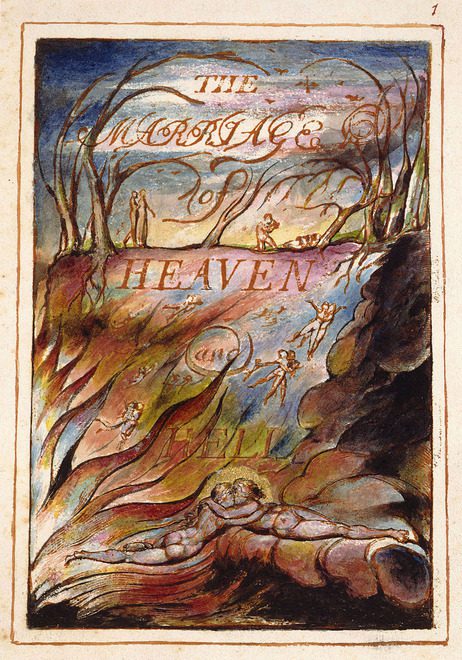
“The Marriage of Heaven and Hell,” William Blake, 1827; Source/Photographer: The William Blake Archive {{PD-US-expired}}.

If Hell is other people, what is Heaven? Here I riff on a statement taken from Jean Paul Sartre’s play “No Exit” to reflect not only upon Hell, but also upon Heaven.
Jean Paul Sarte’s play “No Exit” is about three individuals trapped forever in Hell. They are confined to a room that is locked from the outside. They cannot close their eyes or escape one another’s apprehension and judgment. One of the characters laments at one point, “Hell Is Other People.” It is an oft-misunderstood statement. Sartre did not mean that all our relations are hellish, but that we judge ourselves based on others’ judgments of us. Here’s Sartre’s transcribed explanation taken from a recording made in 1965:
. . .“hell is other people” has always been misunderstood. It has been thought that what I meant by that was that our relations with other people are always poisoned, that they are invariably hellish relations. But what I really mean is something totally different. I mean that if relations with someone else are twisted, vitiated, then that other person can only be hell. Why? Because. . . when we think about ourselves, when we try to know ourselves, . . . we use the knowledge of us which other people already have. We judge ourselves with the means other people have and have given us for judging ourselves. Into whatever I say about myself someone else’s judgment always enters. Into whatever I feel within myself someone else’s judgment enters. . . . But that does not at all mean that one cannot have relations with other people. It simply brings out the capital importance of all other people for each one of us.
As one commentator on the play makes clear, there are no mirrors in Hell. The only way we come to perceive ourselves is through one another, that is, the “Other’s” distorted reflection or perception of us. Perhaps one could even say we are ‘trapped’ or ‘stuck’ in this web of judgments of one another and ourselves.
It is important that we try to perceive and interpret Sartre rightly. It is also important that we perceive and reflect upon one another and ourselves rightly. However, regardless of what Sartre argued, there is a very real sense in which our judgments of one another and ourselves are distorted and in turn easily distort us. Left to ourselves, our relations with one another could easily become hellish. This is especially the case if, as for Martin Luther, our sinful condition traps us in self-absorbed patterns of love, not unlike the demons in C.S. Lewis’s Screwtape Letters, which I discussed in a recent post. Luther writes of our sinful will: “It knows nothing but its own good, or what is good and honorable and useful for itself, but not what is good for God and other people. Therefore it knows and wills more what is particular, yes, only what is an individual good. And this is in agreement with Scripture, which describes man as so turned in on himself that he uses not only physical but even spiritual goods for his own purposes and in all things seeks only himself.” (Martin Luther, Lectures on Romans, trans. Jacob A. O. Preus and Walter Tillmanns, Vol. 25 in Luther’s Works. Edited by Hilton C. Oswald {Saint Louis: Concordia, 1972}, 345.)
Scripture teaches that Hell was made for the devil and his angels (Matthew 25:41), not humans. In contrast to Hell, which is locked inside from the human heart closed off to the God of second chances, the gates of Heaven always remain open (Revelation 21:25). God does not treat us as self-fulfilling prophecies. There is no condemnation for those who are in Christ Jesus (Romans 8:1).
Sartre was a devout atheist and did not believe in a literal Hell. Even so, whether there are mirrors in Hell, I am left to wonder if there are any mirrors in Heaven. Perhaps there is no need for mirrors if God’s view of us frames the narrative.
Perhaps Heaven is where we see one another rightly, where God’s perspective of us takes precedence and reframes our self-understanding and our understanding of our neighbor. Perhaps God even helps us see one another in ourselves, though not in a way that involves sinful, self-absorption. God alone sees rightly. God accounts for the whole of our lives in making judgments. Moreover, God sees those who look to Christ in Christ and not outside him. God brings love centered in Christ to bear upon the perception of us in a way that offers hope. Rather than become self-fulfilling prophecies where we falter and fail based on people’s negative projections of us, we rise to new heights as we no longer see others from a merely human point of view, but in Christ.
Here I call to mind the Apostle Paul’s words to the Corinthian church, which perceived God, Paul, and one another in very distorted ways:
So, from now on we regard no one from a worldly point of view. Though we once regarded Christ in this way, we do so no longer. Therefore, if anyone is in Christ, the new creation has come: The old has gone, the new is here! All this is from God, who reconciled us to himself through Christ and gave us the ministry of reconciliation: that God was reconciling the world to himself in Christ, not counting people’s sins against them. And he has committed to us the message of reconciliation. We are therefore Christ’s ambassadors, as though God were making his appeal through us. We implore you on Christ’s behalf: Be reconciled to God. God made him who had no sin to be sin for us, so that in him we might become the righteousness of God. (2 Corinthians 5:16-21; NIV)
In an earlier letter, he instructs the Corinthian church about how love leads us to perceive people rightly: “Love is patient, love is kind. It does not envy, it does not boast, it is not proud. It does not dishonor others, it is not self-seeking, it is not easily angered, it keeps no record of wrongs. Love does not delight in evil but rejoices with the truth. It always protects, always trusts, always hopes, always perseveres.” (1 Corinthians 14:4-7; NIV)
Sound perceptions and judgments do not ignore mistakes, faulty desires, and problematic relational patterns and behaviors. But when love enters, it reframes our perspective so that we do not become self-fulfilling prophecies leading to Hell. Rather than fixating on the errors, weaknesses, and sins of others and ourselves, love leads us to operate with hope and the expectation that better days are ahead.
Self-fulfilling prophecies that lead people to falter and fail cease when we look upon others and ourselves with a heavenly gaze. Such faulty perceptions are replaced by great expectations that we are made for more and that we will be raised immortal as glorious reflections of Christ Jesus, the ultimate image of God. If Hell involves distorted judgments leading to self-fulfilling prophecies and eternal death, Heaven is where God’s faithful, hopeful, and loving judgment in Christ Jesus brings us eternally new beginnings of life.

About Paul Louis Metzger
Paul Louis Metzger, Ph.D., is Professor of Theology & Culture, Multnomah University & Seminary; Director of The Institute for Cultural Engagement: New Wine, New Wineskins; and Author and Editor of numerous works, including Connecting Christ: How to Discuss Jesus in a World of Diverse Paths (Thomas Nelson, 2012). You can read more about the author here.
Previous Post

April 16, 2023
Divine Mercies Sunday and Everyday Occurrences
Next Post

April 22, 2023 To Capitulate or Recapitulate? That Is the Question.
Recent Comments
"Humility is a powerful weapon of mass construction. "On Palm Sunday, Jesus rides in triumph ..."
Holy Week Is Humble Week: “Beware ..."
"There is a new counter-apologetic method which is successfully being used against the arguments of ..."
Heavenly Father’s Day on Trinity Sunday
"A throwaway culture cannot be our way of proceeding was often emphasized by the late ..."
Excavating the Person in a Throwaway ..."
"Dr. Metzger, I appreciate your insight and transparency in this post. I have just added ..."
Embracing Emotions’ Full Range: From Grief ..."
Browse Our Archives
Select a Category Uncategorized
Select a Month June 2025 April 2025 March 2025 January 2025 December 2024 November 2024 October 2024 September 2024 August 2024 July 2024 June 2024 May 2024 April 2024 March 2024 February 2024 January 2024 December 2023 November 2023 October 2023 September 2023 August 2023 July 2023 June 2023 May 2023 April 2023 March 2023 February 2023 January 2023 December 2022 November 2022 October 2022 September 2022 August 2022 July 2022 June 2022 May 2022 April 2022 March 2022 February 2022 January 2022 December 2021 November 2021 October 2021 September 2021 August 2021 July 2021 June 2021 May 2021 April 2021 March 2021 February 2021 January 2021 December 2020 November 2020 October 2020 September 2020 August 2020 July 2020 June 2020 May 2020 April 2020 March 2020 February 2020 January 2020 December 2019 November 2019 October 2019 September 2019 August 2019 July 2019 June 2019 May 2019 April 2019 March 2019 February 2019 January 2019 December 2018 November 2018 October 2018 September 2018 August 2018 July 2018 June 2018 May 2018 April 2018 March 2018 February 2018 January 2018 December 2017 November 2017 October 2017 September 2017 August 2017 July 2017 June 2017 May 2017 April 2017 March 2017 February 2017 January 2017 December 2016 November 2016 October 2016 September 2016 August 2016 July 2016 June 2016 May 2016 April 2016 March 2016 February 2016 January 2016 December 2015 November 2015 October 2015 September 2015 August 2015 July 2015 June 2015 May 2015 April 2015 March 2015 February 2015 January 2015 December 2014 November 2014 October 2014 September 2014 August 2014 July 2014 June 2014 May 2014 April 2014 March 2014 February 2014 January 2014 December 2013 November 2013 October 2013 September 2013 August 2013 July 2013 June 2013 May 2013 April 2013 March 2013 February 2013 January 2013 December 2012 November 2012 October 2012 September 2012 August 2012 July 2012 June 2012 May 2012 April 2012 March 2012 February 2012
Follow Us!
TAKE THE
Religious Wisdom Quiz
In Isaiah 40, what voice cries out to prepare the way for the Lord?
Select your answer to see how you score.
A trumpet blasting A child singing A voice in the wilderness A lion roaring
Books by This Author Books by Paul Louis Metzger
Related posts from Uncommon God, Common Good

Heavenly Father’s Day on Trinity Sunday

Easter Triduum: Obey Your Thirst—for God

Holy Week Is Humble Week: "Beware of Becoming...

Excavating the Person in a Throwaway Culture
TRENDING AT PATHEOS Evangelical

The REST of Your Life: A Creative Wrestles...
This week I had a conversation with a good friend from church....

How the author of the world's best hymn...
I've been working with John Newton for a while now. This makes...

Long before this Lectio Divina, Psalm 130 - the song - started...

What About the Trees? Another Living Parable
After I finished writing the last article about falling leaves as a...

Why Classical Education Is a Conversation, Not a...
Come and Read: Joy in Classical Education When I was a little...

Cornell University has received a great deal of negative publicity and intense...
view all Evangelical blogs
What Are Your Thoughts?leave a comment
Ad-Free & Subscriber Log-In Subscription Support
- About Us
- 2026 Calendar
- Videos
- Podcasts
- Library of World Religions
- Faith In Media Tracker
- Advertise With Us
- Write for Us
- Privacy Policy
- Terms of Service
- Do Not Sell My Data
- Contact Us
- Radiant Digital
- Manage Newsletter Subscriptions
- Unsubscribe From Notifications
- Sitemap
Copyright 2008-2026, Patheos. All rights reserved.
Subscription Support Ad-Free & Subscriber Log-In
Follow Patheos