
BuddhistCatholicContemplativeEvangelicalGeneral ChristianHinduJewishLatter-day SaintMuslimNew VisionsProgressive Christian
Beliefs
- Buddhist
- Catholic
- Contemplative
- Evangelical
- General Christian
- Hindu
- Jewish
- Latter-day Saint
- More Voices
- Muslim
- New Visions
- Pagan
- Progressive Christian
Topics
- Religion News
- Food and Religion
- Sports and Religion
- Religious Art
- Religious Music and Entertainment
- Religious Events
- History and Religion
- Style and Religion
- Politics and Religion
- Women in Religion
- Recreation Outdoors and Religion
- Business Finance and Religion
- Careers Workplace and Religion
- Education and Religion
- Family Parenting and Religion
- Health Fitness and Religion
- Home and Religion
- Relationships and Religion
- Technology and Religion
- Travel and Religion
Columnists
- Buddhist Columnists
- Business Finance and Religion Columnists
- Careers Workplace and Religion Columnists
- Catholic Columnists
- Contemplative Columnists
- Education and Religion Columnists
- Evangelists Columnists
- Family Parenting and Religion Columnists
- General Christian Columnists
- Health Fitness and Religion Columnists
- Hindu Columnists
- History and Religion Columnists
- Home and Religion Columnists
- Jewish Columnists
- More Voices Columnists
- Latter Day Columnists
- Muslim Columnists
- New Visions Columnists
- Nonreligious Columnists
- Pagan Columnists
- Politics and Religion Columnists
- Progressive Columnists
- Recreation Outdoors and Religion Columnists
- Relationships and Religion Columnists
- Religion News Columnists
- Religious Art Columnists
- Religious Events Columnists
- Religious Music and Entertainment Columnists
- Sports and Religion Columnists
- Style and Religion Columnists
- Technology and Religion Columnists
- Travel and Religion Columnists
- Women in Religion Columnists
Resource Library
- 2026 Calendar
- Library of World Religions
- The 100 Most Holy Places on Earth
- Patheos Answers
- Podcasts
- Videos
- Faith Leaders Database
- Anglican Episcopalian
- Bahai
- Baptist
- Buddhism
- Christianity
- Confucianism
- Eastern Orthodoxy
- Hinduism
- Holiness and Pentecostal
- ISKCON
- Islam
- Judaism
- Lutheran
- Methodist
- The Church of Jesus Christ of Latter-day Saints
- New Age
- Paganism
- Presbytarian and Reformed
- Protestantism
- Religion Behind the Scenes
- Roman Catholic
- Scientology
- Shia Islam
- Sikhism
- Sufism
- Sunni Islam
- Taoism
- Zen
- See all religions
Research Tools
 Ad-Free & Subscriber Log-In Subscription Support
Ad-Free & Subscriber Log-In Subscription Support
Follow Patheos 

- Trending:
- Forgiveness
- |
- Marriage
- |
- Consciousness
- |
- Death Penalty
- |
- Election
- |
- Halloween

- Home
- Evangelical
- Advent and Jesus’ Upside-Down Kingdom Peace
Advent and Jesus’ Upside-Down Kingdom Peace
Last updated on: December 21, 2021 at 9:00 am by Paul Louis Metzger
Advent and Jesus’ Upside-Down Kingdom Peace 2021-12-21T09:00:31-08:00 Paul Louis Metzger
Patheos Explore the world's faith through different perspectives on religion and spirituality! Patheos has the views of the prevalent religions and spiritualities of the world.
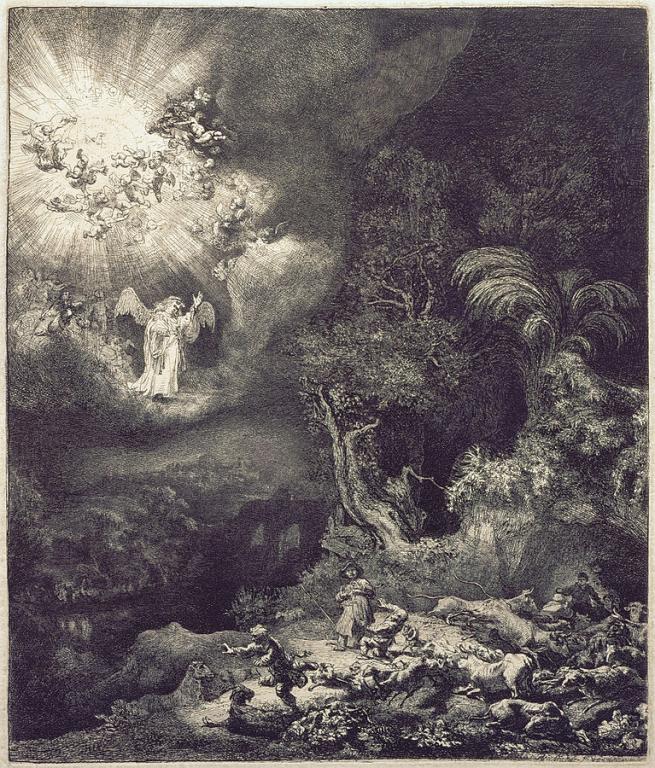
Rembrandt, The Angel Appearing to the Shepherds, 1634 {{US-PD-expired}}.

This week many churches lit the Angel’s Candle on the Advent Wreath. The Angel’s Candle symbolizes peace in keeping with the angelic host’s declaration: “Glory to God in the highest heaven, and on earth peace to those on whom his favor rests” (Luke 2:14; NIV).
Luke’s Gospel connects peace with Jesus’ presence and God’s glory. We find a similar statement in Luke 19. At the Triumphal Entry into Jerusalem, Jesus’ crowd of disciples rather than the angelic host cries out: “Blessed is the king who comes in the name of the Lord! Peace in heaven and glory in the highest!” (Luke 19:38; NIV)
Not everyone associated peace with Jesus’ coming. While the angels and the disciples connected peace with Jesus’ arrival on earth and in Jerusalem, the canonical gospels like Matthew and Luke also reveal that the political and religious authorities were troubled at Jesus’ appearance. Herod sought to kill the infant or toddler Jesus (Matthew 2:3, 13) and the religious authorities sought to silence the people’s praise (Luke 19:39). These reactions signify that they saw Jesus as a threat to the dominant systems in place. Jesus’ peace involves his glorious upside-down kingdom reign that destabilizes power structures that benefit the high and mighty and discount the lowly.
The most pronounced contrast may be between Jesus’ peace and Rome’s peace, which ruled the known world in Jesus’ day. Herod and the religious establishment were subject to Roman rule. The Pax Christi or peace of Christ stands opposed to the Pax Romana—the Roman Peace. Jesus did not/does not operate according to its standards, or any other empire’s peace through the ages.
What was the Roman Peace in Jesus’ time? Yale University Press’s description of Adrian Goldsworthy’s book titled Pax Romana: War, Peace and Conquest in the Roman World provides a succinct and helpful answer: the Roman Peace was “the famous peace and prosperity brought by the Roman Empire at its height in the first and second centuries AD. Yet the Romans were conquerors, imperialists who took by force a vast empire stretching from the Euphrates to the Atlantic coast. Ruthless, Romans won peace not through coexistence but through dominance; millions died and were enslaved during the creation of their empire.”
In contrast to the Romans, who ruled by violence and retribution and who kept the masses down, Jesus elevates the meek (Matthew 5:5) and peacemakers (Matthew 5:9). The meek control or bridle their strength. They know that left to themselves, they will only bring destruction. They hunger and thirst for God’s righteousness, mourning their souls’ impoverished condition as those who are spiritually bankrupt (See Matthew 5:3-6). No wonder the meek will inherit the earth (Matthew 5:3). There would be nothing left of the earth if the violent and retributive Romans were ultimately to inherit it. The meek are peacemakers, not backbreakers who ruthlessly enforce their rule until they consume everything in their path. Contrary to Caesar who was hailed as a god, the peacemakers will be called children of the most-high God (Matthew 5:9). They can rest content, knowing that God will make all things right in the end.
What kind of peace do we long for? What kind of peace or rule do we pursue? The kind that crosses land and sea to take people captive by force, that cuts people off on the road during rush hour, or cuts in line during the holiday rush, or cuts people down in the attempt to get ahead? Such rule only brings fleeting peace. It never quells or subdues a restless spirit.
Jesus’ peace is not like the world’s peace. Jesus comforts his disciples as he prepares them for his arrest, trial, horrific beating, and unbearable death on a Roman cross with these words: “Peace I leave with you; my peace I give you. I do not give to you as the world gives. Do not let your hearts be troubled and do not be afraid” (John 14:27; NIV). Jesus’ peace is so counter-intuitive, so upside down, so wild, that it is calming. No wonder the power brokers had to try and take him down. His peace filled them to the brim with anxiety. There was no way his rule could co-exist with their own. But they could not keep Jesus down or eradicate his peace, which quiets the troubled heart.
Consider Jesus’ appearance to his followers shortly after he rose from the dead. He found them hiding behind locked doors in fear of the authorities. “Jesus came and stood among them and said, ‘Peace be with you!’ After he said this, he showed them his hands and side. The disciples were overjoyed when they saw the Lord” (John 20:19-20; NIV).
I find great comfort in reflecting on Jesus’ peace this advent season. I find it so mysterious and unbelievable in the face of all the turbulence I am experiencing. It is now eleven months to the day since my cherished son endured a traumatic brain injury. I have endured the emotional equivalent of neuro-storming on countless occasions in advocating for him, his precious wife, and adorable daughter on a great many fronts, while also fearing for his life. The COVID outbreak at his facility also adds to the drama for everyone there, including my family. While I can cover my face with a medical grade face mask and face shield, I struggle to cover the upheaval in my heart.
And yet, I find peace and rest at my son’s bedside. Even as I break out in a sweat under the plastic medical gown in moving his sometimes-stiff limbs for range of motion activities, God lubricates my heart. My son’s room may be the most prayed over space in the world. No wonder a respiratory therapist shared with me that Christopher’s room is so peaceful. God is quieting my soul more frequently these days, as we cope with agonizing waits in so many arenas. That is no small feat, except for God. I am not a restful soul by nature. Anyone who knows me can tell you that. But Jesus is at work in my heart.
You and I do not have to cross the earth to conquer foreign lands and peoples, like the Romans did, in the attempt to find rest. We do not have to cut people off or cut in line or cut them down to get ahead. When we do so, we will only fall further behind in the pursuit of peace. I am finding that the less I clutch and grasp, but rather open my heart to the one whose glorious nail-pierced hands holds my son’s future, I will discover more and more peace. This realization does not mean I will advocate less for my son, only better. Peace gives birth to poise in dealing with crisis situations.
My prayer for you and myself this Christmas season is that we would rest in the knowledge of God’s favor: “Glory to God in the highest heaven, and on earth peace to those on whom his favor rests” (Luke 2:14; NIV).
For all the various posts on my family’s unfathomable journey on life support these past eleven months, please click on this link. Thank you for your prayers.

About Paul Louis Metzger
Paul Louis Metzger, Ph.D., is Professor of Theology & Culture, Multnomah University and Seminary; Director of The Institute for Cultural Engagement: New Wine, New Wineskins; and Author and Editor of numerous works, including Beatitudes, Not Platitudes: Jesus' Invitation to the Good Life as well as Setting the Spiritual Clock: Sacred Time Breaking Through the Secular Eclipse. You can read more about the author here.
Previous Post

December 15, 2021
Advent and Unfathomable Joy
Next Post
December 26, 2021 Holiday Blues and Blue Skies: Turning Emotional Triggers into Prompts
Browse Our Archives
Select a Category Uncategorized
Select a Month June 2025 April 2025 March 2025 January 2025 December 2024 November 2024 October 2024 September 2024 August 2024 July 2024 June 2024 May 2024 April 2024 March 2024 February 2024 January 2024 December 2023 November 2023 October 2023 September 2023 August 2023 July 2023 June 2023 May 2023 April 2023 March 2023 February 2023 January 2023 December 2022 November 2022 October 2022 September 2022 August 2022 July 2022 June 2022 May 2022 April 2022 March 2022 February 2022 January 2022 December 2021 November 2021 October 2021 September 2021 August 2021 July 2021 June 2021 May 2021 April 2021 March 2021 February 2021 January 2021 December 2020 November 2020 October 2020 September 2020 August 2020 July 2020 June 2020 May 2020 April 2020 March 2020 February 2020 January 2020 December 2019 November 2019 October 2019 September 2019 August 2019 July 2019 June 2019 May 2019 April 2019 March 2019 February 2019 January 2019 December 2018 November 2018 October 2018 September 2018 August 2018 July 2018 June 2018 May 2018 April 2018 March 2018 February 2018 January 2018 December 2017 November 2017 October 2017 September 2017 August 2017 July 2017 June 2017 May 2017 April 2017 March 2017 February 2017 January 2017 December 2016 November 2016 October 2016 September 2016 August 2016 July 2016 June 2016 May 2016 April 2016 March 2016 February 2016 January 2016 December 2015 November 2015 October 2015 September 2015 August 2015 July 2015 June 2015 May 2015 April 2015 March 2015 February 2015 January 2015 December 2014 November 2014 October 2014 September 2014 August 2014 July 2014 June 2014 May 2014 April 2014 March 2014 February 2014 January 2014 December 2013 November 2013 October 2013 September 2013 August 2013 July 2013 June 2013 May 2013 April 2013 March 2013 February 2013 January 2013 December 2012 November 2012 October 2012 September 2012 August 2012 July 2012 June 2012 May 2012 April 2012 March 2012 February 2012
Follow Us!
TAKE THE
Religious Wisdom Quiz
True or False: In Revelation, Satan is bound in the Abyss for 500 years.
Select your answer to see how you score.
FALSE TRUE
Books by This Author Books by Paul Louis Metzger
Related posts from Uncommon God, Common Good

Heavenly Father’s Day on Trinity Sunday

Easter Triduum: Obey Your Thirst—for God

Holy Week Is Humble Week: "Beware of Becoming...

Excavating the Person in a Throwaway Culture
TRENDING AT PATHEOS Evangelical

The REST of Your Life: A Creative Wrestles...
This week I had a conversation with a good friend from church....

How the author of the world's best hymn...
I've been working with John Newton for a while now. This makes...

Long before this Lectio Divina, Psalm 130 - the song - started...

What About the Trees? Another Living Parable
After I finished writing the last article about falling leaves as a...

Why Classical Education Is a Conversation, Not a...
Come and Read: Joy in Classical Education When I was a little...

Cornell University has received a great deal of negative publicity and intense...
view all Evangelical blogs
Ad-Free & Subscriber Log-In Subscription Support
- About Us
- 2026 Calendar
- Videos
- Podcasts
- Library of World Religions
- Faith In Media Tracker
- Advertise With Us
- Write for Us
- Privacy Policy
- Terms of Service
- Do Not Sell My Data
- Contact Us
- Radiant Digital
- Manage Newsletter Subscriptions
- Unsubscribe From Notifications
- Sitemap
Copyright 2008-2026, Patheos. All rights reserved.
Subscription Support Ad-Free & Subscriber Log-In
Follow Patheos