
BuddhistCatholicContemplativeEvangelicalGeneral ChristianHinduJewishLatter-day SaintMuslimNew VisionsProgressive Christian
Beliefs
- Buddhist
- Catholic
- Contemplative
- Evangelical
- General Christian
- Hindu
- Jewish
- Latter-day Saint
- More Voices
- Muslim
- New Visions
- Pagan
- Progressive Christian
Topics
- Religion News
- Food and Religion
- Sports and Religion
- Religious Art
- Religious Music and Entertainment
- Religious Events
- History and Religion
- Style and Religion
- Politics and Religion
- Women in Religion
- Recreation Outdoors and Religion
- Business Finance and Religion
- Careers Workplace and Religion
- Education and Religion
- Family Parenting and Religion
- Health Fitness and Religion
- Home and Religion
- Relationships and Religion
- Technology and Religion
- Travel and Religion
Columnists
- Buddhist Columnists
- Business Finance and Religion Columnists
- Careers Workplace and Religion Columnists
- Catholic Columnists
- Contemplative Columnists
- Education and Religion Columnists
- Evangelists Columnists
- Family Parenting and Religion Columnists
- General Christian Columnists
- Health Fitness and Religion Columnists
- Hindu Columnists
- History and Religion Columnists
- Home and Religion Columnists
- Jewish Columnists
- More Voices Columnists
- Latter Day Columnists
- Muslim Columnists
- New Visions Columnists
- Nonreligious Columnists
- Pagan Columnists
- Politics and Religion Columnists
- Progressive Columnists
- Recreation Outdoors and Religion Columnists
- Relationships and Religion Columnists
- Religion News Columnists
- Religious Art Columnists
- Religious Events Columnists
- Religious Music and Entertainment Columnists
- Sports and Religion Columnists
- Style and Religion Columnists
- Technology and Religion Columnists
- Travel and Religion Columnists
- Women in Religion Columnists
Resource Library
- 2026 Calendar
- Library of World Religions
- The 100 Most Holy Places on Earth
- Patheos Answers
- Podcasts
- Videos
- Faith Leaders Database
- Anglican Episcopalian
- Bahai
- Baptist
- Buddhism
- Christianity
- Confucianism
- Eastern Orthodoxy
- Hinduism
- Holiness and Pentecostal
- ISKCON
- Islam
- Judaism
- Lutheran
- Methodist
- The Church of Jesus Christ of Latter-day Saints
- New Age
- Paganism
- Presbytarian and Reformed
- Protestantism
- Religion Behind the Scenes
- Roman Catholic
- Scientology
- Shia Islam
- Sikhism
- Sufism
- Sunni Islam
- Taoism
- Zen
- See all religions
Research Tools
 Ad-Free & Subscriber Log-In Subscription Support
Ad-Free & Subscriber Log-In Subscription Support
Follow Patheos 

- Trending:
- Forgiveness
- |
- Marriage
- |
- Consciousness
- |
- Death Penalty
- |
- Election
- |
- Halloween

- Home
- Evangelical
- Lamentations: Unresolved Grief, Unrelenting Hope
Lamentations: Unresolved Grief, Unrelenting Hope
Last updated on: September 23, 2021 at 6:55 pm by Paul Louis Metzger
Lamentations: Unresolved Grief, Unrelenting Hope 2021-09-23T18:55:20-07:00 Paul Louis Metzger
Patheos Explore the world's faith through different perspectives on religion and spirituality! Patheos has the views of the prevalent religions and spiritualities of the world.
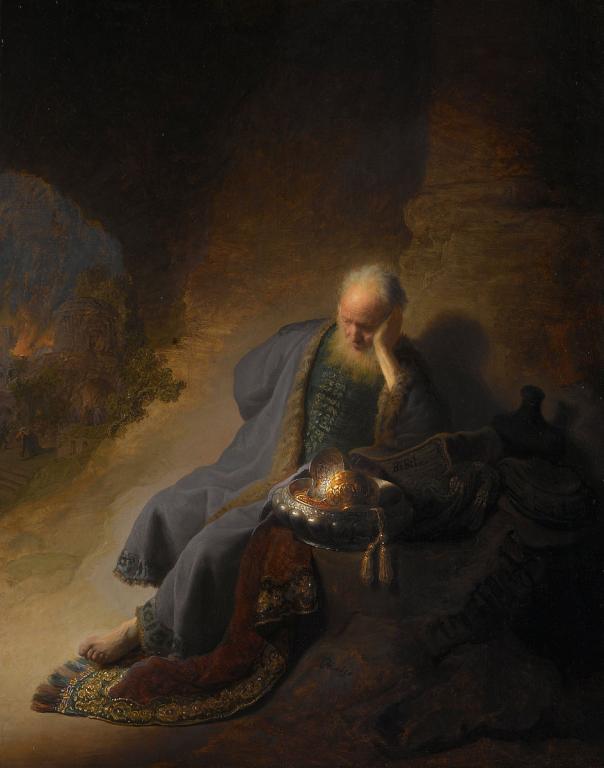
Rembrandt, “Jeremiah Lamenting the Destruction of Jerusalem,” 1630, Wikimedia {{US-PD-expired}}.

I have returned to Lamentations 3 repeatedly the past several days in view of my family’s ordeal surrounding my adult son Christopher’s traumatic brain injury. Often attributed to Jeremiah, known as “the weeping prophet,” Lamentations recounts Jerusalem’s destruction by the Babylonians in 587 B.C.E. and the trauma and humiliation of her people. According to one source, “…scholars for a time found the primary theological purpose of the book in the Deuteronomic righteousness-reward theology with its hope in the possibility of repentance”. However, “more recent discussions have viewed Lamentations as an unresolved expression of grief following the trauma of Jerusalem’s devastation.” Here is a poignant and powerful selection from Lamentations 3:
I remember my affliction and my wandering,
the bitterness and the gall.I well remember them,
and my soul is downcast within me.
Yet this I call to mind
and therefore I have hope:Because of the Lord’s great love we are not consumed,
for his compassions never fail.
They are new every morning;
great is your faithfulness.
I say to myself, “The Lord is my portion;
therefore I will wait for him.”The Lord is good to those whose hope is in him,
to the one who seeks him;
it is good to wait quietly
for the salvation of the Lord.
It is good for a man to bear the yoke
while he is young.Let him sit alone in silence,
for the Lord has laid it on him.
Let him bury his face in the dust—
there may yet be hope.
Let him offer his cheek to one who would strike him,
and let him be filled with disgrace.For no one is cast off
by the Lord forever.
Though he brings grief, he will show compassion,
so great is his unfailing love.
For he does not willingly bring affliction
or grief to anyone. (Lamentations 3:19-33; NIV)
My own unresolved grief finds an emotional connection with the prophetic lament disclosed in these verses. So, too, my unrelenting hope find an emotional connection with the prophet’s longing for God’s deliverance. The prophet remembers his pain and suffering, his “bitterness and gall.” But there is more. There is that little word “yet,” which actually looms large in this passage (Lamentations 3:21). Although the circumstances surrounding Jerusalem’s fall were devastating and catastrophic, yet the prophet and those who look to the Lord with a flickering eye of hope are not consumed. They find that God’s compassionate care never fails. They are renewed every morning. So, they continue to wait for God in the midst of their unrelenting grief.
Sometimes hope slumbers and then reawakens, like my son’s fluctuating consciousness. I live for those moments when my son’s eyes and face register someone’s voice and presence. All of a sudden, he wakes up and becomes aware of his surroundings, like a computer screen that has reemerged from sleep mode. It’s like hope being renewed. For a time after the catastrophic brain injury, there was no light in Christopher’s eyes. His eyes looked as if they were dead. But over time, some level of healing has manifested itself and we see light when we look into his deep brown eyes.
I thought of the light in Christopher’s eyes when recounting the film The Courier the other day. The film is based on the true story of the alliance between British businessman Greville Wynne and Soviet colonel Oleg Penkovsky. Penkovsky provided Wynne with weapons program secrets to pass along to the US and British intelligence communities in the effort to deescalate nuclear tensions between the Soviet Union and the West during the Cold War. They were caught and thrown into prison. Wynne was later released while Penkovsky was executed. Their confinement in the prison quarters was harrowing. All that kept them alive were their hopes for reunion with family and for the world’s survival. In one scene, the light goes on in Wynne’s eyes when Wynne’s wife visits him in prison and tells him what awaits him at home when he is released. Later, the light goes on in Wynne’s and Penkovsky’s eyes when Wynne shares with him during their one encounter behind bars that Penkovky’s actions helped to defuse tensions between the USSR and US surrounding the CUBA Missile Crisis.
The same unrelenting hope manifests itself in the closing scene of John Steinbeck’s Grapes of Wrath set in the Great Depression. A young woman Rose of Sharon grieves the loss of her baby who has just died. But still she keeps going. With unconquerable resolve, Rose of Sharon lifts herself and tends to a man who is withering away from hunger and feeds him. Her love of humanity keeps her going with unrelenting hope in the face of her unresolved grief:
For a minute Rose of Sharon sat still in the whispering barn. Then she hoisted her tired body up and drew the comfort around her. She moved slowly to the corner and stood looking down at the wasted face, into the wide, frightened eyes. Then slowly she lay down beside him. He shook his head slowly from side to side. Rose of Sharon loosened one side of the blanket and bared her breast. “You got to,” she said. She squirmed closer and pulled his head close. “There!” she said. “There.” Her hand moved behind his head and supported it. Her fingers moved gently in his hair. She looked up and across the barn, and her lips came together and smiled mysteriously.
Even Samuel Beckett’s Waiting for Godot conveys the importance of hope. As one summary puts it, the principal characters “Vladimir and Estragon are a pair of human beings who do not know why they were put on earth; they make the tenuous assumption that there must be some point to their existence, and they look to Godot for enlightenment. Because they hold out hope for meaning and direction, they acquire a kind of nobility that enables them to rise above their futile existence.”
Hope in search of meaning in life shapes people to rise above futility, when all else comes crashing down around them. Like Vladimir and Estragon, like Rose of Sharon, like Wynne and Penkovsky, like Jeremiah, I experience the tension of unresolved grief and relentless hope.
There are times when I struggle with the threat of nihilism in view of the fact that my own figurative city of Jerusalem, as in aspirations for my son’s life as originally conceived, have come crashing down, at least for now. Will God rebuild his life? If so, when? Will God rebuild my life with Christopher? I agonizingly hope so.
Given that I am able to continue functioning in every domain of responsibility may lead some to think I have moved on from my son’s tragedy. Some of the emails and phone calls I receive and the questions people ask suggest such a perspective. But how can I move on when my son lies flat on a bed? I lie there with him in my soul.
As our medical consultant Dr. Potter said to me this week in reflecting on Christopher’s status, hope is a slippery thing. I like to think of it like my son’s consciousness that rises and then falls back to sleep for a time.
I will go to bed this evening after visiting Christopher. I will rise again tomorrow morning with the words of Lamentations on my lips, “Because of the Lord’s great love we are not consumed, for his compassions never fail. They are new every morning great is your faithfulness. I say to myself, ‘The Lord is my portion; therefore I will wait for him.’” (Lamentations 3:22-24)
In closing, I wish to share with you a word that I believe God impressed upon my heart and imagination this morning while driving to work. In the midst of my struggle to hold onto slippery hope, I heard these words deep within my mind: “Stay with me, son. Stay with me.” Tears welled up in my eyes while driving. “Yes, Lord. I will stay with you. Stay with my son, Lord. Stay with us, son. Wake up, Christopher. Come back to a steady state of consciousness.” Until then, I am on this journey of unrelenting grief and relentless hope as I take to heart and cherish the light in my son’s noble eyes.

About Paul Louis Metzger
Paul Louis Metzger, Ph.D., is Professor of Theology & Culture, Multnomah University & Seminary; Director of The Institute for Cultural Engagement: New Wine, New Wineskins; and Author and Editor of numerous works, including The Gospel of John: When Love Comes to Town and Setting the Spiritual Clock: Sacred Time Breaking Through the Secular Eclipse. You can read more about the author here.
Previous Post

September 12, 2021
9/12: The Morning After Tragedy Strikes
Next Post
October 3, 2021 Backstage with Greatness, Mick Jagger, & CS Lewis: The Weight of Glory
Browse Our Archives
Select a Category Uncategorized
Select a Month June 2025 April 2025 March 2025 January 2025 December 2024 November 2024 October 2024 September 2024 August 2024 July 2024 June 2024 May 2024 April 2024 March 2024 February 2024 January 2024 December 2023 November 2023 October 2023 September 2023 August 2023 July 2023 June 2023 May 2023 April 2023 March 2023 February 2023 January 2023 December 2022 November 2022 October 2022 September 2022 August 2022 July 2022 June 2022 May 2022 April 2022 March 2022 February 2022 January 2022 December 2021 November 2021 October 2021 September 2021 August 2021 July 2021 June 2021 May 2021 April 2021 March 2021 February 2021 January 2021 December 2020 November 2020 October 2020 September 2020 August 2020 July 2020 June 2020 May 2020 April 2020 March 2020 February 2020 January 2020 December 2019 November 2019 October 2019 September 2019 August 2019 July 2019 June 2019 May 2019 April 2019 March 2019 February 2019 January 2019 December 2018 November 2018 October 2018 September 2018 August 2018 July 2018 June 2018 May 2018 April 2018 March 2018 February 2018 January 2018 December 2017 November 2017 October 2017 September 2017 August 2017 July 2017 June 2017 May 2017 April 2017 March 2017 February 2017 January 2017 December 2016 November 2016 October 2016 September 2016 August 2016 July 2016 June 2016 May 2016 April 2016 March 2016 February 2016 January 2016 December 2015 November 2015 October 2015 September 2015 August 2015 July 2015 June 2015 May 2015 April 2015 March 2015 February 2015 January 2015 December 2014 November 2014 October 2014 September 2014 August 2014 July 2014 June 2014 May 2014 April 2014 March 2014 February 2014 January 2014 December 2013 November 2013 October 2013 September 2013 August 2013 July 2013 June 2013 May 2013 April 2013 March 2013 February 2013 January 2013 December 2012 November 2012 October 2012 September 2012 August 2012 July 2012 June 2012 May 2012 April 2012 March 2012 February 2012
Follow Us!
TAKE THE
Religious Wisdom Quiz
Who was Lydia's profession?
Select your answer to see how you score.
Cloth merchant Potter Farmer Weaver
Books by This Author Books by Paul Louis Metzger
Related posts from Uncommon God, Common Good

Heavenly Father’s Day on Trinity Sunday

Easter Triduum: Obey Your Thirst—for God

Holy Week Is Humble Week: "Beware of Becoming...

Excavating the Person in a Throwaway Culture
TRENDING AT PATHEOS Evangelical

The REST of Your Life: A Creative Wrestles...
This week I had a conversation with a good friend from church....

How the author of the world's best hymn...
I've been working with John Newton for a while now. This makes...

Long before this Lectio Divina, Psalm 130 - the song - started...

What About the Trees? Another Living Parable
After I finished writing the last article about falling leaves as a...

Why Classical Education Is a Conversation, Not a...
Come and Read: Joy in Classical Education When I was a little...

Cornell University has received a great deal of negative publicity and intense...
view all Evangelical blogs
Ad-Free & Subscriber Log-In Subscription Support
- About Us
- 2026 Calendar
- Videos
- Podcasts
- Library of World Religions
- Faith In Media Tracker
- Advertise With Us
- Write for Us
- Privacy Policy
- Terms of Service
- Do Not Sell My Data
- Contact Us
- Radiant Digital
- Manage Newsletter Subscriptions
- Unsubscribe From Notifications
- Sitemap
Copyright 2008-2026, Patheos. All rights reserved.
Subscription Support Ad-Free & Subscriber Log-In
Follow Patheos