
BuddhistCatholicContemplativeEvangelicalGeneral ChristianHinduJewishLatter-day SaintMuslimNew VisionsProgressive Christian
Beliefs
- Buddhist
- Catholic
- Contemplative
- Evangelical
- General Christian
- Hindu
- Jewish
- Latter-day Saint
- More Voices
- Muslim
- New Visions
- Pagan
- Progressive Christian
Topics
- Religion News
- Food and Religion
- Sports and Religion
- Religious Art
- Religious Music and Entertainment
- Religious Events
- History and Religion
- Style and Religion
- Politics and Religion
- Women in Religion
- Recreation Outdoors and Religion
- Business Finance and Religion
- Careers Workplace and Religion
- Education and Religion
- Family Parenting and Religion
- Health Fitness and Religion
- Home and Religion
- Relationships and Religion
- Technology and Religion
- Travel and Religion
Columnists
- Buddhist Columnists
- Business Finance and Religion Columnists
- Careers Workplace and Religion Columnists
- Catholic Columnists
- Contemplative Columnists
- Education and Religion Columnists
- Evangelists Columnists
- Family Parenting and Religion Columnists
- General Christian Columnists
- Health Fitness and Religion Columnists
- Hindu Columnists
- History and Religion Columnists
- Home and Religion Columnists
- Jewish Columnists
- More Voices Columnists
- Latter Day Columnists
- Muslim Columnists
- New Visions Columnists
- Nonreligious Columnists
- Pagan Columnists
- Politics and Religion Columnists
- Progressive Columnists
- Recreation Outdoors and Religion Columnists
- Relationships and Religion Columnists
- Religion News Columnists
- Religious Art Columnists
- Religious Events Columnists
- Religious Music and Entertainment Columnists
- Sports and Religion Columnists
- Style and Religion Columnists
- Technology and Religion Columnists
- Travel and Religion Columnists
- Women in Religion Columnists
Resource Library
- 2026 Calendar
- Library of World Religions
- The 100 Most Holy Places on Earth
- Patheos Answers
- Podcasts
- Videos
- Faith Leaders Database
- Anglican Episcopalian
- Bahai
- Baptist
- Buddhism
- Christianity
- Confucianism
- Eastern Orthodoxy
- Hinduism
- Holiness and Pentecostal
- ISKCON
- Islam
- Judaism
- Lutheran
- Methodist
- The Church of Jesus Christ of Latter-day Saints
- New Age
- Paganism
- Presbytarian and Reformed
- Protestantism
- Religion Behind the Scenes
- Roman Catholic
- Scientology
- Shia Islam
- Sikhism
- Sufism
- Sunni Islam
- Taoism
- Zen
- See all religions
Research Tools
 Ad-Free & Subscriber Log-In Subscription Support
Ad-Free & Subscriber Log-In Subscription Support
Follow Patheos 

- Trending:
- Forgiveness
- |
- Marriage
- |
- Consciousness
- |
- Death Penalty
- |
- Election
- |
- Halloween

- Home
- Evangelical
- Timely Words Bring Healing in Critical Care Situations
Timely Words Bring Healing in Critical Care Situations
Last updated on: May 6, 2021 at 10:39 pm by Paul Louis Metzger
Timely Words Bring Healing in Critical Care Situations 2021-05-06T22:39:45-07:00 Paul Louis Metzger
Patheos Explore the world's faith through different perspectives on religion and spirituality! Patheos has the views of the prevalent religions and spiritualities of the world.
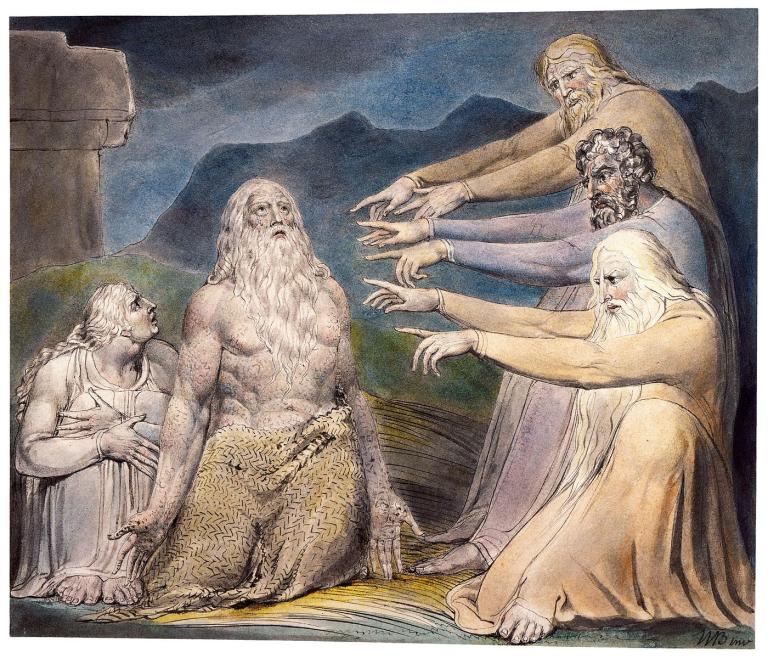
William Blake, “Job Rebuked by His Friends,…” June 1805; Wikimedia {{PD-US-expired}}

I have been reading the Book of Job the past few days. This book was next up on my Bible read-through. I must confess that it’s not easy for me to get through Job, especially now in view of my son Christopher’s traumatic brain injury and three-plus month comatose state. Still, I can’t imagine what the Bible would be like without this book. In fact, it is a timely word that brings healing to me at this critical time.
In case you are not familiar with Job, it is the account of a righteous man in the ancient past in the land of Uz who lost nearly everything other than his life. He lost his children and wealth, as well as his health. To add insult to injury, he endured an agonizing trial of debate with his spouse and friends over God and whether very bad things happen to really righteous people. In the short run, everyone was fine. But then, when God did not come through in quick order to save the day, Job’s wife urged Job to curse God and give up. His friends moved from being silent comforters to judges and jury.
Job’s friends determined that Job must have done something wrong to have experienced such tragedy. Their words were not timely. Wrong person, wrong place, wrong time. Job’s only fault in the book was that he condemned God and justified himself. Still, all he really wanted was for God to speak to him and help bring some sense of meaning and purpose to his tragic life. While God eventually rebuked Job, he also severely chastised Job’s friends for their untimely and unwise words regarding Job. In the end, God restored Job and blessed him exceedingly.
Contrary to much of my experience in contemporary Evangelical Christian culture, the Book of Job like other parts of the Bible, such as the Psalms, Lamentations, Habakkuk, the Gospels, and Revelation, make significant space for grappling and wrestling with God over suffering and evil. This is not a new recognition for me. I have long struggled with what I take to be an imbalanced liturgical diet of celebration in my circles that makes little to no room for lament on the worship plate or platform. Grievously, St. John of the Cross’s dark night of the soul has no place here given the contemporary fixation on plastic sunshine.
I cherish the question posed by Jesus on the cross, “My God, my God, why have you forsaken me?” (Revelation 27:46; NIV) and the cry of the martyred saints under the altar in heaven, “How long, Sovereign Lord, holy and true, until you judge the inhabitants of the earth and avenge our blood?” (Revelation 6:10; NIV) It has been said that Job may be the oldest book in the Bible. It is comforting to know that the Bible does not hide from the horrors and tragedies of life, or the agonizing questions Job and the psalmists asked, but provides a variety of nutrients, medicines, and therapy for helping people on spiritual life support of various kinds.
I encourage myself and encourage others not to wrest oneself from God’s hand, but to wrestle with God. Jacob wrestled with God and prevailed. His name was changed to Israel, which means “to struggle with God” (See Genesis 32:22-32). Job also struggled with God. He did not bury his struggle with God under his pillow of tears or a rock. Though he should not have condemned God to justify himself, there was nothing wrong with lamenting his state and crying out to God in search of a response and understanding, while on spiritual life support.
One does not expect to go through such severe trials in life given God and given faith and hope. My colleague Dr. Karl Kutz, a professor of biblical studies who did his PhD work with Prof. Rabbi Michael Fox on the Book of Job said that lament is about faith and hope. What makes the journey so hard is trying to reconcile our circumstances with our faith. It is our faith that makes us struggle the most with calamity. Lament results from biblical hope and faith. It would be so much easier if Job didn’t believe at all. Then he would not have had to wrestle so with God in his adversity.
For most people, hope as it is often understood in American Christian circles gets in the way of meeting God. They take hope to be a certain kind of answer—a Hollywood ending. In stark contrast to our attempts at using God to experience the American Dream, Job finally realized that God alone was his hope.
It is worth noting that God never answered Job’s “why” questions. He answers a question that Job wasn’t asking in his circumstances—“Who?— Who is God?” It is God’s existence looming large in Job’s psyche and imagination that caused Job to keep wrestling with God. In the end, Job found some sense of peace and resolution when God spoke and informed Job of who God is and how little Job was aware of God’s profound and mysterious workings in the world:
Then Job replied to the Lord:
“I know that you can do all things;
no purpose of yours can be thwarted.
You asked, ‘Who is this that obscures my plans without knowledge?’
Surely I spoke of things I did not understand,
things too wonderful for me to know.“You said, ‘Listen now, and I will speak;
I will question you,
and you shall answer me.’
My ears had heard of you
but now my eyes have seen you.
Therefore I despise myself
and repent in dust and ashes.” (Job 42:1-6; NIV)
In our present family ordeal, so many people have expressed timely words that bring healing. Statements like “I am so sorry” bring comfort and healing. We may think such sentences lack meaning because they lack power to fix things. But what more can we do when things are beyond our control?
I remember sharing these same words “I am so sorry” with a friend who has been enduring a longstanding and relentless struggle that has no apparent end in sight. When I said to him that I wish there was more to say and that I wish I could take away his agonizing ordeal, he said there wasn’t anything I could do. He was just thankful that I listened to him share, that I was and am there for him, and that I pray with him, when he finds it helpful.
We all want to do so much more for those for whom we care. While we must guard against “Be warm and be filled” and support one another as best we can in holistic ways (which so many wonderful people have done so sacrificially and unbelievably for us), words often fail us. We want to say something that helps.
What does not help is when we play God and tell people what God is doing in our life situations. I love Romans 8:28, which reads: “And we know that in all things God works for the good of those who love him, who have been called according to his purpose” (NIV). However, I don’t love how this verse is quoted so often right when people are enduring major crises. During these times, it’s often best to sit still with those going through Job-like ordeals.
Job’s friends started well by sitting silently alongside him in his grief but ended poorly with interrogating Job in theological debate. If you ever endure wrongly timed words by well-intentioned people meaning to provide comfort, you may wish to say: “Father, forgive them. For they do not know what they say.”
Back to my son’s situation, there have been well-meaning health care professionals who have shared words that really hurt, like the nurse who told me at Christopher’s bedside, “I’m so glad I’m not in your shoes.” One doctor told us early on “I don’t think he will wake up.” A neurosurgeon apologized to us for his colleague’s calloused statement and said “We just don’t know” at this juncture. Another nurse said how sorry he was that we were going through such an ordeal. Both the neurosurgeon and this nurse’s statements brought healing and comfort.
Just yesterday, the healthcare professional overseeing Christopher’s care agreed with the neurosurgeon whose words I recounted. She repeated them in the affirmative: “We just don’t know,” as the brain is such a mystery. Moreover, each person responds differently. She also said, “We need more time.” A lot more time, she added. Given her experience and expertise, she knows what she’s talking about and when to share it. Along with her listening skills and attentiveness, those eight words brought so much healing: “We just don’t know…We need more time.” Timely words. Words that fit the occasion.
This health care professional was truly professional. She listened well to what I shared and responded in an appropriate manner. No sugar coating and no overkill with vinegar. Besides, as she and others have noted, Christopher is stable, and we have witnessed some basic improvement in his condition. We continue to hope and pray for moderate to dramatic recovery. Our family friend and ever-present medical consultant Dr. Robert Potter (M.D., Ph.D.), whose areas of expertise include internal medicine, palliative care, and medical ethics, was encouraged to hear how the medical professional overseeing Christopher’s care presently responded in such a nuanced manner that accounted for the complexity of his situation. There was such resonance with his own assessment of our son’s case. As Dr. Potter likes to say, it was “the fitting response—the response that fits the situation.”
Timely words bring healing.
About Paul Louis Metzger
Paul Louis Metzger, Ph.D., is Professor of Theology & Culture, Multnomah University & Seminary; Director of The Institute for Cultural Engagement: New Wine, New Wineskins; and Author of numerous works, including The Word of Christ and the World of Culture: Sacred and Secular Through the Theology of Karl Barth (Eerdmans, 2003) & Setting the Spiritual Clock: Sacred Time Breaking Through the Secular Eclipse (Cascade, 2020). You can read more about the author here.
Previous Post

May 2, 2021
Seeking Stability During Mind-Warping Transitions
Next Post
May 9, 2021 A Mother’s Day Med: He Favors His Mom
Browse Our Archives
Select a Category Uncategorized
Select a Month June 2025 April 2025 March 2025 January 2025 December 2024 November 2024 October 2024 September 2024 August 2024 July 2024 June 2024 May 2024 April 2024 March 2024 February 2024 January 2024 December 2023 November 2023 October 2023 September 2023 August 2023 July 2023 June 2023 May 2023 April 2023 March 2023 February 2023 January 2023 December 2022 November 2022 October 2022 September 2022 August 2022 July 2022 June 2022 May 2022 April 2022 March 2022 February 2022 January 2022 December 2021 November 2021 October 2021 September 2021 August 2021 July 2021 June 2021 May 2021 April 2021 March 2021 February 2021 January 2021 December 2020 November 2020 October 2020 September 2020 August 2020 July 2020 June 2020 May 2020 April 2020 March 2020 February 2020 January 2020 December 2019 November 2019 October 2019 September 2019 August 2019 July 2019 June 2019 May 2019 April 2019 March 2019 February 2019 January 2019 December 2018 November 2018 October 2018 September 2018 August 2018 July 2018 June 2018 May 2018 April 2018 March 2018 February 2018 January 2018 December 2017 November 2017 October 2017 September 2017 August 2017 July 2017 June 2017 May 2017 April 2017 March 2017 February 2017 January 2017 December 2016 November 2016 October 2016 September 2016 August 2016 July 2016 June 2016 May 2016 April 2016 March 2016 February 2016 January 2016 December 2015 November 2015 October 2015 September 2015 August 2015 July 2015 June 2015 May 2015 April 2015 March 2015 February 2015 January 2015 December 2014 November 2014 October 2014 September 2014 August 2014 July 2014 June 2014 May 2014 April 2014 March 2014 February 2014 January 2014 December 2013 November 2013 October 2013 September 2013 August 2013 July 2013 June 2013 May 2013 April 2013 March 2013 February 2013 January 2013 December 2012 November 2012 October 2012 September 2012 August 2012 July 2012 June 2012 May 2012 April 2012 March 2012 February 2012
Follow Us!
TAKE THE
Religious Wisdom Quiz
Who said, “Let there be light”?
Select your answer to see how you score.
Moses Paul Noah God
Books by This Author Books by Paul Louis Metzger
Related posts from Uncommon God, Common Good

Heavenly Father’s Day on Trinity Sunday

Easter Triduum: Obey Your Thirst—for God

Holy Week Is Humble Week: "Beware of Becoming...

Excavating the Person in a Throwaway Culture
TRENDING AT PATHEOS Evangelical

The REST of Your Life: A Creative Wrestles...
This week I had a conversation with a good friend from church....

How the author of the world's best hymn...
I've been working with John Newton for a while now. This makes...

Long before this Lectio Divina, Psalm 130 - the song - started...

What About the Trees? Another Living Parable
After I finished writing the last article about falling leaves as a...

Why Classical Education Is a Conversation, Not a...
Come and Read: Joy in Classical Education When I was a little...

Cornell University has received a great deal of negative publicity and intense...
view all Evangelical blogs
Ad-Free & Subscriber Log-In Subscription Support
- About Us
- 2026 Calendar
- Videos
- Podcasts
- Library of World Religions
- Faith In Media Tracker
- Advertise With Us
- Write for Us
- Privacy Policy
- Terms of Service
- Do Not Sell My Data
- Contact Us
- Radiant Digital
- Manage Newsletter Subscriptions
- Unsubscribe From Notifications
- Sitemap
Copyright 2008-2026, Patheos. All rights reserved.
Subscription Support Ad-Free & Subscriber Log-In
Follow Patheos