
BuddhistCatholicContemplativeEvangelicalGeneral ChristianHinduJewishLatter-day SaintMuslimNew VisionsProgressive Christian
Beliefs
- Buddhist
- Catholic
- Contemplative
- Evangelical
- General Christian
- Hindu
- Jewish
- Latter-day Saint
- More Voices
- Muslim
- New Visions
- Pagan
- Progressive Christian
Topics
- Religion News
- Food and Religion
- Sports and Religion
- Religious Art
- Religious Music and Entertainment
- Religious Events
- History and Religion
- Style and Religion
- Politics and Religion
- Women in Religion
- Recreation Outdoors and Religion
- Business Finance and Religion
- Careers Workplace and Religion
- Education and Religion
- Family Parenting and Religion
- Health Fitness and Religion
- Home and Religion
- Relationships and Religion
- Technology and Religion
- Travel and Religion
Columnists
- Buddhist Columnists
- Business Finance and Religion Columnists
- Careers Workplace and Religion Columnists
- Catholic Columnists
- Contemplative Columnists
- Education and Religion Columnists
- Evangelists Columnists
- Family Parenting and Religion Columnists
- General Christian Columnists
- Health Fitness and Religion Columnists
- Hindu Columnists
- History and Religion Columnists
- Home and Religion Columnists
- Jewish Columnists
- More Voices Columnists
- Latter Day Columnists
- Muslim Columnists
- New Visions Columnists
- Nonreligious Columnists
- Pagan Columnists
- Politics and Religion Columnists
- Progressive Columnists
- Recreation Outdoors and Religion Columnists
- Relationships and Religion Columnists
- Religion News Columnists
- Religious Art Columnists
- Religious Events Columnists
- Religious Music and Entertainment Columnists
- Sports and Religion Columnists
- Style and Religion Columnists
- Technology and Religion Columnists
- Travel and Religion Columnists
- Women in Religion Columnists
Resource Library
- 2026 Calendar
- Library of World Religions
- The 100 Most Holy Places on Earth
- Patheos Answers
- Podcasts
- Videos
- Faith Leaders Database
- Anglican Episcopalian
- Bahai
- Baptist
- Buddhism
- Christianity
- Confucianism
- Eastern Orthodoxy
- Hinduism
- Holiness and Pentecostal
- ISKCON
- Islam
- Judaism
- Lutheran
- Methodist
- The Church of Jesus Christ of Latter-day Saints
- New Age
- Paganism
- Presbytarian and Reformed
- Protestantism
- Religion Behind the Scenes
- Roman Catholic
- Scientology
- Shia Islam
- Sikhism
- Sufism
- Sunni Islam
- Taoism
- Zen
- See all religions
Research Tools
 Ad-Free & Subscriber Log-In Subscription Support
Ad-Free & Subscriber Log-In Subscription Support
Follow Patheos 

- Trending:
- Forgiveness
- |
- Marriage
- |
- Consciousness
- |
- Death Penalty
- |
- Election
- |
- Halloween

- Home
- Evangelical
- It’s Very Easy to Compare Our Suffering with Others, But Difficult to Survive
It’s Very Easy to Compare Our Suffering with Others, But Difficult to Survive
Last updated on: April 6, 2021 at 10:49 am by Paul Louis Metzger
It’s Very Easy to Compare Our Suffering with Others, But Difficult to Survive 2021-04-06T10:49:21-07:00 Paul Louis Metzger
Patheos Explore the world's faith through different perspectives on religion and spirituality! Patheos has the views of the prevalent religions and spiritualities of the world.
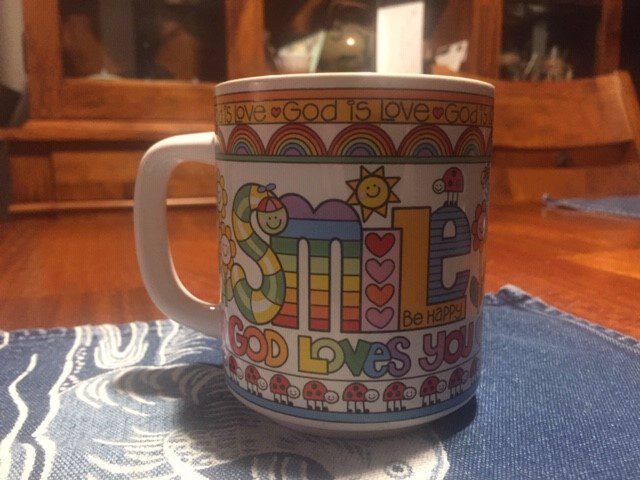
My Beloved Dad’s Favorite Mug–“Smile, God Loves You.”
Have you ever compared yourself and your suffering with others in their life situations? It’s very easy to do, but very difficult to survive. Such comparisons are relative, often lack full context, and take our eyes off of where our focus needs to be in addressing our own life struggles. What do you do if someone says to you, “There are people who have it so much worse than you do…”? Or what do you with the statement made by an otherwise excellent nurse who without meaning any harm literally said over my son Christopher’s bed in his comatose state, “I’m so glad I’m not in your shoes”? What good does it do for us to compare ourselves with others to see who is suffering more or less? If you think you’re suffering more, you can become bitter and go into a downward spiral emotionally. If you think you’re suffering less than those individuals, you still may determine you’re suffering more than other people you know, and there you go again. Downward spiral.
We see that Jesus’ disciple Peter is tempted to compare himself and his impending suffering with another disciple, as recorded in John 21. In the post-resurrection account of John 21, Jesus restores Peter to his apostolic calling and then tells him how he will suffer and die for Christ’s sake. Peter immediately compares himself with “the beloved disciple,” or as this translation puts it, “the disciple whom Jesus loved,” whom many take to be John. Jesus tells Peter not to compare his situation in that way with others. Here’s the text:
…Jesus said, “Feed my sheep. Very truly I tell you, when you were younger you dressed yourself and went where you wanted; but when you are old you will stretch out your hands, and someone else will dress you and lead you where you do not want to go.” Jesus said this to indicate the kind of death by which Peter would glorify God. Then he said to him, “Follow me!”
Peter turned and saw that the disciple whom Jesus loved was following them. (This was the one who had leaned back against Jesus at the supper and had said, “Lord, who is going to betray you?”) When Peter saw him, he asked, “Lord, what about him?”
Jesus answered, “If I want him to remain alive until I return, what is that to you? You must follow me.” Because of this, the rumor spread among the believers that this disciple would not die. But Jesus did not say that he would not die; he only said, “If I want him to remain alive until I return, what is that to you?” (John 21:17-23; NIV)
This biblical text tells us that Peter will stretch out his hands, someone else will dress him and lead him to a place he does not desire to go, indicating what kind of death Peter would die for God’s glory. Further to the text above, tradition tells us that Peter was crucified upside down. Tradition also tells us that John was the only one of the apostles not to die by martyrdom, but rather, natural causes. Regardless, they are not to compare their life destinies with one another. Whenever we ask, “Lord, what about him?” Jesus responds, “If I want him to remain alive until I return, what is that to you? You must follow me.”
I revisited this text this morning, as I drank a cup of coffee from my late beloved Dad’s favorite mug with the words “Smile. God loves you” boldly printed on it (shown above in this post). I think about my Dad and Mom and how much they loved Christopher, our entire family, as well as other people. They drank in God’s love morning by morning and were energized to share that love with others on a daily basis, no matter the various challenges they themselves faced. I am grateful for them and their incomparable love today.
Still, it is easy to lose sight of such love presently. It is also easy, though not prudent, for me to compare our family’s present crisis surrounding my son’s traumatic brain injury and comatose state with others’ life situations. After all, misery loves company. Not that I would ever, ever want anyone to go through what we are enduring, which is almost impossible to communicate, nonetheless, it is still all too tempting to ask why we can’t experience life’s joys like those other people over there…. Of course, I don’t know what other people may be or will be going through, and I pray God’s abundant blessings and mercies on them no matter what joys and sorrows come their way.
Jesus tells each of his followers to follow him. No matter what I am going through, I need to follow through and follow him and concern myself with seeking to glorify God. God is not some cosmic killjoy, but one who brings joy through Jesus’ resurrection that transcends and penetrates life’s various challenging and otherwise debilitating circumstances (See John 16:19-24). Similarly, no matter the hardship, no hardship can separate us from the love of God in Christ, as Paul who suffered greatly declares (See Romans 8:31-39).
While each of Jesus’ followers must follow him and seek to glorify God with their lives, he does not turn any of us into robots. None of us have been given the same script or computer code in life. While we can learn from others’ situations in various ways, and can model those traits in others that we find honorable, we should never try to parrot one another’s lives, or expect that everyone’s lives should turn out the same. After all, we are human persons with incommunicable identities and narratives. We are all fundamentally unique. So, how can I follow Jesus uniquely on this unfathomable journey in the face of great suffering?
The author of the words in John 21 attests to being “the beloved disciple” (John 21:24). There is a very real sense in which John, Peter, and every other follower should see themselves as “the disciple whom Jesus loved.” It’s not that we should compare ourselves with others, thinking that Jesus loves us more than others, or less than them. Rather, we should take to heart Jesus’ call to each of us to follow him on our ultimately incomparable journeys. The God who loves the whole world and sent his Son to die for each of us uniquely loves everyone and wants all of us to follow him. So, I choose to follow Jesus today.
This day, I need to guard against being like one of the “Four Yorkshire Men” in Monty Python’s skit (click here). The humorous sketch portrays four wealthy men who claim to have grown up in poverty. Each of them tries to out-boast the others in terms of how bad they had it growing up. We can either boast about how bad we have it in comparison with others, or lament how bad we have it in relation to them. But such comparisons never get us to where we need to go in crisis situations. The only thing that is going to get me through this ordeal is not following others to see how good or bad they have it, but following Jesus who promises to lead my family and me through this wilderness. Remember: it’s easy to compare ourselves with others, but difficult to survive.
About Paul Louis Metzger
Paul Louis Metzger, Ph.D., is Professor of Theology & Culture, Multnomah University & Seminary; Director of The Institute for Cultural Engagement: New Wine, New Wineskins; and Author of numerous books, including The Gospel of John: When Love Comes to Town and Setting the Spiritual Clock: Sacred Time Breaking Through the Secular Eclipse. You can read more about the author here.
Previous Post

April 5, 2021
COVID Shots, Olive Oil & Prayer
Next Post
April 7, 2021 Taking Baby Steps in Recovering from Traumatic Injuries
Browse Our Archives
Select a Category Uncategorized
Select a Month June 2025 April 2025 March 2025 January 2025 December 2024 November 2024 October 2024 September 2024 August 2024 July 2024 June 2024 May 2024 April 2024 March 2024 February 2024 January 2024 December 2023 November 2023 October 2023 September 2023 August 2023 July 2023 June 2023 May 2023 April 2023 March 2023 February 2023 January 2023 December 2022 November 2022 October 2022 September 2022 August 2022 July 2022 June 2022 May 2022 April 2022 March 2022 February 2022 January 2022 December 2021 November 2021 October 2021 September 2021 August 2021 July 2021 June 2021 May 2021 April 2021 March 2021 February 2021 January 2021 December 2020 November 2020 October 2020 September 2020 August 2020 July 2020 June 2020 May 2020 April 2020 March 2020 February 2020 January 2020 December 2019 November 2019 October 2019 September 2019 August 2019 July 2019 June 2019 May 2019 April 2019 March 2019 February 2019 January 2019 December 2018 November 2018 October 2018 September 2018 August 2018 July 2018 June 2018 May 2018 April 2018 March 2018 February 2018 January 2018 December 2017 November 2017 October 2017 September 2017 August 2017 July 2017 June 2017 May 2017 April 2017 March 2017 February 2017 January 2017 December 2016 November 2016 October 2016 September 2016 August 2016 July 2016 June 2016 May 2016 April 2016 March 2016 February 2016 January 2016 December 2015 November 2015 October 2015 September 2015 August 2015 July 2015 June 2015 May 2015 April 2015 March 2015 February 2015 January 2015 December 2014 November 2014 October 2014 September 2014 August 2014 July 2014 June 2014 May 2014 April 2014 March 2014 February 2014 January 2014 December 2013 November 2013 October 2013 September 2013 August 2013 July 2013 June 2013 May 2013 April 2013 March 2013 February 2013 January 2013 December 2012 November 2012 October 2012 September 2012 August 2012 July 2012 June 2012 May 2012 April 2012 March 2012 February 2012
Follow Us!
TAKE THE
Religious Wisdom Quiz
Where was Jesus born?
Select your answer to see how you score.
Jerusalem Capernaum Bethlehem Nazareth
Books by This Author Books by Paul Louis Metzger
Related posts from Uncommon God, Common Good

Heavenly Father’s Day on Trinity Sunday

Easter Triduum: Obey Your Thirst—for God

Holy Week Is Humble Week: "Beware of Becoming...

Excavating the Person in a Throwaway Culture
TRENDING AT PATHEOS Evangelical

The REST of Your Life: A Creative Wrestles...
This week I had a conversation with a good friend from church....

How the author of the world's best hymn...
I've been working with John Newton for a while now. This makes...

Long before this Lectio Divina, Psalm 130 - the song - started...

What About the Trees? Another Living Parable
After I finished writing the last article about falling leaves as a...

Why Classical Education Is a Conversation, Not a...
Come and Read: Joy in Classical Education When I was a little...

Cornell University has received a great deal of negative publicity and intense...
view all Evangelical blogs
Ad-Free & Subscriber Log-In Subscription Support
- About Us
- 2026 Calendar
- Videos
- Podcasts
- Library of World Religions
- Faith In Media Tracker
- Advertise With Us
- Write for Us
- Privacy Policy
- Terms of Service
- Do Not Sell My Data
- Contact Us
- Radiant Digital
- Manage Newsletter Subscriptions
- Unsubscribe From Notifications
- Sitemap
Copyright 2008-2026, Patheos. All rights reserved.
Subscription Support Ad-Free & Subscriber Log-In
Follow Patheos