
BuddhistCatholicContemplativeEvangelicalGeneral ChristianHinduJewishLatter-day SaintMuslimNew VisionsProgressive Christian
Beliefs
- Buddhist
- Catholic
- Contemplative
- Evangelical
- General Christian
- Hindu
- Jewish
- Latter-day Saint
- More Voices
- Muslim
- New Visions
- Pagan
- Progressive Christian
Topics
- Religion News
- Food and Religion
- Sports and Religion
- Religious Art
- Religious Music and Entertainment
- Religious Events
- History and Religion
- Style and Religion
- Politics and Religion
- Women in Religion
- Recreation Outdoors and Religion
- Business Finance and Religion
- Careers Workplace and Religion
- Education and Religion
- Family Parenting and Religion
- Health Fitness and Religion
- Home and Religion
- Relationships and Religion
- Technology and Religion
- Travel and Religion
Columnists
- Buddhist Columnists
- Business Finance and Religion Columnists
- Careers Workplace and Religion Columnists
- Catholic Columnists
- Contemplative Columnists
- Education and Religion Columnists
- Evangelists Columnists
- Family Parenting and Religion Columnists
- General Christian Columnists
- Health Fitness and Religion Columnists
- Hindu Columnists
- History and Religion Columnists
- Home and Religion Columnists
- Jewish Columnists
- More Voices Columnists
- Latter Day Columnists
- Muslim Columnists
- New Visions Columnists
- Nonreligious Columnists
- Pagan Columnists
- Politics and Religion Columnists
- Progressive Columnists
- Recreation Outdoors and Religion Columnists
- Relationships and Religion Columnists
- Religion News Columnists
- Religious Art Columnists
- Religious Events Columnists
- Religious Music and Entertainment Columnists
- Sports and Religion Columnists
- Style and Religion Columnists
- Technology and Religion Columnists
- Travel and Religion Columnists
- Women in Religion Columnists
Resource Library
- 2026 Calendar
- Library of World Religions
- The 100 Most Holy Places on Earth
- Patheos Answers
- Podcasts
- Videos
- Faith Leaders Database
- Anglican Episcopalian
- Bahai
- Baptist
- Buddhism
- Christianity
- Confucianism
- Eastern Orthodoxy
- Hinduism
- Holiness and Pentecostal
- ISKCON
- Islam
- Judaism
- Lutheran
- Methodist
- The Church of Jesus Christ of Latter-day Saints
- New Age
- Paganism
- Presbytarian and Reformed
- Protestantism
- Religion Behind the Scenes
- Roman Catholic
- Scientology
- Shia Islam
- Sikhism
- Sufism
- Sunni Islam
- Taoism
- Zen
- See all religions
Research Tools
 Ad-Free & Subscriber Log-In Subscription Support
Ad-Free & Subscriber Log-In Subscription Support
Follow Patheos 

- Trending:
- Forgiveness
- |
- Marriage
- |
- Consciousness
- |
- Death Penalty
- |
- Election
- |
- Halloween

- Home
- Evangelical
- A Tale of Two Resurrections
A Tale of Two Resurrections
Last updated on: April 10, 2021 at 7:37 am by Paul Louis Metzger
A Tale of Two Resurrections 2021-04-10T07:37:16-07:00 Paul Louis Metzger
Patheos Explore the world's faith through different perspectives on religion and spirituality! Patheos has the views of the prevalent religions and spiritualities of the world.
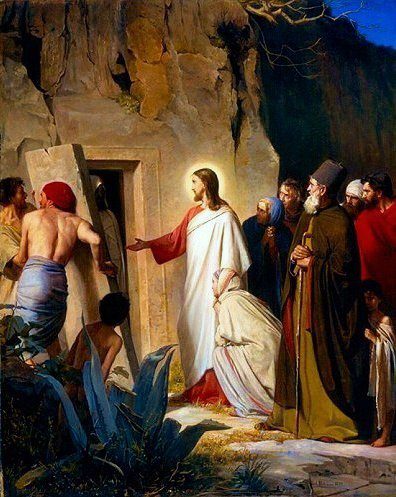
Raising of Lazarus by Jesus, Carl Bloch, 1870s, Wikimedia Commons {{PD-US-expired}}

In John’s Gospel, there are two resurrections: the resurrections of Lazarus and Jesus. The greatest miraculous sign Jesus performs prior to his own resurrection is raising Lazarus from the dead, as recorded in John 11. In Charles Dickens’ A Tale of Two Cities, I find two resurrections—that of Frenchman Charles Darnay and that of Englishman Sydney Carton.
In the crucible of the French Revolution, Carton, who bears a striking resemblance to Darnay, exchanges clothes and changes places with Darnay who awaits execution in a prison cell. Carton cunningly delivers his unsuspecting friend Darnay from his prison cell and impending execution at the guillotine to new life and offers himself up in Darnay’s place in sacrificial death by that same instrument of horror. Carton redeems his own derelict life and infuses it with resurrected meaning by sacrificing himself for Darnay, his wife, and their daughter. As Carton approaches the guillotine, he quotes from John 11: “I am the resurrection and the life.” In fact, he quotes or alludes to that Scripture on several occasions in Dickens’ narrative. Carton also says,
“I see a beautiful city and a brilliant people rising from this abyss. I see the lives for which I lay down my life, peaceful, useful, prosperous and happy. I see that I hold a sanctuary in their hearts, and in the hearts of their descendants, generations hence. It is a far, far better thing that I do, than I have ever done; it is a far, far better rest that I go to than I have ever known.”
In my own family’s situation, I hope for two resurrections: Christopher’s resurrection now from his brain-traumatized comatose bed and his resurrection to new life at the end of the age. Still, if I could take Dickens’ pen and rewrite the script, I would certainly change clothes and neurological places with my son so that he can return to be with his wife and young daughter, his mother and sister, as I told a nurse the other day. I would even throw in these Carton lines for good measure: It would be “a far, far better thing that I do, than I have ever done;” it would be “a far, far better rest that I go to than I have ever known.” However, medically that is impossible. And even if meaningful recovery is deemed medically impossible in the minds of some, as a doctor intimated (though a neurosurgeon and a medical consultant with several decades of experience in such precarious situations begged to differ), still I pray for a medical miracle. After all, I pray to the one who is the resurrection and the life. As Jesus said to Martha,
“I am the resurrection and the life. The one who believes in me will live, even though they die; and whoever lives by believing in me will never die. Do you believe this?” (John 11:25-26; NIV)
Here is a selection from John 11 involving Mary and Martha, the crowds, and Jesus, who had arrived too late to keep Lazarus from dying:
When Mary reached the place where Jesus was and saw him, she fell at his feet and said, “Lord, if you had been here, my brother would not have died.”
When Jesus saw her weeping, and the Jews who had come along with her also weeping, he was deeply moved in spirit and troubled. “Where have you laid him?” he asked.
“Come and see, Lord,” they replied.
Jesus wept.
Then the Jews said, “See how he loved him!”
But some of them said, “Could not he who opened the eyes of the blind man have kept this man from dying?”
Jesus, once more deeply moved, came to the tomb. It was a cave with a stone laid across the entrance. “Take away the stone,” he said.
“But, Lord,” said Martha, the sister of the dead man, “by this time there is a bad odor, for he has been there four days.”
Then Jesus said, “Did I not tell you that if you believe, you will see the glory of God?”
So they took away the stone. Then Jesus looked up and said, “Father, I thank you that you have heard me. I knew that you always hear me, but I said this for the benefit of the people standing here, that they may believe that you sent me.”
When he had said this, Jesus called in a loud voice, “Lazarus, come out!” The dead man came out, his hands and feet wrapped with strips of linen, and a cloth around his face.
Jesus said to them, “Take off the grave clothes and let him go.” (John 11:32-44; NIV)
Just as I sense a connection to Sydney Carton and his derelict life longing for redemption in A Tale of Two Cities, so I sense a connection to a grieving Mary, Martha, and crowd in John 11. Here are the prayerful connections I make for Christopher in view of Lazarus, whose name means “God has helped”:
In Mary-like fashion, I say: Lord, if you had been there, my son Christopher would not have endured a devastating brain injury…
Still Lord, you weep over Christopher. How much you love him…
In crowd-like fashion, I say: Lord, could not you who raised Lazarus to new life and brought sight to the blind man have kept my son from his traumatic brain injury and comatose bed?
In Martha-like fashion, I say: Lord, by this time, the prospects for meaningful recovery are not great given the extent of damage and over seventy days in a comatose state.
Lord Jesus, will you say the Martha-like line to me? “Did I not tell you that if you believe, you will see the glory of God?”
Yes, Lord—I believe! You are the resurrection and the life! May we see the glory of God! May it be said of our own Lazarus, Christopher, that “God has helped.”
About Paul Louis Metzger
Paul Louis Metzger, Ph.D., is Professor of Theology & Culture, Multnomah University & Seminary; Director of The Institute for Cultural Engagement: New Wine, New Wineskins; and Author of numerous works, including The Gospel of John: When Love Comes to Town and Setting the Spiritual Clock: Sacred Time Breaking Through the Secular Eclipse. You can read more about the author here.
Previous Post

April 2, 2021
Stages of Grief & Stations of the Cross
Next Post
April 5, 2021 COVID Shots, Olive Oil & Prayer
Browse Our Archives
Select a Category Uncategorized
Select a Month June 2025 April 2025 March 2025 January 2025 December 2024 November 2024 October 2024 September 2024 August 2024 July 2024 June 2024 May 2024 April 2024 March 2024 February 2024 January 2024 December 2023 November 2023 October 2023 September 2023 August 2023 July 2023 June 2023 May 2023 April 2023 March 2023 February 2023 January 2023 December 2022 November 2022 October 2022 September 2022 August 2022 July 2022 June 2022 May 2022 April 2022 March 2022 February 2022 January 2022 December 2021 November 2021 October 2021 September 2021 August 2021 July 2021 June 2021 May 2021 April 2021 March 2021 February 2021 January 2021 December 2020 November 2020 October 2020 September 2020 August 2020 July 2020 June 2020 May 2020 April 2020 March 2020 February 2020 January 2020 December 2019 November 2019 October 2019 September 2019 August 2019 July 2019 June 2019 May 2019 April 2019 March 2019 February 2019 January 2019 December 2018 November 2018 October 2018 September 2018 August 2018 July 2018 June 2018 May 2018 April 2018 March 2018 February 2018 January 2018 December 2017 November 2017 October 2017 September 2017 August 2017 July 2017 June 2017 May 2017 April 2017 March 2017 February 2017 January 2017 December 2016 November 2016 October 2016 September 2016 August 2016 July 2016 June 2016 May 2016 April 2016 March 2016 February 2016 January 2016 December 2015 November 2015 October 2015 September 2015 August 2015 July 2015 June 2015 May 2015 April 2015 March 2015 February 2015 January 2015 December 2014 November 2014 October 2014 September 2014 August 2014 July 2014 June 2014 May 2014 April 2014 March 2014 February 2014 January 2014 December 2013 November 2013 October 2013 September 2013 August 2013 July 2013 June 2013 May 2013 April 2013 March 2013 February 2013 January 2013 December 2012 November 2012 October 2012 September 2012 August 2012 July 2012 June 2012 May 2012 April 2012 March 2012 February 2012
Follow Us!
TAKE THE
Religious Wisdom Quiz
Who anointed Jesus with expensive perfume?
Select your answer to see how you score.
Salome Peter Mary Martha
Books by This Author Books by Paul Louis Metzger
Related posts from Uncommon God, Common Good

Heavenly Father’s Day on Trinity Sunday

Easter Triduum: Obey Your Thirst—for God

Holy Week Is Humble Week: "Beware of Becoming...

Excavating the Person in a Throwaway Culture
TRENDING AT PATHEOS Evangelical

The REST of Your Life: A Creative Wrestles...
This week I had a conversation with a good friend from church....

How the author of the world's best hymn...
I've been working with John Newton for a while now. This makes...

Long before this Lectio Divina, Psalm 130 - the song - started...

What About the Trees? Another Living Parable
After I finished writing the last article about falling leaves as a...

Why Classical Education Is a Conversation, Not a...
Come and Read: Joy in Classical Education When I was a little...

Cornell University has received a great deal of negative publicity and intense...
view all Evangelical blogs
Ad-Free & Subscriber Log-In Subscription Support
- About Us
- 2026 Calendar
- Videos
- Podcasts
- Library of World Religions
- Faith In Media Tracker
- Advertise With Us
- Write for Us
- Privacy Policy
- Terms of Service
- Do Not Sell My Data
- Contact Us
- Radiant Digital
- Manage Newsletter Subscriptions
- Unsubscribe From Notifications
- Sitemap
Copyright 2008-2026, Patheos. All rights reserved.
Subscription Support Ad-Free & Subscriber Log-In
Follow Patheos