
BuddhistCatholicContemplativeEvangelicalGeneral ChristianHinduJewishLatter-day SaintMuslimNew VisionsProgressive Christian
Beliefs
- Buddhist
- Catholic
- Contemplative
- Evangelical
- General Christian
- Hindu
- Jewish
- Latter-day Saint
- More Voices
- Muslim
- New Visions
- Pagan
- Progressive Christian
Topics
- Religion News
- Food and Religion
- Sports and Religion
- Religious Art
- Religious Music and Entertainment
- Religious Events
- History and Religion
- Style and Religion
- Politics and Religion
- Women in Religion
- Recreation Outdoors and Religion
- Business Finance and Religion
- Careers Workplace and Religion
- Education and Religion
- Family Parenting and Religion
- Health Fitness and Religion
- Home and Religion
- Relationships and Religion
- Technology and Religion
- Travel and Religion
Columnists
- Buddhist Columnists
- Business Finance and Religion Columnists
- Careers Workplace and Religion Columnists
- Catholic Columnists
- Contemplative Columnists
- Education and Religion Columnists
- Evangelists Columnists
- Family Parenting and Religion Columnists
- General Christian Columnists
- Health Fitness and Religion Columnists
- Hindu Columnists
- History and Religion Columnists
- Home and Religion Columnists
- Jewish Columnists
- More Voices Columnists
- Latter Day Columnists
- Muslim Columnists
- New Visions Columnists
- Nonreligious Columnists
- Pagan Columnists
- Politics and Religion Columnists
- Progressive Columnists
- Recreation Outdoors and Religion Columnists
- Relationships and Religion Columnists
- Religion News Columnists
- Religious Art Columnists
- Religious Events Columnists
- Religious Music and Entertainment Columnists
- Sports and Religion Columnists
- Style and Religion Columnists
- Technology and Religion Columnists
- Travel and Religion Columnists
- Women in Religion Columnists
Resource Library
- 2026 Calendar
- Library of World Religions
- The 100 Most Holy Places on Earth
- Patheos Answers
- Podcasts
- Videos
- Faith Leaders Database
- Anglican Episcopalian
- Bahai
- Baptist
- Buddhism
- Christianity
- Confucianism
- Eastern Orthodoxy
- Hinduism
- Holiness and Pentecostal
- ISKCON
- Islam
- Judaism
- Lutheran
- Methodist
- The Church of Jesus Christ of Latter-day Saints
- New Age
- Paganism
- Presbytarian and Reformed
- Protestantism
- Religion Behind the Scenes
- Roman Catholic
- Scientology
- Shia Islam
- Sikhism
- Sufism
- Sunni Islam
- Taoism
- Zen
- See all religions
Research Tools
 Ad-Free & Subscriber Log-In Subscription Support
Ad-Free & Subscriber Log-In Subscription Support
Follow Patheos 

- Trending:
- Forgiveness
- |
- Marriage
- |
- Consciousness
- |
- Death Penalty
- |
- Election
- |
- Halloween

- Home
- Evangelical
- A Mother’s Intuition and Critical Care Assessments
A Mother’s Intuition and Critical Care Assessments
Last updated on: April 17, 2021 at 1:46 pm by Paul Louis Metzger
A Mother’s Intuition and Critical Care Assessments 2021-04-17T13:46:03-07:00 Paul Louis Metzger
Patheos Explore the world's faith through different perspectives on religion and spirituality! Patheos has the views of the prevalent religions and spiritualities of the world.
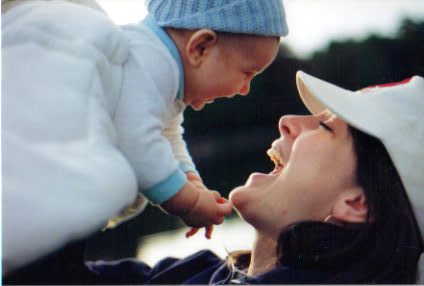
“A mother holds up her child,” Koivth; Creative Commons

My wife Mariko went to the hospital last night to visit our son Christopher, who is in a comatose state after suffering a traumatic brain injury. Here’s what my wife texted the family at the end of her visit:
When I walked into his hospital room and called his name, Christopher moved his head and upper body. I felt certain that he heard my voice. I talked to him in Japanese touching his hands and face, I felt in his facial expression that he was enjoying my attention. I felt it most obviously while moving his wrists and arms and counting the motions in Japanese. It is a sense that is in my gut and is hard to put into words. Christopher is here, the same sweet guy that loves and is loved by his family.
Mariko’s reflection involving her mother’s intuition deeply touched Christopher’s wife Keyonna, his sister Julianne, and me. It also reminded me of what one of the hospitalists overseeing Christopher’s care told me a few weeks ago: “Family members see things we often don’t see.” I think the hospital doctor had in mind our constancy of observations given that we are always visiting Christopher, whereas the medical staff tending to our son changes regularly.
Mariko thinks there is more to the matter than regular observations. She also thinks the familial connections, or what I would refer to as her “mother’s intuition,” has a role to play in the kind of observations she makes. Mariko accounts for the analytical and logical but does not dismiss the intuitive either. All too often, we neglect the intuitive because of societal pressures, anxieties, and certain forms of analysis. That is most unfortunate, since there is something about intuition that can help us analyze problems more adeptly.
In an article titled “A Mother’s Intuition—A parent’s Intuition is a very powerful force, but one we have lost,” psychiatrist Shimi Kang (M.D.) argues that
…the subconscious human mind and body are found to intuitively know which option they should choose and which to avoid before the mind is even consciously aware of it, and long before the analytical left side of the brain can logically explain it. However, whether people act on those intuitions is something completely different and based on many different factors, such as: outside influence, fear, and simply not being out-of-tune with one’s own mind and body.
In analyzing our son’s situation, we do not discount neurological and physiological assessments, but we do not discount daily observations and intuitions either. According to our medical consultant, it is way too early to make a definitive prognosis and must account for a variety of factors when making assessments. We seek to account for clinical analysis as well as personal observations and connections. We must account for all the phenomenon.
It is also worth noting here that intuition has a biological basis. The hormone known as oxytocin fosters the intuitive bond between a mother and her child from the womb onward in life. Moreover, it is not only the case that birth mothers generate and release oxytocin in bonding with an infant. Others can as well. That said, a deficiency in oxytocin may prove challenging to parental care, including the possibility of neglect and abuse.
With this point in mind, my wife and I have been grieving over the recent news report claiming that a teenager with autism was starved to death by a parental figure in our community. How could this happen? But it’s not simply physical starvation that comes into play. So many of us are starving for attention due to an increasing sense of isolation in society. Perhaps never before has it been more important for all of us to be intentional and ensure others that we see them and demonstrate to them that they are not alone.
I can assure you there is no such neglect on the part of Christopher’s mom. Nor are there any concerns over her oxytocin and intuition. They are functioning at optimum levels. It is so important for our son’s care that we account for them in each of us, as well as keen medical assessments.
It is also likely that intuition and oxytocin were functioning at high levels for the Apostle Paul in addressing the crisis involving disunity in the church at Philippi. Paul appears to have intuitively grasped that the problem with disunity was ultimately the result of a lack of relational bonding. And so, he encouraged the Philippian church to call to mind how much God cares for them so that they might care for others. It was a phenomenal diagnosis and prescription. Here’s Paul:
Therefore if you have any encouragement from being united with Christ, if any comfort from his love, if any common sharing in the Spirit, if any tenderness and compassion, then make my joy complete by being like-minded, having the same love, being one in spirit and of one mind. Do nothing out of selfish ambition or vain conceit. Rather, in humility value others above yourselves, not looking to your own interests but each of you to the interests of the others (Philippians 2:1-4; NIV).
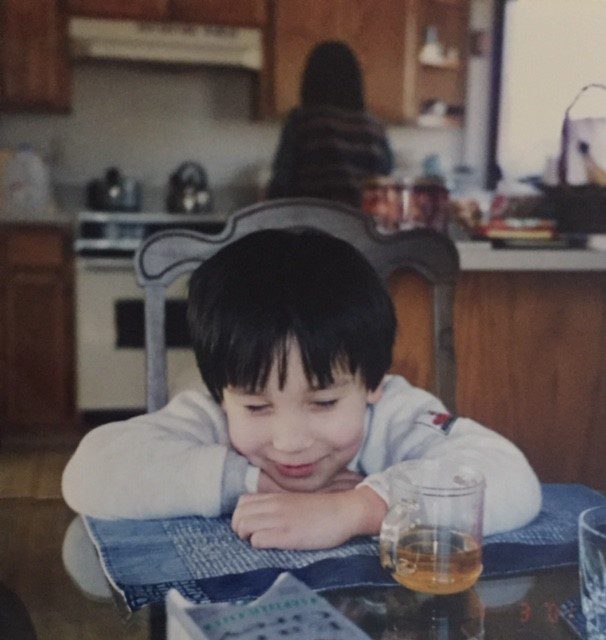
My son Christopher enjoying life as a child many years ago while his mother makes a meal for him.
I wonder what bearing the cultivating of our intuition as well as the generating of oxytocin might mean for addressing problems in our communities and society today. How might consideration of these dimensions of life, as well as Paul’s words about being relationally united or bonded with Christ and sharing in the Spirit, help us in analyzing and diagnosing cultural diseases involving indifference and hostility in so many quarters? We need to reduce fear and anxiety and cultivate secure attachments so that we can really sense what is going on around us and respond more effectively in prescribing solutions and making prognoses. Empathy is critically important in addressing the cultural disease of neglect.
Just as my wife believes our son enjoys her attention, may we be sure to guard against neglect and give attention to others around us so that they can enjoy life and experience emotional and relational healing.
About Paul Louis Metzger
Paul Louis Metzger, Ph.D., is Professor of Theology & Culture, Multnomah University & Seminary; Director of The Institute for Cultural Engagement: New Wine, New Wineskins; and Author and Editor of numerous works, including The Gospel of John: When Love Comes to Town and Cultural Encounters: A Journal for the Theology of Culture. You can read more about the author here.
Previous Post

April 13, 2021
Time Tunnel: the Ancient of Days Holds Our Future
Next Post
April 19, 2021 Develop an Emotional Stimulus Package for Dealing Well with Trauma
Browse Our Archives
Select a Category Uncategorized
Select a Month June 2025 April 2025 March 2025 January 2025 December 2024 November 2024 October 2024 September 2024 August 2024 July 2024 June 2024 May 2024 April 2024 March 2024 February 2024 January 2024 December 2023 November 2023 October 2023 September 2023 August 2023 July 2023 June 2023 May 2023 April 2023 March 2023 February 2023 January 2023 December 2022 November 2022 October 2022 September 2022 August 2022 July 2022 June 2022 May 2022 April 2022 March 2022 February 2022 January 2022 December 2021 November 2021 October 2021 September 2021 August 2021 July 2021 June 2021 May 2021 April 2021 March 2021 February 2021 January 2021 December 2020 November 2020 October 2020 September 2020 August 2020 July 2020 June 2020 May 2020 April 2020 March 2020 February 2020 January 2020 December 2019 November 2019 October 2019 September 2019 August 2019 July 2019 June 2019 May 2019 April 2019 March 2019 February 2019 January 2019 December 2018 November 2018 October 2018 September 2018 August 2018 July 2018 June 2018 May 2018 April 2018 March 2018 February 2018 January 2018 December 2017 November 2017 October 2017 September 2017 August 2017 July 2017 June 2017 May 2017 April 2017 March 2017 February 2017 January 2017 December 2016 November 2016 October 2016 September 2016 August 2016 July 2016 June 2016 May 2016 April 2016 March 2016 February 2016 January 2016 December 2015 November 2015 October 2015 September 2015 August 2015 July 2015 June 2015 May 2015 April 2015 March 2015 February 2015 January 2015 December 2014 November 2014 October 2014 September 2014 August 2014 July 2014 June 2014 May 2014 April 2014 March 2014 February 2014 January 2014 December 2013 November 2013 October 2013 September 2013 August 2013 July 2013 June 2013 May 2013 April 2013 March 2013 February 2013 January 2013 December 2012 November 2012 October 2012 September 2012 August 2012 July 2012 June 2012 May 2012 April 2012 March 2012 February 2012
Follow Us!
TAKE THE
Religious Wisdom Quiz
In Hebrews, Abel's blood spoke, but what does Jesus' blood speak?
Select your answer to see how you score.
The same message as Abel's Words of judgment Words of warning A better word than the blood of Abel
Books by This Author Books by Paul Louis Metzger
Related posts from Uncommon God, Common Good

Heavenly Father’s Day on Trinity Sunday

Easter Triduum: Obey Your Thirst—for God

Holy Week Is Humble Week: "Beware of Becoming...

Excavating the Person in a Throwaway Culture
TRENDING AT PATHEOS Evangelical

The REST of Your Life: A Creative Wrestles...
This week I had a conversation with a good friend from church....

How the author of the world's best hymn...
I've been working with John Newton for a while now. This makes...

Long before this Lectio Divina, Psalm 130 - the song - started...

What About the Trees? Another Living Parable
After I finished writing the last article about falling leaves as a...

Why Classical Education Is a Conversation, Not a...
Come and Read: Joy in Classical Education When I was a little...

Cornell University has received a great deal of negative publicity and intense...
view all Evangelical blogs
Ad-Free & Subscriber Log-In Subscription Support
- About Us
- 2026 Calendar
- Videos
- Podcasts
- Library of World Religions
- Faith In Media Tracker
- Advertise With Us
- Write for Us
- Privacy Policy
- Terms of Service
- Do Not Sell My Data
- Contact Us
- Radiant Digital
- Manage Newsletter Subscriptions
- Unsubscribe From Notifications
- Sitemap
Copyright 2008-2026, Patheos. All rights reserved.
Subscription Support Ad-Free & Subscriber Log-In
Follow Patheos