
BuddhistCatholicContemplativeEvangelicalGeneral ChristianHinduJewishLatter-day SaintMuslimNew VisionsProgressive Christian
Beliefs
- Buddhist
- Catholic
- Contemplative
- Evangelical
- General Christian
- Hindu
- Jewish
- Latter-day Saint
- More Voices
- Muslim
- New Visions
- Pagan
- Progressive Christian
Topics
- Religion News
- Food and Religion
- Sports and Religion
- Religious Art
- Religious Music and Entertainment
- Religious Events
- History and Religion
- Style and Religion
- Politics and Religion
- Women in Religion
- Recreation Outdoors and Religion
- Business Finance and Religion
- Careers Workplace and Religion
- Education and Religion
- Family Parenting and Religion
- Health Fitness and Religion
- Home and Religion
- Relationships and Religion
- Technology and Religion
- Travel and Religion
Columnists
- Buddhist Columnists
- Business Finance and Religion Columnists
- Careers Workplace and Religion Columnists
- Catholic Columnists
- Contemplative Columnists
- Education and Religion Columnists
- Evangelists Columnists
- Family Parenting and Religion Columnists
- General Christian Columnists
- Health Fitness and Religion Columnists
- Hindu Columnists
- History and Religion Columnists
- Home and Religion Columnists
- Jewish Columnists
- More Voices Columnists
- Latter Day Columnists
- Muslim Columnists
- New Visions Columnists
- Nonreligious Columnists
- Pagan Columnists
- Politics and Religion Columnists
- Progressive Columnists
- Recreation Outdoors and Religion Columnists
- Relationships and Religion Columnists
- Religion News Columnists
- Religious Art Columnists
- Religious Events Columnists
- Religious Music and Entertainment Columnists
- Sports and Religion Columnists
- Style and Religion Columnists
- Technology and Religion Columnists
- Travel and Religion Columnists
- Women in Religion Columnists
Resource Library
- 2026 Calendar
- Library of World Religions
- The 100 Most Holy Places on Earth
- Patheos Answers
- Podcasts
- Videos
- Faith Leaders Database
- Anglican Episcopalian
- Bahai
- Baptist
- Buddhism
- Christianity
- Confucianism
- Eastern Orthodoxy
- Hinduism
- Holiness and Pentecostal
- ISKCON
- Islam
- Judaism
- Lutheran
- Methodist
- The Church of Jesus Christ of Latter-day Saints
- New Age
- Paganism
- Presbytarian and Reformed
- Protestantism
- Religion Behind the Scenes
- Roman Catholic
- Scientology
- Shia Islam
- Sikhism
- Sufism
- Sunni Islam
- Taoism
- Zen
- See all religions
Research Tools
 Ad-Free & Subscriber Log-In Subscription Support
Ad-Free & Subscriber Log-In Subscription Support
Follow Patheos 

- Trending:
- Forgiveness
- |
- Marriage
- |
- Consciousness
- |
- Death Penalty
- |
- Election
- |
- Halloween

- Home
- Evangelical
- The Courage to Be or Not to Be: That Is the Question
The Courage to Be or Not to Be: That Is the Question
Last updated on: March 30, 2021 at 10:52 am by Paul Louis Metzger
The Courage to Be or Not to Be: That Is the Question 2021-03-30T10:52:47-07:00 Paul Louis Metzger
Patheos Explore the world's faith through different perspectives on religion and spirituality! Patheos has the views of the prevalent religions and spiritualities of the world.
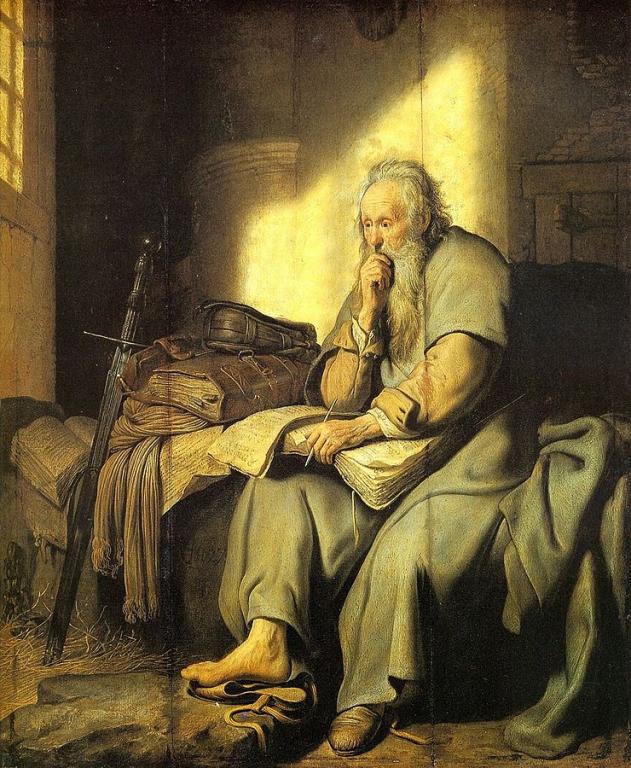
St. Paul in Prison, Rembrandt, 1627; Wikimedia; {{PD-US-expired}}

Not all enduring questions and concerns are welcome ones to ponder. But still, they never get old. Those who seriously examine the human condition over the ages account for intense feelings of finitude and the inevitability of our mortal lives coming to an end, the gnawing question of nihilism and whether life has meaning, and agonizing remorse and regrets over things we have done or failed to do. Such considerations can easily overwhelm us and the inner turmoil they generate may tempt us to throw in the towel. What gives us the courage to be rather than not to be?
Paul Tillich addressed such concerns in The Courage To Be. In confronting the modern epidemic of anxiety associated with such dynamics and the threat of non-being, Tillich writes in his treatment of Friedrich Nietzsche that “courage is the power of life to affirm itself in spite of this ambiguity, while the negation of life because of its negativity is an expression of cowardice.” (Paul Tillich, The Courage to Be, 27) For Tillich himself, according to Shelby L. Condray, “Healthy anxiety is that which leads to the courage to absorb the threat of non-being into oneself through an act of courage.”
Moving on from Tillich, certainly there have been times in our family’s current crisis involving my son Christopher’s traumatic brain injury and unfolding aftermath, where I have wanted simply to crawl into a cave, roll into a ball, and die, as a friend of mine said of his own relentless ordeal. But we don’t give in to the threat of non-being. He and I keep going. Why?
It reminds me of the father and son in Cormac McCarthy’s book The Road. A cosmic disaster leaves the world in tatters. The apocalypse is too much to bear for the wife and mother (pregnant with her son at the time of the cosmic nightmare’s occurrence), who eventually kills herself. The father and son set out on a journey, heading south, in search of warmer weather. Their love for one another keeps them going, until the father dies resulting from severe health complications. Still, his boy finds a home among a caring family of strangers who also keep fighting to live. But what keeps them going on the road to life when it ultimately leads to death? What keeps any of us going?
I have always respected Friedrich Nietzsche because he didn’t settle for easy shortcuts and pat answers, like believing in something simply for pragmatic reasons. If a belief in heaven and the afterlife works for you so you don’t despair, why question it? But as Edward Craig remarks in his comparison of Nietzsche and William James in The Mind of God and the Works of Man, Nietzsche understood so painfully well that an idea held for pragmatic reasons is halfway to its abandonment. So the threat of nihilism remains:
Where pragmatism enters, “Nihilism stands at the door,” [taken from Will to Power, paragraph 1] and to accept nihilism and to overcome it calls for a degree of inner strength far beyond the normal. Hence the force of its competitors, as Nietzsche well knew. (281)
Sometimes it is best to live the question rather than quickly resolve to live without reflection. After all, as Socrates said, the unexamined life is not worth living. From the other end, I cannot examine my life if I quickly resolve to die. Remember that Socrates was forced to kill himself because of his undying determination to pursue truth, which posed a threat to the societal status quo. Most of us who ponder suicide pose no such threat to society. All too often, we are all too busy amusing ourselves to death to ponder truth.
While I could try to answer and resolve the question over what is so meaningful about living in the face of tragedy with some neat and tidy apologetic strategy, I prefer not to do so. I hate Hollywood endings, since life generally or never really works out that way. The struggle to live, to examine, to be stretched in the face of tragedy and overwhelming odds, that requires courage. Such courage in the face of overwhelming anxiety is itself meaningful. I see such courage on display in my wife, my daughter, my daughter-in-law, and granddaughter as we cope in search of hope regarding Christopher’s critical condition. Certainly, my Christian faith sustains me, but not as if it seals me in Saran Wrap or a Tupperware container, where I don’t have to ponder whether to be or not be, where I don’t have to struggle to live.
Pondering the existential questions of finitude and possible meaninglessness, regret and shame, which our race asks from generation to generation keeps me honest, keeps me human, keeps me alive as human. Even the most humane Elie Wiesel, a Holocaust survivor who had lost so much of what he loved, pondered them in works like Night. The courage to be kept him going, even as he struggled to survive his existential questions.
Even the Apostle Paul entertained questions of meaning and meaninglessness. There was no pragmatic shortcut such that he believed in the resurrection of the dead because it made him happy. At one point, he even tells us that he despaired of life itself (2 Corinthians 1:8). Paul and the apostolic community realized that if there be no resurrection from the dead, they were to be most pitied for their monumental suffering for their faith in this life. Apart from the bodily resurrection from the dead, their faith would be completely meaningless. Thus, he could not entertain pragmatic considerations that involve believing in something simply to be happy. For Nietzsche, it was not the doctrine of bodily resurrection, but perhaps the doctrine of eternal recurrence which kept him from giving in to nihilism. For Paul, on the other hand, if there were no resurrection, it is time to eat, drink, and be merry for tomorrow we die (1 Corinthians 15:19, 29-32). I’ll drink to that.
What beliefs, whatever they might be, sustain you and help you to keep going no matter the level of existential anxiety? Those who have never pondered this question have never really lived an examined life. Those who confuse this essay’s engagement of existential anxiety with the kind of anxiousness Paul challenged in Philippians 4:4-7 from his prison cell in Rome should think again. Contrary to Nietzsche’s view that Christianity is a world-denying faith, for Paul, to live was Christ. For Paul, to die in seeking to live for Christ here on earth with great courage against all existential odds was gain (Philippians 1:21). Paul knew well that a belief not worth dying for is not worth living for, which would be the cause of an even greater anxiety. Belief in Christ did not keep Paul from existential anxiety or suffering over the need to examine his life, but led him into it, even if that meant death for doing so. For Paul, his entire existence was Christ, come what may. He put his life where his faith was. Whether crazy or not, I respect such consistency. It takes courage to be, even if that means willingness not to be, whereby one dies so that others can live. For Paul, to live is Christ and others no matter the situation.
It is worth noting how Paul closes his reflection recorded in Philippians 1 from a Roman prison cell on whether he should keep on living or depart and be with Christ. While the option available to him to depart and be with Christ would be better by far for him, he decided to stay for the sake of the community of believers who needed him for their own growth and development in faith (Philippians 1:22-26). Unlike Nietzsche with his absolutely rugged individualism, but like Paul who was a father of faith to these Philippians Christians, like the father in The Road, or the family who took in this father’s son when he died, or countless others throughout history, concern for loved ones who remain, as well as for posterity, give us courage to be. The hope that my son may experience once again a form of meaningful existence, the wellbeing of his wife, his daughter, my wife, my daughter, my faith in Christ, who does not leave us as orphans, gives me courage to be.
About Paul Louis Metzger
Paul Louis Metzger, Ph.D., Professor of Theology & Culture, Multnomah University & Seminary; Director of The Institute for Cultural Engagement: New Wine, New Wineskins; and Author of numerous works, including The Word of Christ and the World of Culture: Sacred and Secular through the Theology of Karl Barth (Eerdmans, 2003) and Connecting Christ: How to Discuss Jesus in a World of Diverse Paths (Thomas Nelson, 2012). You can read more about the author here.
Previous Post

March 28, 2021
If You Have Faith the Size of a Hypothalamus...
Next Post
April 1, 2021 Camino de Santiago and the Linoleum Trail
Browse Our Archives
Select a Category Uncategorized
Select a Month June 2025 April 2025 March 2025 January 2025 December 2024 November 2024 October 2024 September 2024 August 2024 July 2024 June 2024 May 2024 April 2024 March 2024 February 2024 January 2024 December 2023 November 2023 October 2023 September 2023 August 2023 July 2023 June 2023 May 2023 April 2023 March 2023 February 2023 January 2023 December 2022 November 2022 October 2022 September 2022 August 2022 July 2022 June 2022 May 2022 April 2022 March 2022 February 2022 January 2022 December 2021 November 2021 October 2021 September 2021 August 2021 July 2021 June 2021 May 2021 April 2021 March 2021 February 2021 January 2021 December 2020 November 2020 October 2020 September 2020 August 2020 July 2020 June 2020 May 2020 April 2020 March 2020 February 2020 January 2020 December 2019 November 2019 October 2019 September 2019 August 2019 July 2019 June 2019 May 2019 April 2019 March 2019 February 2019 January 2019 December 2018 November 2018 October 2018 September 2018 August 2018 July 2018 June 2018 May 2018 April 2018 March 2018 February 2018 January 2018 December 2017 November 2017 October 2017 September 2017 August 2017 July 2017 June 2017 May 2017 April 2017 March 2017 February 2017 January 2017 December 2016 November 2016 October 2016 September 2016 August 2016 July 2016 June 2016 May 2016 April 2016 March 2016 February 2016 January 2016 December 2015 November 2015 October 2015 September 2015 August 2015 July 2015 June 2015 May 2015 April 2015 March 2015 February 2015 January 2015 December 2014 November 2014 October 2014 September 2014 August 2014 July 2014 June 2014 May 2014 April 2014 March 2014 February 2014 January 2014 December 2013 November 2013 October 2013 September 2013 August 2013 July 2013 June 2013 May 2013 April 2013 March 2013 February 2013 January 2013 December 2012 November 2012 October 2012 September 2012 August 2012 July 2012 June 2012 May 2012 April 2012 March 2012 February 2012
Follow Us!
TAKE THE
Religious Wisdom Quiz
What did the angel tell the shepherds?
Select your answer to see how you score.
The Location of the Newborn Savior To Not Be Afraid How to Recognize the Newborn Savior All of These Things
Books by This Author Books by Paul Louis Metzger
Related posts from Uncommon God, Common Good

Heavenly Father’s Day on Trinity Sunday

Easter Triduum: Obey Your Thirst—for God

Holy Week Is Humble Week: "Beware of Becoming...

Excavating the Person in a Throwaway Culture
TRENDING AT PATHEOS Evangelical

The REST of Your Life: A Creative Wrestles...
This week I had a conversation with a good friend from church....

How the author of the world's best hymn...
I've been working with John Newton for a while now. This makes...

Long before this Lectio Divina, Psalm 130 - the song - started...

What About the Trees? Another Living Parable
After I finished writing the last article about falling leaves as a...

Why Classical Education Is a Conversation, Not a...
Come and Read: Joy in Classical Education When I was a little...

Cornell University has received a great deal of negative publicity and intense...
view all Evangelical blogs
Ad-Free & Subscriber Log-In Subscription Support
- About Us
- 2026 Calendar
- Videos
- Podcasts
- Library of World Religions
- Faith In Media Tracker
- Advertise With Us
- Write for Us
- Privacy Policy
- Terms of Service
- Do Not Sell My Data
- Contact Us
- Radiant Digital
- Manage Newsletter Subscriptions
- Unsubscribe From Notifications
- Sitemap
Copyright 2008-2026, Patheos. All rights reserved.
Subscription Support Ad-Free & Subscriber Log-In
Follow Patheos