
BuddhistCatholicContemplativeEvangelicalGeneral ChristianHinduJewishLatter-day SaintMuslimNew VisionsProgressive Christian
Beliefs
- Buddhist
- Catholic
- Contemplative
- Evangelical
- General Christian
- Hindu
- Jewish
- Latter-day Saint
- More Voices
- Muslim
- New Visions
- Pagan
- Progressive Christian
Topics
- Religion News
- Food and Religion
- Sports and Religion
- Religious Art
- Religious Music and Entertainment
- Religious Events
- History and Religion
- Style and Religion
- Politics and Religion
- Women in Religion
- Recreation Outdoors and Religion
- Business Finance and Religion
- Careers Workplace and Religion
- Education and Religion
- Family Parenting and Religion
- Health Fitness and Religion
- Home and Religion
- Relationships and Religion
- Technology and Religion
- Travel and Religion
Columnists
- Buddhist Columnists
- Business Finance and Religion Columnists
- Careers Workplace and Religion Columnists
- Catholic Columnists
- Contemplative Columnists
- Education and Religion Columnists
- Evangelists Columnists
- Family Parenting and Religion Columnists
- General Christian Columnists
- Health Fitness and Religion Columnists
- Hindu Columnists
- History and Religion Columnists
- Home and Religion Columnists
- Jewish Columnists
- More Voices Columnists
- Latter Day Columnists
- Muslim Columnists
- New Visions Columnists
- Nonreligious Columnists
- Pagan Columnists
- Politics and Religion Columnists
- Progressive Columnists
- Recreation Outdoors and Religion Columnists
- Relationships and Religion Columnists
- Religion News Columnists
- Religious Art Columnists
- Religious Events Columnists
- Religious Music and Entertainment Columnists
- Sports and Religion Columnists
- Style and Religion Columnists
- Technology and Religion Columnists
- Travel and Religion Columnists
- Women in Religion Columnists
Resource Library
- 2026 Calendar
- Library of World Religions
- The 100 Most Holy Places on Earth
- Patheos Answers
- Podcasts
- Videos
- Faith Leaders Database
- Anglican Episcopalian
- Bahai
- Baptist
- Buddhism
- Christianity
- Confucianism
- Eastern Orthodoxy
- Hinduism
- Holiness and Pentecostal
- ISKCON
- Islam
- Judaism
- Lutheran
- Methodist
- The Church of Jesus Christ of Latter-day Saints
- New Age
- Paganism
- Presbytarian and Reformed
- Protestantism
- Religion Behind the Scenes
- Roman Catholic
- Scientology
- Shia Islam
- Sikhism
- Sufism
- Sunni Islam
- Taoism
- Zen
- See all religions
Research Tools
 Ad-Free & Subscriber Log-In Subscription Support
Ad-Free & Subscriber Log-In Subscription Support
Follow Patheos 

- Trending:
- Forgiveness
- |
- Marriage
- |
- Consciousness
- |
- Death Penalty
- |
- Election
- |
- Halloween

- Home
- Evangelical
- Statistical Probabilities and Personal Possibilities in Patient and Pastoral Care
Statistical Probabilities and Personal Possibilities in Patient and Pastoral Care
Last updated on: March 13, 2021 at 2:13 pm by Paul Louis Metzger
Statistical Probabilities and Personal Possibilities in Patient and Pastoral Care 2021-03-13T14:13:25-08:00 Paul Louis Metzger
Patheos Explore the world's faith through different perspectives on religion and spirituality! Patheos has the views of the prevalent religions and spiritualities of the world.
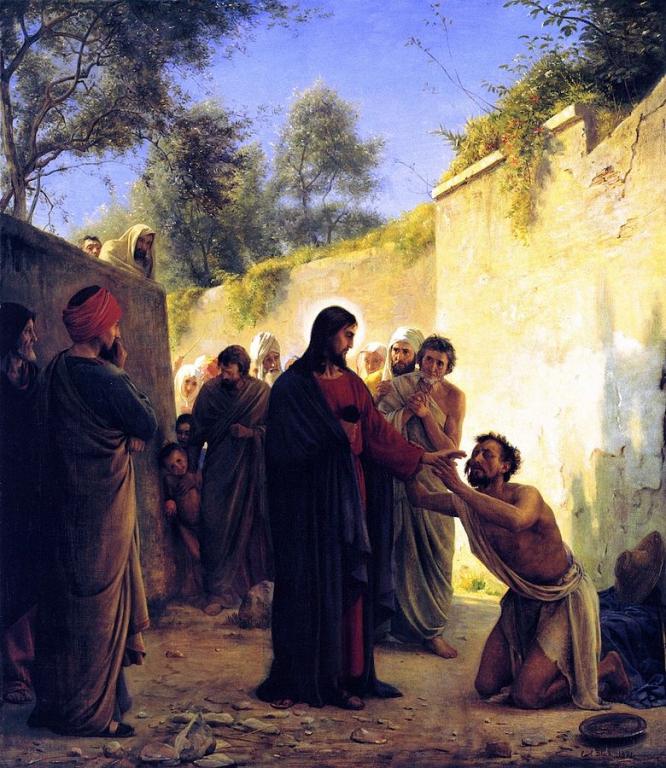
“Healing of the Blind Man,” 1871, Carl Bloch; Wikimedia Commons {{PD-US-expired}}

In his work as a medical ethicist, my friend and mentor Dr. Robert Potter (M.D., Ph.D.) would instruct his students that “learning statistics is learning probabilities,” not actualities in each individual instance. The problem all too frequently arises that medical professionals “translate probabilities into individuals. That’s not possible.” They mistakenly turn their rightful pursuit of objectivity and realism into “thinking they know what will happen in each and every individual case. They need to understand that they have statistical knowledge, but not knowledge of any one particular case.” One has no idea what will ultimately happen in an individual situation. “Probabilities only apply to a group of individuals, not an individual patient.”
As my wife Mariko has said in reflecting on our son Christopher’s situation involving his traumatic brain injury and comatose state, life is a mystery. We need to account for life as a mystery in attending to each individual patient. Persons are not numbers or statistics. When we go beyond probabilities to operate as if we have certainty, we are not objective and realistic enough. Objectivity and realism account for complexity and remote possibilities that may end up defying the statistical generalizations.
I fear that in some unintentional way medical professionals can project possible outcomes onto patients and turn them into self-fulfilling prophecies, if and when they operate according to one or both of the following dynamics: focusing only on generalizations based on statistical groupings; failing to account for the mystery and agency of each critical care patient who is a person. Such presumed realism is not objective enough. That is why I have appreciated the realistic exhortation of a respiratory therapist to remain positive and hopeful, the objective evaluation of a neurosurgeon who left open the room for medical miracles, and a perceptive nurse who said we are waiting to see how Christopher will respond. The combined emphasis on hope, mystery, and a patient’s unique personal agency speaks volumes to me.
It is not simply in the arena of medical patient care where we need to guard against forcing generalizations on individual situations. Probabilities are not certainties in personal relationships and pastoral care either. So, even if a group of people, even a family or church community, operates in a certain way, we must account for the possibility of someone being the exception to the rule. The same goes for an individual who has a problematic or disturbing track record. Their life story is still being written. While consistency of a changed state does not come overnight, we should always be hoping for glimpses of reformation, transformation, and growth toward relational and spiritual healing. We should never give up on others, but always hope for their repentance to stick. Jesus is the God who always uses multiplication in detailing statistics on the subject of forgiveness. Take for example his response to Peter recorded in Matthew 18:
Then Peter came to Jesus and asked, “Lord, how many times shall I forgive my brother or sister who sins against me? Up to seven times?”
Jesus answered, “I tell you, not seven times, but seventy-seven times. (Matthew 18:21-22; NIV)
The advanced numbering system Jesus offers can be alternatively rendered “seventy times seven.” Jesus had to apply such advanced numbering in Peter’s case in various instances, including his restoration of Peter following his threefold denial of Jesus during his trial preceding the crucifixion.
In personal relationships and pastoral care, we need to be on guard against being cynical on the one hand and naïve or gullible on the other hand in giving people second, third, and seventy-seven chances. We need to be hopeful, which entails being both innocent as doves and shrewd as serpents, not shrewd as doves and innocent as serpents.
Statistics matter. Track records matter. But may we never approach individual cases or individual encounters in patient and pastoral care as if there is no place for healing and reform.
In closing, I draw attention to one of the most dramatic literary scenes that brings this point home. The scene is found in Victor Hugo’s Les Miserables, where police caught the ex-convict Jean Valjean with the silver he stole from the bishop’s home. Instead of crying out that the police should send Jean Valjean back to a life of hard prison labor, the bishop scolds Jean Valjean for not taking the silver candlesticks, too! After sending the stupefied police away, an even more stupefied Jean Valjean nearly faints. The elderly bishop strengthens and transforms him in that very moment, not with probabilities bound up with the statistics from the ex-convict’s prior and present way of life, or what will happen to most convicts when they return to civilian life. Rather, the bishop perceives Jean Valjean in view of the divine possibility of a changed life bound up with the miraculous mystery of forgiveness:
Jean Valjean was like a man on the point of fainting.
The Bishop drew near to him, and said in a low voice:–
“Do not forget, never forget, that you have promised to use this money in becoming an honest man.”
Jean Valjean, who had no recollection of ever having promised anything, remained speechless. The Bishop had emphasized the words when he uttered them. He resumed with solemnity:–
“Jean Valjean, my brother, you no longer belong to evil, but to good. It is your soul that I buy from you; I withdraw it from black thoughts and the spirit of perdition, and I give it to God.”
Jean Valjean lived the rest of his days as a new man who did not steal from others, but gave his life for their well-being.
In our rightful desire to account for statistical probabilities in patient and pastoral care, may we, like Victor Hugo’s bishop, always make room for the impossible possibility of healing, reformation, and growth.
About Paul Louis Metzger
Paul Louis Metzger, Ph.D., is Professor of Theology & Culture, Multnomah University & Seminary; as well as the Director of The Institute for Cultural Engagement: New Wine, New Wineskins. He is the author and editor of numerous works, including the journal Cultural Encounters: A Journal for the Theology of Culture. You can read more about the author here.
Previous Post

March 11, 2021
Be Creative in Your Suffering
Next Post
March 18, 2021 Approaching Critical Care Situations with a Glass Half Full
Browse Our Archives
Select a Category Uncategorized
Select a Month June 2025 April 2025 March 2025 January 2025 December 2024 November 2024 October 2024 September 2024 August 2024 July 2024 June 2024 May 2024 April 2024 March 2024 February 2024 January 2024 December 2023 November 2023 October 2023 September 2023 August 2023 July 2023 June 2023 May 2023 April 2023 March 2023 February 2023 January 2023 December 2022 November 2022 October 2022 September 2022 August 2022 July 2022 June 2022 May 2022 April 2022 March 2022 February 2022 January 2022 December 2021 November 2021 October 2021 September 2021 August 2021 July 2021 June 2021 May 2021 April 2021 March 2021 February 2021 January 2021 December 2020 November 2020 October 2020 September 2020 August 2020 July 2020 June 2020 May 2020 April 2020 March 2020 February 2020 January 2020 December 2019 November 2019 October 2019 September 2019 August 2019 July 2019 June 2019 May 2019 April 2019 March 2019 February 2019 January 2019 December 2018 November 2018 October 2018 September 2018 August 2018 July 2018 June 2018 May 2018 April 2018 March 2018 February 2018 January 2018 December 2017 November 2017 October 2017 September 2017 August 2017 July 2017 June 2017 May 2017 April 2017 March 2017 February 2017 January 2017 December 2016 November 2016 October 2016 September 2016 August 2016 July 2016 June 2016 May 2016 April 2016 March 2016 February 2016 January 2016 December 2015 November 2015 October 2015 September 2015 August 2015 July 2015 June 2015 May 2015 April 2015 March 2015 February 2015 January 2015 December 2014 November 2014 October 2014 September 2014 August 2014 July 2014 June 2014 May 2014 April 2014 March 2014 February 2014 January 2014 December 2013 November 2013 October 2013 September 2013 August 2013 July 2013 June 2013 May 2013 April 2013 March 2013 February 2013 January 2013 December 2012 November 2012 October 2012 September 2012 August 2012 July 2012 June 2012 May 2012 April 2012 March 2012 February 2012
Follow Us!
TAKE THE
Religious Wisdom Quiz
True or False: The apostles drew lots to choose Matthias to replace Judas.
Select your answer to see how you score.
TRUE FALSE
Books by This Author Books by Paul Louis Metzger
Related posts from Uncommon God, Common Good

Heavenly Father’s Day on Trinity Sunday

Easter Triduum: Obey Your Thirst—for God

Holy Week Is Humble Week: "Beware of Becoming...

Excavating the Person in a Throwaway Culture
TRENDING AT PATHEOS Evangelical

The REST of Your Life: A Creative Wrestles...
This week I had a conversation with a good friend from church....

How the author of the world's best hymn...
I've been working with John Newton for a while now. This makes...

Long before this Lectio Divina, Psalm 130 - the song - started...

What About the Trees? Another Living Parable
After I finished writing the last article about falling leaves as a...

Why Classical Education Is a Conversation, Not a...
Come and Read: Joy in Classical Education When I was a little...

Cornell University has received a great deal of negative publicity and intense...
view all Evangelical blogs
Ad-Free & Subscriber Log-In Subscription Support
- About Us
- 2026 Calendar
- Videos
- Podcasts
- Library of World Religions
- Faith In Media Tracker
- Advertise With Us
- Write for Us
- Privacy Policy
- Terms of Service
- Do Not Sell My Data
- Contact Us
- Radiant Digital
- Manage Newsletter Subscriptions
- Unsubscribe From Notifications
- Sitemap
Copyright 2008-2026, Patheos. All rights reserved.
Subscription Support Ad-Free & Subscriber Log-In
Follow Patheos