
BuddhistCatholicContemplativeEvangelicalGeneral ChristianHinduJewishLatter-day SaintMuslimNew VisionsProgressive Christian
Beliefs
- Buddhist
- Catholic
- Contemplative
- Evangelical
- General Christian
- Hindu
- Jewish
- Latter-day Saint
- More Voices
- Muslim
- New Visions
- Pagan
- Progressive Christian
Topics
- Religion News
- Food and Religion
- Sports and Religion
- Religious Art
- Religious Music and Entertainment
- Religious Events
- History and Religion
- Style and Religion
- Politics and Religion
- Women in Religion
- Recreation Outdoors and Religion
- Business Finance and Religion
- Careers Workplace and Religion
- Education and Religion
- Family Parenting and Religion
- Health Fitness and Religion
- Home and Religion
- Relationships and Religion
- Technology and Religion
- Travel and Religion
Columnists
- Buddhist Columnists
- Business Finance and Religion Columnists
- Careers Workplace and Religion Columnists
- Catholic Columnists
- Contemplative Columnists
- Education and Religion Columnists
- Evangelists Columnists
- Family Parenting and Religion Columnists
- General Christian Columnists
- Health Fitness and Religion Columnists
- Hindu Columnists
- History and Religion Columnists
- Home and Religion Columnists
- Jewish Columnists
- More Voices Columnists
- Latter Day Columnists
- Muslim Columnists
- New Visions Columnists
- Nonreligious Columnists
- Pagan Columnists
- Politics and Religion Columnists
- Progressive Columnists
- Recreation Outdoors and Religion Columnists
- Relationships and Religion Columnists
- Religion News Columnists
- Religious Art Columnists
- Religious Events Columnists
- Religious Music and Entertainment Columnists
- Sports and Religion Columnists
- Style and Religion Columnists
- Technology and Religion Columnists
- Travel and Religion Columnists
- Women in Religion Columnists
Resource Library
- 2026 Calendar
- Library of World Religions
- The 100 Most Holy Places on Earth
- Patheos Answers
- Podcasts
- Videos
- Faith Leaders Database
- Anglican Episcopalian
- Bahai
- Baptist
- Buddhism
- Christianity
- Confucianism
- Eastern Orthodoxy
- Hinduism
- Holiness and Pentecostal
- ISKCON
- Islam
- Judaism
- Lutheran
- Methodist
- The Church of Jesus Christ of Latter-day Saints
- New Age
- Paganism
- Presbytarian and Reformed
- Protestantism
- Religion Behind the Scenes
- Roman Catholic
- Scientology
- Shia Islam
- Sikhism
- Sufism
- Sunni Islam
- Taoism
- Zen
- See all religions
Research Tools
 Ad-Free & Subscriber Log-In Subscription Support
Follow Patheos 

- Trending:
- Advent
- |
- Forgiveness
- |
- Thanksgiving
- |
- Election
- |
- Seasonal Holidays
- |
- Marriage

- Home
- Evangelical
- What Constitutes Moral Authority in the US Today?
What Constitutes Moral Authority in the US Today?
Last updated on: January 6, 2021 at 10:06 am by Paul Louis Metzger
What Constitutes Moral Authority in the US Today? 2021-01-06T10:06:39-08:00 Paul Louis Metzger
Patheos Explore the world's faith through different perspectives on religion and spirituality! Patheos has the views of the prevalent religions and spiritualities of the world.
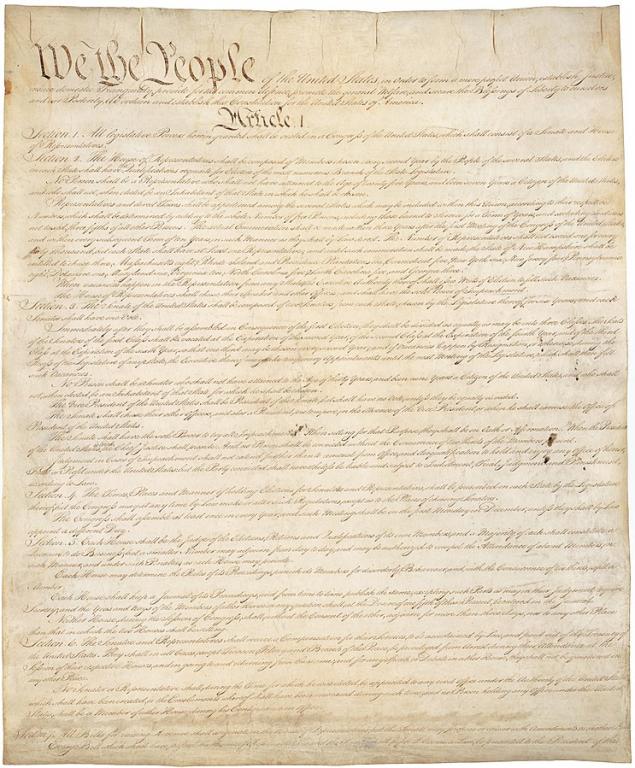
Constitution of the United States, September 17, 1787, Public Domain

Rep. Adam Kinzinger, a Republican Congressman from Illinois, has spoken out about the loss of “moral authority” in the GOP. Refer here, for example. This week, he repeated his challenge to his party. Those GOP members of Congress who object to President-elect Biden’s victory today have lost their “moral authority” to take issue if Democrats return the favor and object to a future GOP Presidential election victory. Watch here. It raises the question: What constitutes moral authority in the US—or anywhere for that matter—today and always?
Is it popularity and public opinion, economic, political or military prowess, adherence to a country’s founding legal documents, pure reason, divine law, something else? Kinzinger states that adherence to the US Constitution dictates whether one has moral authority as a political leader in this country. His reflections remind me of the speech of General Mark Milley, Chairman of the Joint Chiefs of Staff, which Milley gave at the dedication of the US Army Museum last November: “We are unique among militaries.” How so? “We do not take an oath to a king or a queen, a tyrant or a dictator. We do not take an oath to an individual.” Milley asserted that the military has an unambiguous duty to safeguard the Constitution, which he referred to as the “moral north star” for US military personnel. “We take an oath to the Constitution,” and “will protect and defend that document regardless of personal price.”
Regardless of one’s personal opinions regarding Kinzinger and Milley, one should take to heart Kinzinger’s call for consistency of conviction and adherence to the Constitution, as well as Milley’s call to protect the Constitution regardless of personal price. To the extent that they and we who are US citizens do that in our respective areas of service, we demonstrate moral authority. Certainly, we can seek legal amendments to the Constitution, as has occurred occasionally over our country’s history (take for example the 13th Amendment abolishing slavery). However, those amendments are intended to reflect the spirit and ultimate aims of the Constitution.
Our country’s founding fathers took stock of the French Revolution. One of the major influences on their thought was Montesquieu and his separation of powers. For the purposes of this present post, I wish to draw attention briefly to Montesquieu’s categories of government and see how they might bear on our current context in the US. His three categories that apply to various societies are despotic, monarchial, and republican. The founding fathers sought to create a republican society (not to be confused with the Republican Party) rather than a monarchial or despotic system. The ethos that shapes a despotic society is fear. Honor marks the ethos of a monarchial society. In contrast to these two frameworks, virtue characterizes a republic. In a despotic state, the motivation for obedience to the law is fear of the consequences of not obeying the dictates of the tyrant. In a monarchial state, the motivation for obedience to the law is honor and status. In a republic, the motivation for obedience to the law is esteem for civic virtue. The government must make serious efforts to educate its citizenry in civic virtue with all its attending demands (See Alasdair McIntyre’s articulation of these categories and critique of Montesquieu’s analysis of social life in chapter 13 of A Short History of Ethics).
Regardless of our political affiliations and desires, hopefully we all agree that what we need from our civic leaders today is consistency of character to uphold the US Constitution. How can the government train the citizenry in civic virtue if they themselves are swayed by political opportunism and opinion polls? For the rest of us, we need to make sure that we seek to embody moral authority by growing in civic virtue. As a child in my Republican family household, I used to reflect on a plaque that hung in my bedroom. It included the words of the late President John F. Kennedy’s inaugural address: “Ask not what your country can do for you – ask what you can do for your country.” Presidents Kennedy and Eisenhower understood the importance of this statement as the Republican Eisenhower (and famous World War II veteran general) supported the peaceful transition of power to the Democratic Kennedy (also a World War II hero). Eisenhower sat nearby as Kennedy uttered his inauguration speech. Our ultimate commitment as citizens in this country is not to this or that political leader, but to the Constitution, which serves as the “moral north star” for our whole country, not just the military. What can we do as citizens today? Grow in personal consistency of conviction centered around the Constitution, not a political leader, and personal sacrifice for the greater good, not simply for one’s political or cultural ingroup. After all, we are one nation under God and under the Constitution, not under President Trump or President-elect Biden, or a political party.
About Paul Louis Metzger
Paul Louis Metzger, PhD, is Professor of Theology & Culture, Multnomah University & Seminary; Director of The Institute for Cultural Engagement: New Wine, New Wineskins; and author and editor of numerous works. You can read more about the author here.
Previous Post

December 27, 2020
Holiday Cleaning and the Messiah’s Coming
Next Post
January 11, 2021 Clean Up the Temple of Our Democracy and Our Hearts
Browse Our Archives
Select a Category Uncategorized
Select a Month June 2025 April 2025 March 2025 January 2025 December 2024 November 2024 October 2024 September 2024 August 2024 July 2024 June 2024 May 2024 April 2024 March 2024 February 2024 January 2024 December 2023 November 2023 October 2023 September 2023 August 2023 July 2023 June 2023 May 2023 April 2023 March 2023 February 2023 January 2023 December 2022 November 2022 October 2022 September 2022 August 2022 July 2022 June 2022 May 2022 April 2022 March 2022 February 2022 January 2022 December 2021 November 2021 October 2021 September 2021 August 2021 July 2021 June 2021 May 2021 April 2021 March 2021 February 2021 January 2021 December 2020 November 2020 October 2020 September 2020 August 2020 July 2020 June 2020 May 2020 April 2020 March 2020 February 2020 January 2020 December 2019 November 2019 October 2019 September 2019 August 2019 July 2019 June 2019 May 2019 April 2019 March 2019 February 2019 January 2019 December 2018 November 2018 October 2018 September 2018 August 2018 July 2018 June 2018 May 2018 April 2018 March 2018 February 2018 January 2018 December 2017 November 2017 October 2017 September 2017 August 2017 July 2017 June 2017 May 2017 April 2017 March 2017 February 2017 January 2017 December 2016 November 2016 October 2016 September 2016 August 2016 July 2016 June 2016 May 2016 April 2016 March 2016 February 2016 January 2016 December 2015 November 2015 October 2015 September 2015 August 2015 July 2015 June 2015 May 2015 April 2015 March 2015 February 2015 January 2015 December 2014 November 2014 October 2014 September 2014 August 2014 July 2014 June 2014 May 2014 April 2014 March 2014 February 2014 January 2014 December 2013 November 2013 October 2013 September 2013 August 2013 July 2013 June 2013 May 2013 April 2013 March 2013 February 2013 January 2013 December 2012 November 2012 October 2012 September 2012 August 2012 July 2012 June 2012 May 2012 April 2012 March 2012 February 2012
Follow Us!
TAKE THE
Religious Wisdom Quiz
Who interpreted Pharaoh's dreams in Egypt?
Select your answer to see how you score.
David Joseph Aaron Moses
Books by This Author Books by Paul Louis Metzger
Related posts from Uncommon God, Common Good

Heavenly Father’s Day on Trinity Sunday

Easter Triduum: Obey Your Thirst—for God

Holy Week Is Humble Week: "Beware of Becoming...

Excavating the Person in a Throwaway Culture
TRENDING AT PATHEOS Evangelical

Making Stones Into Bread: Choosing the “Right” Work
I was on my online arts ministry Zoom meeting with the International...

Ukraine’s exhausted Christians face fifth winter of war
By Julian Lukins The full-scale war in Ukraine is taking “a serious...

Russell Brand's Conviction is not anti-Christian Persecution
How do we shed the reputation that the Church is OK with...

Have you ever caught yourself saying, “I’ll do it tomorrow,” or “Now...

Write Your Story: A Great Way to Find...
A few month’s back, my son was scrolling around Facebook and saw...

Throughout history, people have pursued pleasure, possessions, relationships, and success in an...
view all Evangelical blogs
Ad-Free & Subscriber Log-In Subscription Support
- About Us
- 2026 Calendar
- Videos
- Podcasts
- Library of World Religions
- Faith In Media Tracker
- Advertise With Us
- Write for Us
- Privacy Policy
- Terms of Service
- Do Not Sell My Data
- Contact Us
- Radiant Digital
- Manage Newsletter Subscriptions
- Unsubscribe From Notifications
- Sitemap
Copyright 2008-2026, Patheos. All rights reserved.
Subscription Support Ad-Free & Subscriber Log-In
Follow Patheos