
BuddhistCatholicContemplativeEvangelicalGeneral ChristianHinduJewishLatter-day SaintMuslimNew VisionsProgressive Christian
Beliefs
- Buddhist
- Catholic
- Contemplative
- Evangelical
- General Christian
- Hindu
- Jewish
- Latter-day Saint
- More Voices
- Muslim
- New Visions
- Pagan
- Progressive Christian
Topics
- Religion News
- Food and Religion
- Sports and Religion
- Religious Art
- Religious Music and Entertainment
- Religious Events
- History and Religion
- Style and Religion
- Politics and Religion
- Women in Religion
- Recreation Outdoors and Religion
- Business Finance and Religion
- Careers Workplace and Religion
- Education and Religion
- Family Parenting and Religion
- Health Fitness and Religion
- Home and Religion
- Relationships and Religion
- Technology and Religion
- Travel and Religion
Columnists
- Buddhist Columnists
- Business Finance and Religion Columnists
- Careers Workplace and Religion Columnists
- Catholic Columnists
- Contemplative Columnists
- Education and Religion Columnists
- Evangelists Columnists
- Family Parenting and Religion Columnists
- General Christian Columnists
- Health Fitness and Religion Columnists
- Hindu Columnists
- History and Religion Columnists
- Home and Religion Columnists
- Jewish Columnists
- More Voices Columnists
- Latter Day Columnists
- Muslim Columnists
- New Visions Columnists
- Nonreligious Columnists
- Pagan Columnists
- Politics and Religion Columnists
- Progressive Columnists
- Recreation Outdoors and Religion Columnists
- Relationships and Religion Columnists
- Religion News Columnists
- Religious Art Columnists
- Religious Events Columnists
- Religious Music and Entertainment Columnists
- Sports and Religion Columnists
- Style and Religion Columnists
- Technology and Religion Columnists
- Travel and Religion Columnists
- Women in Religion Columnists
Resource Library
- 2026 Calendar
- Library of World Religions
- The 100 Most Holy Places on Earth
- Patheos Answers
- Podcasts
- Videos
- Faith Leaders Database
- Anglican Episcopalian
- Bahai
- Baptist
- Buddhism
- Christianity
- Confucianism
- Eastern Orthodoxy
- Hinduism
- Holiness and Pentecostal
- ISKCON
- Islam
- Judaism
- Lutheran
- Methodist
- The Church of Jesus Christ of Latter-day Saints
- New Age
- Paganism
- Presbytarian and Reformed
- Protestantism
- Religion Behind the Scenes
- Roman Catholic
- Scientology
- Shia Islam
- Sikhism
- Sufism
- Sunni Islam
- Taoism
- Zen
- See all religions
Research Tools
 Ad-Free & Subscriber Log-In Subscription Support
Ad-Free & Subscriber Log-In Subscription Support
Follow Patheos 

- Trending:
- Forgiveness
- |
- Marriage
- |
- Consciousness
- |
- Death Penalty
- |
- Election
- |
- Halloween

- Home
- Evangelical
- Holiday Cleaning and the Messiah’s Coming
Holiday Cleaning and the Messiah’s Coming
Last updated on: December 27, 2020 at 9:02 am by Paul Louis Metzger
Holiday Cleaning and the Messiah’s Coming 2020-12-27T09:02:20-08:00 Paul Louis Metzger
Patheos Explore the world's faith through different perspectives on religion and spirituality! Patheos has the views of the prevalent religions and spiritualities of the world.
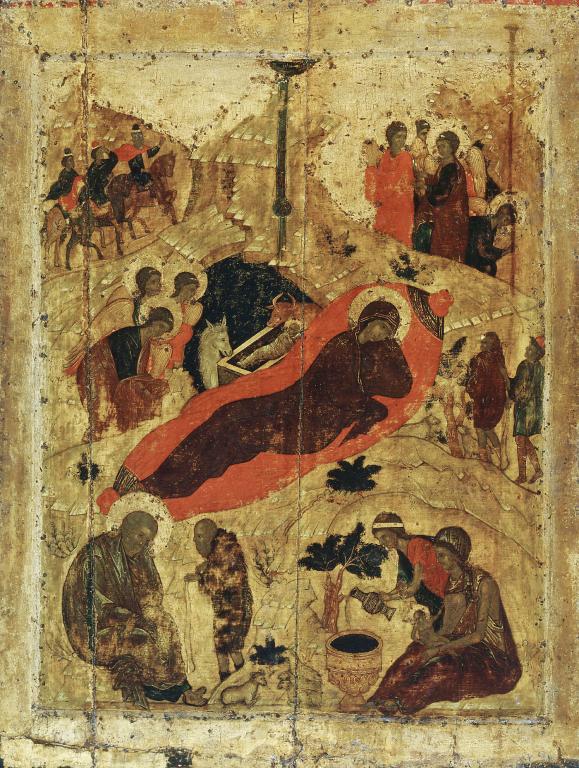
Andrei Rublev, “Nativity of the Lord,” 15th Century. For a striking article about the presence of clean and unclean animals in Nativity paintings, refer here.

We invest so much energy cleaning up before and after holiday festivities. This year, we have also invested an exceptional amount of effort and energy sanitizing ourselves and things with which we come into contact. Perhaps there are even moments as we clean and sanitize during this holiday season in our secular age that we unconsciously yearn for the sacred domain of seemingly primitive times, reminiscent of Mircea Eliade’s book The Sacred and the Profane.
All this stood out to me as I have been reading through Leviticus the past few days. One might find it odd to be reading through Leviticus during Advent and Christmastide, but I find it most appropriate. Here’s why. There are no doubt sanitization grounds for some purity or cleanliness laws in the Bible. Still, I am all the more interested in how we might take to heart their import for purification of the heart and our need for Messiah Jesus who comes to earth—not to avoid sinners like me—but to love on us so purely that he cleanses us and makes us whole as we respond in faith.
Central to the Bible is the imperative to discern the difference between the holy and common, the sacred and profane. Leviticus 10-11 highlight its importance and provide the ultimate rationale:
You are to distinguish between the holy and the common, and between the unclean and the clean; and you are to teach the people of Israel all the statutes that the Lord has spoken to them through Moses…For I am the Lord your God; sanctify yourselves therefore, and be holy, for I am holy. You shall not defile yourselves with any swarming creature that moves on the earth. For I am the Lord who brought you up from the land of Egypt, to be your God; you shall be holy, for I am holy (Leviticus 11:10-11; 44-45; NRSV).
Consideration of the sacred and profane was also central to the growing tension and conflict between Jesus and the religious establishment. The establishment went so far as to view Jesus as unrighteous and unclean based on his internalizing of cleanliness and his Table fellowship with sinners. Regarding Jesus’ internalization of cleanliness, note Mark 7:
When he had left the crowd and entered the house, his disciples asked him about the parable. He said to them, “Then do you also fail to understand? Do you not see that whatever goes into a person from outside cannot defile, since it enters, not the heart but the stomach, and goes out into the sewer?” (Thus he declared all foods clean.) And he said, “It is what comes out of a person that defiles. For it is from within, from the human heart, that evil intentions come: fornication, theft, murder, adultery, avarice, wickedness, deceit, licentiousness, envy, slander, pride, folly. All these evil things come from within, and they defile a person” (Mark 17:17-23; NRSV).
Here it is worth noting what The Jewish Encyclopedia has to say about the cleanliness laws related to food and Messianic speculation:
Like the Jewish religious philosophers, the mystics have stated their speculations concerning the grounds of these laws. According to the cabalistic theory which makes the negative Sefirot the cause of the existence of evil in the world, the Zohar (Shemini, 3:41b) explains that the unclean animals originate from some of these negative Sefirot, and therefore they are forbidden as food but as with the arrival of the Messiah all will become purer and nobler, these animals will then be permitted as food (Yalḳ . Ḥ adash, Liḳ ḳ utim, 36,79). In this manner the mystics explained the idea, expressed in Midrash Tehillim to cxlvi., that in the future God will declare the unclean animals clean. This Midrash caused Abravanel and other Jewish scholars much embarrassment (see Buber, ad loc.), so that several of them did not hesitate to declare it a Christian interpolation but without reason, as similar opinions have been held and expressed in the remotest time (compare Antinomianism), and probably had their origin in pre-Christian times.
Regardless of what readers make of this Jewish scholarly debate, those like me who seek to follow Messiah Jesus must make sure we concern ourselves with purifying our hearts. As fitting as it is to clean up during the holidays (and throughout the year!), and as critically important as it is to remain diligent and sanitize to help safeguard against the pandemic’s spread, we must be all the more diligent to guard against the defilement of our hearts in view of Messiah Jesus coming to take up residence there. As the Christmas song goes, “O come to my heart, Lord Jesus, There is room in my heart for Thee.”
I discuss the sacred and secular calendars, including various Christian and Jewish holidays, in my latest book, Setting the Spiritual Clock: Sacred Time Breaking Through the Secular Eclipse. You can find a link to the sampler here.
About Paul Louis Metzger
Paul Louis Metzger, Ph.D., is Professor of Theology & Culture, Multnomah University & Seminary; Director of The Institute for Cultural Engagement: New Wine, New Wineskins; and author of numerous works, including Consuming Jesus, Exploring Ecclesiology, and Setting the Spiritual Clock. You can read more about the author here.
Previous Post

December 20, 2020
Hanukkah and Advent Peace—In Search of Shalom
Next Post
January 6, 2021 What Constitutes Moral Authority in the US Today?
Browse Our Archives
Select a Category Uncategorized
Select a Month June 2025 April 2025 March 2025 January 2025 December 2024 November 2024 October 2024 September 2024 August 2024 July 2024 June 2024 May 2024 April 2024 March 2024 February 2024 January 2024 December 2023 November 2023 October 2023 September 2023 August 2023 July 2023 June 2023 May 2023 April 2023 March 2023 February 2023 January 2023 December 2022 November 2022 October 2022 September 2022 August 2022 July 2022 June 2022 May 2022 April 2022 March 2022 February 2022 January 2022 December 2021 November 2021 October 2021 September 2021 August 2021 July 2021 June 2021 May 2021 April 2021 March 2021 February 2021 January 2021 December 2020 November 2020 October 2020 September 2020 August 2020 July 2020 June 2020 May 2020 April 2020 March 2020 February 2020 January 2020 December 2019 November 2019 October 2019 September 2019 August 2019 July 2019 June 2019 May 2019 April 2019 March 2019 February 2019 January 2019 December 2018 November 2018 October 2018 September 2018 August 2018 July 2018 June 2018 May 2018 April 2018 March 2018 February 2018 January 2018 December 2017 November 2017 October 2017 September 2017 August 2017 July 2017 June 2017 May 2017 April 2017 March 2017 February 2017 January 2017 December 2016 November 2016 October 2016 September 2016 August 2016 July 2016 June 2016 May 2016 April 2016 March 2016 February 2016 January 2016 December 2015 November 2015 October 2015 September 2015 August 2015 July 2015 June 2015 May 2015 April 2015 March 2015 February 2015 January 2015 December 2014 November 2014 October 2014 September 2014 August 2014 July 2014 June 2014 May 2014 April 2014 March 2014 February 2014 January 2014 December 2013 November 2013 October 2013 September 2013 August 2013 July 2013 June 2013 May 2013 April 2013 March 2013 February 2013 January 2013 December 2012 November 2012 October 2012 September 2012 August 2012 July 2012 June 2012 May 2012 April 2012 March 2012 February 2012
Follow Us!
TAKE THE
Religious Wisdom Quiz
Who is the author of the Book of Revelation?
Select your answer to see how you score.
Paul John Peter Ezekiel
Books by This Author Books by Paul Louis Metzger
Related posts from Uncommon God, Common Good

Heavenly Father’s Day on Trinity Sunday

Easter Triduum: Obey Your Thirst—for God

Holy Week Is Humble Week: "Beware of Becoming...

Excavating the Person in a Throwaway Culture
TRENDING AT PATHEOS Evangelical

The REST of Your Life: A Creative Wrestles...
This week I had a conversation with a good friend from church....

How the author of the world's best hymn...
I've been working with John Newton for a while now. This makes...

Long before this Lectio Divina, Psalm 130 - the song - started...

What About the Trees? Another Living Parable
After I finished writing the last article about falling leaves as a...

Why Classical Education Is a Conversation, Not a...
Come and Read: Joy in Classical Education When I was a little...

Cornell University has received a great deal of negative publicity and intense...
view all Evangelical blogs
Ad-Free & Subscriber Log-In Subscription Support
- About Us
- 2026 Calendar
- Videos
- Podcasts
- Library of World Religions
- Faith In Media Tracker
- Advertise With Us
- Write for Us
- Privacy Policy
- Terms of Service
- Do Not Sell My Data
- Contact Us
- Radiant Digital
- Manage Newsletter Subscriptions
- Unsubscribe From Notifications
- Sitemap
Copyright 2008-2026, Patheos. All rights reserved.
Subscription Support Ad-Free & Subscriber Log-In
Follow Patheos