
BuddhistCatholicContemplativeEvangelicalGeneral ChristianHinduJewishLatter-day SaintMuslimNew VisionsProgressive Christian
Beliefs
- Buddhist
- Catholic
- Contemplative
- Evangelical
- General Christian
- Hindu
- Jewish
- Latter-day Saint
- More Voices
- Muslim
- New Visions
- Pagan
- Progressive Christian
Topics
- Religion News
- Food and Religion
- Sports and Religion
- Religious Art
- Religious Music and Entertainment
- Religious Events
- History and Religion
- Style and Religion
- Politics and Religion
- Women in Religion
- Recreation Outdoors and Religion
- Business Finance and Religion
- Careers Workplace and Religion
- Education and Religion
- Family Parenting and Religion
- Health Fitness and Religion
- Home and Religion
- Relationships and Religion
- Technology and Religion
- Travel and Religion
Columnists
- Buddhist Columnists
- Business Finance and Religion Columnists
- Careers Workplace and Religion Columnists
- Catholic Columnists
- Contemplative Columnists
- Education and Religion Columnists
- Evangelists Columnists
- Family Parenting and Religion Columnists
- General Christian Columnists
- Health Fitness and Religion Columnists
- Hindu Columnists
- History and Religion Columnists
- Home and Religion Columnists
- Jewish Columnists
- More Voices Columnists
- Latter Day Columnists
- Muslim Columnists
- New Visions Columnists
- Nonreligious Columnists
- Pagan Columnists
- Politics and Religion Columnists
- Progressive Columnists
- Recreation Outdoors and Religion Columnists
- Relationships and Religion Columnists
- Religion News Columnists
- Religious Art Columnists
- Religious Events Columnists
- Religious Music and Entertainment Columnists
- Sports and Religion Columnists
- Style and Religion Columnists
- Technology and Religion Columnists
- Travel and Religion Columnists
- Women in Religion Columnists
Resource Library
- 2026 Calendar
- Library of World Religions
- The 100 Most Holy Places on Earth
- Patheos Answers
- Podcasts
- Videos
- Faith Leaders Database
- Anglican Episcopalian
- Bahai
- Baptist
- Buddhism
- Christianity
- Confucianism
- Eastern Orthodoxy
- Hinduism
- Holiness and Pentecostal
- ISKCON
- Islam
- Judaism
- Lutheran
- Methodist
- The Church of Jesus Christ of Latter-day Saints
- New Age
- Paganism
- Presbytarian and Reformed
- Protestantism
- Religion Behind the Scenes
- Roman Catholic
- Scientology
- Shia Islam
- Sikhism
- Sufism
- Sunni Islam
- Taoism
- Zen
- See all religions
Research Tools
 Ad-Free & Subscriber Log-In Subscription Support
Ad-Free & Subscriber Log-In Subscription Support
Follow Patheos 

- Trending:
- Forgiveness
- |
- Marriage
- |
- Consciousness
- |
- Death Penalty
- |
- Election
- |
- Halloween

- Home
- Evangelical
- Sin with Dignity: Musings from Moses to Steinbeck
Sin with Dignity: Musings from Moses to Steinbeck
Last updated on: November 28, 2020 at 8:56 am by Paul Louis Metzger
Sin with Dignity: Musings from Moses to Steinbeck 2020-11-28T08:56:50-08:00 Paul Louis Metzger
Patheos Explore the world's faith through different perspectives on religion and spirituality! Patheos has the views of the prevalent religions and spiritualities of the world.
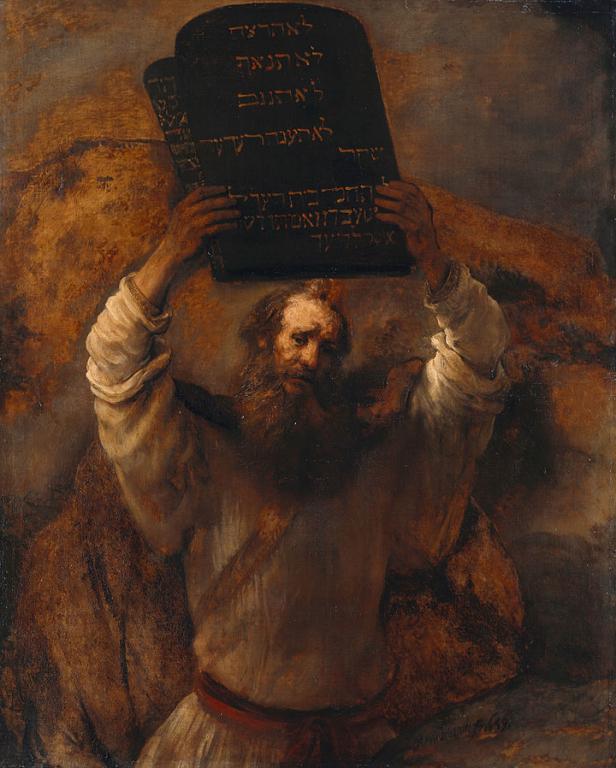
Rembrandt, “Moses Smashing the Tablets of the Law,” 1659 {{PD-US-expired}}.

On a cursory reading of the Law and Prophets, one may be tempted to think of God as a cosmic killjoy and his commands as real downers. All the Bible’s talk of sin might come across as a real drag. But that’s only if we create a god from a Moralistic Therapeutic Deistic perspective, where the deity is a “divine butler” or “cosmic therapist,” to reference Christian Smith’s study of MTD.
Moses and the biblical Prophets did not see God and the Law in such negative terms. To the contrary, we find just the opposite assessment. Take, for example, Deuteronomy 4, where Moses exhorts the people of Israel to obey God’s Word:
See, just as the Lord my God has charged me, I now teach you statutes and ordinances for you to observe in the land that you are about to enter and occupy. You must observe them diligently, for this will show your wisdom and discernment to the peoples, who, when they hear all these statutes, will say, “Surely this great nation is a wise and discerning people!” For what other great nation has a god so near to it as the Lord our God is whenever we call to him? And what other great nation has statutes and ordinances as just as this entire law that I am setting before you today? But take care and watch yourselves closely, so as neither to forget the things that your eyes have seen nor to let them slip from your mind all the days of your life; make them known to your children and your children’s children…. (Deuteronomy 4:5-9; NRSV)
John Steinbeck seems to have viewed the matter similarly. In Travels with Charley in Search of America, Steinbeck reflects on having visited a “John Knox church” in Vermont one Sunday morning at the outset of his cross-country sojourn. There he heard a fire-and-brimstone message. Steinbeck never struck me as a very religious person, just humane. So, his reflection might surprise his readership:
It is our practice now, at least in the large cities, to find from our psychiatric priesthood that our sins aren’t really sins at all but accidents that are set in motion by forces beyond our control. . . . For some years now God has been a pal to us, practicing togetherness, and that causes the same emptiness a father does playing softball with his son. But this Vermont God cared enough about me to go to a lot of trouble kicking the hell out of me. He put my sins in a new perspective. Whereas they had been small and mean and nasty and best forgotten, this minister gave them some size and bloom and dignity. I hadn’t been thinking very well of myself for some years, but if my sins had this dimension there was some pride left. I wasn’t a naughty child but a first rate sinner, and I was going to catch it (John Steinbeck, Travels with Charley in Search of America {New York: Penguin Books, 1962}, pages 60–61).
We may not appreciate some of Steinbeck’s language like “kicking the hell out of me,” but please note what precedes it: the God in question “cared enough about me to go to a lot of trouble…” God cared about Steinbeck, so he would not let him off the hook. Moreover, the God who judged Steinbeck gave his sins “some size and bloom and dignity.” As a result, Steinbeck confesses that he felt better as a result of God’s judgment and that he had some remnant of pride left to his name.
It is also worth noting that God gives us laws so we are not left guessing as to what God desires for our lives. As with Steinbeck’s account of the “Vermont God,” he could see his sins clearly and “in a new perspective.” Contrary to the Canaanite deities or Kafka’s Trial, we are not left guessing as to what we’ve done wrong. Contrary to the MTD priesthood, we are not left guessing as to whether our offenses are really offensive to God. Indeed, they are. God gives us laws as a divine mercy so that we can know God intimately and experience the fullness of life in his will, not simply to hold us accountable. However, with such a high calling of desired intimacy comes responsibility. Without responsibility, we lose our dignity. God takes us and our sins seriously, so much so that he judges sin, so much so that he bears our sin for us, as Jesus is the judge who is judged on our behalf, which Karl Barth developed in Church Dogmatics, IV.1, §59.2, “The Judge Judged in Our Place.” So, let’s take our sins seriously so that we do not lose sight of our dignity as responsible human agents and so that we take all the more seriously our Savior.
None of the preceding remarks should lead us to lose sight of the much-welcome understanding of structural evil and social conditioning that plagues us as humans. But we should not allow the repudiation of “miserable sinner” caricatures to lead us to throw out the baby with the dirty bathwater either. As Marguerite Schuster said, “…loss of the category of sin at the individual level more surely robs us of dignity of hope than does the most punishing ‘miserable sinner’ theology of another age (Marguerite Shuster, The Fall and Sin: What We Have Become As Sinners {Grand Rapids: Eerdmans, 2003}, page 101).
So, when you and I sin, let’s sin with dignity by taking responsibility, repenting, and returning in faith to God through Jesus for renewal (1 John 1:9).
About Paul Louis Metzger
Paul Louis Metzger, Ph.D., is Professor of Theology & Culture, Multnomah University & Seminary; Director of The Institute for Cultural Engagement: New Wine, New Wineskins; and author of numerous works, including Connecting Christ: How to Discuss Jesus in a World of Diverse Paths; Beatitudes, Not Platitudes: Jesus' Invitation to the Good Life. You can read more about the author here.
Previous Post

November 27, 2020
What Liturgy Shapes Your Church—a Sacred or Secular One?
Next Post
November 29, 2020 What Characterizes Biblical Hope During Advent and Beyond?
Browse Our Archives
Select a Category Uncategorized
Select a Month June 2025 April 2025 March 2025 January 2025 December 2024 November 2024 October 2024 September 2024 August 2024 July 2024 June 2024 May 2024 April 2024 March 2024 February 2024 January 2024 December 2023 November 2023 October 2023 September 2023 August 2023 July 2023 June 2023 May 2023 April 2023 March 2023 February 2023 January 2023 December 2022 November 2022 October 2022 September 2022 August 2022 July 2022 June 2022 May 2022 April 2022 March 2022 February 2022 January 2022 December 2021 November 2021 October 2021 September 2021 August 2021 July 2021 June 2021 May 2021 April 2021 March 2021 February 2021 January 2021 December 2020 November 2020 October 2020 September 2020 August 2020 July 2020 June 2020 May 2020 April 2020 March 2020 February 2020 January 2020 December 2019 November 2019 October 2019 September 2019 August 2019 July 2019 June 2019 May 2019 April 2019 March 2019 February 2019 January 2019 December 2018 November 2018 October 2018 September 2018 August 2018 July 2018 June 2018 May 2018 April 2018 March 2018 February 2018 January 2018 December 2017 November 2017 October 2017 September 2017 August 2017 July 2017 June 2017 May 2017 April 2017 March 2017 February 2017 January 2017 December 2016 November 2016 October 2016 September 2016 August 2016 July 2016 June 2016 May 2016 April 2016 March 2016 February 2016 January 2016 December 2015 November 2015 October 2015 September 2015 August 2015 July 2015 June 2015 May 2015 April 2015 March 2015 February 2015 January 2015 December 2014 November 2014 October 2014 September 2014 August 2014 July 2014 June 2014 May 2014 April 2014 March 2014 February 2014 January 2014 December 2013 November 2013 October 2013 September 2013 August 2013 July 2013 June 2013 May 2013 April 2013 March 2013 February 2013 January 2013 December 2012 November 2012 October 2012 September 2012 August 2012 July 2012 June 2012 May 2012 April 2012 March 2012 February 2012
Follow Us!
TAKE THE
Religious Wisdom Quiz
True or False: Philip baptized the Ethiopian eunuch after explaining Isaiah 53 to him.
Select your answer to see how you score.
TRUE FALSE
Books by This Author Books by Paul Louis Metzger
Related posts from Uncommon God, Common Good

Heavenly Father’s Day on Trinity Sunday

Easter Triduum: Obey Your Thirst—for God

Holy Week Is Humble Week: "Beware of Becoming...

Excavating the Person in a Throwaway Culture
TRENDING AT PATHEOS Evangelical

The REST of Your Life: A Creative Wrestles...
This week I had a conversation with a good friend from church....

How the author of the world's best hymn...
I've been working with John Newton for a while now. This makes...

Long before this Lectio Divina, Psalm 130 - the song - started...

What About the Trees? Another Living Parable
After I finished writing the last article about falling leaves as a...

Why Classical Education Is a Conversation, Not a...
Come and Read: Joy in Classical Education When I was a little...

Cornell University has received a great deal of negative publicity and intense...
view all Evangelical blogs
Ad-Free & Subscriber Log-In Subscription Support
- About Us
- 2026 Calendar
- Videos
- Podcasts
- Library of World Religions
- Faith In Media Tracker
- Advertise With Us
- Write for Us
- Privacy Policy
- Terms of Service
- Do Not Sell My Data
- Contact Us
- Radiant Digital
- Manage Newsletter Subscriptions
- Unsubscribe From Notifications
- Sitemap
Copyright 2008-2026, Patheos. All rights reserved.
Subscription Support Ad-Free & Subscriber Log-In
Follow Patheos