
BuddhistCatholicContemplativeEvangelicalGeneral ChristianHinduJewishLatter-day SaintMuslimNew VisionsProgressive Christian
Beliefs
- Buddhist
- Catholic
- Contemplative
- Evangelical
- General Christian
- Hindu
- Jewish
- Latter-day Saint
- More Voices
- Muslim
- New Visions
- Pagan
- Progressive Christian
Topics
- Religion News
- Food and Religion
- Sports and Religion
- Religious Art
- Religious Music and Entertainment
- Religious Events
- History and Religion
- Style and Religion
- Politics and Religion
- Women in Religion
- Recreation Outdoors and Religion
- Business Finance and Religion
- Careers Workplace and Religion
- Education and Religion
- Family Parenting and Religion
- Health Fitness and Religion
- Home and Religion
- Relationships and Religion
- Technology and Religion
- Travel and Religion
Columnists
- Buddhist Columnists
- Business Finance and Religion Columnists
- Careers Workplace and Religion Columnists
- Catholic Columnists
- Contemplative Columnists
- Education and Religion Columnists
- Evangelists Columnists
- Family Parenting and Religion Columnists
- General Christian Columnists
- Health Fitness and Religion Columnists
- Hindu Columnists
- History and Religion Columnists
- Home and Religion Columnists
- Jewish Columnists
- More Voices Columnists
- Latter Day Columnists
- Muslim Columnists
- New Visions Columnists
- Nonreligious Columnists
- Pagan Columnists
- Politics and Religion Columnists
- Progressive Columnists
- Recreation Outdoors and Religion Columnists
- Relationships and Religion Columnists
- Religion News Columnists
- Religious Art Columnists
- Religious Events Columnists
- Religious Music and Entertainment Columnists
- Sports and Religion Columnists
- Style and Religion Columnists
- Technology and Religion Columnists
- Travel and Religion Columnists
- Women in Religion Columnists
Resource Library
- 2026 Calendar
- Library of World Religions
- The 100 Most Holy Places on Earth
- Patheos Answers
- Podcasts
- Videos
- Faith Leaders Database
- Anglican Episcopalian
- Bahai
- Baptist
- Buddhism
- Christianity
- Confucianism
- Eastern Orthodoxy
- Hinduism
- Holiness and Pentecostal
- ISKCON
- Islam
- Judaism
- Lutheran
- Methodist
- The Church of Jesus Christ of Latter-day Saints
- New Age
- Paganism
- Presbytarian and Reformed
- Protestantism
- Religion Behind the Scenes
- Roman Catholic
- Scientology
- Shia Islam
- Sikhism
- Sufism
- Sunni Islam
- Taoism
- Zen
- See all religions
Research Tools
 Ad-Free & Subscriber Log-In Subscription Support
Ad-Free & Subscriber Log-In Subscription Support
Follow Patheos 

- Trending:
- Forgiveness
- |
- Marriage
- |
- Consciousness
- |
- Death Penalty
- |
- Election
- |
- Halloween

- Home
- Evangelical
- Great Leaders Model Courage of Conviction, Not Cowardice or Temerity
Great Leaders Model Courage of Conviction, Not Cowardice or Temerity
Last updated on: November 1, 2020 at 11:16 am by Paul Louis Metzger
Great Leaders Model Courage of Conviction, Not Cowardice or Temerity 2020-11-01T11:16:04-08:00 Paul Louis Metzger
Patheos Explore the world's faith through different perspectives on religion and spirituality! Patheos has the views of the prevalent religions and spiritualities of the world.
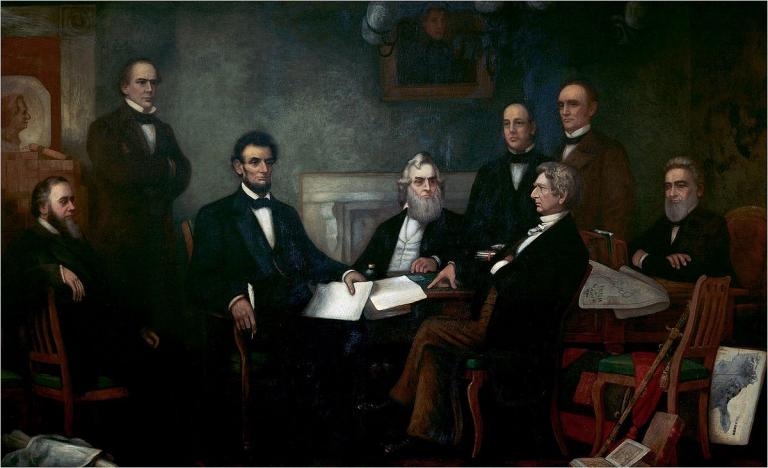
First Reading of the Emancipation Proclamation, Francis Bicknell Carpenter, 1864; Wikimedia Commons

Aristotle claimed that courage is the means between cowardice and temerity or excessive confidence. Great leaders model such courage, and this quality was on display in President Abraham Lincoln’s life.
This is my fourth and final post in a series running up to the U.S. Presidential election on the qualities of leadership that President Lincoln modeled. The basis for my reflections results from my reading of Doris Kearns Goodwin’s bestselling Team of Rivals: the Political Genius of Abraham Lincoln, winner of the Lincoln Prize.
Lincoln did not allow public opinion to sway and alter his convictions, but he did have to account for it as a democratically elected leader. Regarding the importance of accounting for public opinion rather than steamrolling ahead in what I would consider excessive confidence, Goodwin recounts:
Lincoln understood that the greatest challenge for a leader in a democratic society is to educate public opinion. “with public sentiment, nobody can fail; without it nothing can succeed,” he said. “Consequently he who moulds public sentiment, goes deeper than he who enacts statues or pronounces decisions” (206).
Later Goodwin argues:
All his life, Lincoln had exhibited an exceptionally sensitive grasp of the limits set by public opinion. As a politician, he had an intuitive sense of when to hold fast, when to wait, and when to lead. “It is my conviction,” Lincoln later said, “that, had the [Emancipation] proclamation been issued even six months earlier than it was, public sentiment would not have sustained it” (501-502).
It’s not that Lincoln waited idly by, but rather sought to guide and change public opinion given its import for democratic governance. Even so, there was a limit to what Lincoln would do in his political ambitions. Faced with the real possibility that he might not win reelection, Lincoln did not alter his convictions even if it meant defeat. And if defeat were imminent, which at one point appeared likely, he was determined to do as much as possible to effect change in keeping with his ideals that shaped his convictions and transcended his own personal ambition for public office.
The “extraordinary pressures” he faced revealed “much about his character, according to Goodwin. Although Lincoln had “the common pride of humanity to wish my past four years administration endorsed,” and although he felt he was the most able person to lead the country through the perilous war, he would try his best to unify the country and bring as many slaves to freedom as possible before losing reelection (648). His goals ever remained: the union and freedom for all (651). Both goals stemmed from what he told an Ohio regimen of soldiers fighting to realize these ideals:
“I happen temporarily to occupy this big White House, he said. “I am a living witness that any one of your children may look to come here as my father’s child has. It is in order that each of you may have through this free government which we have enjoyed, an open field and a fair chance for your industry, enterprise and intelligence; that you may all have equal privileges in the race of life, with all its desirable human aspirations. It is for this the struggle should be maintained, that we may not lose our birthright…. The nation is worth fighting for, to secure such an inestimable jewel” (653).
No doubt, Lincoln’s courage of conviction and twin goals and ideals swayed a great host of people, including among the troops. Lincoln’s political opponents failed to grasp that even though his rival in the U.S. Presidential race, General George McClellan, was admired by many soldiers, that paled in comparison to the “almost mystical devotion” they felt to Father Abraham. And so, they voted to continue the war for union and freedom for all (666).
Perhaps these soldiers also knew that Lincoln was equally committed to them to go down with them, just as they were willing to sacrifice for him and for the transcendent ideals he lived out before their eyes: “I would rather be defeated with the soldier vote behind me than to be elected without it” (664).
In the minds of some, Lincoln was painstakingly slow to weigh positions and come to a conclusion, but once he did decide, he was immovable. As he told Frederick Douglass, “I think it cannot be shown that when I have once taken a position, I have ever retreated from it” (Goodwin, 552).
There’s no question that Lincoln was a politician and not a prophet, even though there was certainly a prophetic element in his public political theology as President. Prophets like Jeremiah of old do not have to account for opinion polls in any way. They simply speak forth the word of the Lord. But democratically elected officials must seek to sway public opinion to match their convictions. It is for the betterment of the country that Lincoln’s own convictions transcended his ego and great lifelong pursuit and passion to be esteemed as a great leader. His grand and noble ideals of union and freedom for a democracy of the people and by the people and for the people shaped him at a far deeper level than personal ambition. No doubt, this deeper passion played a key factor in why he could be magnanimous among his team of rivals and in the face of so much criticism and hostility aimed at his person (Refer here to the first post in this series for a discussion of his magnanimous spirit).
Courage of conviction marks great leaders. They do not fall prey to either extreme of weak or poor leaders: those marked by cowardice where one’s convictions shift with the changing wind of public opinion; and those marked by excessive confidence or temerity that leaves them ill-prepared to withstand political and cultural tempests. What is needed more than ever today are leaders with courage of conviction shaped by transcendent ideals benefiting all people: union and freedom. Such ideals lead them to try and shape public opinion for the common good rather than popularity contests for their own good. Lincoln was such a leader. What kind of leaders do you and I vote for and what kind of leader do you and I seek to be in our own spheres of influence?
About Paul Louis Metzger
Paul Louis Metzger, Ph.D., is Professor of Theology and Culture; Director of The Institute for Cultural Engagement: New Wine, New Wineskins; and Editor of Cultural Encounters: A Journal for the Theology of Culture. He is the author of numerous works. You can read more about the author here.
Previous Post

October 25, 2020
Great Leaders Model Empathy and Humaneness, Not Inhumanity
Next Post
November 3, 2020 Don't Minimize Politics. Maximize God.
Browse Our Archives
Select a Category Uncategorized
Select a Month June 2025 April 2025 March 2025 January 2025 December 2024 November 2024 October 2024 September 2024 August 2024 July 2024 June 2024 May 2024 April 2024 March 2024 February 2024 January 2024 December 2023 November 2023 October 2023 September 2023 August 2023 July 2023 June 2023 May 2023 April 2023 March 2023 February 2023 January 2023 December 2022 November 2022 October 2022 September 2022 August 2022 July 2022 June 2022 May 2022 April 2022 March 2022 February 2022 January 2022 December 2021 November 2021 October 2021 September 2021 August 2021 July 2021 June 2021 May 2021 April 2021 March 2021 February 2021 January 2021 December 2020 November 2020 October 2020 September 2020 August 2020 July 2020 June 2020 May 2020 April 2020 March 2020 February 2020 January 2020 December 2019 November 2019 October 2019 September 2019 August 2019 July 2019 June 2019 May 2019 April 2019 March 2019 February 2019 January 2019 December 2018 November 2018 October 2018 September 2018 August 2018 July 2018 June 2018 May 2018 April 2018 March 2018 February 2018 January 2018 December 2017 November 2017 October 2017 September 2017 August 2017 July 2017 June 2017 May 2017 April 2017 March 2017 February 2017 January 2017 December 2016 November 2016 October 2016 September 2016 August 2016 July 2016 June 2016 May 2016 April 2016 March 2016 February 2016 January 2016 December 2015 November 2015 October 2015 September 2015 August 2015 July 2015 June 2015 May 2015 April 2015 March 2015 February 2015 January 2015 December 2014 November 2014 October 2014 September 2014 August 2014 July 2014 June 2014 May 2014 April 2014 March 2014 February 2014 January 2014 December 2013 November 2013 October 2013 September 2013 August 2013 July 2013 June 2013 May 2013 April 2013 March 2013 February 2013 January 2013 December 2012 November 2012 October 2012 September 2012 August 2012 July 2012 June 2012 May 2012 April 2012 March 2012 February 2012
Follow Us!
TAKE THE
Religious Wisdom Quiz
Who was Abraham's firstborn son?
Select your answer to see how you score.
Esau Ishmael Isaac Jacob
Books by This Author Books by Paul Louis Metzger
Related posts from Uncommon God, Common Good

Heavenly Father’s Day on Trinity Sunday

Easter Triduum: Obey Your Thirst—for God

Holy Week Is Humble Week: "Beware of Becoming...

Excavating the Person in a Throwaway Culture
TRENDING AT PATHEOS Evangelical

The REST of Your Life: A Creative Wrestles...
This week I had a conversation with a good friend from church....

How the author of the world's best hymn...
I've been working with John Newton for a while now. This makes...

Long before this Lectio Divina, Psalm 130 - the song - started...

What About the Trees? Another Living Parable
After I finished writing the last article about falling leaves as a...

Why Classical Education Is a Conversation, Not a...
Come and Read: Joy in Classical Education When I was a little...

Cornell University has received a great deal of negative publicity and intense...
view all Evangelical blogs
Ad-Free & Subscriber Log-In Subscription Support
- About Us
- 2026 Calendar
- Videos
- Podcasts
- Library of World Religions
- Faith In Media Tracker
- Advertise With Us
- Write for Us
- Privacy Policy
- Terms of Service
- Do Not Sell My Data
- Contact Us
- Radiant Digital
- Manage Newsletter Subscriptions
- Unsubscribe From Notifications
- Sitemap
Copyright 2008-2026, Patheos. All rights reserved.
Subscription Support Ad-Free & Subscriber Log-In
Follow Patheos