
BuddhistCatholicContemplativeEvangelicalGeneral ChristianHinduJewishLatter-day SaintMuslimNew VisionsProgressive Christian
Beliefs
- Buddhist
- Catholic
- Contemplative
- Evangelical
- General Christian
- Hindu
- Jewish
- Latter-day Saint
- More Voices
- Muslim
- New Visions
- Pagan
- Progressive Christian
Topics
- Religion News
- Food and Religion
- Sports and Religion
- Religious Art
- Religious Music and Entertainment
- Religious Events
- History and Religion
- Style and Religion
- Politics and Religion
- Women in Religion
- Recreation Outdoors and Religion
- Business Finance and Religion
- Careers Workplace and Religion
- Education and Religion
- Family Parenting and Religion
- Health Fitness and Religion
- Home and Religion
- Relationships and Religion
- Technology and Religion
- Travel and Religion
Columnists
- Buddhist Columnists
- Business Finance and Religion Columnists
- Careers Workplace and Religion Columnists
- Catholic Columnists
- Contemplative Columnists
- Education and Religion Columnists
- Evangelists Columnists
- Family Parenting and Religion Columnists
- General Christian Columnists
- Health Fitness and Religion Columnists
- Hindu Columnists
- History and Religion Columnists
- Home and Religion Columnists
- Jewish Columnists
- More Voices Columnists
- Latter Day Columnists
- Muslim Columnists
- New Visions Columnists
- Nonreligious Columnists
- Pagan Columnists
- Politics and Religion Columnists
- Progressive Columnists
- Recreation Outdoors and Religion Columnists
- Relationships and Religion Columnists
- Religion News Columnists
- Religious Art Columnists
- Religious Events Columnists
- Religious Music and Entertainment Columnists
- Sports and Religion Columnists
- Style and Religion Columnists
- Technology and Religion Columnists
- Travel and Religion Columnists
- Women in Religion Columnists
Resource Library
- 2026 Calendar
- Library of World Religions
- The 100 Most Holy Places on Earth
- Patheos Answers
- Podcasts
- Videos
- Faith Leaders Database
- Anglican Episcopalian
- Bahai
- Baptist
- Buddhism
- Christianity
- Confucianism
- Eastern Orthodoxy
- Hinduism
- Holiness and Pentecostal
- ISKCON
- Islam
- Judaism
- Lutheran
- Methodist
- The Church of Jesus Christ of Latter-day Saints
- New Age
- Paganism
- Presbytarian and Reformed
- Protestantism
- Religion Behind the Scenes
- Roman Catholic
- Scientology
- Shia Islam
- Sikhism
- Sufism
- Sunni Islam
- Taoism
- Zen
- See all religions
Research Tools
 Ad-Free & Subscriber Log-In Subscription Support
Ad-Free & Subscriber Log-In Subscription Support
Follow Patheos 

- Trending:
- Forgiveness
- |
- Marriage
- |
- Consciousness
- |
- Death Penalty
- |
- Election
- |
- Halloween

- Home
- Evangelical
- The Christian Conspiracy: In Pursuit of Truth
The Christian Conspiracy: In Pursuit of Truth
Last updated on: September 19, 2020 at 9:41 am by Paul Louis Metzger
The Christian Conspiracy: In Pursuit of Truth 2020-09-19T09:41:41-07:00 Paul Louis Metzger
Patheos Explore the world's faith through different perspectives on religion and spirituality! Patheos has the views of the prevalent religions and spiritualities of the world.
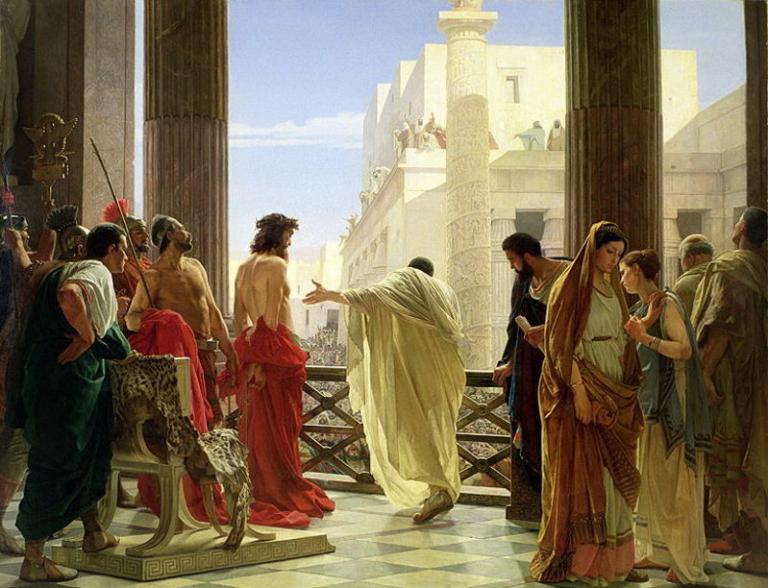
Antonio Ciseri, Ecce Homo (“Behold the Man!”), between 1860 and 1880); Public Domain

In “Conspiracy Theories: In Pursuit of Truth,” I claimed that New Testament Christianity may have been a conspiracy theory movement. I made that claim based on a certain definition of “conspiracy theory.” To repeat that definition, political scientist Joseph E. Uscinski, an expert on the subject matter, defines conspiracy theories in a video recorded interview as follows:
A conspiracy theory…is a[n] accusatory perception in which a small group of powerful people are working in secret for their own benefit against the common good and in a way that undermines our bedrock ground rules against the widespread use of force and fraud. And further, this perception has not been granted legitimacy as true by the appropriate epistemological experts with data that is open to refutation.
Again, based on this definition, New Testament Christianity may have been deemed a conspiracy theory movement. But that does not mean New Testament Christianity was false. As noted in the prior blog post referenced above, some conspiracy theories turn out to be true, as in the case of the Watergate scandal.
In what follows, we will seek to show that the New Testament community did indeed adhere to what may be deemed a conspiracy theory. We will also sketch out how the church sought to gain legitimacy as being true. Let’s begin with the Apostles Peter and John standing before the Sanhedrin, as recorded in Acts 4. The authorities arrest and threaten them based on their having caused a commotion by healing a lame beggar and preaching in Jesus’ name (Acts 4:1-22). Certainly, the Sanhedrin and Rome would try to silence and terminate the fledgling though quickly growing church given the risks it posed to their established ways.
According to John’s Gospel, the same fear of risk to the establishment existed prior to the governing authorities conspiring to kill Jesus. In the face of the threat to their honored status and national security, they determined to seek Jesus’ death:
“…If we let him go on like this, everyone will believe in him, and the Romans will come and take away both our place and our nation.” But one of them, Caiaphas, who was high priest that year, said to them, “You know nothing at all. Nor do you understand that it is better for you that one man should die for the people, not that the whole nation should perish.” He did not say this of his own accord, but being high priest that year he prophesied that Jesus would die for the nation, and not for the nation only, but also to gather into one the children of God who are scattered abroad. So from that day on they made plans to put him to death (John 11:48-53; ESV).
Back to Acts 4, later upon release from custody, Peter and John returned to the church and shared all that had transpired. Upon hearing from Peter and John, the community raised their voices in unison as they quoted and expanded upon Psalm 2:1-2. The church did not see themselves as a counterfeit organization. Rather, they interpreted the actions of the rulers and authorities as a conspiracy against the Lord and his Anointed, and that Jesus’ followers were the faithful remnant:
Sovereign Lord, who made the heaven and the earth and the sea and everything in them, who through the mouth of our father David, your servant, said by the Holy Spirit,
“‘Why did the Gentiles rage,
and the peoples plot in vain?
The kings of the earth set themselves,
and the rulers were gathered together,
against the Lord and against his Anointed’—for truly in this city there were gathered together against your holy servant Jesus, whom you anointed, both Herod and Pontius Pilate, along with the Gentiles and the peoples of Israel, to do whatever your hand and your plan had predestined to take place. And now, Lord, look upon their threats and grant to your servants to continue to speak your word with all boldness, while you stretch out your hand to heal, and signs and wonders are performed through the name of your holy servant Jesus.” And when they had prayed, the place in which they were gathered together was shaken, and they were all filled with the Holy Spirit and continued to speak the word of God with boldness (Acts 4:24b-31; ESV).
It is interesting to note that the NIV translation of Psalm 2:1 reads that the nations “conspire.” The footnote claims that the Hebrew is best rendered as “conspire” whereas the Septuagint translation into English is “rage.” The NIV translation of Acts 4:27 also reads that Herod, Pontius Pilate, the Gentiles, and people of Israel in Jerusalem determined to “conspire” against God’s “holy servant Jesus,” whom God had “appointed.”
Let’s pause for a moment to highlight that in no way, shape or form should the New Testament use and extension of Psalm 2 be taken as a form of anti-Semitism. The Acts of the Apostles sees what transpired as a set group of Gentile political and Jewish religious leaders conspiring against Jesus, not a select group of Jewish leaders alone, or the Jewish people as a majority or in their entirety.
Certainly, the New Testament community interpret what happened to Jesus as a conspiracy of a small, powerful and elite force of Roman and Jewish leaders arrayed against Jesus, which in turn would have a negative bearing on the common good. Now while they certainly wished to retain their standing, they may have determined (wrongly) that what was good for them as those in power (Herod, Pilate, and the Sanhedrin) was in the best interest of the people. Regardless of whether they sought to benefit the people and not simply themselves, this small powerful force abused their authority in condemning an innocent man (indeed, the Lord’s Anointed) to death. At least in Pilate’s case, he handled Jesus over to be crucified to be spared from the possibility of Caesar’s wrath (John 19:11-16). Here we find at least two of three of the following criteria in Prof. Uscinski’s definition for determining if the New Testament account of Jesus’ death is a conspiracy: “a small group of powerful people are working in secret for their own benefit against the common good and in a way that undermines our bedrock ground rules against the widespread use of force and fraud.”
Uscinski’s definition involves one more criterion for labeling a theory as a “conspiracy”: “And further, this perception has not been granted legitimacy as true by the appropriate epistemological experts with data that is open to refutation.” As stated in the prior post titled “Conspiracy Theories: In Pursuit of Truth,” a conspiracy theory can be true. However, it must be shown to be true by gaining the approval of “the appropriate epistemological experts.” The Acts of the Apostles seeks to make the case for the truthfulness of the theory that Jesus was/is the Lord’s Anointed, that he was wrongly condemned and executed by a small powerful force that (ill-intentioned or not) impacted negatively the common good, and that he was raised from the dead, thereby demonstrating God’s validation. In view of the same guidelines articulated in the prior post for distinguishing whether a conspiracy theory is true, I argue:
- The New Testament community had to go public rather than remain anonymous and present their views to subject matter experts. The Acts of the Apostles shows that Peter, John, Paul and others were more than willing to make their case to those in positions of authority. Paul himself determined to take his case and the gospel all the way to the Roman Emperor’s throne. The Lord Jesus also spoke publicly and engaged the established rule of Israel and Rome. He did not operate in secret and anonymously.
- The New Testament community had to be open to the possibility that they were wrong and that they would live with the consequences rather than secretly retract or shift their views all the while wrongly refusing to admit mistakes. 1 Corinthians 15:16-19, 32 suggests that Paul was willing to accept the consequences for his very public claims that if Jesus be not raised he and the church were the most pitiful people in existence.
- The New Testament community did not seek to benefit from their claims, but rather served the common good at the risk of great personal loss (1 Corinthians 15:29-31; Romans 8:35-36).
- The New Testament community reasoned and engaged in a civil and non-violent manner (2 Timothy 2:24-26; 1 Peter 3:13-17).
How did Jesus engage the Sanhedrin and Roman governor? How did the Apostolic community engage those in authority and the surrounding society?
- If they’re bombastic, be bombastic?
- If they’re controlling, be controlling?
- No, with meekness, cruciform power, patience, civility, and neighborliness.
- Whether viewed positively (the New Testament apostolic community) or negatively (by the church’s detractors) as a conspiracy theory, the focus was the fruit of the Spirit, compassionate co-existence, public rational and self-sacrificial engagement as loving neighbors that confounded the authorities and convicted as well as captivated the people at large (See the whole of Acts 4-5).
Two passages in the New Testament referenced above reflect the kind of virtuous engagement required of those who wish to show that their Christian conspiracy theory is true, not false, or who seek to correct someone whose ideas, including conspiracy theories, are indeed false:
And the Lord’s servant must not be quarrelsome but kind to everyone, able to teach, patiently enduring evil, correcting his opponents with gentleness. God may perhaps grant them repentance leading to a knowledge of the truth, and they may come to their senses and escape from the snare of the devil, after being captured by him to do his will (2 Timothy 2:24-26; ESV).
Now who is there to harm you if you are zealous for what is good? But even if you should suffer for righteousness’ sake, you will be blessed. Have no fear of them, nor be troubled, but in your hearts honor Christ the Lord as holy, always being prepared to make a defense to anyone who asks you for a reason for the hope that is in you; yet do it with gentleness and respect, having a good conscience, so that, when you are slandered, those who revile your good behavior in Christ may be put to shame. For it is better to suffer for doing good, if that should be God’s will, than for doing evil (1 Peter 3:13-17; ESV).
Of course, the criticism of the Christian faith as untrue is not simply a first-century phenomenon. May we who embrace the Christian conspiracy theory today follow the example of the Apostolic community and New Testament instructions as we engage critics. And may those Christians who articulate or critique political positions deemed conspiracies in the present moment follow suit.
About Paul Louis Metzger
Paul Louis Metzger, Ph.D., is Professor of Christian Theology & Theology of Culture; Director of The Institute for Cultural Engagement: New Wine, New Wineskins; and author of numerous works. You can read more about the author here.
Previous Post

September 18, 2020
Deep State, Deep Market, Shallow Jesus, Shallow Church
Next Post
September 25, 2020 Don’t Name Drop for Fifteen Minutes of Fame.
Browse Our Archives
Select a Category Uncategorized
Select a Month June 2025 April 2025 March 2025 January 2025 December 2024 November 2024 October 2024 September 2024 August 2024 July 2024 June 2024 May 2024 April 2024 March 2024 February 2024 January 2024 December 2023 November 2023 October 2023 September 2023 August 2023 July 2023 June 2023 May 2023 April 2023 March 2023 February 2023 January 2023 December 2022 November 2022 October 2022 September 2022 August 2022 July 2022 June 2022 May 2022 April 2022 March 2022 February 2022 January 2022 December 2021 November 2021 October 2021 September 2021 August 2021 July 2021 June 2021 May 2021 April 2021 March 2021 February 2021 January 2021 December 2020 November 2020 October 2020 September 2020 August 2020 July 2020 June 2020 May 2020 April 2020 March 2020 February 2020 January 2020 December 2019 November 2019 October 2019 September 2019 August 2019 July 2019 June 2019 May 2019 April 2019 March 2019 February 2019 January 2019 December 2018 November 2018 October 2018 September 2018 August 2018 July 2018 June 2018 May 2018 April 2018 March 2018 February 2018 January 2018 December 2017 November 2017 October 2017 September 2017 August 2017 July 2017 June 2017 May 2017 April 2017 March 2017 February 2017 January 2017 December 2016 November 2016 October 2016 September 2016 August 2016 July 2016 June 2016 May 2016 April 2016 March 2016 February 2016 January 2016 December 2015 November 2015 October 2015 September 2015 August 2015 July 2015 June 2015 May 2015 April 2015 March 2015 February 2015 January 2015 December 2014 November 2014 October 2014 September 2014 August 2014 July 2014 June 2014 May 2014 April 2014 March 2014 February 2014 January 2014 December 2013 November 2013 October 2013 September 2013 August 2013 July 2013 June 2013 May 2013 April 2013 March 2013 February 2013 January 2013 December 2012 November 2012 October 2012 September 2012 August 2012 July 2012 June 2012 May 2012 April 2012 March 2012 February 2012
Follow Us!
TAKE THE
Religious Wisdom Quiz
Where did Elisha multiply oil?
Select your answer to see how you score.
Samaria Shunem Zarephath Jericho
Books by This Author Books by Paul Louis Metzger
Related posts from Uncommon God, Common Good

Heavenly Father’s Day on Trinity Sunday

Easter Triduum: Obey Your Thirst—for God

Holy Week Is Humble Week: "Beware of Becoming...

Excavating the Person in a Throwaway Culture
TRENDING AT PATHEOS Evangelical

The REST of Your Life: A Creative Wrestles...
This week I had a conversation with a good friend from church....

How the author of the world's best hymn...
I've been working with John Newton for a while now. This makes...

Long before this Lectio Divina, Psalm 130 - the song - started...

What About the Trees? Another Living Parable
After I finished writing the last article about falling leaves as a...

Why Classical Education Is a Conversation, Not a...
Come and Read: Joy in Classical Education When I was a little...

Cornell University has received a great deal of negative publicity and intense...
view all Evangelical blogs
Ad-Free & Subscriber Log-In Subscription Support
- About Us
- 2026 Calendar
- Videos
- Podcasts
- Library of World Religions
- Faith In Media Tracker
- Advertise With Us
- Write for Us
- Privacy Policy
- Terms of Service
- Do Not Sell My Data
- Contact Us
- Radiant Digital
- Manage Newsletter Subscriptions
- Unsubscribe From Notifications
- Sitemap
Copyright 2008-2026, Patheos. All rights reserved.
Subscription Support Ad-Free & Subscriber Log-In
Follow Patheos