
BuddhistCatholicContemplativeEvangelicalGeneral ChristianHinduJewishLatter-day SaintMuslimNew VisionsProgressive Christian
Beliefs
- Buddhist
- Catholic
- Contemplative
- Evangelical
- General Christian
- Hindu
- Jewish
- Latter-day Saint
- More Voices
- Muslim
- New Visions
- Pagan
- Progressive Christian
Topics
- Religion News
- Food and Religion
- Sports and Religion
- Religious Art
- Religious Music and Entertainment
- Religious Events
- History and Religion
- Style and Religion
- Politics and Religion
- Women in Religion
- Recreation Outdoors and Religion
- Business Finance and Religion
- Careers Workplace and Religion
- Education and Religion
- Family Parenting and Religion
- Health Fitness and Religion
- Home and Religion
- Relationships and Religion
- Technology and Religion
- Travel and Religion
Columnists
- Buddhist Columnists
- Business Finance and Religion Columnists
- Careers Workplace and Religion Columnists
- Catholic Columnists
- Contemplative Columnists
- Education and Religion Columnists
- Evangelists Columnists
- Family Parenting and Religion Columnists
- General Christian Columnists
- Health Fitness and Religion Columnists
- Hindu Columnists
- History and Religion Columnists
- Home and Religion Columnists
- Jewish Columnists
- More Voices Columnists
- Latter Day Columnists
- Muslim Columnists
- New Visions Columnists
- Nonreligious Columnists
- Pagan Columnists
- Politics and Religion Columnists
- Progressive Columnists
- Recreation Outdoors and Religion Columnists
- Relationships and Religion Columnists
- Religion News Columnists
- Religious Art Columnists
- Religious Events Columnists
- Religious Music and Entertainment Columnists
- Sports and Religion Columnists
- Style and Religion Columnists
- Technology and Religion Columnists
- Travel and Religion Columnists
- Women in Religion Columnists
Resource Library
- 2026 Calendar
- Library of World Religions
- The 100 Most Holy Places on Earth
- Patheos Answers
- Podcasts
- Videos
- Faith Leaders Database
- Anglican Episcopalian
- Bahai
- Baptist
- Buddhism
- Christianity
- Confucianism
- Eastern Orthodoxy
- Hinduism
- Holiness and Pentecostal
- ISKCON
- Islam
- Judaism
- Lutheran
- Methodist
- The Church of Jesus Christ of Latter-day Saints
- New Age
- Paganism
- Presbytarian and Reformed
- Protestantism
- Religion Behind the Scenes
- Roman Catholic
- Scientology
- Shia Islam
- Sikhism
- Sufism
- Sunni Islam
- Taoism
- Zen
- See all religions
Research Tools
 Ad-Free & Subscriber Log-In Subscription Support
Ad-Free & Subscriber Log-In Subscription Support
Follow Patheos 

- Trending:
- Forgiveness
- |
- Marriage
- |
- Consciousness
- |
- Death Penalty
- |
- Election
- |
- Halloween

- Home
- Evangelical
- How Do We Respond When Fires Rage? Learning from Monks & Muslims in Algeria
How Do We Respond When Fires Rage? Learning from Monks & Muslims in Algeria
Last updated on: September 13, 2020 at 8:45 am by Paul Louis Metzger
How Do We Respond When Fires Rage? Learning from Monks & Muslims in Algeria 2020-09-13T08:45:42-07:00 Paul Louis Metzger
Patheos Explore the world's faith through different perspectives on religion and spirituality! Patheos has the views of the prevalent religions and spiritualities of the world.
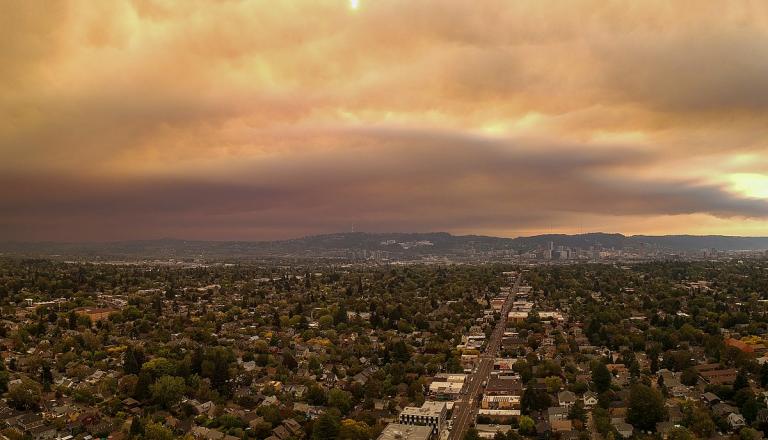
2020 wildfires in Oregon. Looking at Council Crest, OHSU, and downtown Portland along Hawthorne Blvd, Tedder, September 9, 2020; Creative Commons

Loved ones and friends from across the States have reached out and asked how we are doing in the face of all the social tension in Portland. They have also raised concerns amid the fires raging in Oregon, Washington, and California. Add to that the ongoing alarm over COVID, which knows no geographical or ideological boundaries. And don’t forget the upcoming November elections that affect us all. There are so many raging fires and disasters to put out across our region, country, and world—natural, viral, racial, political, religious. It can get so overwhelming. How do we respond or react when so many fires rage?
A day after the anniversary of 9/11, I found some solace in reading John W. Kiser’s volume, The Monks of Tibhirine: Faith, Love, and Terror in Algeria (New York: St. Martin’s Griffin, 2002). It is the story of the bond between a small group of Roman Catholic Trappist monks and their Muslim neighbors during the civil war in Algeria in the 1990’s. The monks in the village of Tibhirine refused to depart for their homeland France. They determined to stay in solidarity with their Muslim neighbors as the war raged around them. All but one of the monks were taken hostage in a move at first intended to gain the freedom of rebel prisoners. Later, the monks were executed and decapitated by the rebel forces. And yet, their deaths and the civil war—which pitted French colonizers against Algerians and their French sympathizers like these monks, as well as the rebel Muslim forces against their fellow Algerian Muslims and French Catholic monastics—did not have the last word. The last word goes to the enduring bond of neighborliness and friendship that was evident between these French Catholic monks and their friends, the Algerian Muslim villagers. As we face various forms of extremism and polarization in our world today, and as various fires rage, I find here a story of solace, comfort, and hope.
One of the monks, Christian de Chergé, had been a soldier in the French military stationed in Algeria. During his tour of duty, he had become close friends with an older Muslim—an “unlettered policeman and family man” (10) named Mohammed. One day when they were walking, a group of rebels suddenly came upon them. They pointed their rifles at Christian’s chest. Rather than step aside, Mohammed intervened, positioned himself between the guns and Christian, and sought to assure the rebels that this French soldier was a man of God and friend to Muslims. The rebels let them go, but the next day Mohammed was found dead, throat slit, not far from the home where he and his spouse with nearly a dozen children lived (9).
Mohammed saved Christian in more ways than one. Here I quote from the book in the context of Christian’s bewilderment in the face of all the tensions and fires raging involving French colonizers and Algerian rebels, French Christians and Algerian Muslims, and Muslims and Muslims:
Depressed by the spiritual confusion he felt around him, de Chergé took solace in the exceptions. Mohammed had been a light in a morally confused landscape where “war had sterilized both the land and people’s hearts,” he wrote years later. “He changed my life by liberating my faith in spite of the complexity of daily life and showed me how to live it simply as a response to what is natural and authentic in others” (10).
This conversion was instrumental in Christian’s determination to become a Cistercian monk and serve in Algeria, where later in 1996 he and his fellow monks died at the hands of their rebel captors.
In no way, shape, or form should we sweep under the carpet the issues that separate us today in our society. We must tirelessly, patiently and urgently work through them, including the debate over climate change and their alleged bearing on the raging fires on the west coast, the struggle to address and right the wrongs of racial inequity in our society, the best and most prudent course of action to subjugate COVID, as well as the other political, ideological, and religious issues that divide Americans , including Christian nationalism and cultural pluralism. I contend that we cannot have civility without equity. We cannot have unity without diversity. Nor can we achieve lasting equity and diversity without civility and unity. Amid the fires that rage without and within each of us, I hope that we can learn from Christian and Mohammed’s example. We need a liberated faith that “in spite of the complexity of daily life” we resolve to “live it simply as a response to what is natural and authentic in others” (10).
All our fears over the “deep state” or “deep market,” for example, will overwhelm us. It is vital that we experience a liberated faith shaped by divine love. Such love looks like this: “Love is patient and kind; love does not envy or boast; it is not arrogant or rude. It does not insist on its own way; it is not irritable or resentful; it does not rejoice at wrongdoing but rejoices with the truth. Love bears all things, believes all things, hopes all things, endures all things” (1 Corinthians 13:4-7; ESV). Faith in Jesus should never lead us to avoid or escape addressing the pressing issues that engulf us as raging fires. Rather, his deep, deep love and a community of faith, hope and love, including model examples like Christian and Mohammed’s friendship, extinguish overwhelming anxiety. Such divine and humane resources provide a cushion and a shield as well as oxygen to press on to address the ills that plague us all so that someday we can breathe freely.
About Paul Louis Metzger
Paul Louis Metzger. Ph.D., is Professor of Theology & Culture, Multnomah University & Seminary; Director of The Institute for Cultural Engagement: New Wine, New Wineskins; and author of numerous works, including Consuming Jesus: Beyond Race and Class Divisions in a Consumer Church as well as Connecting Christ: How to Discuss Jesus in a World of Diverse Paths. You can read more about the author here.
Next Post

September 18, 2020 Deep State, Deep Market, Shallow Jesus, Shallow Church
Browse Our Archives
Select a Category Uncategorized
Select a Month June 2025 April 2025 March 2025 January 2025 December 2024 November 2024 October 2024 September 2024 August 2024 July 2024 June 2024 May 2024 April 2024 March 2024 February 2024 January 2024 December 2023 November 2023 October 2023 September 2023 August 2023 July 2023 June 2023 May 2023 April 2023 March 2023 February 2023 January 2023 December 2022 November 2022 October 2022 September 2022 August 2022 July 2022 June 2022 May 2022 April 2022 March 2022 February 2022 January 2022 December 2021 November 2021 October 2021 September 2021 August 2021 July 2021 June 2021 May 2021 April 2021 March 2021 February 2021 January 2021 December 2020 November 2020 October 2020 September 2020 August 2020 July 2020 June 2020 May 2020 April 2020 March 2020 February 2020 January 2020 December 2019 November 2019 October 2019 September 2019 August 2019 July 2019 June 2019 May 2019 April 2019 March 2019 February 2019 January 2019 December 2018 November 2018 October 2018 September 2018 August 2018 July 2018 June 2018 May 2018 April 2018 March 2018 February 2018 January 2018 December 2017 November 2017 October 2017 September 2017 August 2017 July 2017 June 2017 May 2017 April 2017 March 2017 February 2017 January 2017 December 2016 November 2016 October 2016 September 2016 August 2016 July 2016 June 2016 May 2016 April 2016 March 2016 February 2016 January 2016 December 2015 November 2015 October 2015 September 2015 August 2015 July 2015 June 2015 May 2015 April 2015 March 2015 February 2015 January 2015 December 2014 November 2014 October 2014 September 2014 August 2014 July 2014 June 2014 May 2014 April 2014 March 2014 February 2014 January 2014 December 2013 November 2013 October 2013 September 2013 August 2013 July 2013 June 2013 May 2013 April 2013 March 2013 February 2013 January 2013 December 2012 November 2012 October 2012 September 2012 August 2012 July 2012 June 2012 May 2012 April 2012 March 2012 February 2012
Follow Us!
TAKE THE
Religious Wisdom Quiz
What did the angel tell the shepherds?
Select your answer to see how you score.
The Location of the Newborn Savior To Not Be Afraid How to Recognize the Newborn Savior All of These Things
Books by This Author Books by Paul Louis Metzger
Related posts from Uncommon God, Common Good

Heavenly Father’s Day on Trinity Sunday

Easter Triduum: Obey Your Thirst—for God

Holy Week Is Humble Week: "Beware of Becoming...

Excavating the Person in a Throwaway Culture
TRENDING AT PATHEOS Evangelical

The REST of Your Life: A Creative Wrestles...
This week I had a conversation with a good friend from church....

How the author of the world's best hymn...
I've been working with John Newton for a while now. This makes...

Long before this Lectio Divina, Psalm 130 - the song - started...

What About the Trees? Another Living Parable
After I finished writing the last article about falling leaves as a...

Why Classical Education Is a Conversation, Not a...
Come and Read: Joy in Classical Education When I was a little...

Cornell University has received a great deal of negative publicity and intense...
view all Evangelical blogs
Ad-Free & Subscriber Log-In Subscription Support
- About Us
- 2026 Calendar
- Videos
- Podcasts
- Library of World Religions
- Faith In Media Tracker
- Advertise With Us
- Write for Us
- Privacy Policy
- Terms of Service
- Do Not Sell My Data
- Contact Us
- Radiant Digital
- Manage Newsletter Subscriptions
- Unsubscribe From Notifications
- Sitemap
Copyright 2008-2026, Patheos. All rights reserved.
Subscription Support Ad-Free & Subscriber Log-In
Follow Patheos