
BuddhistCatholicContemplativeEvangelicalGeneral ChristianHinduJewishLatter-day SaintMuslimNew VisionsProgressive Christian
Beliefs
- Buddhist
- Catholic
- Contemplative
- Evangelical
- General Christian
- Hindu
- Jewish
- Latter-day Saint
- More Voices
- Muslim
- New Visions
- Pagan
- Progressive Christian
Topics
- Religion News
- Food and Religion
- Sports and Religion
- Religious Art
- Religious Music and Entertainment
- Religious Events
- History and Religion
- Style and Religion
- Politics and Religion
- Women in Religion
- Recreation Outdoors and Religion
- Business Finance and Religion
- Careers Workplace and Religion
- Education and Religion
- Family Parenting and Religion
- Health Fitness and Religion
- Home and Religion
- Relationships and Religion
- Technology and Religion
- Travel and Religion
Columnists
- Buddhist Columnists
- Business Finance and Religion Columnists
- Careers Workplace and Religion Columnists
- Catholic Columnists
- Contemplative Columnists
- Education and Religion Columnists
- Evangelists Columnists
- Family Parenting and Religion Columnists
- General Christian Columnists
- Health Fitness and Religion Columnists
- Hindu Columnists
- History and Religion Columnists
- Home and Religion Columnists
- Jewish Columnists
- More Voices Columnists
- Latter Day Columnists
- Muslim Columnists
- New Visions Columnists
- Nonreligious Columnists
- Pagan Columnists
- Politics and Religion Columnists
- Progressive Columnists
- Recreation Outdoors and Religion Columnists
- Relationships and Religion Columnists
- Religion News Columnists
- Religious Art Columnists
- Religious Events Columnists
- Religious Music and Entertainment Columnists
- Sports and Religion Columnists
- Style and Religion Columnists
- Technology and Religion Columnists
- Travel and Religion Columnists
- Women in Religion Columnists
Resource Library
- 2026 Calendar
- Library of World Religions
- The 100 Most Holy Places on Earth
- Patheos Answers
- Podcasts
- Videos
- Faith Leaders Database
- Anglican Episcopalian
- Bahai
- Baptist
- Buddhism
- Christianity
- Confucianism
- Eastern Orthodoxy
- Hinduism
- Holiness and Pentecostal
- ISKCON
- Islam
- Judaism
- Lutheran
- Methodist
- The Church of Jesus Christ of Latter-day Saints
- New Age
- Paganism
- Presbytarian and Reformed
- Protestantism
- Religion Behind the Scenes
- Roman Catholic
- Scientology
- Shia Islam
- Sikhism
- Sufism
- Sunni Islam
- Taoism
- Zen
- See all religions
Research Tools
 Ad-Free & Subscriber Log-In Subscription Support
Ad-Free & Subscriber Log-In Subscription Support
Follow Patheos 

- Trending:
- Forgiveness
- |
- Marriage
- |
- Consciousness
- |
- Death Penalty
- |
- Election
- |
- Halloween

- Home
- Evangelical
- Remove Dividing Walls of Hostility and Indifference
Remove Dividing Walls of Hostility and Indifference
Last updated on: October 7, 2020 at 6:07 am by Paul Louis Metzger
Remove Dividing Walls of Hostility and Indifference 2020-10-07T06:07:52-07:00 Paul Louis Metzger
Patheos Explore the world's faith through different perspectives on religion and spirituality! Patheos has the views of the prevalent religions and spiritualities of the world.
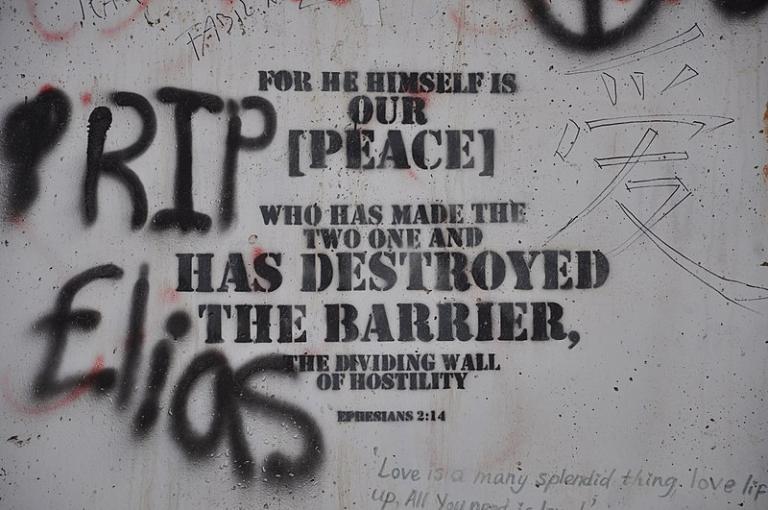
“The Dividing Wall of Hostility,” Neil Ward, August 2, 2012; Creative Commons

Ephesians 2:11-22 features the church as a community made up of Jews and Gentiles. That includes everyone through faith in Christ. Paul writes of how the triune God has removed the dividing wall of hostility involving certain applications of the Law that functioned to polarize the two groups. Through Christ, the two have been brought together as one new humanity (2:15), fellow citizens of his kingdom, members of his household (2:19), and temple parts/participants (2:21):
Therefore remember that at one time you Gentiles in the flesh, called “the uncircumcision” by what is called the circumcision, which is made in the flesh by hands— remember that you were at that time separated from Christ, alienated from the commonwealth of Israel and strangers to the covenants of promise, having no hope and without God in the world. But now in Christ Jesus you who once were far off have been brought near by the blood of Christ. For he himself is our peace, who has made us both one and has broken down in his flesh the dividing wall of hostility by abolishing the law of commandments expressed in ordinances, that he might create in himself one new man in place of the two, so making peace, and might reconcile us both to God in one body through the cross, thereby killing the hostility. And he came and preached peace to you who were far off and peace to those who were near. For through him we both have access in one Spirit to the Father. So then you are no longer strangers and aliens, but you are fellow citizens with the saints and members of the household of God, built on the foundation of the apostles and prophets, Christ Jesus himself being the cornerstone, in whom the whole structure, being joined together, grows into a holy temple in the Lord. In him you also are being built together into a dwelling place for God by the Spirit (Ephesians 2:11-22; ESV).
Paul didn’t make it happen. God did: “For through him we both have access in one Spirit to the Father” (2:18). The new humanity is God’s household (2:19) in which Jesus is the cornerstone (2:20) and in whom God dwells by his Spirit (2:22). Even though God made and makes it happen, we still have a choice as to whether we are going to live as one or try kicking one another out or living in isolated quarters. Paul encourages and challenges us to live into who we are as one humanity, one body, one household, and one temple.
In Paul’s day, certain interpretations and applications of the Law served to ostracize Gentiles. It was not that the Law itself was done away with by Jesus, but the written code or letter of the law. New Testament scholar F.F. Bruce argues,
It is not the law as a revelation of the character and will of God that has been done away with in Christ….The righteousness required by the law of God is realized more fully by the inward enabling of the Spirit—in Jew and Gentile alike—than was possible under the old covenant. But the law as a written code, threatening death instead of imparting life, is done away with in Christ… (F.F. Bruce, The Epistles to the Colossians, to Philemon, and to the Ephesians, The New International Commentary on the New Testament, 2nd rev. ed. {Grand Rapids: Eerdmans, 1984}, 298).
We have laws that isolate and ‘otherize’ us today. It might not be visible or explicit laws of religious legalism, or slavery, segregation, and redlining. They could simply be laws of social segregation that allow us to stay entrenched in our respective domains of confirmation bias, conservative and liberal forms of identity politics, and consumer comfort zones, which keep us from realizing our emancipation and full equality in Christ. Often such laws of separation involve a sense of superiority. In the biblical context involving Jews and Gentiles, whether the wall of hostility was the barrier that divided the court of the Jews from the court of the Gentiles in the Temple or the Law as a written code, the fundamental problem according to Bruce was ultimately psychological—often a sense of superiority bound up with separateness. Bruce writes,
The barrier between Jews and Gentiles was largely a psychological barrier, the antipathy aroused by the separateness of the Jews, accompanied as it often was by a sense of superiority on their part, But this antipathy, it is affirmed, has been abolished by Christ “in his flesh”—that is, by his death… How? Because by his death he has done away with that which separated the Jews from the Gentile, ‘the law of commandments, ordinances and all” (Bruce, Ephesians, 298).
We need to remember who we were before Christ—and what Christ has since made us. May no sense of superiority or inferiority lead us to segregate from one another. We need to live into the reality of our new humanity in Christ and not allow such dynamics as racial bigotry and social segregation to make us hostile and indifferent to one another. We should note that just as with Jews and Gentiles the sense of superiority or inferiority is not bound up with spiritual reality, for we are one humanity in Christ. Similarly, we are not separate biologically. Here, too, what we take to be genetic or biological differences between whites and blacks as supposed “races” are really social and psychological constructs. Princeton University anthropologist Agustín Fuentes discusses this theme in an article at Psychology Today titled “Busting Myths About Human Nature.” Here are a few of the points he makes:
In humans today, there are not multiple biological groups called “races.” However, race is real and it impacts us all. What we call “race” are social categories.
There is currently one biological race in our species: Homo sapiens sapiens. However, that does not mean that what we call “races” (our society’s way of dividing people up) don’t exist. Societies, like the U.S., construct racial classifications, not as units of biology, but as ways to lump together groups of people with varying historical, linguistic, ethnic, religious, or other backgrounds. These categories are not static; they change over time as societies grow, diversify, and alter their social, political and historical make-ups. For example, in the U.S., the Irish were not always “white,” and despite our government’s legal definition, most Hispanics/Latinos are not seen as white today (by themselves or by others).
The biologized racial fallacy “influences people to see racism and inequality not as the products of economic, social, and political histories but more as a natural state of affairs.”
Just as there is only one biological species to which all humans belong, namely, “Homo sapiens sapiens,” so we who trust in Christ are all one new humanity in him, according to Paul. Paul encourages us to remember who we were before Christ and who we are now in Christ. Elsewhere Paul encourages us to accept one another in view of Christ accepting us (Romans 15:7), to put on love and empathy (Colossians 3:14-17), and to consider others better than ourselves because of the triune God’s exemplary care for us (Philippians 2:1-11).
Let’s take time to remember where we come from, what God has done for us, and who we are as one new humanity in and through Jesus, the Jewish Messiah. Let us accept one another, put on love and empathy, and consider others better than ourselves in view of God’s care. Instead of reacting, let’s respond. Instead of speaking first, let’s listen. Let’s try and step inside one another’s shoes, especially those who haven’t had shoes, boots, or bootstraps. As one African American bishop in my city said in response to the dismissive remark that the African American community needs to pick themselves up by their own bootstraps, “Then give me some bootstraps.” Release the choke-hold and remove the knee from the collective neck.
Let’s try to see one another not as other than us, but as one with us in solidarity. Let’s remove the walls of hostility and indifference that we create and instead live into our new humanity in Christ. We will all be better for it.
A few specific items come into play at this point related to what I wrote above and how it bears on the present-day cultural tumult:
Instead of immediately reacting when we hear “Black Lives Matter” by saying “All Lives Matter,” let’s first ask ourselves pointedly to what extent have African American lives really mattered to the rest of us? Are we concerned about social inequities involving education, employment, healthcare, law enforcement, and imprisonment? How has such concern shaped our daily lives, relationships, and how we live? Instead of quickly raising questions about the Black Lives Matter movement’s entire platform, we should ask ourselves whether we have embraced candidates and voted for people and platforms not because of their entire package, but because of certain key aspects of their political agendas. And for those who say the church should not be political or discuss these matters, consider how often such dismissals simply serve as cover for us not to bring our faith to bear honestly and openly into view on our voting patterns and decisions. We are all political. The question is to what extent the politics of Jesus’ kingdom impacts every aspect of our personal and public lives.
To the extent we are able to engage in conversations today in our church communities on such subjects in this open and equitable way, to that extent we can begin removing the walls of hostility and indifference in our own minds and hearts bound up with laws of social segregation and consumer comfort. To that extent, and to the extent that we remember who we were before Christ and who we are together in Christ, we can live into our new humanity as the church in our multiethnic society.
The honest, heartfelt and equitable questions and conversations called for above must continue on beyond the passing heated cultural moment. Otherwise, indifference and hostility will easily re-emerge due to social isolation. Just as we have ongoing access through Christ in the Spirit to the Father, let’s keep open access to one another as the new humanity over the days, weeks, months, and years ahead.
Check out the video below featuring this blog post followed by a conversation on the theme with pastoral leaders from diverse backgrounds and ministry contexts, along with New Wine, New Wineskins’ Dr. Matt Farlow and me. The pastoral leaders are as follows: Pastor Jeff Harley, Pastor of Harambe Baptist Church Philadelphia, PA and Executive Director of Called To Serve Community Development Corporation in Philadelphia, PA; Pastor Noelani Jai, a former family law attorney who with her husband in 2018 began Jesus House out of Hope Chapel Huntington Beach where she is currently the pastor; Pastor Jim Sequeira, Pastor of Cascade View Covenant Church, and who also serves at the conference and denominational level in the Evangelical Covenant Church’s Department of Compassion, Mercy and Justice; and Pastor Jimi Calhoun, an author, ethicist, and musician, ordained in the International Church of the Foursquare Gospel, currently serving as Pastor of Bridging Austin.
Previous Post

June 24, 2020
How Well Do We See? A Devotional on Disabilities
Next Post
July 4, 2020 Trust God. Be Free. Wear Masks.
Browse Our Archives
Select a Category Uncategorized
Select a Month June 2025 April 2025 March 2025 January 2025 December 2024 November 2024 October 2024 September 2024 August 2024 July 2024 June 2024 May 2024 April 2024 March 2024 February 2024 January 2024 December 2023 November 2023 October 2023 September 2023 August 2023 July 2023 June 2023 May 2023 April 2023 March 2023 February 2023 January 2023 December 2022 November 2022 October 2022 September 2022 August 2022 July 2022 June 2022 May 2022 April 2022 March 2022 February 2022 January 2022 December 2021 November 2021 October 2021 September 2021 August 2021 July 2021 June 2021 May 2021 April 2021 March 2021 February 2021 January 2021 December 2020 November 2020 October 2020 September 2020 August 2020 July 2020 June 2020 May 2020 April 2020 March 2020 February 2020 January 2020 December 2019 November 2019 October 2019 September 2019 August 2019 July 2019 June 2019 May 2019 April 2019 March 2019 February 2019 January 2019 December 2018 November 2018 October 2018 September 2018 August 2018 July 2018 June 2018 May 2018 April 2018 March 2018 February 2018 January 2018 December 2017 November 2017 October 2017 September 2017 August 2017 July 2017 June 2017 May 2017 April 2017 March 2017 February 2017 January 2017 December 2016 November 2016 October 2016 September 2016 August 2016 July 2016 June 2016 May 2016 April 2016 March 2016 February 2016 January 2016 December 2015 November 2015 October 2015 September 2015 August 2015 July 2015 June 2015 May 2015 April 2015 March 2015 February 2015 January 2015 December 2014 November 2014 October 2014 September 2014 August 2014 July 2014 June 2014 May 2014 April 2014 March 2014 February 2014 January 2014 December 2013 November 2013 October 2013 September 2013 August 2013 July 2013 June 2013 May 2013 April 2013 March 2013 February 2013 January 2013 December 2012 November 2012 October 2012 September 2012 August 2012 July 2012 June 2012 May 2012 April 2012 March 2012 February 2012
Follow Us!
TAKE THE
Religious Wisdom Quiz
You are robbing me in tithes and offerings. Bring the whole tithe into the storehouse and test me in this. What will I do?
Select your answer to see how you score.
Care for the poor Open the floodgates of heaven Forgive you Return it tenfold
Books by This Author Books by Paul Louis Metzger
Related posts from Uncommon God, Common Good

Heavenly Father’s Day on Trinity Sunday

Easter Triduum: Obey Your Thirst—for God

Holy Week Is Humble Week: "Beware of Becoming...

Excavating the Person in a Throwaway Culture
TRENDING AT PATHEOS Evangelical

The REST of Your Life: A Creative Wrestles...
This week I had a conversation with a good friend from church....

How the author of the world's best hymn...
I've been working with John Newton for a while now. This makes...

Long before this Lectio Divina, Psalm 130 - the song - started...

What About the Trees? Another Living Parable
After I finished writing the last article about falling leaves as a...

Why Classical Education Is a Conversation, Not a...
Come and Read: Joy in Classical Education When I was a little...

Cornell University has received a great deal of negative publicity and intense...
view all Evangelical blogs
Ad-Free & Subscriber Log-In Subscription Support
- About Us
- 2026 Calendar
- Videos
- Podcasts
- Library of World Religions
- Faith In Media Tracker
- Advertise With Us
- Write for Us
- Privacy Policy
- Terms of Service
- Do Not Sell My Data
- Contact Us
- Radiant Digital
- Manage Newsletter Subscriptions
- Unsubscribe From Notifications
- Sitemap
Copyright 2008-2026, Patheos. All rights reserved.
Subscription Support Ad-Free & Subscriber Log-In
Follow Patheos