
BuddhistCatholicContemplativeEvangelicalGeneral ChristianHinduJewishLatter-day SaintMuslimNew VisionsProgressive Christian
Beliefs
- Buddhist
- Catholic
- Contemplative
- Evangelical
- General Christian
- Hindu
- Jewish
- Latter-day Saint
- More Voices
- Muslim
- New Visions
- Pagan
- Progressive Christian
Topics
- Religion News
- Food and Religion
- Sports and Religion
- Religious Art
- Religious Music and Entertainment
- Religious Events
- History and Religion
- Style and Religion
- Politics and Religion
- Women in Religion
- Recreation Outdoors and Religion
- Business Finance and Religion
- Careers Workplace and Religion
- Education and Religion
- Family Parenting and Religion
- Health Fitness and Religion
- Home and Religion
- Relationships and Religion
- Technology and Religion
- Travel and Religion
Columnists
- Buddhist Columnists
- Business Finance and Religion Columnists
- Careers Workplace and Religion Columnists
- Catholic Columnists
- Contemplative Columnists
- Education and Religion Columnists
- Evangelists Columnists
- Family Parenting and Religion Columnists
- General Christian Columnists
- Health Fitness and Religion Columnists
- Hindu Columnists
- History and Religion Columnists
- Home and Religion Columnists
- Jewish Columnists
- More Voices Columnists
- Latter Day Columnists
- Muslim Columnists
- New Visions Columnists
- Nonreligious Columnists
- Pagan Columnists
- Politics and Religion Columnists
- Progressive Columnists
- Recreation Outdoors and Religion Columnists
- Relationships and Religion Columnists
- Religion News Columnists
- Religious Art Columnists
- Religious Events Columnists
- Religious Music and Entertainment Columnists
- Sports and Religion Columnists
- Style and Religion Columnists
- Technology and Religion Columnists
- Travel and Religion Columnists
- Women in Religion Columnists
Resource Library
- 2026 Calendar
- Library of World Religions
- The 100 Most Holy Places on Earth
- Patheos Answers
- Podcasts
- Videos
- Faith Leaders Database
- Anglican Episcopalian
- Bahai
- Baptist
- Buddhism
- Christianity
- Confucianism
- Eastern Orthodoxy
- Hinduism
- Holiness and Pentecostal
- ISKCON
- Islam
- Judaism
- Lutheran
- Methodist
- The Church of Jesus Christ of Latter-day Saints
- New Age
- Paganism
- Presbytarian and Reformed
- Protestantism
- Religion Behind the Scenes
- Roman Catholic
- Scientology
- Shia Islam
- Sikhism
- Sufism
- Sunni Islam
- Taoism
- Zen
- See all religions
Research Tools
 Ad-Free & Subscriber Log-In Subscription Support
Follow Patheos 

- Trending:
- Advent
- |
- Forgiveness
- |
- Thanksgiving
- |
- Election
- |
- Seasonal Holidays
- |
- Marriage

- Home
- Evangelical
- Maundy Thursday: Jesus’ Last Stand Is Everlasting
Maundy Thursday: Jesus’ Last Stand Is Everlasting
Last updated on: April 8, 2020 at 4:31 pm by Paul Louis Metzger
Maundy Thursday: Jesus’ Last Stand Is Everlasting 2020-04-08T16:31:47-07:00 Paul Louis Metzger
Patheos Explore the world's faith through different perspectives on religion and spirituality! Patheos has the views of the prevalent religions and spiritualities of the world.
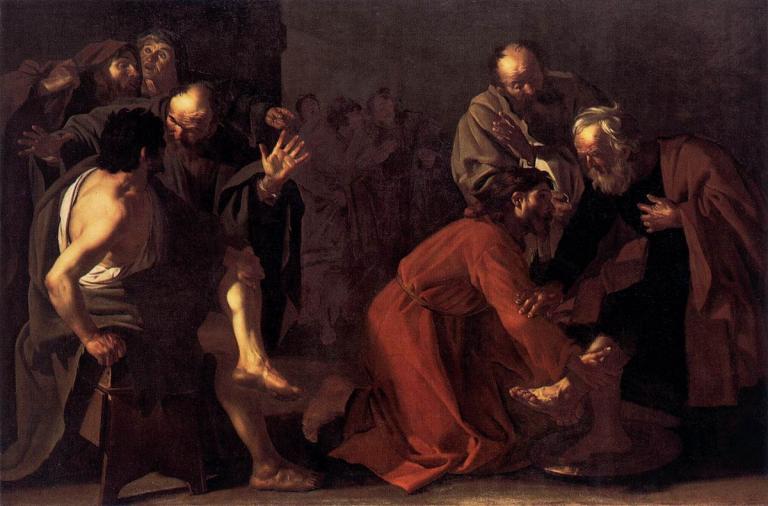
Dirck van Baburen: Christ Washing the Apostles Feet (circa 1616); {{PD-US-expired}}

On Maundy Thursday, we remember Jesus’ Last Supper with his disciples where he washed their feet, followed by final instructions to them and his high priestly prayer. Together they serve as the tactical moves for the Lord’s last stand against his adversaries.
Now if you were preparing for battle with your enemies, wouldn’t you be padding the upper room, lower rooms and surrounding premises with sandbags while stockpiling ammunition? In contrast, Jesus prepares for his last stand with a family meal, a foot washing, a farewell discourse,[1] and intimate prayer to his Heavenly Father (See John 13-17). Given Jesus’ Passover sacrifice of himself that the church remembers on Good Friday to bring liberation from bondage in Egypt or Empire and his resurrection from the dead on Easter Sunday, what transpired in his last stand is everlasting. Thus, we are called to live into this everlasting kingdom reality signified by Maundy Thursday. What does it entail for us? This entry will provide an answer to the question.
The United States prizes autonomy and is a fast-food society. As a result, it is easy to discount family meals and hospitality. And so, we may easily bypass what occurred on Maundy Thursday as nothing more than quaint and dispensable. To the contrary, it is qualitatively all-important and indispensable for the Christian movement and what transpired on Good Friday. N.T. Wright has this to say:
When Jesus wanted to explain to his followers what his forthcoming death was all about, he did not give them a theory, a model, a metaphor, or any other such thing; he gave them a meal, a Passover meal.[2]
Many people claim that the meal was the equivalent of the Passover Seder.[3] On this view, Jesus is the head of his family made up of his followers. The only difference is that this head of the home and rabbi offers his own body and blood as the sacrificial lamb, which is signified by the bread that he breaks and wine that he pours out at the meal.
John’s Gospel is the only canonical gospel account that does not record the institution of the Lord’s Supper on Maundy Thursday. John’s Gospel is also the only canonical gospel that records the foot washing. Most of us have never had someone wash our feet at a meal, and likely never by the head of the home or table. But just as Jesus offers himself as the Passover sacrifice (Luke 22:14-20), so he washes his followers’ feet during the supper:
Now before the Feast of the Passover, when Jesus knew that his hour had come to depart from this world to the Father, having loved his own who were in the world, he loved them to the end. During supper, when the devil had already put it into the heart of Judas Iscariot, Simon’s son, to betray him, Jesus, knowing that the Father had given all things into his hands, and that he had come from God and was going back to God, rose from supper. He laid aside his outer garments, and taking a towel, tied it around his waist. Then he poured water into a basin and began to wash the disciples’ feet and to wipe them with the towel that was wrapped around him (John 13:1-5; ESV).
Jesus’ unassuming act was too much for Peter. At first, he refused to let Jesus wash his feet (John 13:6, 8). But given our culture of familiarity with the passage and our culture in which familiarity easily breeds contempt, we may not find the foot washing so radical and feel we are entitled to Jesus stooping low to tend to us. But it is radical and momentous. Again, here’s Wright:
Within the gospels’ recounting of that ultimate Passover, one scene stands out with special poignancy and power. John’s gospel displays deft artistry and fathomless theology throughout, but especially in the footwashing scene in chapter 13. In a few lines we glimpse a tableau both intimate and touching and scary and dangerous. Having begun his gospel with the all-creative Word becoming flesh and revealing God’s glory, John begins the shorter second half with an acted parable of the same thing. Jesus removes his outer garments and kneels down to wash the disciples’ feet, summing up all that is to come in this act of divine humility, of loving redemption, of cleansing for service. For John, as indeed throughout the New Testament, Jesus’ vocation to rescue the world from its plight, and in so doing to reveal the divine glory in action, is focused, symbolized, encoded in an action simultaneously dramatic, fraught with cosmic significance, and gentle, tender with human emotion. If you want to understand the great mysteries of Christian theology, of Trinity, Incarnation, and atonement itself, you could do worse than spend time with this scene.[4]
Jesus calls on his followers to care for one another in the same manner (John 13:12-17). If we thought Jesus went too far with washing his disciples’ feet, we may think he went beyond the breaking point with calling them to care for one another in the same servant-like manner. Even if we like the title of servant-leader or lead servant, we easily take offense if we’re not esteemed in ministry. My colleague Albert Baylis put it well when he remarked: we all want to be called servant leaders until someone treats us like one.
The challenge to our sense of entitlement does not end there. Not only does Jesus wash Peter’s feet, but also he washes the feet of Judas, whom the Lord knew would betray him that very night. Jesus breaks bread with the very one who would hand him over to be broken and poured out in death. However, rather than protect himself, Jesus offers himself as a willing sacrifice in order to destroy hatred with love and bring new life.
If we had more time and space, we would discuss the farewell discourse recorded in chapters 14-16 and Jesus’ high priestly prayer in chapter 17. The church recalls these subjects and the other themes noted here on Maundy Thursday. In each and every one of them—from the family meal and foot washing to the farewell discourse and prayer to his Father as well as the betrayal—Jesus models humility, vulnerability, and the desire for relational intimacy that mark his kingdom glory and vision for our lives as his kingdom community.
May we follow suit. We have every reason to be inspired by Jesus’ glorious, all-powerful example of holy and pure love on Maundy Thursday and Good Friday, and his resurrection from the dead on Easter Sunday. As a result of the bodily resurrection, what transpired at Jesus’ last stand in his battle to the death with his enemies inaugurated the eternal kingdom reality. Humility, vulnerability and relational intimacy win out in the end. Will we live into this reality or go back to the way things used to be before Jesus’ last and everlasting stand?
_______________
[1]For further reflection on this theme, see Paul Louis Metzger, The Gospel of John: When Love Comes to Town, Resonate Series (Downers Grove: InterVarsity Press, 2010), pages 167-171.
[2]N.T. Wright, The Day the Revolution Began: Reconsidering the Meaning of Jesus’s Crucifixion (New York: HarperOne, 2016), page 182.
[3]For a treatment of parallels between the Last Supper and the Passover Seder, see Joachim Jeremias, The Eucharistic Words of Jesus, 3rd ed. (London: SCM Press, 1966), pages 42–61. For an overview as well as critique of the Last Supper as a Passover Seder, see Jonathan Klawans, “Was Jesus’ Last Supper a Seder?” Bible History Daily, April 19, 2019; https://www.biblicalarchaeology.org/daily/people-cultures-in-the-bible/jesus-historical-jesus/was-jesus-last-supper-a-seder/ (accessed on 3/23/2020).
[4]N.T. Wright, “The Royal Revolution: Fresh Perspectives on the Cross,” Calvin College January Series, January 24, 2017; https://ntwrightpage.com/2017/01/30/the-royal-revolution-fresh-perspectives-on-the-cross/ (accessed on 3/23/2020).
Previous Post

April 4, 2020
Palm Sunday, Holy Week and Holy War
Next Post
April 10, 2020 Don’t Pass Over the Passover on Good Friday
Browse Our Archives
Select a Category Uncategorized
Select a Month June 2025 April 2025 March 2025 January 2025 December 2024 November 2024 October 2024 September 2024 August 2024 July 2024 June 2024 May 2024 April 2024 March 2024 February 2024 January 2024 December 2023 November 2023 October 2023 September 2023 August 2023 July 2023 June 2023 May 2023 April 2023 March 2023 February 2023 January 2023 December 2022 November 2022 October 2022 September 2022 August 2022 July 2022 June 2022 May 2022 April 2022 March 2022 February 2022 January 2022 December 2021 November 2021 October 2021 September 2021 August 2021 July 2021 June 2021 May 2021 April 2021 March 2021 February 2021 January 2021 December 2020 November 2020 October 2020 September 2020 August 2020 July 2020 June 2020 May 2020 April 2020 March 2020 February 2020 January 2020 December 2019 November 2019 October 2019 September 2019 August 2019 July 2019 June 2019 May 2019 April 2019 March 2019 February 2019 January 2019 December 2018 November 2018 October 2018 September 2018 August 2018 July 2018 June 2018 May 2018 April 2018 March 2018 February 2018 January 2018 December 2017 November 2017 October 2017 September 2017 August 2017 July 2017 June 2017 May 2017 April 2017 March 2017 February 2017 January 2017 December 2016 November 2016 October 2016 September 2016 August 2016 July 2016 June 2016 May 2016 April 2016 March 2016 February 2016 January 2016 December 2015 November 2015 October 2015 September 2015 August 2015 July 2015 June 2015 May 2015 April 2015 March 2015 February 2015 January 2015 December 2014 November 2014 October 2014 September 2014 August 2014 July 2014 June 2014 May 2014 April 2014 March 2014 February 2014 January 2014 December 2013 November 2013 October 2013 September 2013 August 2013 July 2013 June 2013 May 2013 April 2013 March 2013 February 2013 January 2013 December 2012 November 2012 October 2012 September 2012 August 2012 July 2012 June 2012 May 2012 April 2012 March 2012 February 2012
Follow Us!
TAKE THE
Religious Wisdom Quiz
What does "Christian" mean?
Select your answer to see how you score.
Follower of Christ Believer Messenger Disciple
Books by This Author Books by Paul Louis Metzger
Related posts from Uncommon God, Common Good

Heavenly Father’s Day on Trinity Sunday

Easter Triduum: Obey Your Thirst—for God

Holy Week Is Humble Week: "Beware of Becoming...

Excavating the Person in a Throwaway Culture
TRENDING AT PATHEOS Evangelical

Making Stones Into Bread: Choosing the “Right” Work
I was on my online arts ministry Zoom meeting with the International...

Ukraine’s exhausted Christians face fifth winter of war
By Julian Lukins The full-scale war in Ukraine is taking “a serious...

Russell Brand's Conviction is not anti-Christian Persecution
How do we shed the reputation that the Church is OK with...

Have you ever caught yourself saying, “I’ll do it tomorrow,” or “Now...

Write Your Story: A Great Way to Find...
A few month’s back, my son was scrolling around Facebook and saw...

Throughout history, people have pursued pleasure, possessions, relationships, and success in an...
view all Evangelical blogs
Ad-Free & Subscriber Log-In Subscription Support
- About Us
- 2026 Calendar
- Videos
- Podcasts
- Library of World Religions
- Faith In Media Tracker
- Advertise With Us
- Write for Us
- Privacy Policy
- Terms of Service
- Do Not Sell My Data
- Contact Us
- Radiant Digital
- Manage Newsletter Subscriptions
- Unsubscribe From Notifications
- Sitemap
Copyright 2008-2026, Patheos. All rights reserved.
Subscription Support Ad-Free & Subscriber Log-In
Follow Patheos