
BuddhistCatholicContemplativeEvangelicalGeneral ChristianHinduJewishLatter-day SaintMuslimNew VisionsProgressive Christian
Beliefs
- Buddhist
- Catholic
- Contemplative
- Evangelical
- General Christian
- Hindu
- Jewish
- Latter-day Saint
- More Voices
- Muslim
- New Visions
- Pagan
- Progressive Christian
Topics
- Religion News
- Food and Religion
- Sports and Religion
- Religious Art
- Religious Music and Entertainment
- Religious Events
- History and Religion
- Style and Religion
- Politics and Religion
- Women in Religion
- Recreation Outdoors and Religion
- Business Finance and Religion
- Careers Workplace and Religion
- Education and Religion
- Family Parenting and Religion
- Health Fitness and Religion
- Home and Religion
- Relationships and Religion
- Technology and Religion
- Travel and Religion
Columnists
- Buddhist Columnists
- Business Finance and Religion Columnists
- Careers Workplace and Religion Columnists
- Catholic Columnists
- Contemplative Columnists
- Education and Religion Columnists
- Evangelists Columnists
- Family Parenting and Religion Columnists
- General Christian Columnists
- Health Fitness and Religion Columnists
- Hindu Columnists
- History and Religion Columnists
- Home and Religion Columnists
- Jewish Columnists
- More Voices Columnists
- Latter Day Columnists
- Muslim Columnists
- New Visions Columnists
- Nonreligious Columnists
- Pagan Columnists
- Politics and Religion Columnists
- Progressive Columnists
- Recreation Outdoors and Religion Columnists
- Relationships and Religion Columnists
- Religion News Columnists
- Religious Art Columnists
- Religious Events Columnists
- Religious Music and Entertainment Columnists
- Sports and Religion Columnists
- Style and Religion Columnists
- Technology and Religion Columnists
- Travel and Religion Columnists
- Women in Religion Columnists
Resource Library
- 2026 Calendar
- Library of World Religions
- The 100 Most Holy Places on Earth
- Patheos Answers
- Podcasts
- Videos
- Faith Leaders Database
- Anglican Episcopalian
- Bahai
- Baptist
- Buddhism
- Christianity
- Confucianism
- Eastern Orthodoxy
- Hinduism
- Holiness and Pentecostal
- ISKCON
- Islam
- Judaism
- Lutheran
- Methodist
- The Church of Jesus Christ of Latter-day Saints
- New Age
- Paganism
- Presbytarian and Reformed
- Protestantism
- Religion Behind the Scenes
- Roman Catholic
- Scientology
- Shia Islam
- Sikhism
- Sufism
- Sunni Islam
- Taoism
- Zen
- See all religions
Research Tools
 Ad-Free & Subscriber Log-In Subscription Support
Follow Patheos 

- Trending:
- Advent
- |
- Forgiveness
- |
- Thanksgiving
- |
- Election
- |
- Seasonal Holidays
- |
- Marriage

- Home
- Evangelical
- Holy Saturday: Wholly in the Dark?
Holy Saturday: Wholly in the Dark?
Last updated on: April 11, 2020 at 9:17 am by Paul Louis Metzger
Holy Saturday: Wholly in the Dark? 2020-04-11T09:17:24-07:00 Paul Louis Metzger
Patheos Explore the world's faith through different perspectives on religion and spirituality! Patheos has the views of the prevalent religions and spiritualities of the world.
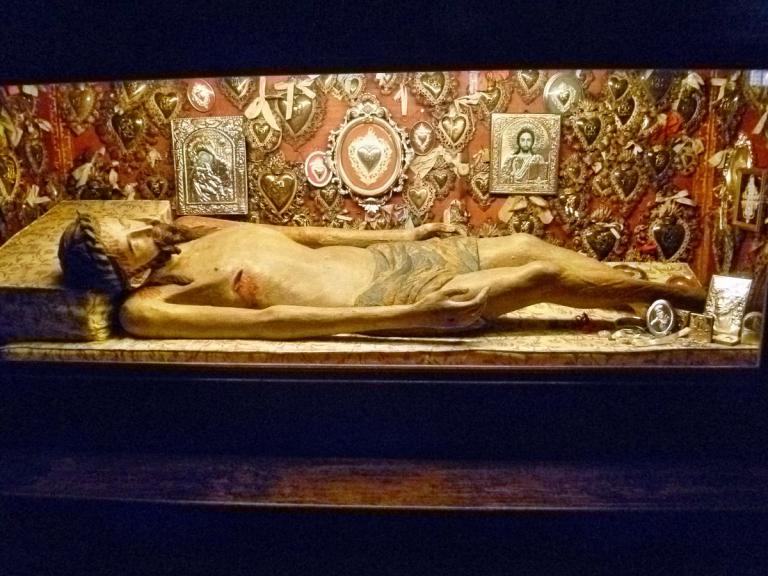
Wooden sculpture of Christ in His tomb; Chiesa di San Zaccaria, Venice, Italy, JoJan, October 10, 2013; Creative Commons

We often skip over the Saturday that falls between Good Friday and Easter. We simply pass through it and so lose out on its monumental significance. It’s almost as if we are wholly in the dark about Holy Saturday’s import.[1]
Speaking of being in the dark, that’s exactly where Jesus and his disciples were on Holy Saturday. For his part, Jesus was dead in the darkened grave. For their part, his followers were spiritually at a dead-end. Who knows what thoughts they had of Jesus and their relation to him? Had they been deceived? Was he a messianic impostor? How could the One who was to lead Israel out of Egypt into the Promised Land die as a sacrificial victim to the victimizing evil Empire of Egypt/Babylon/Rome? Imposing doubts darkened the disciples’ minds. They did not realize until later that Jesus was not only the New Moses to deliver them from bondage in Egypt but also the Passover Lamb.
If the disciples and we come into the light of the entirety of Holy Scripture that provides 20/20 vision, we will find that Holy Saturday is critically important for our faith. It is a date to mark on our church calendars. Without it Good Friday’s not so good, and Easter’s not so hopeful. In what follows, we will provide three reasons why Holy Saturday is wholly relevant to our faith and lives.
First, identification. Holy Saturday signifies that Jesus’ passion is our passion. He endures what we endure. He does not excuse himself from fully identifying with us. If we die, he dies. He accepts our human limitations and submits himself to bearing the burden of our fallen and sinful state. Here it is worth accounting for Tania M. Geist’s reflection on Pope Benedict’s 2013 meditation on the theological significance of the Shroud of Turin for Holy Saturday. Benedict considered the crucified man emblazoned on the burial garment to be Jesus. Geist writes,
Insofar as the Shroud symbolizes Christ’s suffering and death, however, it also conveys a message of hope and life. Benedict mused that the image on the Shroud functions like a photographic negative, its contrast of dark and light being essential. So too with the paschal mystery, wherein “the darkest mystery of faith is at the same time the most luminous symbol of boundless hope. Holy Saturday is the ‘no man’s land’ between death and Resurrection, but One has entered into this ‘no man’s land.’” And the One who has entered has come to share in our death, in a historic and unrepeatable gesture of “the most radical solidarity.”
Benedict sees this to be the true power of the Shroud and what it represents: that in his descent, Christ takes on our suffering, our sins—“Passio Christi. Passio hominis.”…[2]
Yes, Holy Saturday conveys “the most radical solidarity” between Jesus, God, and us. Such solidarity highlights God’s exceeding goodness that we also find displayed on Good Friday.
There is more, though. Second, annihilation and transformation. Holy Saturday signifies that we are dead to the old-world system and can “walk in newness of life” given our baptismal union with Jesus in his death and burial, as Paul writes in Romans 6. Here is the full context of his remarks on this subject:
What shall we say then? Are we to continue in sin that grace may abound? By no means! How can we who died to sin still live in it? Do you not know that all of us who have been baptized into Christ Jesus were baptized into his death? We were buried therefore with him by baptism into death, in order that, just as Christ was raised from the dead by the glory of the Father, we too might walk in newness of life (Romans 6:1-4; ESV).
If Jesus were not dead and buried, our sinful state and old humanity would not be dead and buried. But given that Jesus who bore our sins on the cross died and was buried, we are dead to sin as we have been “baptized into his death.” The annihilation of our old humanity makes possible the transformation of our humanity in accordance with Easter’s emphasis on new life. As the link between Good Friday and Easter, Holy Saturday underlines and highlights God’s goodness in terminating the old order of being and points forward with hope to Easter and the transformation of our existence as the new humanity.
Lastly, attention. Just as the chief priests tried to be attentive, so should we be, albeit for different reasons. The chief priests wanted a guard posted to keep Jesus’ disciples from stealing the body (Matthew 27:62-66). But it was pointless to try and keep him in the tomb. The guards became like dead men when the angel appeared Easter morn (Matthew 28:4). And for those who argue that the disciples were responsible for Jesus’ body’s disappearance, think again. From the likes of the disciples at the time of Jesus’ death and his post-crucifixion appearances, this clueless and cowardly band could not have put together a cunning and courageous, risky plan to steal the body of their fallen Lord and claim that he had been raised from the dead.[3]
To return to the disciples, they were not attentive to Jesus’ prophetic hints offered throughout the gospels. They had no clue of Jesus’ imminent resurrection. Would we be more cognizant, though? Hindsight’s always 20/20. Not so with peering into the future, especially in view of the traumatic days when Jesus suffered and died. Jesus’ followers could not come to terms and fathom all that Jesus had told them would occur, including the bodily resurrection from the grave. Still, as Jesus instructed them on Maundy Thursday, they were to watch and pray. Easier said than done in their case, and no doubt our own:
And he came to the disciples and found them sleeping. And he said to Peter, “So, could you not watch with me one hour? Watch and pray that you may not enter into temptation. The spirit indeed is willing, but the flesh is weak” (Matthew 26:40-41; ESV).
In talking about the need for attentiveness during Passover and beyond, we can learn a thing or two from God’s command to Israel at the time of the first Passover celebration and Exodus:
In this manner you shall eat it: with your belt fastened, your sandals on your feet, and your staff in your hand. And you shall eat it in haste. It is the Lord’s Passover (Exodus 12:11; ESV).
No doubt, Jesus’ exhortation to watch and pray during the Passover celebration in Jerusalem during Holy Week bears some similarity to the first Passover whereby the Israelites were to be ready to set out on mission at any moment. When they did depart, it was with the urgent pleading of Pharaoh and the Egyptians (Exodus 12:29-42). The Israelites did indeed leave in haste. So, no wonder they were encouraged to keep watch. As Exodus 12:42 indicates, Passover is a night of watching or vigil: “It was a night of watching by the Lord, to bring them out of the land of Egypt; so this same night is a night of watching kept to the Lord by all the people of Israel throughout their generations” (Exodus 12:42; ESV).
While eating the Passover meal, the Israelites were to be prepared for departure, for missional sojourn—with belts and sandals fastened, staff and food in hand in haste. If that were true of them, what about us? What are we waiting for? The answer: for God to call us to embark. We are to wait on God attentively rather than sit back and relax or take matters into our own hands. Be vigilant and wait, which is not easy for us, especially when we don’t know what to do, as on Holy Saturday when Jesus’s first disciples were totally in the dark.[4]
God’s goodness, divine comfort and hope are on display on Holy Saturday. The disciples could not have concocted or comprehended that Jesus was the suffering servant and Pascal Lamb. Only he and his Father knew in advance of Good Friday and Easter that it was he who had to suffer vicariously for the deliverance of the world. He had to suffer as a silent lamb led to slaughter (rather than suffer as the leader of a violent rebellion of a loyal remnant like the Maccabean martyrs, as some maintained), whom God would use to free the world from the evil and idolatrous Empire and bring about the new creation.[5] Only Jesus knew that the Father would raise him from the darkness of the tomb. Although Jesus’ followers could not do anything to keep Jesus from falling into the hands of his enemies, and although they could not have stolen his body from the grave, God was in control and everything was in his hands, including their own lives. No one could snatch them from Jesus’ or his Father’s hands (John 10:28-30).
In view of what has been shared, watch and pray. Do not be taken by surprise. The Passover Lamb’s blood has been spilt and the Angel of Death has passed over our heads and homes while God liberates us from captivity. Watch and pray for not only does the Passover Lamb identify with us in our suffering, but also as the New Moses and High Priest, he transforms our state of being from slaves to God’s firstborn heirs, a royal priesthood and holy nation, God’s chosen people (1 Peter 2:9). God will lead us into the light of day and out of Egypt into the Promised Land. Those who are attentive and waiting on God will find in view of Holy Saturday how good and hopeful Good Friday and Easter truly are.
_______________
[1]For a novel and robust analysis of Holy Saturday, see Alan E. Lewis, Between Cross and Resurrection: A Theology of Holy Saturday, with a foreword by John Alsup (Grand Rapids: Eerdmans, 2003).
[2]Tania M. Geist, “Benedict XVI’s Theology of Holy Saturday,” First Things, March 30, 2013; https://www.firstthings.com/web-exclusives/2013/03/benedict-xvis-theology-of-holy-saturday (accessed on 3/29/2020).
[3]N.T. Wright comments that the disciples’ bewilderment (See John 20:1-18) points to the authenticity of the resurrection account. N.T. Wright, “The Uncomfortable Truth of Easter,” A Sermon at the Sung Eucharist in Durham Cathedral, Easter Day 2008; https://ntwrightpage.com/2016/03/30/the-uncomfortable-truth-of-easter/ (accessed on 3/29/2020).
[4]N.T. Wright, “God in Private and Public,” Sermon at the Maundy Thursday Sung Eucharist, 20 March 2008; https://ntwrightpage.com/2016/03/30/god-in-private-and-public/ (accessed on 3/29/2020).
[5]See here the following interview between Michael Bird and N.T. Wright: “N. T. Wright: The Church Continues the Revolution Jesus Started,” Christianity Today, October 13, 2016; https://www.christianitytoday.com/ct/2016/october-web-only/n-t-wright-jesus-death-does-more-than-just-get-us-into-heav.html (accessed on 3/29/2020). Refer also to this discussion in Wright’s work, The Day the Revolution Began: Reconsidering the Meaning of Jesus’s Crucifixion (New York: HarperOne, 2016).
Previous Post

April 10, 2020
Don’t Pass Over the Passover on Good Friday
Next Post
April 12, 2020 Easter: New Creation and Vocation in the Promised Land
Browse Our Archives
Select a Category Uncategorized
Select a Month June 2025 April 2025 March 2025 January 2025 December 2024 November 2024 October 2024 September 2024 August 2024 July 2024 June 2024 May 2024 April 2024 March 2024 February 2024 January 2024 December 2023 November 2023 October 2023 September 2023 August 2023 July 2023 June 2023 May 2023 April 2023 March 2023 February 2023 January 2023 December 2022 November 2022 October 2022 September 2022 August 2022 July 2022 June 2022 May 2022 April 2022 March 2022 February 2022 January 2022 December 2021 November 2021 October 2021 September 2021 August 2021 July 2021 June 2021 May 2021 April 2021 March 2021 February 2021 January 2021 December 2020 November 2020 October 2020 September 2020 August 2020 July 2020 June 2020 May 2020 April 2020 March 2020 February 2020 January 2020 December 2019 November 2019 October 2019 September 2019 August 2019 July 2019 June 2019 May 2019 April 2019 March 2019 February 2019 January 2019 December 2018 November 2018 October 2018 September 2018 August 2018 July 2018 June 2018 May 2018 April 2018 March 2018 February 2018 January 2018 December 2017 November 2017 October 2017 September 2017 August 2017 July 2017 June 2017 May 2017 April 2017 March 2017 February 2017 January 2017 December 2016 November 2016 October 2016 September 2016 August 2016 July 2016 June 2016 May 2016 April 2016 March 2016 February 2016 January 2016 December 2015 November 2015 October 2015 September 2015 August 2015 July 2015 June 2015 May 2015 April 2015 March 2015 February 2015 January 2015 December 2014 November 2014 October 2014 September 2014 August 2014 July 2014 June 2014 May 2014 April 2014 March 2014 February 2014 January 2014 December 2013 November 2013 October 2013 September 2013 August 2013 July 2013 June 2013 May 2013 April 2013 March 2013 February 2013 January 2013 December 2012 November 2012 October 2012 September 2012 August 2012 July 2012 June 2012 May 2012 April 2012 March 2012 February 2012
Follow Us!
TAKE THE
Religious Wisdom Quiz
What does "Christian" mean?
Select your answer to see how you score.
Follower of Christ Believer Messenger Disciple
Books by This Author Books by Paul Louis Metzger
Related posts from Uncommon God, Common Good

Heavenly Father’s Day on Trinity Sunday

Easter Triduum: Obey Your Thirst—for God

Holy Week Is Humble Week: "Beware of Becoming...

Excavating the Person in a Throwaway Culture
TRENDING AT PATHEOS Evangelical

Making Stones Into Bread: Choosing the “Right” Work
I was on my online arts ministry Zoom meeting with the International...

Ukraine’s exhausted Christians face fifth winter of war
By Julian Lukins The full-scale war in Ukraine is taking “a serious...

Russell Brand's Conviction is not anti-Christian Persecution
How do we shed the reputation that the Church is OK with...

Have you ever caught yourself saying, “I’ll do it tomorrow,” or “Now...

Write Your Story: A Great Way to Find...
A few month’s back, my son was scrolling around Facebook and saw...

Throughout history, people have pursued pleasure, possessions, relationships, and success in an...
view all Evangelical blogs
Ad-Free & Subscriber Log-In Subscription Support
- About Us
- 2026 Calendar
- Videos
- Podcasts
- Library of World Religions
- Faith In Media Tracker
- Advertise With Us
- Write for Us
- Privacy Policy
- Terms of Service
- Do Not Sell My Data
- Contact Us
- Radiant Digital
- Manage Newsletter Subscriptions
- Unsubscribe From Notifications
- Sitemap
Copyright 2008-2026, Patheos. All rights reserved.
Subscription Support Ad-Free & Subscriber Log-In
Follow Patheos