
BuddhistCatholicContemplativeEvangelicalGeneral ChristianHinduJewishLatter-day SaintMuslimNew VisionsProgressive Christian
Beliefs
- Buddhist
- Catholic
- Contemplative
- Evangelical
- General Christian
- Hindu
- Jewish
- Latter-day Saint
- More Voices
- Muslim
- New Visions
- Pagan
- Progressive Christian
Topics
- Religion News
- Food and Religion
- Sports and Religion
- Religious Art
- Religious Music and Entertainment
- Religious Events
- History and Religion
- Style and Religion
- Politics and Religion
- Women in Religion
- Recreation Outdoors and Religion
- Business Finance and Religion
- Careers Workplace and Religion
- Education and Religion
- Family Parenting and Religion
- Health Fitness and Religion
- Home and Religion
- Relationships and Religion
- Technology and Religion
- Travel and Religion
Columnists
- Buddhist Columnists
- Business Finance and Religion Columnists
- Careers Workplace and Religion Columnists
- Catholic Columnists
- Contemplative Columnists
- Education and Religion Columnists
- Evangelists Columnists
- Family Parenting and Religion Columnists
- General Christian Columnists
- Health Fitness and Religion Columnists
- Hindu Columnists
- History and Religion Columnists
- Home and Religion Columnists
- Jewish Columnists
- More Voices Columnists
- Latter Day Columnists
- Muslim Columnists
- New Visions Columnists
- Nonreligious Columnists
- Pagan Columnists
- Politics and Religion Columnists
- Progressive Columnists
- Recreation Outdoors and Religion Columnists
- Relationships and Religion Columnists
- Religion News Columnists
- Religious Art Columnists
- Religious Events Columnists
- Religious Music and Entertainment Columnists
- Sports and Religion Columnists
- Style and Religion Columnists
- Technology and Religion Columnists
- Travel and Religion Columnists
- Women in Religion Columnists
Resource Library
- 2026 Calendar
- Library of World Religions
- The 100 Most Holy Places on Earth
- Patheos Answers
- Podcasts
- Videos
- Faith Leaders Database
- Anglican Episcopalian
- Bahai
- Baptist
- Buddhism
- Christianity
- Confucianism
- Eastern Orthodoxy
- Hinduism
- Holiness and Pentecostal
- ISKCON
- Islam
- Judaism
- Lutheran
- Methodist
- The Church of Jesus Christ of Latter-day Saints
- New Age
- Paganism
- Presbytarian and Reformed
- Protestantism
- Religion Behind the Scenes
- Roman Catholic
- Scientology
- Shia Islam
- Sikhism
- Sufism
- Sunni Islam
- Taoism
- Zen
- See all religions
Research Tools
 Ad-Free & Subscriber Log-In Subscription Support
Follow Patheos 

- Trending:
- Advent
- |
- Forgiveness
- |
- Thanksgiving
- |
- Election
- |
- Seasonal Holidays
- |
- Marriage

- Home
- Evangelical
- Don’t Pass Over the Passover on Good Friday
Don’t Pass Over the Passover on Good Friday
Last updated on: April 10, 2020 at 9:38 am by Paul Louis Metzger
Don’t Pass Over the Passover on Good Friday 2020-04-10T09:38:32-07:00 Paul Louis Metzger
Patheos Explore the world's faith through different perspectives on religion and spirituality! Patheos has the views of the prevalent religions and spiritualities of the world.
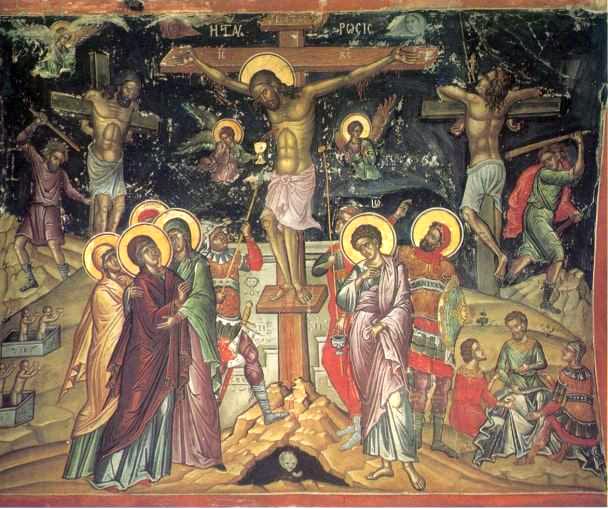
Theophanes the Cretan, The Crucifixion, Mid 16th Century; {{PD-US-expired}}

The New Testament is a very Jewish book. There is no way around it. One cannot understand what is going on anywhere in the New Testament without a grasp of what goes on everywhere in the Hebrew Scriptures. In fact, the Scriptures that Christians often refer to as the Old Testament are foundational to the New Testament and find fulfillment and perfection in the New. Good Friday—the day the church generally associates with Jesus’ death—is no exception given that Jesus’ death and resurrection are vitally connected to Passover.[1]
The canonical gospels record the significance of Jesus choosing Passover (See Exodus 12) rather than the Day of Atonement (See Leviticus 16) or one of the other two pilgrimage feasts (the Feast of Weeks and Festival of Booths; Deuteronomy 16:16) for his grand, climactic entrance into Jerusalem. N.T. Wright has this to say about Holy Week and its relation to Passover as the occasion when Jesus confronts the nationalistic piety centered in the Temple establishment:
All four gospels make clear one vital point: that Jesus chose Passover to go to Jerusalem and confront the Temple establishment with his radical counter-claim, knowing where it would lead. He didn’t choose Tabernacles or [Hanukkah]; he didn’t choose the Day of Atonement. He chose Passover, because Jesus’ understanding of his own vocation was to accomplish, once and for all, the New Exodus for which Israel had longed. Passover-imagery isn’t just miscellaneous decoration around the edge of an atonement-theory whose real focus is elsewhere. It is the flesh-and-blood reality.[2]
Jesus presents himself as the embodiment of the temple where God meets with his people. In fact, he told the Jewish authorities at the time of the first of several Passovers recorded in John’s Gospel that he would destroy the temple of his body and raise it up in three days. Thus, he had the authority to cleanse the Temple in Jerusalem (John 2:13-22; see also Matthew 21 for Jesus’ confrontation with the Temple authorities as the final Passover draws near).
Again, as Wright indicates, the canonical gospels present Jesus choosing the Passover for his climactic action of salvation for his people. Even so, the New Testament also presents a connection to the Jewish Day of Atonement or Yom Kippur, which occurs in the autumn of the year. According to the Epistle to the Hebrews, Jesus has entered the Holy of Holies as the great and sinless High Priest who has offered his own pure blood once and for all as eternal cleansing from our sin (See Hebrews 9).
It is all-too easy for us to privatize Jesus’ message and not see him as bringing deliverance for his people from established nationalistic theo-political structures that enslaved them. Such enslavement involving nationalism brought about their demise as the Jewish people sought vengeance against Rome. Their rebellion led to Rome’s destruction of Jerusalem and the Temple in A.D. 70. Jesus desired to spare his people just as he seeks to spare us from all-consuming nationalistic and individualistic idols as well as vengeance that leads to self-destruction.[3] But all too often, we hide behind our idols, including holy buildings and cities, holy books and holidays of religious and national prominence and fail to account for Jesus’ presence in our midst as the replacement or fulfillment of these types, as the case may be, at the end of the age. As the Book of Revelation reminds us, God and the Lamb are the temple in the eschaton, not some building no matter how prominent or cherished: “And I saw no temple in the city, for its temple is the Lord God the Almighty and the Lamb” (Revelation 21:22; ESV).
For the sake of security and autonomy, we are tempted to stay put and not take to heart that the celebration of Good Friday and Easter overlap with Passover, the ultimate Pilgrimage feast. But as we come to terms with Jesus offering himself as the ultimate Passover Lamb[4] and leading his people in pilgrimage out of Egypt to the Promised Land, we realize we cannot stay put. We must press forward and not return to Egypt. As Hebrews 11 makes clear to us, like Abraham and other saints of old, we still have not found what we are looking for (Hebrews 11:39-40). The Promised Land, which will appear before us as the New Heavens and Earth dawn, beckons us. The Spirit and the Bride say come (Revelation 22:17).
So, don’t pass over the Passover as we celebrate Good Friday. It’s time to leave Egypt or Rome or whatever nation or city typifies Empire at a given time. And for those who have already left, don’t go back. Too much is at stake. Go forward to enter the promised rest. Remember that Jesus has conquered the grave and has authority and power and glory over all kingdoms of the world. He has won while Caesar has lost, a point that Revelation brings home. Revelation 5:12 declares: “Worthy is the Lamb who was slain, to receive power and wealth and wisdom and might and honor and glory and blessing!” (Revelation 5:12; ESV).[5] Good Friday’s here. But Easter Sunday’s coming.
_______________
[1]Religion scholar James Tabor argues that Jesus died on Thursday, not Good Friday, in the following article: “Jesus Died on a Thursday not a Friday,” Taborblog, March 20, 2016; https://jamestabor.com/jesus-died-on-a-thursday-not-a-friday/ (accessed on 3/23/2020). Regardless of the day that Jesus’ death occurred during Holy Week, the connection between Passover and Jesus’ passion and resurrection is an intimate one for the New Testament community. For another article discussing their historical connection, refer to Paula Fredriksen, “When Jesus Celebrated Passover,” Wall Street Journal, April 19, 2019; https://www.wsj.com/articles/when-jesus-celebrated-passover-11555685683 (accessed on 3/23/2020).
[2]N.T. Wright, “The Royal Revolution: Fresh Perspectives on the Cross,” Calvin College January Series, January 24, 2017; https://ntwrightpage.com/2017/01/30/the-royal-revolution-fresh-perspectives-on-the-cross/ (accessed on 3/23/2020).
[3]N.T. Wright argues that while the Jewish authorities believed Jesus’ approach and political and eschatological reinterpretation of the Scriptures and sacred symbols will lead to their destruction, it is Jesus’ reinterpretation that would lead to their preservation and victory as a people. See N.T. Wright, The Challenge of Jesus: Rediscovering Who Jesus Was and Is (Downers Grove, Ill.: InterVarsity Press, 1999), pages 54-73.
[4]John the Baptist refers to Jesus as the Passover Lamb as recorded in John 1:29 and Paul does as well in 1 Corinthians 5:7. Revelation 5:6, 12 refer to Jesus as a lamb that was slain.
[5]It has been argued that “You are worthy” and “our Lord and God” greeted Emperor Domitian when he appeared in triumphal procession. The Apocalypse commandeers such language and applies it to the Ancient of Days and to the Lion who is the Lamb slain and raised bodily to new life. In effect, John seeks to convey to his readers that Caesar loses; Christ wins. See the following treatments of this theme: Robert H. Mounce, The Book of Revelation, The New International Commentary on the New Testament, revised (Grand Rapids: William B. Eerdmans, 1998), pages 126-127. Hanns Lilje, The Last Book of the Bible, trans. Olive Wyon (Philadelphia: Muhlenberg Press, 1957), pages 108-109; Ethelbert Stauffer, Christ and the Caesars (London: SCM Press, 1955), pages 150-159; and Robert E. Coleman, Singing with the Angels (Grand Rapids: Fleming H. Revell, 1980), pages 40-41.
Previous Post

April 8, 2020
Maundy Thursday: Jesus’ Last Stand Is Everlasting
Next Post
April 11, 2020 Holy Saturday: Wholly in the Dark?
Browse Our Archives
Select a Category Uncategorized
Select a Month June 2025 April 2025 March 2025 January 2025 December 2024 November 2024 October 2024 September 2024 August 2024 July 2024 June 2024 May 2024 April 2024 March 2024 February 2024 January 2024 December 2023 November 2023 October 2023 September 2023 August 2023 July 2023 June 2023 May 2023 April 2023 March 2023 February 2023 January 2023 December 2022 November 2022 October 2022 September 2022 August 2022 July 2022 June 2022 May 2022 April 2022 March 2022 February 2022 January 2022 December 2021 November 2021 October 2021 September 2021 August 2021 July 2021 June 2021 May 2021 April 2021 March 2021 February 2021 January 2021 December 2020 November 2020 October 2020 September 2020 August 2020 July 2020 June 2020 May 2020 April 2020 March 2020 February 2020 January 2020 December 2019 November 2019 October 2019 September 2019 August 2019 July 2019 June 2019 May 2019 April 2019 March 2019 February 2019 January 2019 December 2018 November 2018 October 2018 September 2018 August 2018 July 2018 June 2018 May 2018 April 2018 March 2018 February 2018 January 2018 December 2017 November 2017 October 2017 September 2017 August 2017 July 2017 June 2017 May 2017 April 2017 March 2017 February 2017 January 2017 December 2016 November 2016 October 2016 September 2016 August 2016 July 2016 June 2016 May 2016 April 2016 March 2016 February 2016 January 2016 December 2015 November 2015 October 2015 September 2015 August 2015 July 2015 June 2015 May 2015 April 2015 March 2015 February 2015 January 2015 December 2014 November 2014 October 2014 September 2014 August 2014 July 2014 June 2014 May 2014 April 2014 March 2014 February 2014 January 2014 December 2013 November 2013 October 2013 September 2013 August 2013 July 2013 June 2013 May 2013 April 2013 March 2013 February 2013 January 2013 December 2012 November 2012 October 2012 September 2012 August 2012 July 2012 June 2012 May 2012 April 2012 March 2012 February 2012
Follow Us!
TAKE THE
Religious Wisdom Quiz
What is the effect of the Red Horse's arrival in revelations?
Select your answer to see how you score.
Plagues spread across the land The sun turns black Peace is taken from the earth People fall into a deep sleep
Books by This Author Books by Paul Louis Metzger
Related posts from Uncommon God, Common Good

Heavenly Father’s Day on Trinity Sunday

Easter Triduum: Obey Your Thirst—for God

Holy Week Is Humble Week: "Beware of Becoming...

Excavating the Person in a Throwaway Culture
TRENDING AT PATHEOS Evangelical

Making Stones Into Bread: Choosing the “Right” Work
I was on my online arts ministry Zoom meeting with the International...

Ukraine’s exhausted Christians face fifth winter of war
By Julian Lukins The full-scale war in Ukraine is taking “a serious...

Russell Brand's Conviction is not anti-Christian Persecution
How do we shed the reputation that the Church is OK with...

Have you ever caught yourself saying, “I’ll do it tomorrow,” or “Now...

Write Your Story: A Great Way to Find...
A few month’s back, my son was scrolling around Facebook and saw...

Throughout history, people have pursued pleasure, possessions, relationships, and success in an...
view all Evangelical blogs
Ad-Free & Subscriber Log-In Subscription Support
- About Us
- 2026 Calendar
- Videos
- Podcasts
- Library of World Religions
- Faith In Media Tracker
- Advertise With Us
- Write for Us
- Privacy Policy
- Terms of Service
- Do Not Sell My Data
- Contact Us
- Radiant Digital
- Manage Newsletter Subscriptions
- Unsubscribe From Notifications
- Sitemap
Copyright 2008-2026, Patheos. All rights reserved.
Subscription Support Ad-Free & Subscriber Log-In
Follow Patheos