
BuddhistCatholicContemplativeEvangelicalGeneral ChristianHinduJewishLatter-day SaintMuslimNew VisionsProgressive Christian
Beliefs
- Buddhist
- Catholic
- Contemplative
- Evangelical
- General Christian
- Hindu
- Jewish
- Latter-day Saint
- More Voices
- Muslim
- New Visions
- Pagan
- Progressive Christian
Topics
- Religion News
- Food and Religion
- Sports and Religion
- Religious Art
- Religious Music and Entertainment
- Religious Events
- History and Religion
- Style and Religion
- Politics and Religion
- Women in Religion
- Recreation Outdoors and Religion
- Business Finance and Religion
- Careers Workplace and Religion
- Education and Religion
- Family Parenting and Religion
- Health Fitness and Religion
- Home and Religion
- Relationships and Religion
- Technology and Religion
- Travel and Religion
Columnists
- Buddhist Columnists
- Business Finance and Religion Columnists
- Careers Workplace and Religion Columnists
- Catholic Columnists
- Contemplative Columnists
- Education and Religion Columnists
- Evangelists Columnists
- Family Parenting and Religion Columnists
- General Christian Columnists
- Health Fitness and Religion Columnists
- Hindu Columnists
- History and Religion Columnists
- Home and Religion Columnists
- Jewish Columnists
- More Voices Columnists
- Latter Day Columnists
- Muslim Columnists
- New Visions Columnists
- Nonreligious Columnists
- Pagan Columnists
- Politics and Religion Columnists
- Progressive Columnists
- Recreation Outdoors and Religion Columnists
- Relationships and Religion Columnists
- Religion News Columnists
- Religious Art Columnists
- Religious Events Columnists
- Religious Music and Entertainment Columnists
- Sports and Religion Columnists
- Style and Religion Columnists
- Technology and Religion Columnists
- Travel and Religion Columnists
- Women in Religion Columnists
Resource Library
- 2026 Calendar
- Library of World Religions
- The 100 Most Holy Places on Earth
- Patheos Answers
- Podcasts
- Videos
- Faith Leaders Database
- Anglican Episcopalian
- Bahai
- Baptist
- Buddhism
- Christianity
- Confucianism
- Eastern Orthodoxy
- Hinduism
- Holiness and Pentecostal
- ISKCON
- Islam
- Judaism
- Lutheran
- Methodist
- The Church of Jesus Christ of Latter-day Saints
- New Age
- Paganism
- Presbytarian and Reformed
- Protestantism
- Religion Behind the Scenes
- Roman Catholic
- Scientology
- Shia Islam
- Sikhism
- Sufism
- Sunni Islam
- Taoism
- Zen
- See all religions
Research Tools
 Ad-Free & Subscriber Log-In Subscription Support
Follow Patheos 

- Trending:
- Advent
- |
- Forgiveness
- |
- Thanksgiving
- |
- Election
- |
- Seasonal Holidays
- |
- Marriage

- Home
- Evangelical
- Esther’s Fast, Purim, Lent & International Women’s Day
Esther’s Fast, Purim, Lent & International Women’s Day
Last updated on: March 7, 2020 at 5:23 pm by Paul Louis Metzger
Esther’s Fast, Purim, Lent & International Women’s Day 2020-03-07T17:23:21-08:00 Paul Louis Metzger
Patheos Explore the world's faith through different perspectives on religion and spirituality! Patheos has the views of the prevalent religions and spiritualities of the world.
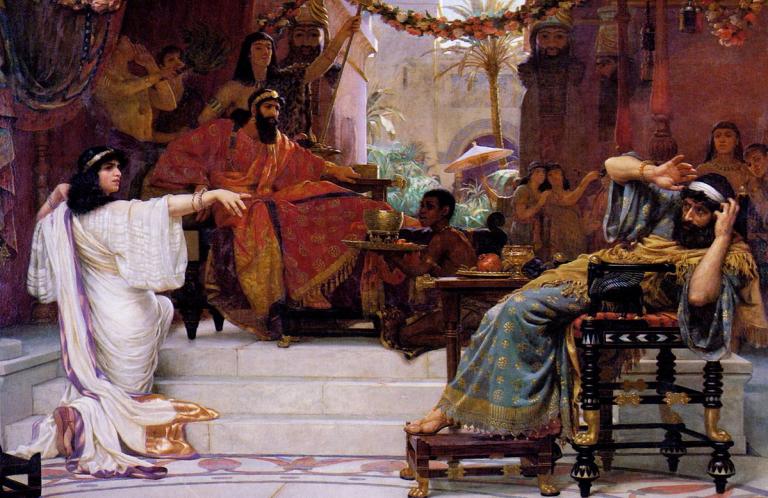
Esther Denouncing Haman, 1888, Ernest Normand; Wikimedia Commons

The Book of Esther does not mention God anywhere, but it is obvious that divine providence permeates the book. God preserves the Jewish people while under hostile Gentile rule in a foreign land. The Fast of Esther and Purim, which the Book of Esther documents, highlight God’s people’s suffering and deliverance from their enemies in the Persian Empire.
Whether it is providential or coincidental, the Fast of Esther and Purim overlap with the Christian season of Lent and International Women’s Day in 2020. Like Esther’s Fast and Purim, Lent also entails fasting in keeping with Jesus’ suffering for the deliverance of God’s people. International Women’s Day with its emphasis on gender equality, women’s achievements and confrontation of inequality immediately precedes the Fast of Esther and Purim in 2020, as it falls on March 8th. Esther’s Fast occurs on March 9th and Purim begins on the night of March 9th and runs through the 10th this year. Purim occurs every 14th day of the Hebrew month of Adar, which is at the end of winter or early spring.
Much has been made of Esther’s import for women’s rights. The book focuses primarily on the providential protection of the Jewish people under oppressive foreign rule, as noted above. Even so, it bears import for Jewish and Christian feminist concerns and advocacy for women and recognition of their accomplishments while enduring and confronting patriarchy over the centuries up to the present day. This entry will highlight certain features of Esther as a Jewish and Christian canonical book, including Esther’s Fast and Purim, that features God’s people’s liberation and bear upon women’s dignity and equality.
Any fair engagement of a particular text must account for its argument and context rather than run roughshod over them with an alternative agenda and in an anachronistic manner. Esther is not first and foremost about contending against patriarchy. Nor does it present our heroine as an ancient identical twin of a self-avowed modern western feminist. The same would be true for the canonical gospels’ purpose(s) about Jesus’ aim and how the women express their agency in an ancient middle near-eastern patriarchal world. Scripture is not made of one seamless cloth regarding women either. One finds in Jewish Scripture and tradition an evolution of thought enhancing greater respect and affirmation of women’s status as equals.[1] We find this dynamic at work in Esther.
The Book of Esther offers various portrayals of women. Take for example Vashti’s strong resistance to the king’s command to entertain his guests. Her refusal leads to her dethronement. Compare her with the young maiden Esther as she makes her appearance in chapter 1. Whereas Vashti is defiant (Esther 1:10-12), Esther is compliant (Esther 2:1-18), as she is prepared to visit the king’s chamber in view of his selection of a queen to replace the deposed Vashti. Still, Esther evolves as a person. At first, she takes orders from the royal court (Esther 2:8-18) and her relative and patron Mordecai (Esther 2:10, 20; 4:8). But later she engages Mordecai dialogically as an equal (Esther 4:10-14), and then goes so far as to give him orders as the heroine of her people (Esther 4:15-17). Esther also goes before the king without an invitation, which could get her killed (Esther 4:8-17). She risks all in order to denounce the evil royal official Haman and advocate for her people’s liberation (Esther 7-8).
No matter how one views the subject, women’s status was precarious in the Persian empire, as illustrated in the treatment of Vashti and Esther. The consequence of Queen Vashti’s refusal to be put on display as the equivalent of a concubine and sex object for the king’s drunken guests to gawk at lustfully was severe. She was deposed and made an object of derision. The empire’s patriarchal leaders feared that if she were not made an object lesson, other women would follow her example and refuse to submit to male rule (Esther 1:13-22). No doubt, Esther was viewed as a model replacement—beautiful and submissive (Esther 2:5-18). Like other women, including the queen herself, Esther’s likely fear and deep reservation about being an object of sexual pleasure for the king would not matter in the slightest to the reigning forces. Such was the tragic and heinous state of affairs in which they found themselves.
Some critiques of Esther portray her as “passive and devious,” according to Michael V. Fox. Fox finds such judgments “misguided.” In contrast, Fox points out how Esther underwent a metamorphosis: “Esther has a great challenge thrust upon her. In facing it, she gains three powers that could not have been foreseen from her early behavior: agency, strategy, and authority.”
As the narrative unfolds, Esther models courage in going before the mercurial king (Esther 4:11; 5:1-4), cunning in how she entraps Haman in his hubris and hatred of the Jews (Esther 5:9-14), and compassion in how she advocates for her people (Esther 4:15-17). Esther becomes a model for Jewish leadership while in bondage in exile. Regarding this matter, Fox writes,
In Esther, the author has created a model for Jews in the diaspora, who in the absence of a national state and army, must rely on their own courage and ingenuity to deal with dangers…This picture should not, however, be understood as a reassessment of woman’s stature. Rather, it is an attempt to reconceive the status of Jews in a new context.[2]
Even if the Book of Esther does not argue for a reassessment of women’s place in the ancient world, it certainly goes a long way toward opening the door to new possibilities. We should honor Esther’s accomplishments as a courageous, cunning and compassionate leader on behalf of God’s suffering people. Esther leads us forward in demonstrating human agency in contending against the objectification and oppression of people wherever it is found.
Like Jesus after her, Esther puts people’s interests above her own. As a result, she faces the very real threat of losing not only her position as queen but also her life. We find this theme of self-sacrifice in play in the Fast of Esther. The text in Esther 4 reads:
Then Esther told them to reply to Mordecai, “Go, gather all the Jews to be found in Susa, and hold a fast on my behalf, and do not eat or drink for three days, night or day. I and my young women will also fast as you do. Then I will go to the king, though it is against the law, and if I perish, I perish.” Mordecai then went away and did everything as Esther had ordered him (Esther 4:15-17; ESV).
Like Moses before her, God raises up Esther as a savior for her people Israel. Together they foreshadow Jesus who delivers his people from their bondage to sin and liberation from oppression. During Lent, Christians would do well to remember the Fast of Esther and Purim, which their Jewish brothers and sisters honor, as instituted in Esther 9:20-22:
And Mordecai recorded these things and sent letters to all the Jews who were in all the provinces of King Ahasuerus, both near and far, obliging them to keep the fourteenth day of the month Adar and also the fifteenth day of the same, year by year, as the days on which the Jews got relief from their enemies, and as the month that had been turned for them from sorrow into gladness and from mourning into a holiday; that they should make them days of feasting and gladness, days for sending gifts of food to one another and gifts to the poor (Esther 9:20-22; ESV).
May we take to heart God’s providential care for Israel and the Church. May we also honor great leaders like Esther and follow their example. You don’t need to be Jewish to honor Esther’s Fast and Purim. But you do need to believe God providentially cares for Abraham’s people. You don’t need to be a man to be a great leader of all the people or a woman to honor International Women’s Day. But you do need to stand with women in cherishing their accomplishments and confronting inequity and abuse committed against them wherever it exists.
_______________
[1]On this subject, see Judith Hauptman, Rereading the Rabbis: A Woman’s Voice, Radical Traditions (Boulder, CO.: Westview Press, 1998).
[2]In addition to Fox’s online article from which the quotes are taken, see his earlier work on which the article builds: Michael V. Fox, Character and Ideology in the Book of Esther (Columbia: University of South Carolina Press, 1991; 2nd ed.: Grand Rapids: Eerdmans, 2000; reprint: Eugene: Wipf & Stock, 2010). In his online treatment, Fox affirms the feminist perspective of Sidnie D. White-Crawford, as set forth in “Esther: a Feminine Model for Jewish Diaspora,” in Gender and Difference in Ancient Israel, ed. Peggy Day (Minneapolis, MN: Fortress), pages 161-177. I also reference her encyclopedia article on Esther here.
Previous Post

March 4, 2020
Boost Your Spiritual Immune System During Lent
Next Post
March 11, 2020 Redefine Success During Lent
Browse Our Archives
Select a Category Uncategorized
Select a Month June 2025 April 2025 March 2025 January 2025 December 2024 November 2024 October 2024 September 2024 August 2024 July 2024 June 2024 May 2024 April 2024 March 2024 February 2024 January 2024 December 2023 November 2023 October 2023 September 2023 August 2023 July 2023 June 2023 May 2023 April 2023 March 2023 February 2023 January 2023 December 2022 November 2022 October 2022 September 2022 August 2022 July 2022 June 2022 May 2022 April 2022 March 2022 February 2022 January 2022 December 2021 November 2021 October 2021 September 2021 August 2021 July 2021 June 2021 May 2021 April 2021 March 2021 February 2021 January 2021 December 2020 November 2020 October 2020 September 2020 August 2020 July 2020 June 2020 May 2020 April 2020 March 2020 February 2020 January 2020 December 2019 November 2019 October 2019 September 2019 August 2019 July 2019 June 2019 May 2019 April 2019 March 2019 February 2019 January 2019 December 2018 November 2018 October 2018 September 2018 August 2018 July 2018 June 2018 May 2018 April 2018 March 2018 February 2018 January 2018 December 2017 November 2017 October 2017 September 2017 August 2017 July 2017 June 2017 May 2017 April 2017 March 2017 February 2017 January 2017 December 2016 November 2016 October 2016 September 2016 August 2016 July 2016 June 2016 May 2016 April 2016 March 2016 February 2016 January 2016 December 2015 November 2015 October 2015 September 2015 August 2015 July 2015 June 2015 May 2015 April 2015 March 2015 February 2015 January 2015 December 2014 November 2014 October 2014 September 2014 August 2014 July 2014 June 2014 May 2014 April 2014 March 2014 February 2014 January 2014 December 2013 November 2013 October 2013 September 2013 August 2013 July 2013 June 2013 May 2013 April 2013 March 2013 February 2013 January 2013 December 2012 November 2012 October 2012 September 2012 August 2012 July 2012 June 2012 May 2012 April 2012 March 2012 February 2012
Follow Us!
TAKE THE
Religious Wisdom Quiz
What did God confuse to stop the Tower of Babel from being finished?
Select your answer to see how you score.
The weather Their tools The bricks The people’s language
Books by This Author Books by Paul Louis Metzger
Related posts from Uncommon God, Common Good

Heavenly Father’s Day on Trinity Sunday

Easter Triduum: Obey Your Thirst—for God

Holy Week Is Humble Week: "Beware of Becoming...

Excavating the Person in a Throwaway Culture
TRENDING AT PATHEOS Evangelical

Making Stones Into Bread: Choosing the “Right” Work
I was on my online arts ministry Zoom meeting with the International...

Ukraine’s exhausted Christians face fifth winter of war
By Julian Lukins The full-scale war in Ukraine is taking “a serious...

Russell Brand's Conviction is not anti-Christian Persecution
How do we shed the reputation that the Church is OK with...

Have you ever caught yourself saying, “I’ll do it tomorrow,” or “Now...

Write Your Story: A Great Way to Find...
A few month’s back, my son was scrolling around Facebook and saw...

Throughout history, people have pursued pleasure, possessions, relationships, and success in an...
view all Evangelical blogs
Ad-Free & Subscriber Log-In Subscription Support
- About Us
- 2026 Calendar
- Videos
- Podcasts
- Library of World Religions
- Faith In Media Tracker
- Advertise With Us
- Write for Us
- Privacy Policy
- Terms of Service
- Do Not Sell My Data
- Contact Us
- Radiant Digital
- Manage Newsletter Subscriptions
- Unsubscribe From Notifications
- Sitemap
Copyright 2008-2026, Patheos. All rights reserved.
Subscription Support Ad-Free & Subscriber Log-In
Follow Patheos