
BuddhistCatholicContemplativeEvangelicalGeneral ChristianHinduJewishLatter-day SaintMuslimNew VisionsProgressive Christian
Beliefs
- Buddhist
- Catholic
- Contemplative
- Evangelical
- General Christian
- Hindu
- Jewish
- Latter-day Saint
- More Voices
- Muslim
- New Visions
- Pagan
- Progressive Christian
Topics
- Religion News
- Food and Religion
- Sports and Religion
- Religious Art
- Religious Music and Entertainment
- Religious Events
- History and Religion
- Style and Religion
- Politics and Religion
- Women in Religion
- Recreation Outdoors and Religion
- Business Finance and Religion
- Careers Workplace and Religion
- Education and Religion
- Family Parenting and Religion
- Health Fitness and Religion
- Home and Religion
- Relationships and Religion
- Technology and Religion
- Travel and Religion
Columnists
- Buddhist Columnists
- Business Finance and Religion Columnists
- Careers Workplace and Religion Columnists
- Catholic Columnists
- Contemplative Columnists
- Education and Religion Columnists
- Evangelists Columnists
- Family Parenting and Religion Columnists
- General Christian Columnists
- Health Fitness and Religion Columnists
- Hindu Columnists
- History and Religion Columnists
- Home and Religion Columnists
- Jewish Columnists
- More Voices Columnists
- Latter Day Columnists
- Muslim Columnists
- New Visions Columnists
- Nonreligious Columnists
- Pagan Columnists
- Politics and Religion Columnists
- Progressive Columnists
- Recreation Outdoors and Religion Columnists
- Relationships and Religion Columnists
- Religion News Columnists
- Religious Art Columnists
- Religious Events Columnists
- Religious Music and Entertainment Columnists
- Sports and Religion Columnists
- Style and Religion Columnists
- Technology and Religion Columnists
- Travel and Religion Columnists
- Women in Religion Columnists
Resource Library
- 2026 Calendar
- Library of World Religions
- The 100 Most Holy Places on Earth
- Patheos Answers
- Podcasts
- Videos
- Faith Leaders Database
- Anglican Episcopalian
- Bahai
- Baptist
- Buddhism
- Christianity
- Confucianism
- Eastern Orthodoxy
- Hinduism
- Holiness and Pentecostal
- ISKCON
- Islam
- Judaism
- Lutheran
- Methodist
- The Church of Jesus Christ of Latter-day Saints
- New Age
- Paganism
- Presbytarian and Reformed
- Protestantism
- Religion Behind the Scenes
- Roman Catholic
- Scientology
- Shia Islam
- Sikhism
- Sufism
- Sunni Islam
- Taoism
- Zen
- See all religions
Research Tools
 Ad-Free & Subscriber Log-In Subscription Support
Follow Patheos 

- Trending:
- Advent
- |
- Forgiveness
- |
- Thanksgiving
- |
- Election
- |
- Seasonal Holidays
- |
- Marriage

- Home
- Evangelical
- Religious Events
- Lent and Black History: Liturgies of Lament and Celebration
Lent and Black History: Liturgies of Lament and Celebration
Last updated on: February 2, 2024 at 8:59 am by Paul Louis Metzger
Lent and Black History: Liturgies of Lament and Celebration 2024-02-02T08:59:03-08:00 Paul Louis Metzger
Patheos Explore the world's faith through different perspectives on religion and spirituality! Patheos has the views of the prevalent religions and spiritualities of the world.
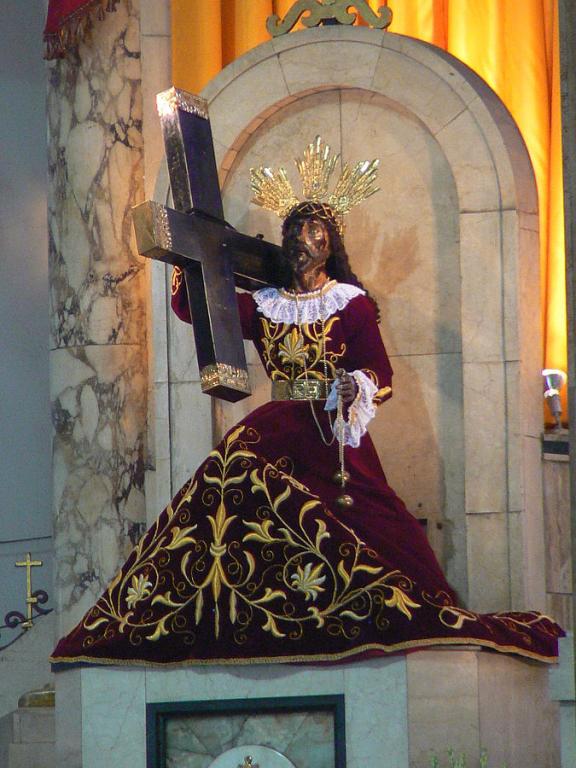
Black Nazarene at Quiapo Church, Manila., Constantine Agustin, July 20, 2007; Creative Commons

In the last entry which featured Ash Wednesday, it was argued that a liturgy that makes no space for lament caters to the “haves.” A liturgy of suffering features the “have-nots.”[1] A truly Christian liturgy rightly conceived accounts for both lament and celebration, and in view of Jesus’ cruciform glory, must move through lament to celebration. Thus, we must keep Lent if we wish to honor Easter.
Black History Month, which runs throughout February, often overlaps with Lent, which begins in February or March. Black History Month accounts for lament and celebration. It laments the oppression committed against African Americans and celebrates their achievements in the face of overwhelming obstacles. Like the Lenten and Easter seasons, Black History Month moves through lament to celebration.
James Cone, the Father of Black Theology, rightly highlighted the need for Christian theologians to prioritize themes of oppression and liberation. He went so far as to call Jesus black, as Jesus identifies with the oppressed or have-nots against oppression.[2] Indeed, Jesus liberates the poor, the downtrodden, the marginalized in an all-encompassing manner of soul and body. As we find in Matthew 5, Jesus blesses the poor in spirit, just as he blesses the poor in Luke 6, while cursing the rich oppressors (similar themes appear in James 1 and 2). We must account for both passages in distinct though inseparable relation. Gordon Fee and Douglas Stuart put the matter well:
In Matthew the poor are “the poor in spirit”; in Luke they are simply “you poor” in contrast to “you that are rich” (6:24). On such points most people tend to have only half a canon. Traditional evangelicals tend to read only “the poor in spirit”; social activists tend to read only “you poor.” We insist that both are canonical. In a truly profound sense the real poor are those who recognize themselves as impoverished before God. But the God of the Bible, who became incarnate in Jesus of Nazareth, is a God who pleads the cause of the oppressed and the disenfranchised. One can scarcely read Luke’s gospel without recognizing his interest in this aspect of the divine revelation (see 14:12-14; cf. 12:33-34 with the Matthean parallel, 6:19-21).[3]
Many white Evangelical Christians may argue that all this about the Black Jesus, oppression and liberation is nothing more than identity politics and a form of social gospel. They easily forget that every theology has an identity that is culturally and politically embedded. What passes for authentic theology and liturgy is often no more than a contextualized Eurocentric ethnic form of theology that caters to dominant culture ways of life that have become homogenized due to familiarity. They also appear to replace a social gospel with an otherworldly gospel. In contrast, the whole gospel features salvation of the whole person in the whole community where the kingdom of heaven flourishes on earth. In place of a materialistic social gospel or a pie-in-the-sky asocial gospel, the gospel is relational and social and addresses our total human condition.
What is needed, then, is a liturgy that accounts for blackness, namely themes of oppression and liberation, and not simply personal salvation. Just like the church historically accounted for red martyrdom (persecution where Christians shed their blood for their faith) and white martyrdom (asceticism/monasticism where Christians deny themselves for their faith),[4] we need to account for black martyrdom. Black martyrdom involves living in solidarity with the oppressed in view of Jesus who comes to set the captive free.
The US calendar formally features black history only one month of each year. The rest of the year generally features white history. Lent only occurs over forty days during the church calendar cycle. But we must not allow it to recede into distant memory as we proceed toward Easter and Ascension. After all, “the black Jesus” became poor so that we could become the riches of God (2 Corinthians 8:9). When he ascended, he led captives in his train and gave gifts to humankind (Ephesians 4:8). Here I am not promoting a form of prosperity gospel teaching, simply that God cares for the whole person and brings about liberation from oppression for the captive and seeks to make us spiritually, physically and socially whole through the realization of God’s eschatological kingdom in which we participate presently and which will be realized in full one day.[5] The vital connection between Lent, Easter and Ascension signifies that Jesus’ glory ever remains cruciform.
As noted in the last entry, forty percent of the psalms feature lament,[6] and all four gospels give significant attention to the way of the cross and Jesus’ passion. Given these factors, maybe we should feature lament in our liturgy forty percent of the year. In that case, forty plus days of Lent are not enough. Nor are thirty days for black history. We must account for lament as well as celebration, along with black martyrdom, throughout the year, if we are to cherish the have-nots with whom Jesus identifies as the Suffering Servant and man of sorrows, familiar with suffering (Isaiah 53:3).[7]
_______________
[1]Walter Brueggemann, Peace (St. Louis: Chalice Press, 2001), pages 26-28.
[2]See James H. Cone, A Black Theology of Liberation, Twentieth Anniversary Edition (Maryknoll, NY: Orbis Books, 1990), pages 119-124.
[3]Gordon Fee and Douglas Stuart, How to Read the Bible for All Its Worth, 2nd ed. (Grand Rapids: Zondervan, 1993), page 125.
[4]There are at least four forms of martyrdom discussed in various sources: red, white, blue, and green. Thomas Cahill discusses “green martyrdom” and associates it with the distinctive witness of Irish monasticism. See How the Irish Saved Civilization: The Untold Story of Ireland’s Heroic Role from the Fall of Rome to the Rise of Medieval Europe, The Hinges of History (New York: Anchor Books, 1996). Red stands for the shedding of blood and death. White stands for asceticism. Blue stands for penitence. Here’s a brief summary of these three forms: “White martyrdom was the daily living of the ascetic life for Christ’s sake; red, of course, meant the shedding of blood and death itself for Christ’s sake. Blue martyrdom, which seems to have been a particularly Irish development, stood for the way of the penitent in penance, in bewailing of sins and in labour.” Cheslyn Jones, Geoffrey Wainwright, and Edward Yarnold, S.J., eds., The Study of Spirituality (New York: Oxford University Press, 1986), page 221.
[5]Note that while many white Evangelicals look down on the prosperity gospel movement, we have a tendency to promote it in more subtle terms with our implicit or explicit adherence to a riff off of Max Weber’s thesis of the Protestant work ethic. Prosperity reflects assurance of God’s favor and blessing as a result of our hard work.
[6]Glenn Pemberton, Hurting with God: Learning to Lament with the Psalms (Abilene: Abilene Christian University Press, 2012), Kindle loc. 441-445.
[7]Here it is worth accounting for Cone’s connection between the Suffering Servant and the Black Jesus: “If Jesus is the Suffering Servant of God, he is an oppressed being who has taken on that very form of human existence that is responsible for human misery. What we need to ask is this: ‘What is the form of humanity that accounts for human suffering in our society? What is it, except blackness?’ If Christ is truly the Suffering Servant of God who takes upon himself the suffering of his people, thereby establishing the covenant of God, then he must be black.” Cone, A Black Theology of Liberation, page 122.
I engage the themes of Black History Month, Lent, lament, and celebration in my recent book, Setting the Spiritual Clock: Sacred Time Breaking Through the Secular Eclipse (Cascade, 2020). Here is the trailer for the book.
Religious Events
History and Religion
About Paul Louis Metzger
Paul Louis Metzger, Ph.D., is Professor of Theology & Culture, Multnomah University & Seminary; Director of The Institute for Cultural Engagement: New Wine, New Wineskins; and author of numerous works, including Setting the Spiritual Clock: Sacred Time Breaking Through the Secular Eclipse and Consuming Jesus: Beyond Race and Class Divisions in a Consumer Church. You can read more about the author here.
Previous Post

February 25, 2020
Ash Wednesday: Lament Indifferent Faith
Next Post
February 29, 2020 Build Booths of Transfigured Glory in Lenten Lives
Browse Our Archives
Select a Category Uncategorized
Select a Month June 2025 April 2025 March 2025 January 2025 December 2024 November 2024 October 2024 September 2024 August 2024 July 2024 June 2024 May 2024 April 2024 March 2024 February 2024 January 2024 December 2023 November 2023 October 2023 September 2023 August 2023 July 2023 June 2023 May 2023 April 2023 March 2023 February 2023 January 2023 December 2022 November 2022 October 2022 September 2022 August 2022 July 2022 June 2022 May 2022 April 2022 March 2022 February 2022 January 2022 December 2021 November 2021 October 2021 September 2021 August 2021 July 2021 June 2021 May 2021 April 2021 March 2021 February 2021 January 2021 December 2020 November 2020 October 2020 September 2020 August 2020 July 2020 June 2020 May 2020 April 2020 March 2020 February 2020 January 2020 December 2019 November 2019 October 2019 September 2019 August 2019 July 2019 June 2019 May 2019 April 2019 March 2019 February 2019 January 2019 December 2018 November 2018 October 2018 September 2018 August 2018 July 2018 June 2018 May 2018 April 2018 March 2018 February 2018 January 2018 December 2017 November 2017 October 2017 September 2017 August 2017 July 2017 June 2017 May 2017 April 2017 March 2017 February 2017 January 2017 December 2016 November 2016 October 2016 September 2016 August 2016 July 2016 June 2016 May 2016 April 2016 March 2016 February 2016 January 2016 December 2015 November 2015 October 2015 September 2015 August 2015 July 2015 June 2015 May 2015 April 2015 March 2015 February 2015 January 2015 December 2014 November 2014 October 2014 September 2014 August 2014 July 2014 June 2014 May 2014 April 2014 March 2014 February 2014 January 2014 December 2013 November 2013 October 2013 September 2013 August 2013 July 2013 June 2013 May 2013 April 2013 March 2013 February 2013 January 2013 December 2012 November 2012 October 2012 September 2012 August 2012 July 2012 June 2012 May 2012 April 2012 March 2012 February 2012
Follow Us!
TAKE THE
Religious Wisdom Quiz
In 1 Timothy, what does Paul say is a trustworthy saying?
Select your answer to see how you score.
Christ Jesus came into the world to save sinners God is love The righteous will live by faith Faith without works is dead
Books by This Author Books by Paul Louis Metzger
Related posts from Uncommon God, Common Good

Black History Month: Repeat Black Excellence
Black History Month: “If We Don’t Tell Our...

Lincoln’s Birthday, Black History and Church Growth

Heavenly Father’s Day on Trinity Sunday
TRENDING AT PATHEOS Evangelical

Making Stones Into Bread: Choosing the “Right” Work
I was on my online arts ministry Zoom meeting with the International...

Ukraine’s exhausted Christians face fifth winter of war
By Julian Lukins The full-scale war in Ukraine is taking “a serious...

Russell Brand's Conviction is not anti-Christian Persecution
How do we shed the reputation that the Church is OK with...

Have you ever caught yourself saying, “I’ll do it tomorrow,” or “Now...

Write Your Story: A Great Way to Find...
A few month’s back, my son was scrolling around Facebook and saw...

Throughout history, people have pursued pleasure, possessions, relationships, and success in an...
view all Evangelical blogs
Ad-Free & Subscriber Log-In Subscription Support
- About Us
- 2026 Calendar
- Videos
- Podcasts
- Library of World Religions
- Faith In Media Tracker
- Advertise With Us
- Write for Us
- Privacy Policy
- Terms of Service
- Do Not Sell My Data
- Contact Us
- Radiant Digital
- Manage Newsletter Subscriptions
- Unsubscribe From Notifications
- Sitemap
Copyright 2008-2026, Patheos. All rights reserved.
Subscription Support Ad-Free & Subscriber Log-In
Follow Patheos