
BuddhistCatholicContemplativeEvangelicalGeneral ChristianHinduJewishLatter-day SaintMuslimNew VisionsProgressive Christian
Beliefs
- Buddhist
- Catholic
- Contemplative
- Evangelical
- General Christian
- Hindu
- Jewish
- Latter-day Saint
- More Voices
- Muslim
- New Visions
- Pagan
- Progressive Christian
Topics
- Religion News
- Food and Religion
- Sports and Religion
- Religious Art
- Religious Music and Entertainment
- Religious Events
- History and Religion
- Style and Religion
- Politics and Religion
- Women in Religion
- Recreation Outdoors and Religion
- Business Finance and Religion
- Careers Workplace and Religion
- Education and Religion
- Family Parenting and Religion
- Health Fitness and Religion
- Home and Religion
- Relationships and Religion
- Technology and Religion
- Travel and Religion
Columnists
- Buddhist Columnists
- Business Finance and Religion Columnists
- Careers Workplace and Religion Columnists
- Catholic Columnists
- Contemplative Columnists
- Education and Religion Columnists
- Evangelists Columnists
- Family Parenting and Religion Columnists
- General Christian Columnists
- Health Fitness and Religion Columnists
- Hindu Columnists
- History and Religion Columnists
- Home and Religion Columnists
- Jewish Columnists
- More Voices Columnists
- Latter Day Columnists
- Muslim Columnists
- New Visions Columnists
- Nonreligious Columnists
- Pagan Columnists
- Politics and Religion Columnists
- Progressive Columnists
- Recreation Outdoors and Religion Columnists
- Relationships and Religion Columnists
- Religion News Columnists
- Religious Art Columnists
- Religious Events Columnists
- Religious Music and Entertainment Columnists
- Sports and Religion Columnists
- Style and Religion Columnists
- Technology and Religion Columnists
- Travel and Religion Columnists
- Women in Religion Columnists
Resource Library
- 2026 Calendar
- Library of World Religions
- The 100 Most Holy Places on Earth
- Patheos Answers
- Podcasts
- Videos
- Faith Leaders Database
- Anglican Episcopalian
- Bahai
- Baptist
- Buddhism
- Christianity
- Confucianism
- Eastern Orthodoxy
- Hinduism
- Holiness and Pentecostal
- ISKCON
- Islam
- Judaism
- Lutheran
- Methodist
- The Church of Jesus Christ of Latter-day Saints
- New Age
- Paganism
- Presbytarian and Reformed
- Protestantism
- Religion Behind the Scenes
- Roman Catholic
- Scientology
- Shia Islam
- Sikhism
- Sufism
- Sunni Islam
- Taoism
- Zen
- See all religions
Research Tools
 Ad-Free & Subscriber Log-In Subscription Support
Follow Patheos 

- Trending:
- Advent
- |
- Forgiveness
- |
- Thanksgiving
- |
- Election
- |
- Seasonal Holidays
- |
- Marriage

- Home
- Evangelical
- All Sinners’ Day
All Sinners’ Day
Last updated on: November 1, 2019 at 6:55 am by Paul Louis Metzger
All Sinners’ Day 2019-11-01T06:55:21-07:00 Paul Louis Metzger
Patheos Explore the world's faith through different perspectives on religion and spirituality! Patheos has the views of the prevalent religions and spiritualities of the world.
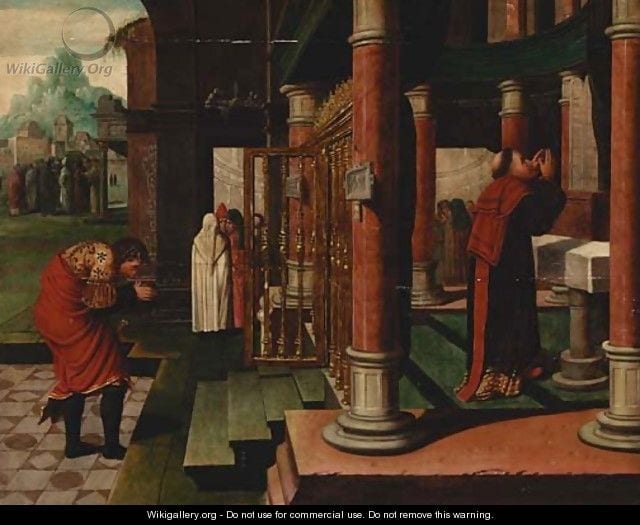
“The Parable of the Pharisee and the Publican,” Bernaert Van Orley, Wikigallery
This coming week, on November 1st, many Christians will celebrate All Saints’ Day. Today, I will mark the thirtieth Sunday of Ordinary Time by honoring repentant sinners. I’m calling it “All Sinners’ Day.” As a son of the Reformation (which will also be celebrated this week on October 31st), I share Martin Luther’s view that the believer is simultaneously righteous and sinful. We are always completely dependent on Jesus, who is our righteousness. Apart from him, we stand before God as guilty—in a desperate state of unrighteous despair. We are blessed when we live as repentant sinners, abiding in God’s mercy.
One place where we find this emphasis in Luther is in an early Reformation treatise titled The Freedom of a Christian, which Luther dedicated to the Pope. Here Luther speaks of our being righteous in relation to Christ, not in ourselves. Luther uses marital imagery to convey this notion of relational union:
Who then can fully appreciate what this royal marriage means? Who can understand the riches of the glory of this grace? Here this rich and divine bridegroom Christ marries this poor, wicked harlot, redeems her from all her evil, and adorns her with all his goodness. Her sins cannot now destroy her, since they are laid upon Christ and swallowed up by him. And she has that righteousness in Christ, her husband, of which she may boast as of her own and which she can confidently display alongside her sins in the face of death and hell and say, “‘If I have sinned, yet my Christ, in whom I believe, has not sinned, and all his is mine and all mine is his,’ as the bride in the Song of Solomon (2:16) says, ‘My beloved is mine and I am his.’”[1]
Protestants following Luther are not alone in drawing attention to our desperate need for God’s mercy. A Catholic online publication marks this thirtieth Sunday in Ordinary Time by drawing attention to the parable of the self-righteous Pharisee and repentant tax collector praying in the Temple (Refer here). Let’s reflect on this same passage taken from Luke’s Gospel:
He also told this parable to some who trusted in themselves that they were righteous, and treated others with contempt: “Two men went up into the temple to pray, one a Pharisee and the other a tax collector. The Pharisee, standing by himself, prayed[a] thus: ‘God, I thank you that I am not like other men, extortioners, unjust, adulterers, or even like this tax collector. I fast twice a week; I give tithes of all that I get.’ But the tax collector, standing far off, would not even lift up his eyes to heaven, but beat his breast, saying, ‘God, be merciful to me, a sinner!’ I tell you, this man went down to his house justified, rather than the other. For everyone who exalts himself will be humbled, but the one who humbles himself will be exalted” (Luke 18:9-14; ESV).
As Luke’s Gospel reveals, Jesus directs his parable to those who trusted in themselves and their supposed self-righteous standing before God while looking down their noses at those around them. Jesus warns them and us today that those who exalt themselves will be humbled, while those who humble themselves will be exalted.
We find in this parable that the Pharisee’s prayer is self-referential, paralleling his self-righteous attitude. In other words, he thanks God that he is worthy of God’s favor given all his good deeds and his favorable standing in comparison with godless people, like this tax collector. In refreshing contrast, the tax collector does not praise himself or compare himself to others. He keeps his head down while beating his breast and crying out to God for mercy. Jesus declares that the tax collector goes home that day justified, but not the Pharisee. It reminds me of the psalmist’s words, which supposedly this Pharisee fails to recall:
For you will not delight in sacrifice, or I would give it; you will not be pleased with a burnt offering.
The sacrifices of God are a broken spirit; a broken and contrite heart, O God, you will not despise (Psalm 51:16-17; ESV).
We will return to this theme on Reformation Day. For now, we would do well to remember always that God exalts those who humble themselves and humbles those who exalt themselves. May our trust ever be in God, not ourselves, and may we never play the comparative righteousness game with others.
In closing, as we go to church this thirtieth Sunday in Ordinary Time, may we ever seek to keep in mind that the church is both a sanctuary of saints and a hospital of sinners. In fact, these two groups are really one. That is, the church is made up of saints who are sinners and sinners who are saints. May we wear both name tags today simultaneously (“Righteous” and “Sinful”) and introduce ourselves to others in good Lutheran fashion: “Hello, I’m ____, a repentant sinner and holy child of God saved by grace. So glad you’re here!” Moreover, may we encourage one another to live godly lives of gratitude daily in view of God’s amazing mercy and grace.
_______________
[1]Martin Luther, The Freedom of a Christian, in Martin Luther’s Basic Theological Writings (ed. Timothy F. Lull; Minneapolis: Fortress Press, 1989), page 604.
Previous Post

October 25, 2019
Harness Hope for the Race for Life
Next Post
November 3, 2019 All Saints Sunday
Browse Our Archives
Select a Category Uncategorized
Select a Month June 2025 April 2025 March 2025 January 2025 December 2024 November 2024 October 2024 September 2024 August 2024 July 2024 June 2024 May 2024 April 2024 March 2024 February 2024 January 2024 December 2023 November 2023 October 2023 September 2023 August 2023 July 2023 June 2023 May 2023 April 2023 March 2023 February 2023 January 2023 December 2022 November 2022 October 2022 September 2022 August 2022 July 2022 June 2022 May 2022 April 2022 March 2022 February 2022 January 2022 December 2021 November 2021 October 2021 September 2021 August 2021 July 2021 June 2021 May 2021 April 2021 March 2021 February 2021 January 2021 December 2020 November 2020 October 2020 September 2020 August 2020 July 2020 June 2020 May 2020 April 2020 March 2020 February 2020 January 2020 December 2019 November 2019 October 2019 September 2019 August 2019 July 2019 June 2019 May 2019 April 2019 March 2019 February 2019 January 2019 December 2018 November 2018 October 2018 September 2018 August 2018 July 2018 June 2018 May 2018 April 2018 March 2018 February 2018 January 2018 December 2017 November 2017 October 2017 September 2017 August 2017 July 2017 June 2017 May 2017 April 2017 March 2017 February 2017 January 2017 December 2016 November 2016 October 2016 September 2016 August 2016 July 2016 June 2016 May 2016 April 2016 March 2016 February 2016 January 2016 December 2015 November 2015 October 2015 September 2015 August 2015 July 2015 June 2015 May 2015 April 2015 March 2015 February 2015 January 2015 December 2014 November 2014 October 2014 September 2014 August 2014 July 2014 June 2014 May 2014 April 2014 March 2014 February 2014 January 2014 December 2013 November 2013 October 2013 September 2013 August 2013 July 2013 June 2013 May 2013 April 2013 March 2013 February 2013 January 2013 December 2012 November 2012 October 2012 September 2012 August 2012 July 2012 June 2012 May 2012 April 2012 March 2012 February 2012
Follow Us!
TAKE THE
Religious Wisdom Quiz
Who betrayed David to Absalom, offering counsel that was not followed?
Select your answer to see how you score.
Abiathar Zadok Joab Ahithophel
Books by This Author Books by Paul Louis Metzger
Related posts from Uncommon God, Common Good

Heavenly Father’s Day on Trinity Sunday

Easter Triduum: Obey Your Thirst—for God

Holy Week Is Humble Week: "Beware of Becoming...

Excavating the Person in a Throwaway Culture
TRENDING AT PATHEOS Evangelical

Making Stones Into Bread: Choosing the “Right” Work
I was on my online arts ministry Zoom meeting with the International...

Ukraine’s exhausted Christians face fifth winter of war
By Julian Lukins The full-scale war in Ukraine is taking “a serious...

Russell Brand's Conviction is not anti-Christian Persecution
How do we shed the reputation that the Church is OK with...

Have you ever caught yourself saying, “I’ll do it tomorrow,” or “Now...

Write Your Story: A Great Way to Find...
A few month’s back, my son was scrolling around Facebook and saw...

Throughout history, people have pursued pleasure, possessions, relationships, and success in an...
view all Evangelical blogs
Ad-Free & Subscriber Log-In Subscription Support
- About Us
- 2026 Calendar
- Videos
- Podcasts
- Library of World Religions
- Faith In Media Tracker
- Advertise With Us
- Write for Us
- Privacy Policy
- Terms of Service
- Do Not Sell My Data
- Contact Us
- Radiant Digital
- Manage Newsletter Subscriptions
- Unsubscribe From Notifications
- Sitemap
Copyright 2008-2026, Patheos. All rights reserved.
Subscription Support Ad-Free & Subscriber Log-In
Follow Patheos