
BuddhistCatholicContemplativeEvangelicalGeneral ChristianHinduJewishLatter-day SaintMuslimNew VisionsProgressive Christian
Beliefs
- Buddhist
- Catholic
- Contemplative
- Evangelical
- General Christian
- Hindu
- Jewish
- Latter-day Saint
- More Voices
- Muslim
- New Visions
- Pagan
- Progressive Christian
Topics
- Religion News
- Food and Religion
- Sports and Religion
- Religious Art
- Religious Music and Entertainment
- Religious Events
- History and Religion
- Style and Religion
- Politics and Religion
- Women in Religion
- Recreation Outdoors and Religion
- Business Finance and Religion
- Careers Workplace and Religion
- Education and Religion
- Family Parenting and Religion
- Health Fitness and Religion
- Home and Religion
- Relationships and Religion
- Technology and Religion
- Travel and Religion
Columnists
- Buddhist Columnists
- Business Finance and Religion Columnists
- Careers Workplace and Religion Columnists
- Catholic Columnists
- Contemplative Columnists
- Education and Religion Columnists
- Evangelists Columnists
- Family Parenting and Religion Columnists
- General Christian Columnists
- Health Fitness and Religion Columnists
- Hindu Columnists
- History and Religion Columnists
- Home and Religion Columnists
- Jewish Columnists
- More Voices Columnists
- Latter Day Columnists
- Muslim Columnists
- New Visions Columnists
- Nonreligious Columnists
- Pagan Columnists
- Politics and Religion Columnists
- Progressive Columnists
- Recreation Outdoors and Religion Columnists
- Relationships and Religion Columnists
- Religion News Columnists
- Religious Art Columnists
- Religious Events Columnists
- Religious Music and Entertainment Columnists
- Sports and Religion Columnists
- Style and Religion Columnists
- Technology and Religion Columnists
- Travel and Religion Columnists
- Women in Religion Columnists
Resource Library
- 2026 Calendar
- Library of World Religions
- The 100 Most Holy Places on Earth
- Patheos Answers
- Podcasts
- Videos
- Faith Leaders Database
- Anglican Episcopalian
- Bahai
- Baptist
- Buddhism
- Christianity
- Confucianism
- Eastern Orthodoxy
- Hinduism
- Holiness and Pentecostal
- ISKCON
- Islam
- Judaism
- Lutheran
- Methodist
- The Church of Jesus Christ of Latter-day Saints
- New Age
- Paganism
- Presbytarian and Reformed
- Protestantism
- Religion Behind the Scenes
- Roman Catholic
- Scientology
- Shia Islam
- Sikhism
- Sufism
- Sunni Islam
- Taoism
- Zen
- See all religions
Research Tools
 Ad-Free & Subscriber Log-In Subscription Support
Ad-Free & Subscriber Log-In Subscription Support
Follow Patheos 

- Trending:
- Forgiveness
- |
- Marriage
- |
- Consciousness
- |
- Death Penalty
- |
- Election
- |
- Halloween

- Home
- Evangelical
- May Jesus Order Our Steps During Ordinary Time
May Jesus Order Our Steps During Ordinary Time
Last updated on: July 15, 2019 at 6:01 am by Paul Louis Metzger
May Jesus Order Our Steps During Ordinary Time 2019-07-15T06:01:07-07:00 Paul Louis Metzger
Patheos Explore the world's faith through different perspectives on religion and spirituality! Patheos has the views of the prevalent religions and spiritualities of the world.
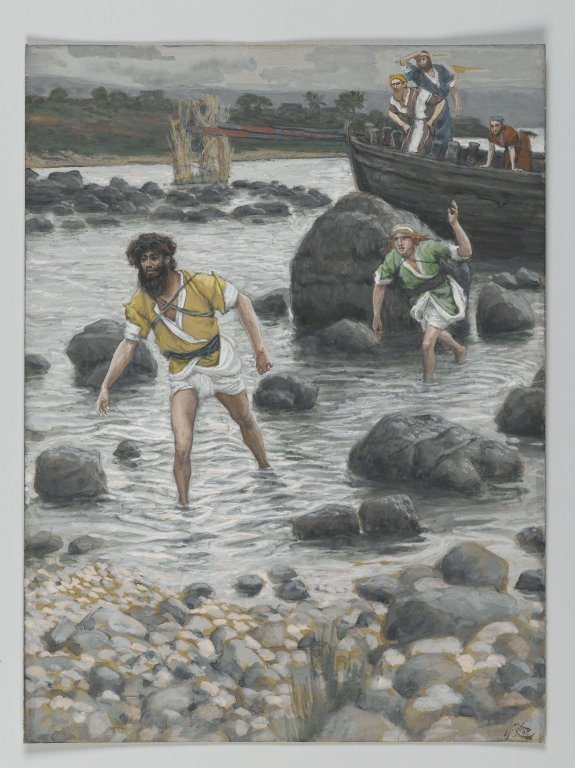
The Calling of Saint James and Saint John, James Tissot; {{PD-US-expired-abroad}}

Ordinary Time in the Christian calendar is not about ordinary and ho-hum events, but about the ordering of Christian existence according to Jesus’ life and teaching above and beyond the Advent and Christmas, Lenten and Easter seasons. This blog post will reflect on what such ordering involves and how important it is for Jesus to order our lives throughout the year, including Ordinary Time.
Before we go further, let’s consider more carefully the meaning of Ordinary Time. Here is what one helpful article explains about Ordinary Time:
Because the term ordinary in English most often means something that’s not special or distinctive, many people think that Ordinary Time refers to parts of the calendar of the Catholic Church that are unimportant. Even though the season of Ordinary Time makes up most of the liturgical year in the Catholic Church, the fact that Ordinary Time refers to those periods that fall outside of the major liturgical seasons reinforces this impression. Yet Ordinary Time is far from unimportant or uninteresting.
Ordinary Time is called “ordinary” not because it is common but simply because the weeks of Ordinary Time are numbered. The Latin word ordinalis, which refers to numbers in a series, stems from the Latin word ordo, from which we get the English word order. Thus, the numbered weeks of Ordinary Time, in fact, represent the ordered life of the Church—the period in which we live our lives neither in feasting (as in the Christmas and Easter seasons) or in more severe penance (as in Advent and Lent), but in watchfulness and expectation of the Second Coming of Christ.
There is no better way to live in watchfulness and expectation for Jesus’ second coming than to submit to Jesus in ordering our steps according to his life and teaching presented during his first coming. So, as we proceed, let’s ask: what’s involved in Jesus ordering our steps during Ordinary Time? The answer: total trust and obedience.
Jesus calls us. The question we must ask ourselves during any season of the year, including Ordinary Time is: will we follow? Are there strings attached—like fishing nets—to our decision as to whether and how far and in what manner we will follow?
Consider Jesus’ first recorded encounter with his first disciples in Matthew chapter 4. Notice that for Peter and Andrew, James and John, there were no strings attached to their determination when Jesus beckoned. They left everything to follow him, illustrated by leaving their nets, their boat(s), and father(s) (Matthew 4:18-22). At the outset of Jesus’ ministry in which he calls people to repent for the kingdom of heaven is at hand (Matthew 4:17), we find him calling his first disciples. Notice their response:
While walking by the Sea of Galilee, he saw two brothers, Simon (who is called Peter) and Andrew his brother, casting a net into the sea, for they were fishermen. And he said to them, “Follow me, and I will make you fishers of men.” Immediately they left their nets and followed him. And going on from there he saw two other brothers, James the son of Zebedee and John his brother, in the boat with Zebedee their father, mending their nets, and he called them. Immediately they left the boat and their father and followed him. (Matthew 4:18-22; ESV)
The disciples leave behind their allegiances to their families and their fishing businesses, the only way of life they had likely ever known, to become Jesus’ apprentices in his work of fishing for people. These four knew nothing of the path laid out before them, only Jesus’ call to follow. They followed unreservedly, no strings or nets attached. The only thing that they were attached to was Jesus’ word in a spirit of total trust and obedience. I find such a response refreshing, though shocking and staggering given the all-too-human impulse in our day to hedge our bets, keep our relational options open, and play the perpetual cynic.
From the get go, Jesus’ call is a call to die—to die to the old order of life, all they had ever known, to live anew according to his way of being. Thus, we find resonance with what Dietrich Bonhoeffer asserts in his volume on discipleship: “The cross is not the end of a pious, happy life. Instead, it stands at the beginning of community with Jesus Christ. Whenever Christ calls us, his call leads us to death” (Bonhoeffer, Discipleship, Bonhoeffer Works, page 87). While Jesus’ disciples certainly did not understand all that stood before them on the path ahead, they certainly understood that their past was dead to them in living in accordance with Jesus’ future for them. Thus, there should have been no real surprise when Jesus exclaims later in the same gospel: “If anyone would come after me, let him deny himself and take up his cross and follow me” (Matthew 16:24; ESV). A few pages later in Discipleship, we find Bonhoeffer quoting Martin Luther who urges us to “submerge” ourselves in a “lack of understanding” to gain Jesus’ understanding (page 91). Again, total trust and obedience in the face of death to new life is required. This requires unlearning to learn anew from Jesus.
No doubt, such total dependence and allegiance, and with it, new learning, can prove unnerving and disturbing to many. But from Jesus’ vantage point, as well as his disciple Bonhoeffer, such dependence and allegiance is liberating and life-giving. Take for example Jesus’ words in Matthew 11:28-30 and Bonhoeffer’s accompanying reflections:
Come to me, all who labor and are heavy laden, and I will give you rest. Take my yoke upon you, and learn from me, for I am gentle and lowly in heart, and you will find rest for your souls. For my yoke is easy, and my burden is light” (Matthew 11:28-30; ESV).
Jesus beckons those who are weary and weighed down with many burdens to come to him to find rest. How do they find such rest? By taking his yoke—which involves his cross—upon them! And how will that relieve them of their heavy burden? Jesus takes their burdens upon himself and replaces their burdens with his abiding presence involving his gentle and lowly spirit. Only then can they find rest for their souls, as they wear his easy yoke and light burden, of which he himself ultimately bears the brunt. Such a path of discipleship involves unlearning the old system of bearing their own burdens and learning as for the first time what it means to follow Jesus. So, he urges them to learn from him and to get to know him and his character and his good life-giving aims for their lives. The same holds true for us today.
Bonhoeffer explains why Jesus’ burden is light and how his way for us is life-giving in the following manner:
Those who follow Jesus’ commandment entirely, who let Jesus’ yoke rest on them without resistance, will find the burdens they must bear to be light. In the gentle pressure of this yoke they will receive the strength to walk the right path without becoming weary. Jesus’ commandment is harsh, inhumanly harsh for someone who resists it. Jesus’ commandment is gentle and not difficult for someone who willingly accepts it. “His commandments are not burdensome” (1 John 5:3). Jesus’ commandment has nothing to do with forced spiritual cures. Jesus demands nothing from us without giving us the strength to comply. Jesus’ commandment never wishes to destroy life, but rather to preserve, strength, and heal life (Discipleship, page 39).
Jesus’ call to us every day of the year, including during Ordinary Time, appears so unordinary, so counterintuitive. As has been argued in this blog post, Jesus’ call intends and invites a response of total trust and obedience, one that from its inception leads to death for the old order of our existence, but that from beginning to end involves new and abundant life. May we submit ourselves to Jesus during Ordinary Time, and not just on Sundays or during Christmastide and Eastertide. May Jesus order our lives. Only his order brings true order out of the chaos of our daily existence. May we not be like those who experience the harsh reality of resisting Jesus’ word, but like those first followers who experienced the gentle reality of obeying Jesus’ life-giving command as they dropped their nets and left their family fishing boats to follow him.
Previous Post

July 13, 2019
Guard Against Polluting the Heart
Next Post
July 25, 2019 Trump, Race and the Better Angels of Our Nature
Browse Our Archives
Select a Category Uncategorized
Select a Month June 2025 April 2025 March 2025 January 2025 December 2024 November 2024 October 2024 September 2024 August 2024 July 2024 June 2024 May 2024 April 2024 March 2024 February 2024 January 2024 December 2023 November 2023 October 2023 September 2023 August 2023 July 2023 June 2023 May 2023 April 2023 March 2023 February 2023 January 2023 December 2022 November 2022 October 2022 September 2022 August 2022 July 2022 June 2022 May 2022 April 2022 March 2022 February 2022 January 2022 December 2021 November 2021 October 2021 September 2021 August 2021 July 2021 June 2021 May 2021 April 2021 March 2021 February 2021 January 2021 December 2020 November 2020 October 2020 September 2020 August 2020 July 2020 June 2020 May 2020 April 2020 March 2020 February 2020 January 2020 December 2019 November 2019 October 2019 September 2019 August 2019 July 2019 June 2019 May 2019 April 2019 March 2019 February 2019 January 2019 December 2018 November 2018 October 2018 September 2018 August 2018 July 2018 June 2018 May 2018 April 2018 March 2018 February 2018 January 2018 December 2017 November 2017 October 2017 September 2017 August 2017 July 2017 June 2017 May 2017 April 2017 March 2017 February 2017 January 2017 December 2016 November 2016 October 2016 September 2016 August 2016 July 2016 June 2016 May 2016 April 2016 March 2016 February 2016 January 2016 December 2015 November 2015 October 2015 September 2015 August 2015 July 2015 June 2015 May 2015 April 2015 March 2015 February 2015 January 2015 December 2014 November 2014 October 2014 September 2014 August 2014 July 2014 June 2014 May 2014 April 2014 March 2014 February 2014 January 2014 December 2013 November 2013 October 2013 September 2013 August 2013 July 2013 June 2013 May 2013 April 2013 March 2013 February 2013 January 2013 December 2012 November 2012 October 2012 September 2012 August 2012 July 2012 June 2012 May 2012 April 2012 March 2012 February 2012
Follow Us!
TAKE THE
Religious Wisdom Quiz
What qualification does Paul give for elders, saying they must be the husband of how many wives?
Select your answer to see how you score.
Two wives One wife As many as he can support No more than three wives
Books by This Author Books by Paul Louis Metzger
Related posts from Uncommon God, Common Good

Heavenly Father’s Day on Trinity Sunday

Easter Triduum: Obey Your Thirst—for God

Holy Week Is Humble Week: "Beware of Becoming...

Excavating the Person in a Throwaway Culture
TRENDING AT PATHEOS Evangelical

The REST of Your Life: A Creative Wrestles...
This week I had a conversation with a good friend from church....

How the author of the world's best hymn...
I've been working with John Newton for a while now. This makes...

Long before this Lectio Divina, Psalm 130 - the song - started...

What About the Trees? Another Living Parable
After I finished writing the last article about falling leaves as a...

Why Classical Education Is a Conversation, Not a...
Come and Read: Joy in Classical Education When I was a little...

Cornell University has received a great deal of negative publicity and intense...
view all Evangelical blogs
Ad-Free & Subscriber Log-In Subscription Support
- About Us
- 2026 Calendar
- Videos
- Podcasts
- Library of World Religions
- Faith In Media Tracker
- Advertise With Us
- Write for Us
- Privacy Policy
- Terms of Service
- Do Not Sell My Data
- Contact Us
- Radiant Digital
- Manage Newsletter Subscriptions
- Unsubscribe From Notifications
- Sitemap
Copyright 2008-2026, Patheos. All rights reserved.
Subscription Support Ad-Free & Subscriber Log-In
Follow Patheos