
BuddhistCatholicContemplativeEvangelicalGeneral ChristianHinduJewishLatter-day SaintMuslimNew VisionsProgressive Christian
Beliefs
- Buddhist
- Catholic
- Contemplative
- Evangelical
- General Christian
- Hindu
- Jewish
- Latter-day Saint
- More Voices
- Muslim
- New Visions
- Pagan
- Progressive Christian
Topics
- Religion News
- Food and Religion
- Sports and Religion
- Religious Art
- Religious Music and Entertainment
- Religious Events
- History and Religion
- Style and Religion
- Politics and Religion
- Women in Religion
- Recreation Outdoors and Religion
- Business Finance and Religion
- Careers Workplace and Religion
- Education and Religion
- Family Parenting and Religion
- Health Fitness and Religion
- Home and Religion
- Relationships and Religion
- Technology and Religion
- Travel and Religion
Columnists
- Buddhist Columnists
- Business Finance and Religion Columnists
- Careers Workplace and Religion Columnists
- Catholic Columnists
- Contemplative Columnists
- Education and Religion Columnists
- Evangelists Columnists
- Family Parenting and Religion Columnists
- General Christian Columnists
- Health Fitness and Religion Columnists
- Hindu Columnists
- History and Religion Columnists
- Home and Religion Columnists
- Jewish Columnists
- More Voices Columnists
- Latter Day Columnists
- Muslim Columnists
- New Visions Columnists
- Nonreligious Columnists
- Pagan Columnists
- Politics and Religion Columnists
- Progressive Columnists
- Recreation Outdoors and Religion Columnists
- Relationships and Religion Columnists
- Religion News Columnists
- Religious Art Columnists
- Religious Events Columnists
- Religious Music and Entertainment Columnists
- Sports and Religion Columnists
- Style and Religion Columnists
- Technology and Religion Columnists
- Travel and Religion Columnists
- Women in Religion Columnists
Resource Library
- 2026 Calendar
- Library of World Religions
- The 100 Most Holy Places on Earth
- Patheos Answers
- Podcasts
- Videos
- Faith Leaders Database
- Anglican Episcopalian
- Bahai
- Baptist
- Buddhism
- Christianity
- Confucianism
- Eastern Orthodoxy
- Hinduism
- Holiness and Pentecostal
- ISKCON
- Islam
- Judaism
- Lutheran
- Methodist
- The Church of Jesus Christ of Latter-day Saints
- New Age
- Paganism
- Presbytarian and Reformed
- Protestantism
- Religion Behind the Scenes
- Roman Catholic
- Scientology
- Shia Islam
- Sikhism
- Sufism
- Sunni Islam
- Taoism
- Zen
- See all religions
Research Tools
 Ad-Free & Subscriber Log-In Subscription Support
Ad-Free & Subscriber Log-In Subscription Support
Follow Patheos 

- Trending:
- Forgiveness
- |
- Marriage
- |
- Consciousness
- |
- Death Penalty
- |
- Election
- |
- Halloween

- Home
- Evangelical
- Sometimes Doubt Is Devotion
Sometimes Doubt Is Devotion
Last updated on: May 19, 2019 at 9:13 pm by Paul Louis Metzger
Sometimes Doubt Is Devotion 2019-05-19T21:13:04-07:00 Paul Louis Metzger
Patheos Explore the world's faith through different perspectives on religion and spirituality! Patheos has the views of the prevalent religions and spiritualities of the world.
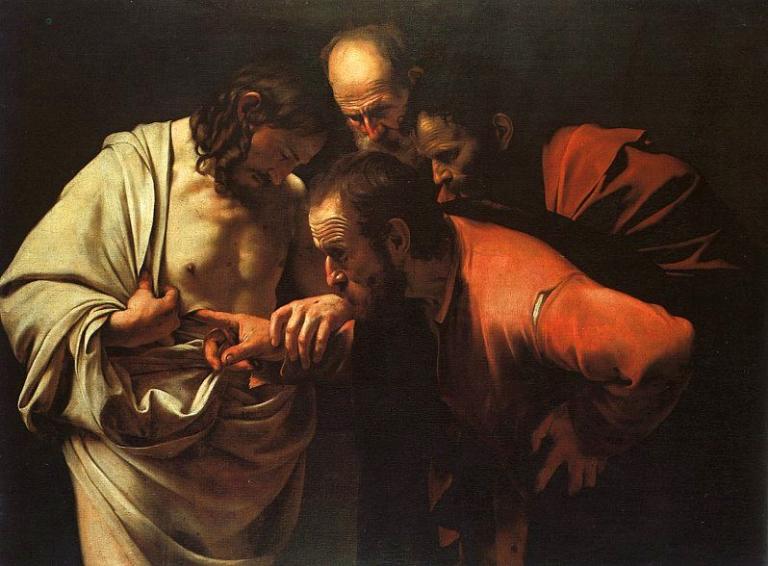
Caravaggio, “The Incredulity of St. Thomas.” Creative Commons

You’ve heard of the doubting Thomas? He’s the disciple who would not believe the testimony of his fellow apostles that Jesus had been raised bodily from the dead. He replied that he would only believe if he could place his finger and hand in the risen Jesus’ cruciform wounds. I really think his doubt was a form of devotion. Let’s consider Thomas’ relationship with Jesus more closely, beginning with the gospel account to which I just alluded:
Now Thomas, one of the twelve, called the Twin, was not with them when Jesus came. So the other disciples told him, “We have seen the Lord.” But he said to them, “Unless I see in his hands the mark of the nails, and place my finger into the mark of the nails, and place my hand into his side, I will never believe” (John 20:24-25; ESV).
Later Jesus appeared to Thomas in the presence of the other apostles and encouraged Thomas to do exactly what Thomas had told the other disciples he must do if he were to believe that Jesus was indeed alive:
Eight days later, his disciples were inside again, and Thomas was with them. Although the doors were locked, Jesus came and stood among them and said, “Peace be with you.” Then he said to Thomas, “Put your finger here, and see my hands; and put out your hand, and place it in my side. Do not disbelieve, but believe.” Thomas answered him, “My Lord and my God!” Jesus said to him, “Have you believed because you have seen me? Blessed are those who have not seen and yet have believed.” (John 20:26-29; ESV).
Notice that Jesus did not rebuff Thomas on account of his doubt by telling him to believe only with the heart or with his naked eyes. Jesus engaged Thomas where he was at, so to speak. In Caravaggio’s painting of the encounter, which is visible above in this post, Jesus went so far as to take Thomas by the hand and place the hand in his side. While it is certainly true that the text records Jesus as saying that those who believe without seeing him are blessed, Jesus’ statement does not come across to me as a rebuke of Thomas. Rather, it is at this point that John’s Gospel turns to those readers, who have never had visible access to Jesus (which includes us) and calls them blessed for simply believing the testimony of faithful witnesses concerning his bodily resurrection. Again, if Caravaggio’s painting provides any indication of Jesus’ intended remarks, it would be that the Lord welcomed Thomas’ genuine, honest, and open inquiry.
Remember, too, how devoted Thomas was to Jesus in his discipleship: when he realized Jesus had determined to go up to the vicinity of Jerusalem at a time when his life was at risk there, Thomas urged his fellow disciples to go up with him and die with the Lord. (John 11:16; ESV). Going further, it is not certain how Thomas died. One report indicates that he traveled as far as India and founded the church there. The report indicates that he died when pierced with the spears of four soldiers. While it is not certain how Thomas died, it does appear certain how he lived, according to John’s Gospel—as devoted to Jesus. He would rather have been the doubting Thomas than the gullible Thomas. He did not want to believe in an apparition or a figment of the imagination. Too much was at stake—the real Jesus and faithful witness to the Lord that would lead to his death.
Like C.S. Lewis many centuries later, Thomas was not after convenient or comfortable faith, but honest and true faith. Regarding costly faith, Lewis wrote in God in the Dock:
I have an elderly acquaintance of about eighty, who has lived a life of unbroken selfishness and admiration from the earliest years, and is, more or less, I regret to say, one of the happiest men I know. From the moral point of view, it is very difficult! I am not approaching the question from that angle. As you perhaps know, I haven’t always been a Christian. I didn’t go to religion to make me happy. I always knew a bottle of Port would do that. If you want a religion to make you feel really comfortable, I certainly don’t recommend Christianity.
It is far better to doubt than to engage in easy believism, where ignorance is bliss. Thomas was no cynic. But he was not a silly, drunken fool either. He desired sufficient reason to believe, and Jesus welcomed his search. He will welcome our genuine quest as well. As former atheist now Christian Dr. Sarah Irving-Stonebraker of Western Sydney University wrote in an article for The Veritas Forum,
Christianity, it turned out, looked nothing like the caricature I once held. I found the story of Jacob wrestling with God especially compelling: God wants anything but the unthinking faith I had once assumed characterized Christianity. God wants us to wrestle with Him; to struggle through doubt and faith, sorrow and hope.
While the Lord may not appear in person to take away any doubt you and I may have about him, I do believe he will reveal himself uniquely to those who really seek after him with genuine questions on their minds and in their hearts, like the devoted Thomas. As in the case of Thomas, those who want to remove all doubt from their faith are truly devoted.
Previous Post

May 18, 2019
Evangelism and Religious Diplomacy Complement One Another
Next Post
May 24, 2019 Post-Resurrection Appearances—Faith Resuscitation
Browse Our Archives
Select a Category Uncategorized
Select a Month June 2025 April 2025 March 2025 January 2025 December 2024 November 2024 October 2024 September 2024 August 2024 July 2024 June 2024 May 2024 April 2024 March 2024 February 2024 January 2024 December 2023 November 2023 October 2023 September 2023 August 2023 July 2023 June 2023 May 2023 April 2023 March 2023 February 2023 January 2023 December 2022 November 2022 October 2022 September 2022 August 2022 July 2022 June 2022 May 2022 April 2022 March 2022 February 2022 January 2022 December 2021 November 2021 October 2021 September 2021 August 2021 July 2021 June 2021 May 2021 April 2021 March 2021 February 2021 January 2021 December 2020 November 2020 October 2020 September 2020 August 2020 July 2020 June 2020 May 2020 April 2020 March 2020 February 2020 January 2020 December 2019 November 2019 October 2019 September 2019 August 2019 July 2019 June 2019 May 2019 April 2019 March 2019 February 2019 January 2019 December 2018 November 2018 October 2018 September 2018 August 2018 July 2018 June 2018 May 2018 April 2018 March 2018 February 2018 January 2018 December 2017 November 2017 October 2017 September 2017 August 2017 July 2017 June 2017 May 2017 April 2017 March 2017 February 2017 January 2017 December 2016 November 2016 October 2016 September 2016 August 2016 July 2016 June 2016 May 2016 April 2016 March 2016 February 2016 January 2016 December 2015 November 2015 October 2015 September 2015 August 2015 July 2015 June 2015 May 2015 April 2015 March 2015 February 2015 January 2015 December 2014 November 2014 October 2014 September 2014 August 2014 July 2014 June 2014 May 2014 April 2014 March 2014 February 2014 January 2014 December 2013 November 2013 October 2013 September 2013 August 2013 July 2013 June 2013 May 2013 April 2013 March 2013 February 2013 January 2013 December 2012 November 2012 October 2012 September 2012 August 2012 July 2012 June 2012 May 2012 April 2012 March 2012 February 2012
Follow Us!
TAKE THE
Religious Wisdom Quiz
Which book of the Bible has only one chapter?
Select your answer to see how you score.
Nahum Obadiah Zephaniah Habakkuk
Books by This Author Books by Paul Louis Metzger
Related posts from Uncommon God, Common Good

Heavenly Father’s Day on Trinity Sunday

Easter Triduum: Obey Your Thirst—for God

Holy Week Is Humble Week: "Beware of Becoming...

Excavating the Person in a Throwaway Culture
TRENDING AT PATHEOS Evangelical

The REST of Your Life: A Creative Wrestles...
This week I had a conversation with a good friend from church....

How the author of the world's best hymn...
I've been working with John Newton for a while now. This makes...

Long before this Lectio Divina, Psalm 130 - the song - started...

What About the Trees? Another Living Parable
After I finished writing the last article about falling leaves as a...

Why Classical Education Is a Conversation, Not a...
Come and Read: Joy in Classical Education When I was a little...

Cornell University has received a great deal of negative publicity and intense...
view all Evangelical blogs
Ad-Free & Subscriber Log-In Subscription Support
- About Us
- 2026 Calendar
- Videos
- Podcasts
- Library of World Religions
- Faith In Media Tracker
- Advertise With Us
- Write for Us
- Privacy Policy
- Terms of Service
- Do Not Sell My Data
- Contact Us
- Radiant Digital
- Manage Newsletter Subscriptions
- Unsubscribe From Notifications
- Sitemap
Copyright 2008-2026, Patheos. All rights reserved.
Subscription Support Ad-Free & Subscriber Log-In
Follow Patheos