
BuddhistCatholicContemplativeEvangelicalGeneral ChristianHinduJewishLatter-day SaintMuslimNew VisionsProgressive Christian
Beliefs
- Buddhist
- Catholic
- Contemplative
- Evangelical
- General Christian
- Hindu
- Jewish
- Latter-day Saint
- More Voices
- Muslim
- New Visions
- Pagan
- Progressive Christian
Topics
- Religion News
- Food and Religion
- Sports and Religion
- Religious Art
- Religious Music and Entertainment
- Religious Events
- History and Religion
- Style and Religion
- Politics and Religion
- Women in Religion
- Recreation Outdoors and Religion
- Business Finance and Religion
- Careers Workplace and Religion
- Education and Religion
- Family Parenting and Religion
- Health Fitness and Religion
- Home and Religion
- Relationships and Religion
- Technology and Religion
- Travel and Religion
Columnists
- Buddhist Columnists
- Business Finance and Religion Columnists
- Careers Workplace and Religion Columnists
- Catholic Columnists
- Contemplative Columnists
- Education and Religion Columnists
- Evangelists Columnists
- Family Parenting and Religion Columnists
- General Christian Columnists
- Health Fitness and Religion Columnists
- Hindu Columnists
- History and Religion Columnists
- Home and Religion Columnists
- Jewish Columnists
- More Voices Columnists
- Latter Day Columnists
- Muslim Columnists
- New Visions Columnists
- Nonreligious Columnists
- Pagan Columnists
- Politics and Religion Columnists
- Progressive Columnists
- Recreation Outdoors and Religion Columnists
- Relationships and Religion Columnists
- Religion News Columnists
- Religious Art Columnists
- Religious Events Columnists
- Religious Music and Entertainment Columnists
- Sports and Religion Columnists
- Style and Religion Columnists
- Technology and Religion Columnists
- Travel and Religion Columnists
- Women in Religion Columnists
Resource Library
- 2026 Calendar
- Library of World Religions
- The 100 Most Holy Places on Earth
- Patheos Answers
- Podcasts
- Videos
- Faith Leaders Database
- Anglican Episcopalian
- Bahai
- Baptist
- Buddhism
- Christianity
- Confucianism
- Eastern Orthodoxy
- Hinduism
- Holiness and Pentecostal
- ISKCON
- Islam
- Judaism
- Lutheran
- Methodist
- The Church of Jesus Christ of Latter-day Saints
- New Age
- Paganism
- Presbytarian and Reformed
- Protestantism
- Religion Behind the Scenes
- Roman Catholic
- Scientology
- Shia Islam
- Sikhism
- Sufism
- Sunni Islam
- Taoism
- Zen
- See all religions
Research Tools
 Ad-Free & Subscriber Log-In Subscription Support
Ad-Free & Subscriber Log-In Subscription Support
Follow Patheos 

- Trending:
- Forgiveness
- |
- Marriage
- |
- Consciousness
- |
- Death Penalty
- |
- Election
- |
- Halloween

- Home
- Evangelical
- Reconstruction and the Racial Construction of the American Present
Reconstruction and the Racial Construction of the American Present
Last updated on: May 25, 2019 at 8:40 pm by Paul Louis Metzger
Reconstruction and the Racial Construction of the American Present 2019-05-25T20:40:15-07:00 Paul Louis Metzger
Patheos Explore the world's faith through different perspectives on religion and spirituality! Patheos has the views of the prevalent religions and spiritualities of the world.
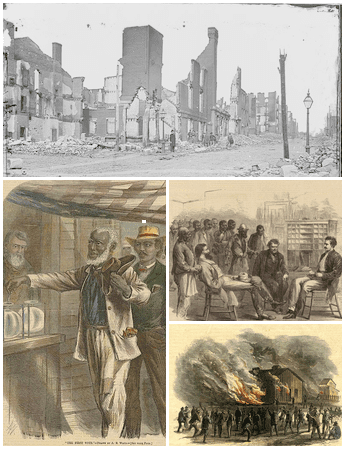
Reconstruction Era Collage; Wikimedia Commons

The philosopher George Santayana remarked that those who do not understand history tend to repeat it. I was reminded of this statement in view of a recent conversation. If we don’t understand the history surrounding Reconstruction after the Civil War, we may be repeating some of the same heinous, historical mistakes.
The person who encouraged me to reflect back on Reconstruction is Rev. Dr. LeRoy Haynes, Jr. This week, Dr. Haynes and I met for lunch in downtown Portland. I have known Dr. Haynes for many years and have found his perspective on civil rights issues invaluable, and for good reason. Dr. Haynes is the author of God’s Prophet in Non-Violence: The Story of Dr. Martin Luther King Jr.’s Life. In addition to his longstanding service as a pastoral leader in the Christian Methodist Episcopal Church, The Portland Observer wrote concerning him: “An acclaimed civil rights activist in Texas before moving to Portland, he served as a youth organizer for Martin Luther King Jr.’s Southern Christian Leadership Conference ; was a field organizer for the Student Non-Violent Coordinating Committee; and was co-founder of the Texas Black Panther Party.” His civil rights activism continues into the present on matters pertaining to the collective well-being of people across the region and nation on such matters as racism, poverty, and healthcare. Recently, he was voted into the Oregon Historical Society. So, when Dr. Haynes encourages me to consider a matter from racialized American history to understand the present, I am wise if I take the matter to heart.
Now for those of us who may be wondering what Reconstruction was, Encyclopedia Britannica offers this helpful definition:
Reconstruction, in U.S. history, the period (1865–77) that followed the American Civil War and during which attempts were made to redress the inequities of slavery and its political, social, and economic legacy and to solve the problems arising from the readmission to the Union of the 11 states that had seceded at or before the outbreak of war. Long portrayed by many historians as a time when vindictive Radical Republicans fastened black supremacy upon the defeated Confederacy, Reconstruction has since the late 20th century been viewed more sympathetically as a laudable experiment in interracial democracy. Reconstruction witnessed far-reaching changes in America’s political life. At the national level, new laws and constitutional amendments permanently altered the federal system and the definition of American citizenship. In the South, a politically mobilized black community joined with white allies to bring the Republican Party to power, and with it a redefinition of the responsibilities of government.
Put positively, Reconstruction was the first significant attempt to address racial inequities after the emancipation of America’s slave population. No matter how it is framed, though, it is worth noting that the KKK arose in response to Reconstruction in the effort to suppress and terrorize the recently emancipated African American slaves and all those who sought to aid them in their full inclusion in American society.
Dr. Haynes and I spoke of recent issues that stand in the way of full inclusion in our society today, such as the Supreme Court’s 2013 overturning of an essential aspect of the Voting Rights Act (Refer here and here). As a historical refresher, the Voting Rights Act of 1965 was intended to award the federal government the authority to safeguard against discrimination in voting practices on the state level. We also discussed the rise of white nationalism, as well as mass incarceration serving as the vehicle for what Michelle Alexander refers to as The New Jim Crow.
Given the limits of space, in what follows, we will discuss briefly the rise of white nationalism. In April 2019, a Pew study claimed that the “Public has negative views of the country’s racial progress; more than half say Trump has made race relations worse.” The study also claimed “Most Americans say it’s now more common for people to express racist or racially insensitive views; more than four-in-ten say it’s more acceptable.”
Whether true or not, a new study conducted by researchers at the University of Pennsylvania claims that “Racial prejudice has declined as a reaction to Trump’s presidency, a new study suggests.” The study is not arguing that the President is wrongly accused of making racist statements and fostering a racist ideology, but rather that his assertions are having the reverse effect of what is often expected. A May 24th Washington Post article focusing on the new research claims that President Trump’s racist rhetoric is leading people away from his orientation and stated opinion. The article reads,
There are two ways that effect might play out, the study observes. One is normalization, whereby members of the public would feel more comfortable expressing racist beliefs that they always harbored but once felt were outside the mainstream. The other is so-called opinion leadership, whereby the public would be moved to adopt racist positions advanced by political elites.
Instead, the authors found evidence of an altogether different effect — people actually moving away from the positions embraced by those in power.
Time will tell if the U Penn study meets with wide-ranging appeal. What it does point to in the interim concerns whether the President is having the impact his comments are presumably intended to convey. Surely we should be encouraged if indeed the majority of Americans are standing up rather than capitulating to expressing racist views or advancing racist positions. Even so, no matter if the greater percentage of Americans are leaning in the opposite direction of the President at the present time, public opinion can change suddenly. What we can learn from Reconstruction in this instance is that no matter how successful racial equity appears to be in the early going, one must never let down one’s guard. If we are not vigilant, and simply going with the flow, then President Trump’s racially charged rhetoric has a real chance of regaining momentum, just as was true of the racist reactions by many across the land following Reconstruction’s early successes.
Previous Post

May 24, 2019
Post-Resurrection Appearances—Faith Resuscitation
Next Post
June 5, 2019 Sturdy Fence Posts Make for Good LDS and Evangelical Neighbors
Browse Our Archives
Select a Category Uncategorized
Select a Month June 2025 April 2025 March 2025 January 2025 December 2024 November 2024 October 2024 September 2024 August 2024 July 2024 June 2024 May 2024 April 2024 March 2024 February 2024 January 2024 December 2023 November 2023 October 2023 September 2023 August 2023 July 2023 June 2023 May 2023 April 2023 March 2023 February 2023 January 2023 December 2022 November 2022 October 2022 September 2022 August 2022 July 2022 June 2022 May 2022 April 2022 March 2022 February 2022 January 2022 December 2021 November 2021 October 2021 September 2021 August 2021 July 2021 June 2021 May 2021 April 2021 March 2021 February 2021 January 2021 December 2020 November 2020 October 2020 September 2020 August 2020 July 2020 June 2020 May 2020 April 2020 March 2020 February 2020 January 2020 December 2019 November 2019 October 2019 September 2019 August 2019 July 2019 June 2019 May 2019 April 2019 March 2019 February 2019 January 2019 December 2018 November 2018 October 2018 September 2018 August 2018 July 2018 June 2018 May 2018 April 2018 March 2018 February 2018 January 2018 December 2017 November 2017 October 2017 September 2017 August 2017 July 2017 June 2017 May 2017 April 2017 March 2017 February 2017 January 2017 December 2016 November 2016 October 2016 September 2016 August 2016 July 2016 June 2016 May 2016 April 2016 March 2016 February 2016 January 2016 December 2015 November 2015 October 2015 September 2015 August 2015 July 2015 June 2015 May 2015 April 2015 March 2015 February 2015 January 2015 December 2014 November 2014 October 2014 September 2014 August 2014 July 2014 June 2014 May 2014 April 2014 March 2014 February 2014 January 2014 December 2013 November 2013 October 2013 September 2013 August 2013 July 2013 June 2013 May 2013 April 2013 March 2013 February 2013 January 2013 December 2012 November 2012 October 2012 September 2012 August 2012 July 2012 June 2012 May 2012 April 2012 March 2012 February 2012
Follow Us!
TAKE THE
Religious Wisdom Quiz
Who was the wife of Isaac?
Select your answer to see how you score.
Sarah Rachel Rebekah Leah
Books by This Author Books by Paul Louis Metzger
Related posts from Uncommon God, Common Good

Heavenly Father’s Day on Trinity Sunday

Easter Triduum: Obey Your Thirst—for God

Holy Week Is Humble Week: "Beware of Becoming...

Excavating the Person in a Throwaway Culture
TRENDING AT PATHEOS Evangelical

The REST of Your Life: A Creative Wrestles...
This week I had a conversation with a good friend from church....

How the author of the world's best hymn...
I've been working with John Newton for a while now. This makes...

Long before this Lectio Divina, Psalm 130 - the song - started...

What About the Trees? Another Living Parable
After I finished writing the last article about falling leaves as a...

Why Classical Education Is a Conversation, Not a...
Come and Read: Joy in Classical Education When I was a little...

Cornell University has received a great deal of negative publicity and intense...
view all Evangelical blogs
Ad-Free & Subscriber Log-In Subscription Support
- About Us
- 2026 Calendar
- Videos
- Podcasts
- Library of World Religions
- Faith In Media Tracker
- Advertise With Us
- Write for Us
- Privacy Policy
- Terms of Service
- Do Not Sell My Data
- Contact Us
- Radiant Digital
- Manage Newsletter Subscriptions
- Unsubscribe From Notifications
- Sitemap
Copyright 2008-2026, Patheos. All rights reserved.
Subscription Support Ad-Free & Subscriber Log-In
Follow Patheos