
BuddhistCatholicContemplativeEvangelicalGeneral ChristianHinduJewishLatter-day SaintMuslimNew VisionsProgressive Christian
Beliefs
- Buddhist
- Catholic
- Contemplative
- Evangelical
- General Christian
- Hindu
- Jewish
- Latter-day Saint
- More Voices
- Muslim
- New Visions
- Pagan
- Progressive Christian
Topics
- Religion News
- Food and Religion
- Sports and Religion
- Religious Art
- Religious Music and Entertainment
- Religious Events
- History and Religion
- Style and Religion
- Politics and Religion
- Women in Religion
- Recreation Outdoors and Religion
- Business Finance and Religion
- Careers Workplace and Religion
- Education and Religion
- Family Parenting and Religion
- Health Fitness and Religion
- Home and Religion
- Relationships and Religion
- Technology and Religion
- Travel and Religion
Columnists
- Buddhist Columnists
- Business Finance and Religion Columnists
- Careers Workplace and Religion Columnists
- Catholic Columnists
- Contemplative Columnists
- Education and Religion Columnists
- Evangelists Columnists
- Family Parenting and Religion Columnists
- General Christian Columnists
- Health Fitness and Religion Columnists
- Hindu Columnists
- History and Religion Columnists
- Home and Religion Columnists
- Jewish Columnists
- More Voices Columnists
- Latter Day Columnists
- Muslim Columnists
- New Visions Columnists
- Nonreligious Columnists
- Pagan Columnists
- Politics and Religion Columnists
- Progressive Columnists
- Recreation Outdoors and Religion Columnists
- Relationships and Religion Columnists
- Religion News Columnists
- Religious Art Columnists
- Religious Events Columnists
- Religious Music and Entertainment Columnists
- Sports and Religion Columnists
- Style and Religion Columnists
- Technology and Religion Columnists
- Travel and Religion Columnists
- Women in Religion Columnists
Resource Library
- 2026 Calendar
- Library of World Religions
- The 100 Most Holy Places on Earth
- Patheos Answers
- Podcasts
- Videos
- Faith Leaders Database
- Anglican Episcopalian
- Bahai
- Baptist
- Buddhism
- Christianity
- Confucianism
- Eastern Orthodoxy
- Hinduism
- Holiness and Pentecostal
- ISKCON
- Islam
- Judaism
- Lutheran
- Methodist
- The Church of Jesus Christ of Latter-day Saints
- New Age
- Paganism
- Presbytarian and Reformed
- Protestantism
- Religion Behind the Scenes
- Roman Catholic
- Scientology
- Shia Islam
- Sikhism
- Sufism
- Sunni Islam
- Taoism
- Zen
- See all religions
Research Tools
 Ad-Free & Subscriber Log-In Subscription Support
Ad-Free & Subscriber Log-In Subscription Support
Follow Patheos 

- Trending:
- Forgiveness
- |
- Marriage
- |
- Consciousness
- |
- Death Penalty
- |
- Election
- |
- Halloween

- Home
- Evangelical
- Thank God It’s Divine Mercy Sunday
Thank God It’s Divine Mercy Sunday
Last updated on: April 29, 2019 at 7:17 am by Paul Louis Metzger
Thank God It’s Divine Mercy Sunday 2019-04-29T07:17:00-07:00 Paul Louis Metzger
Patheos Explore the world's faith through different perspectives on religion and spirituality! Patheos has the views of the prevalent religions and spiritualities of the world.
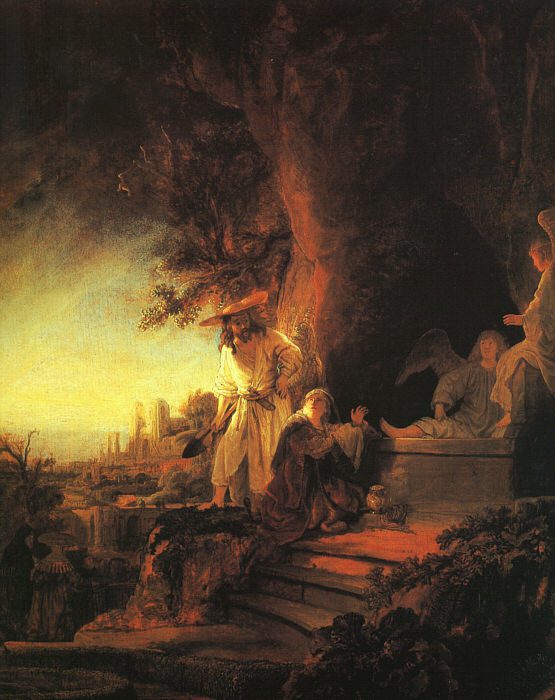
Rembrandt, The Risen Christ Appearing to Mary Magdalen, 1638 {{PD-US-expired}}; Wikimedia
No doubt you’ve heard the saying “Thank God it’s Friday.” People can’t wait to get off work and enjoy their weekends. But what if their lives are difficult not simply during the week, but also on the weekend. Thus, it’s not enough to look forward to having a few days off from work. One must look forward with expectation for signs of divine mercy throughout the week, including today, which is Divine Mercy Sunday.
Today is the second Sunday of Easter, which as stated above, is also Divine Mercy Sunday. It is associated with Faustina Kowalska, later known as St. Faustina, who was a Polish girl of poor education and humble means who lived during the Great Depression in Poland. She claimed to have visions of the risen Jesus that lasted for years. Regardless of what many people then and now think of visions of the risen Jesus, one thing is certain: the risen Jesus does indeed reveal himself uniquely to each one of us, manifesting his divine mercy. Perhaps the question we should ask ourselves is: are we looking or listening carefully and with expectation for revelations of Jesus’ divine mercy?
We find such unique revelatory manifestations of mercy in the resurrection accounts in chapters 20 and 21 of John’s Gospel. Consider Jesus’ appearance to Mary Magdalene, as well as to Thomas—known as the Twin, and to Simon Peter, among others. We will consider each encounter in successive posts, beginning here with Jesus’ interaction with Mary Magdalene in the garden where the tomb lies open.
Mary Magdalene came early to the tomb on Sunday morning to mourn over her deceased Lord. To her deep chagrin and dismay, she found the stone rolled away and Jesus’ body missing. She beckoned Peter and the beloved disciple (John) to come and see for themselves that Jesus’ body was missing. Though Peter and this other disciple came and observed that what Mary had said was true, they soon departed. However, Mary remained (See John 20:1-10).
Just as Mary was not prepared for the empty tomb, so she was not prepared for what happened next. First, Mary saw two angelic beings inside the tomb after Peter and John had departed. Then, to her utter amazement, the risen Jesus appeared to her. It is quite striking that instead of appearing first to Peter and John, Jesus appeared first to Mary, who initially mistook him for the gardener. But when Jesus called Mary by name, her eyes were opened and she recognized the Lord. Here is the whole text of this moving account:
But Mary stood weeping outside the tomb, and as she wept she stooped to look into the tomb. And she saw two angels in white, sitting where the body of Jesus had lain, one at the head and one at the feet. They said to her, “Woman, why are you weeping?” She said to them, “They have taken away my Lord, and I do not know where they have laid him.” Having said this, she turned around and saw Jesus standing, but she did not know that it was Jesus. Jesus said to her, “Woman, why are you weeping? Whom are you seeking?” Supposing him to be the gardener, she said to him, “Sir, if you have carried him away, tell me where you have laid him, and I will take him away.” Jesus said to her, “Mary.” She turned and said to him in Aramaic, “Rabboni!” (which means Teacher). Jesus said to her, “Do not cling to me, for I have not yet ascended to the Father; but go to my brothers and say to them, ‘I am ascending to my Father and your Father, to my God and your God.’” Mary Magdalene went and announced to the disciples, “I have seen the Lord”—and that he had said these things to her (John 20:11-18; ESV).
Perhaps it was the intonation, or just perhaps that he knew Mary by name. No anonymous gardener would have known her name, but Jesus knew Mary by name, just as he knows each of us by name.
Jesus knows exactly how to engage each person who seeks after him, whether it be Mary, Thomas, Peter, or any of the other disciples, as well as you and me.
Like Faustina, Mary Magdalene no doubt experienced her own form of great depression, as her crucified Lord’s dead body had been taken from her. Perhaps like Faustina, she is not someone to whom we would naturally expect the resurrected Lord to appear. Surely, in our natural way of thinking, we would expect the Lord to appear to his enemies to confound and overwhelm them, or to leading citizens who would instantly become distinguished followers, unlike the band of misfits Jesus led for three years in his public ministry. But instead of his adversaries or the brightest and best, Jesus appeared to Thomas and Peter, Mary and Faustina.
Here in these revelatory encounters we find evidence of divine mercy. No one deserves God’s revelatory mercies, neither Mary nor Faustina, neither Thomas nor Peter, neither the rich and powerful nor Jesus’ enemies, neither you nor me. So it always comes as a bit of a shock when Jesus mercifully reveals himself to us at the empty tombs of our own lives. And given that Jesus reveals himself mercifully to us, we should not be surprised when he reveals himself to those we would never expect to be recipients of his mercy and grace. Moreover, we should be signs of God’s revelatory mercy to all those around us, including those the world would ignore or slight, like Mary and Faustina. In honor of those often bypassed as seemingly unworthy of God’s mercy (as if any are worthy of God’s mercy!), I close with words that Faustina recorded in her diary to mark the Feast of Mercy that Roman Catholics and many Anglicans celebrate this day:
On one occasion, I heard these words: “My daughter, tell the whole world about My inconceivable mercy. I desire that the Feast of Mercy be a refuge and shelter for all souls, and especially for poor sinners. On that day the very depths of My tender mercy are open. I pour out a whole ocean of graces upon those souls who approach the fount of My mercy. The soul that will go to Confession and receive Holy Communion shall obtain complete forgiveness of sins and punishment. On that day all the divine floodgates through which graces flow are opened. Let no soul fear to draw near to Me, even though its sins be as scarlet. My mercy is so great that no mind, be it of man or of angel, will be able to fathom it throughout all eternity. Everything that exists has come forth from the very depths of My most tender mercy. Every soul in its relation to Me will contemplate My love and mercy throughout eternity. The Feast of Mercy emerged from My very depths of tenderness. It is My desire that it be solemnly celebrated on the first Sunday after Easter. Mankind will not have peace until it turns to the Fount of My Mercy.
You don’t have to be Catholic or Anglican to appreciate these words. You can be Catholic or Anglican, Baptist or Reformed, Independent or institutionally Indifferent. But don’t be indifferent to God’s mercy poured out on your behalf. Thank God it’s Divine Mercy Sunday.
Next Post

May 2, 2019 Restoring Hope for Children Who Have Experienced Trauma
Browse Our Archives
Select a Category Uncategorized
Select a Month June 2025 April 2025 March 2025 January 2025 December 2024 November 2024 October 2024 September 2024 August 2024 July 2024 June 2024 May 2024 April 2024 March 2024 February 2024 January 2024 December 2023 November 2023 October 2023 September 2023 August 2023 July 2023 June 2023 May 2023 April 2023 March 2023 February 2023 January 2023 December 2022 November 2022 October 2022 September 2022 August 2022 July 2022 June 2022 May 2022 April 2022 March 2022 February 2022 January 2022 December 2021 November 2021 October 2021 September 2021 August 2021 July 2021 June 2021 May 2021 April 2021 March 2021 February 2021 January 2021 December 2020 November 2020 October 2020 September 2020 August 2020 July 2020 June 2020 May 2020 April 2020 March 2020 February 2020 January 2020 December 2019 November 2019 October 2019 September 2019 August 2019 July 2019 June 2019 May 2019 April 2019 March 2019 February 2019 January 2019 December 2018 November 2018 October 2018 September 2018 August 2018 July 2018 June 2018 May 2018 April 2018 March 2018 February 2018 January 2018 December 2017 November 2017 October 2017 September 2017 August 2017 July 2017 June 2017 May 2017 April 2017 March 2017 February 2017 January 2017 December 2016 November 2016 October 2016 September 2016 August 2016 July 2016 June 2016 May 2016 April 2016 March 2016 February 2016 January 2016 December 2015 November 2015 October 2015 September 2015 August 2015 July 2015 June 2015 May 2015 April 2015 March 2015 February 2015 January 2015 December 2014 November 2014 October 2014 September 2014 August 2014 July 2014 June 2014 May 2014 April 2014 March 2014 February 2014 January 2014 December 2013 November 2013 October 2013 September 2013 August 2013 July 2013 June 2013 May 2013 April 2013 March 2013 February 2013 January 2013 December 2012 November 2012 October 2012 September 2012 August 2012 July 2012 June 2012 May 2012 April 2012 March 2012 February 2012
Follow Us!
TAKE THE
Religious Wisdom Quiz
True or False: Mark's Gospel is the shortest of the four Gospels.
Select your answer to see how you score.
TRUE FALSE
Books by This Author Books by Paul Louis Metzger
Related posts from Uncommon God, Common Good

Heavenly Father’s Day on Trinity Sunday

Easter Triduum: Obey Your Thirst—for God

Holy Week Is Humble Week: "Beware of Becoming...

Excavating the Person in a Throwaway Culture
TRENDING AT PATHEOS Evangelical

The REST of Your Life: A Creative Wrestles...
This week I had a conversation with a good friend from church....

How the author of the world's best hymn...
I've been working with John Newton for a while now. This makes...

Long before this Lectio Divina, Psalm 130 - the song - started...

What About the Trees? Another Living Parable
After I finished writing the last article about falling leaves as a...

Why Classical Education Is a Conversation, Not a...
Come and Read: Joy in Classical Education When I was a little...

Cornell University has received a great deal of negative publicity and intense...
view all Evangelical blogs
Ad-Free & Subscriber Log-In Subscription Support
- About Us
- 2026 Calendar
- Videos
- Podcasts
- Library of World Religions
- Faith In Media Tracker
- Advertise With Us
- Write for Us
- Privacy Policy
- Terms of Service
- Do Not Sell My Data
- Contact Us
- Radiant Digital
- Manage Newsletter Subscriptions
- Unsubscribe From Notifications
- Sitemap
Copyright 2008-2026, Patheos. All rights reserved.
Subscription Support Ad-Free & Subscriber Log-In
Follow Patheos