
BuddhistCatholicContemplativeEvangelicalGeneral ChristianHinduJewishLatter-day SaintMuslimNew VisionsProgressive Christian
Beliefs
- Buddhist
- Catholic
- Contemplative
- Evangelical
- General Christian
- Hindu
- Jewish
- Latter-day Saint
- More Voices
- Muslim
- New Visions
- Pagan
- Progressive Christian
Topics
- Religion News
- Food and Religion
- Sports and Religion
- Religious Art
- Religious Music and Entertainment
- Religious Events
- History and Religion
- Style and Religion
- Politics and Religion
- Women in Religion
- Recreation Outdoors and Religion
- Business Finance and Religion
- Careers Workplace and Religion
- Education and Religion
- Family Parenting and Religion
- Health Fitness and Religion
- Home and Religion
- Relationships and Religion
- Technology and Religion
- Travel and Religion
Columnists
- Buddhist Columnists
- Business Finance and Religion Columnists
- Careers Workplace and Religion Columnists
- Catholic Columnists
- Contemplative Columnists
- Education and Religion Columnists
- Evangelists Columnists
- Family Parenting and Religion Columnists
- General Christian Columnists
- Health Fitness and Religion Columnists
- Hindu Columnists
- History and Religion Columnists
- Home and Religion Columnists
- Jewish Columnists
- More Voices Columnists
- Latter Day Columnists
- Muslim Columnists
- New Visions Columnists
- Nonreligious Columnists
- Pagan Columnists
- Politics and Religion Columnists
- Progressive Columnists
- Recreation Outdoors and Religion Columnists
- Relationships and Religion Columnists
- Religion News Columnists
- Religious Art Columnists
- Religious Events Columnists
- Religious Music and Entertainment Columnists
- Sports and Religion Columnists
- Style and Religion Columnists
- Technology and Religion Columnists
- Travel and Religion Columnists
- Women in Religion Columnists
Resource Library
- 2026 Calendar
- Library of World Religions
- The 100 Most Holy Places on Earth
- Patheos Answers
- Podcasts
- Videos
- Faith Leaders Database
- Anglican Episcopalian
- Bahai
- Baptist
- Buddhism
- Christianity
- Confucianism
- Eastern Orthodoxy
- Hinduism
- Holiness and Pentecostal
- ISKCON
- Islam
- Judaism
- Lutheran
- Methodist
- The Church of Jesus Christ of Latter-day Saints
- New Age
- Paganism
- Presbytarian and Reformed
- Protestantism
- Religion Behind the Scenes
- Roman Catholic
- Scientology
- Shia Islam
- Sikhism
- Sufism
- Sunni Islam
- Taoism
- Zen
- See all religions
Research Tools
 Ad-Free & Subscriber Log-In Subscription Support
Ad-Free & Subscriber Log-In Subscription Support
Follow Patheos 

- Trending:
- Forgiveness
- |
- Marriage
- |
- Consciousness
- |
- Death Penalty
- |
- Election
- |
- Halloween

- Home
- Evangelical
- Why Should We Care for People with Disabilities?
Why Should We Care for People with Disabilities?
Last updated on: March 17, 2019 at 8:26 am by Paul Louis Metzger
Why Should We Care for People with Disabilities? 2019-03-17T08:26:59-07:00 Paul Louis Metzger
Patheos Explore the world's faith through different perspectives on religion and spirituality! Patheos has the views of the prevalent religions and spiritualities of the world.
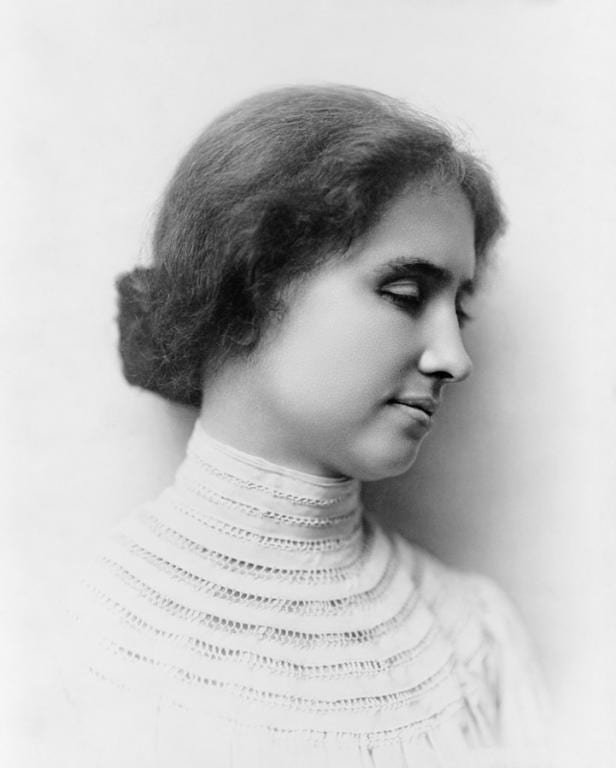
Helen Keller in profile, 1904; Wikimedia Commons.

There are many reasons why we should care for people with disabilities. Here are four reasons: inevitability; invisibility and isolation; inseparability; and invaluable worth and indispensability. The following reflections unpack these reasons.
First, we should care for people with disabilities because it is inevitable. What is inevitable? We either know, will know, or will become someone with a disability. According to a U.S. Census Bureau report released in 2012, “nearly 1 in 5 people have a disability in the U.S.” Recently, a leader in the disability community cited the same figure. While reports vary due to various factors, the numbers and percentages in the different studies are significant.[1] So, this is no fringe issue. Certainly, we should care about disability issues and people with disabilities no matter how many people have them. If anything, we should become even more attentive and engaged on addressing the concerns of the disability community based on such inevitability.
Second, we should care for people with disabilities because they are often invisible in our society and subject to increasing isolation.[2] Frequently, we don’t see people with disabilities. Our cultural and relational blindness may result from a lack of awareness, insensitivity, or intentionality. Such invisibility and isolation increase as depression sets in for those with disabilities and they resign themselves to being on the margins. We must make every effort to open our eyes and communities to be inclusive.
Third, we should care for people with disabilities because Jesus is inseparable from those on the margins. He was a man of sorrows and familiar with suffering. Isaiah 53:3 reads: “He was despised and rejected by men, a man of sorrows and acquainted with grief; and as one from whom men hide their faces he was despised, and we esteemed him not” (ESV). As the community of the wounded healer, we must enter and share in people’s suffering, including disabilities, a point Henri Nouwen brings home so powerfully.[3]
Fourth, we should care for people with disabilities because they are invaluable and indispensable. In addition to the idea that they are created in the image of God and have invaluable worth like everyone else, those with disabilities often teach us a great deal about how to live. For example, those with disabilities frequently report that they live a very fulfilling life, contrary to the way society at large often views them.[4] The courage, encouraging outlook on life, creativity and resilience of so many people with disabilities is exemplary. We need them. Bethesda Lutheran Communities highlights 1 Corinthians 12:22 in addressing the indispensability of people with disabilities: “On the contrary, the parts of the body that seem to be weaker are indispensable” (ESV). Rather than view people with disabilities as worn-out dispensable cogs in a machine, we need to see them as indispensable persons in community. May we partner with them to contribute to human flourishing.
New Wine, New Wineskins hosted “From Isolation to Invitation: A Conference on Disabilities” on March 16th 2019 at Multnomah University and Seminary. You can find at the close of this post a video interview of one of our conference speakers, Ian Jaquiss, Interim ADA Coordinator, Oregon Health and Science University.
_______________
[1]Refer here to a 2017 Pew Research Center report offering different figures, as does the 2017 Disability Statistics Annual Report, which can be found here.
[2]See for example the following article at the Invisible Disabilities Association, which touches on this subject as it relates to how pain and illness furthers isolation: Wayne Connell, “The Loneliness of Illness and Pain,” August 6, 2014.
[3]See Henri J. M. Nouwen, The Wounded Healer: Ministry in Contemporary Society (New York: Image, 1979), pages 92–93.
[4]See for example Gary L. Albrecht and Patrick J. Devlieger, “The Disability Paradox: High Quality of Life Against All Odds,” Social Science & Medicine, 48 (1999): 977-988.
Previous Post

March 14, 2019
Is Our Society Blind, Deaf and Dumb on Disabilities?
Next Post
March 22, 2019 Who Would You Pick as Designated Survivor?
Browse Our Archives
Select a Category Uncategorized
Select a Month June 2025 April 2025 March 2025 January 2025 December 2024 November 2024 October 2024 September 2024 August 2024 July 2024 June 2024 May 2024 April 2024 March 2024 February 2024 January 2024 December 2023 November 2023 October 2023 September 2023 August 2023 July 2023 June 2023 May 2023 April 2023 March 2023 February 2023 January 2023 December 2022 November 2022 October 2022 September 2022 August 2022 July 2022 June 2022 May 2022 April 2022 March 2022 February 2022 January 2022 December 2021 November 2021 October 2021 September 2021 August 2021 July 2021 June 2021 May 2021 April 2021 March 2021 February 2021 January 2021 December 2020 November 2020 October 2020 September 2020 August 2020 July 2020 June 2020 May 2020 April 2020 March 2020 February 2020 January 2020 December 2019 November 2019 October 2019 September 2019 August 2019 July 2019 June 2019 May 2019 April 2019 March 2019 February 2019 January 2019 December 2018 November 2018 October 2018 September 2018 August 2018 July 2018 June 2018 May 2018 April 2018 March 2018 February 2018 January 2018 December 2017 November 2017 October 2017 September 2017 August 2017 July 2017 June 2017 May 2017 April 2017 March 2017 February 2017 January 2017 December 2016 November 2016 October 2016 September 2016 August 2016 July 2016 June 2016 May 2016 April 2016 March 2016 February 2016 January 2016 December 2015 November 2015 October 2015 September 2015 August 2015 July 2015 June 2015 May 2015 April 2015 March 2015 February 2015 January 2015 December 2014 November 2014 October 2014 September 2014 August 2014 July 2014 June 2014 May 2014 April 2014 March 2014 February 2014 January 2014 December 2013 November 2013 October 2013 September 2013 August 2013 July 2013 June 2013 May 2013 April 2013 March 2013 February 2013 January 2013 December 2012 November 2012 October 2012 September 2012 August 2012 July 2012 June 2012 May 2012 April 2012 March 2012 February 2012
Follow Us!
TAKE THE
Religious Wisdom Quiz
What Christian group primarily follows the teachings of Martin Luther?
Select your answer to see how you score.
Baptists Presbyterians Methodists Lutherans
Books by This Author Books by Paul Louis Metzger
Related posts from Uncommon God, Common Good

Heavenly Father’s Day on Trinity Sunday

Easter Triduum: Obey Your Thirst—for God

Holy Week Is Humble Week: "Beware of Becoming...

Excavating the Person in a Throwaway Culture
TRENDING AT PATHEOS Evangelical

The REST of Your Life: A Creative Wrestles...
This week I had a conversation with a good friend from church....

How the author of the world's best hymn...
I've been working with John Newton for a while now. This makes...

Long before this Lectio Divina, Psalm 130 - the song - started...

What About the Trees? Another Living Parable
After I finished writing the last article about falling leaves as a...

Why Classical Education Is a Conversation, Not a...
Come and Read: Joy in Classical Education When I was a little...

Cornell University has received a great deal of negative publicity and intense...
view all Evangelical blogs
Ad-Free & Subscriber Log-In Subscription Support
- About Us
- 2026 Calendar
- Videos
- Podcasts
- Library of World Religions
- Faith In Media Tracker
- Advertise With Us
- Write for Us
- Privacy Policy
- Terms of Service
- Do Not Sell My Data
- Contact Us
- Radiant Digital
- Manage Newsletter Subscriptions
- Unsubscribe From Notifications
- Sitemap
Copyright 2008-2026, Patheos. All rights reserved.
Subscription Support Ad-Free & Subscriber Log-In
Follow Patheos