
BuddhistCatholicContemplativeEvangelicalGeneral ChristianHinduJewishLatter-day SaintMuslimNew VisionsProgressive Christian
Beliefs
- Buddhist
- Catholic
- Contemplative
- Evangelical
- General Christian
- Hindu
- Jewish
- Latter-day Saint
- More Voices
- Muslim
- New Visions
- Pagan
- Progressive Christian
Topics
- Religion News
- Food and Religion
- Sports and Religion
- Religious Art
- Religious Music and Entertainment
- Religious Events
- History and Religion
- Style and Religion
- Politics and Religion
- Women in Religion
- Recreation Outdoors and Religion
- Business Finance and Religion
- Careers Workplace and Religion
- Education and Religion
- Family Parenting and Religion
- Health Fitness and Religion
- Home and Religion
- Relationships and Religion
- Technology and Religion
- Travel and Religion
Columnists
- Buddhist Columnists
- Business Finance and Religion Columnists
- Careers Workplace and Religion Columnists
- Catholic Columnists
- Contemplative Columnists
- Education and Religion Columnists
- Evangelists Columnists
- Family Parenting and Religion Columnists
- General Christian Columnists
- Health Fitness and Religion Columnists
- Hindu Columnists
- History and Religion Columnists
- Home and Religion Columnists
- Jewish Columnists
- More Voices Columnists
- Latter Day Columnists
- Muslim Columnists
- New Visions Columnists
- Nonreligious Columnists
- Pagan Columnists
- Politics and Religion Columnists
- Progressive Columnists
- Recreation Outdoors and Religion Columnists
- Relationships and Religion Columnists
- Religion News Columnists
- Religious Art Columnists
- Religious Events Columnists
- Religious Music and Entertainment Columnists
- Sports and Religion Columnists
- Style and Religion Columnists
- Technology and Religion Columnists
- Travel and Religion Columnists
- Women in Religion Columnists
Resource Library
- 2026 Calendar
- Library of World Religions
- The 100 Most Holy Places on Earth
- Patheos Answers
- Podcasts
- Videos
- Faith Leaders Database
- Anglican Episcopalian
- Bahai
- Baptist
- Buddhism
- Christianity
- Confucianism
- Eastern Orthodoxy
- Hinduism
- Holiness and Pentecostal
- ISKCON
- Islam
- Judaism
- Lutheran
- Methodist
- The Church of Jesus Christ of Latter-day Saints
- New Age
- Paganism
- Presbytarian and Reformed
- Protestantism
- Religion Behind the Scenes
- Roman Catholic
- Scientology
- Shia Islam
- Sikhism
- Sufism
- Sunni Islam
- Taoism
- Zen
- See all religions
Research Tools
 Ad-Free & Subscriber Log-In Subscription Support
Ad-Free & Subscriber Log-In Subscription Support
Follow Patheos 

- Trending:
- Forgiveness
- |
- Marriage
- |
- Consciousness
- |
- Death Penalty
- |
- Election
- |
- Halloween

- Home
- Evangelical
- People with Disabilities Are Indispensable to the Church
People with Disabilities Are Indispensable to the Church
Last updated on: December 1, 2018 at 3:25 pm by Paul Louis Metzger
People with Disabilities Are Indispensable to the Church 2018-12-01T15:25:00-08:00 Paul Louis Metzger
Patheos Explore the world's faith through different perspectives on religion and spirituality! Patheos has the views of the prevalent religions and spiritualities of the world.
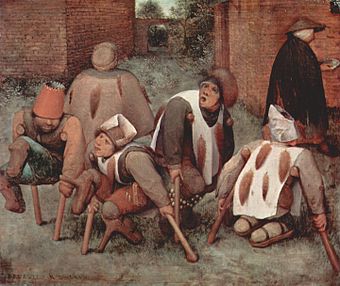
“The Cripples,” Pieter Bruegel, 1568; {{PD-1923}}

Bethesda Lutheran Communities has a phenomenal vision and perspective on supporting people with disabilities. Bethesda Lutheran Communities firmly believes that those with disabilities are indispensable to the church, which is the body of Jesus Christ (Go to this video link for their promotion of this theme). Of particular import is 1 Corinthians 12:22, which reads: “…the parts of the body that seem to be weaker are indispensable” (ESV). Here is the full context:
The eye cannot say to the hand, “I have no need of you,” nor again the head to the feet, “I have no need of you.” On the contrary, the parts of the body that seem to be weaker are indispensable, and on those parts of the body that we think less honorable we bestow the greater honor, and our unpresentable parts are treated with greater modesty, which our more presentable parts do not require. But God has so composed the body, giving greater honor to the part that lacked it, that there may be no division in the body, but that the members may have the same care for one another. If one member suffers, all suffer together; if one member is honored, all rejoice together (1 Corinthians 12:21-26; ESV).
The Corinthian Christians celebrated the spiritual gifts that were more visible and showy, that is, when used wrongly (See 1 Corinthians 12 and 14). They celebrated a fleshly kind of power and wisdom rather than the weakness and foolishness of the cross, as revealed in 1 Corinthians 1. Given their lack of spiritual discernment, they would often fail to discern Godly power and wisdom. Thus, it is no wonder that Paul needs to highlights how indispensable the weaker parts of the body are. In Bethesda Lutheran Community’s view, those who are indispensable include those with disabilities in the church. I heartily agree.
Rather than see ministry among those with disabilities involving simply “to” and “for,” Bethesda also emphasizes “with.” Those with disabilities have gifts that benefit the body of Jesus Christ. We need those with disabilities as much as they need us. Perhaps we even need them more in American culture given the dominant emphasis in the States on intellectual prowess and efficiency. While intellect and efficiency have their place, we must not allow these traits to shape how we expect the Spirit to operate. After all, even a cursory glance at the New Testament reveals that God often operates in a counter-cultural, upside-down and paradoxical way.
Speaking of paradoxical, the journal Social Science and Medicine published an article titled “The Disability Paradox: High Quality of Life Against All Odds.” The authors ask about what they take to be a “disability paradox”: “Why do many people with serious and persistent disabilities report that they experience a good or excellent quality of life when to most external observers these individuals seem to live an undesirable daily existence?”
Not only do we find a paradox, but at least in the case of Down Syndrome, there is an advantage. A New York Times article titled “The Truth About Down Syndrome” discusses the “Down syndrome advantage.” For example, there is often less familial stress for families with pre-schoolers suffering from Down syndrome than those with pre-schoolers suffering from autism. In fact, it is sometimes comparable to families with non-disabled children. Moreover, divorce raters are lower for parents of children with Down syndrome than for parents of non-disabled children and those of children with other congenital disabilities. A very high percentage of siblings claim to be better people as a result of their Down syndrome family members. Moreover, Down syndrome individuals have much greater adaptive skills than their low IQ scores may convey.
Speaking of IQ scores, we need to account for multiple forms of intelligence, including the need for an expansive imagination. Indeed, a narrow view of intelligence is often accompanied by a failure of imagination. An article on disabilities in the Stanford Encyclopedia of Philosophy argues that “the difficulty in appreciating that people with disabilities may have lives as good as those of people without disabilities, objectively as well as subjectively, may arise in part from a failure of imagination by nondisabled people.” I would go so far as to say that those of us who are not disabled may be crippled in our emotional and imaginative states and need those with disabilities to instruct and help us.
In future posts, I hope to discuss further how indispensable people with disabilities are to the life of the church and society at large. Among other things, including our need for growing imaginatively, people with disabilities reveal to us the nature and character of God’s kingdom, as already indicated in this post. As the Apostle Paul writes in 1 Corinthians 1,
For consider your calling, brothers: not many of you were wise according to worldly standards, not many were powerful, not many were of noble birth. But God chose what is foolish in the world to shame the wise; God chose what is weak in the world to shame the strong; God chose what is low and despised in the world, even things that are not, to bring to nothing things that are, so that no human being might boast in the presence of God. And because of him you are in Christ Jesus, who became to us wisdom from God, righteousness and sanctification and redemption, so that, as it is written, “Let the one who boasts, boast in the Lord” (1 Corinthians 1:26-31; ESV).
If God uses what is deemed by the world weak and foolish to shame the strong and wise, we should be quick to repent of our sense of adequacy in our own might and what we deem right in our autonomy and self-sufficiency. People with disabilities reveal to us our deep need to depend on God at every turn!
Moreover, further to what was referenced above in scholarly literature, people with disabilities reveal to us our need to enhance our own quality of life. They are often far-better adjusted and more grateful, since they do not take as much as we–who are able-bodied but crippled in thanksgiving–do for granted.
So, rather than sweep those with disabilities out of the church, or remove them to some downstairs backroom, or simply minister to them, include those with disabilities in various forms of leadership. After all, they are indispensable.
Join The Institute for Cultural Engagement: New Wine, New Wineskins for our conference “From Isolation to Inclusion: A Conference on Disabilities” scheduled for Saturday, March 16th in Portland, Oregon at Multnomah University and Multnomah Biblical Seminary. Bethesda Lutheran Communities will be participating with New Wine, along with others.
Previous Post

November 30, 2018
Identity Politics and Zero-Sum Games
Next Post

December 3, 2018 The Church Has a Mandate to Break Down Barriers and Build Bridges
Browse Our Archives
Select a Category Uncategorized
Select a Month June 2025 April 2025 March 2025 January 2025 December 2024 November 2024 October 2024 September 2024 August 2024 July 2024 June 2024 May 2024 April 2024 March 2024 February 2024 January 2024 December 2023 November 2023 October 2023 September 2023 August 2023 July 2023 June 2023 May 2023 April 2023 March 2023 February 2023 January 2023 December 2022 November 2022 October 2022 September 2022 August 2022 July 2022 June 2022 May 2022 April 2022 March 2022 February 2022 January 2022 December 2021 November 2021 October 2021 September 2021 August 2021 July 2021 June 2021 May 2021 April 2021 March 2021 February 2021 January 2021 December 2020 November 2020 October 2020 September 2020 August 2020 July 2020 June 2020 May 2020 April 2020 March 2020 February 2020 January 2020 December 2019 November 2019 October 2019 September 2019 August 2019 July 2019 June 2019 May 2019 April 2019 March 2019 February 2019 January 2019 December 2018 November 2018 October 2018 September 2018 August 2018 July 2018 June 2018 May 2018 April 2018 March 2018 February 2018 January 2018 December 2017 November 2017 October 2017 September 2017 August 2017 July 2017 June 2017 May 2017 April 2017 March 2017 February 2017 January 2017 December 2016 November 2016 October 2016 September 2016 August 2016 July 2016 June 2016 May 2016 April 2016 March 2016 February 2016 January 2016 December 2015 November 2015 October 2015 September 2015 August 2015 July 2015 June 2015 May 2015 April 2015 March 2015 February 2015 January 2015 December 2014 November 2014 October 2014 September 2014 August 2014 July 2014 June 2014 May 2014 April 2014 March 2014 February 2014 January 2014 December 2013 November 2013 October 2013 September 2013 August 2013 July 2013 June 2013 May 2013 April 2013 March 2013 February 2013 January 2013 December 2012 November 2012 October 2012 September 2012 August 2012 July 2012 June 2012 May 2012 April 2012 March 2012 February 2012
Follow Us!
TAKE THE
Religious Wisdom Quiz
How old was Moses when he died?
Select your answer to see how you score.
100 years 90 years 120 years 110 years
Books by This Author Books by Paul Louis Metzger
Related posts from Uncommon God, Common Good

Heavenly Father’s Day on Trinity Sunday

Easter Triduum: Obey Your Thirst—for God

Holy Week Is Humble Week: "Beware of Becoming...

Excavating the Person in a Throwaway Culture
TRENDING AT PATHEOS Evangelical

The REST of Your Life: A Creative Wrestles...
This week I had a conversation with a good friend from church....

How the author of the world's best hymn...
I've been working with John Newton for a while now. This makes...

Long before this Lectio Divina, Psalm 130 - the song - started...

What About the Trees? Another Living Parable
After I finished writing the last article about falling leaves as a...

Why Classical Education Is a Conversation, Not a...
Come and Read: Joy in Classical Education When I was a little...

Cornell University has received a great deal of negative publicity and intense...
view all Evangelical blogs
Ad-Free & Subscriber Log-In Subscription Support
- About Us
- 2026 Calendar
- Videos
- Podcasts
- Library of World Religions
- Faith In Media Tracker
- Advertise With Us
- Write for Us
- Privacy Policy
- Terms of Service
- Do Not Sell My Data
- Contact Us
- Radiant Digital
- Manage Newsletter Subscriptions
- Unsubscribe From Notifications
- Sitemap
Copyright 2008-2026, Patheos. All rights reserved.
Subscription Support Ad-Free & Subscriber Log-In
Follow Patheos